
Red Dachshund: Shaded, Clear, Sable and the Hidden Dapple


A red dachshund is a one-colored dachshund whose coat runs from light red to a rich, deep red, with a black nose and black nails under the AKC breed standard. Red comes in all three coats and both sizes.
The Dachshund Club of America counts red, with black and tan, as one of the two most common colors in smooth and longhaired dachshunds, so your red dachshund isn’t rare. What catches owners out is that “red” covers several different coats, and two things you’d want to know about yours, its nose color and whether a dapple is hiding under the red, aren’t things the coat shows you plainly.
What makes a dachshund red?
A dachshund is red when its whole coat is one red shade with no tan points, which the AKC standard files under one-colored dogs. It asks for a black nose and black nails, and it allows a little white on the chest without liking it.
Here’s the wording in the AKC’s official dachshund standard: “One-colored Dachshunds include red and cream, with or without a shading of interspersed dark hairs.”
Longhairs follow the smooth rules word for word, so a red longhair is judged on exactly the same color terms as a red smooth. You’ll find the coat itself in the long haired dachshund guide.
How red is red? Coast to Coast Dachshund Rescue describes the range as light red to rich red, with black hairs running “from none, to few to many”. If you have a very pale dog, cream is a separate one-colored dog in the standard, and the English cream dachshund guide shows where that line falls.
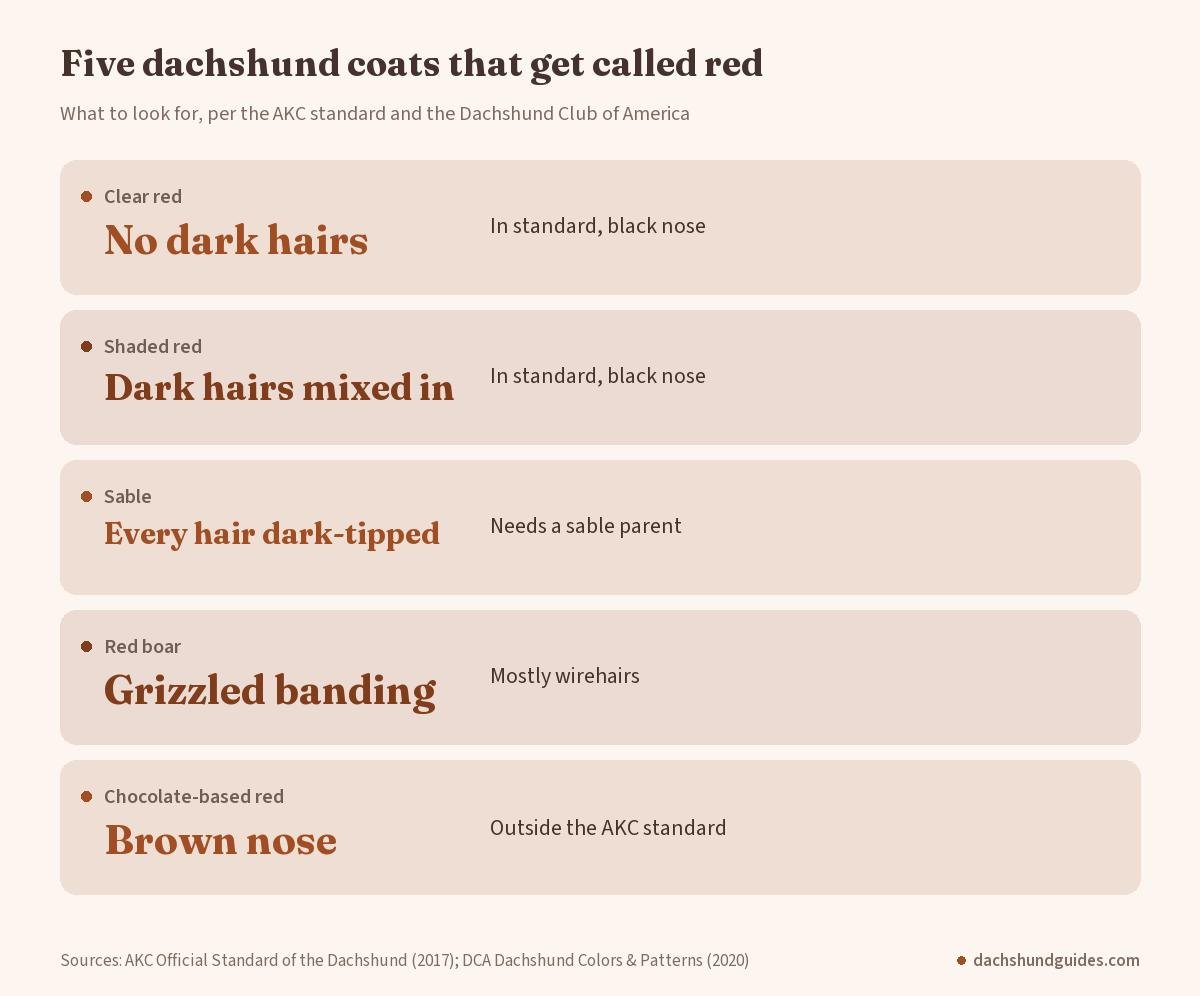
Wirehairs get their own note. Their most common colors, per the standard, are “wild boar, black and tan, and various shades of red”, and it names red boar as a variation: a red base with grizzled banding on each hair. You can read more about that coat in the wire haired dachshund guide.
Clear red, shaded red or sable?
A shaded red dachshund is a red with dark hairs scattered through the coat, which the AKC standard covers with the words “with or without a shading of interspersed dark hairs”. A clear red has none of those dark hairs. Both are standard reds with black noses.
Neither is the same thing as a sable, though.
Sable is listed in the standard as a pattern, not a color. It’s a “uniform dark overlay on red dogs” where each overlay hair is darker at the tip than at the base, usually with a widow’s peak on the head.
The Dachshund Club of America (DCA) adds a parent rule you can check: a true sable needs a sable parent. Red longhairs with a dark overlay are often mistaken for sables, the club says, so a seller’s label isn’t proof on its own.
Shaded coats don’t sit still, either. In a r/Dachshund thread where owners shared their shaded dogs, one described the coat changing with the seasons:
“Rohan is 1.5 years old. His coat is definitely more blonde in the summer, almost highlighted. But the black is always there.”
– r/Dachshund, January 2025 (93 upvotes)
Can’t tell shaded from sable by eye? Ask about the parents. They’ll settle it faster than the coat will.
Chocolate-based red: the red with a brown nose
A chocolate-based red is a red dachshund with a brown nose and brown eye rims instead of black ones. One-colored dogs need “Nose and nails-black” under the AKC standard, so this dog falls outside it, even though the coat can look like any other red.
You’ll sometimes hear it called a “dilute red”, which makes it sound like it belongs with blue and Isabella. It doesn’t. The DCA names gray (blue) and fawn (Isabella) as the dilutes, and those are the two it ties to thin coats, skin sensitivity and other health issues.
Neither source treats a brown nose on a red as a health problem. If you plan to show or breed, it matters. If you don’t, it’s simply part of your dog.
Can a red dachshund hide a dapple?
Yes. A red dachshund can carry the dapple gene and show little or none of the pattern, because dapple works by lightening black or brown pigment, and a red coat has very little of it to lighten.
A 2021 study in Human Genetics tested the dapple gene in 140 dachshunds and found “numerous cases” of hidden dapple in dogs with light or red coats.
Ballif and colleagues also describe the case that shows why it matters. One dog carried a large dapple variant with no visible dapple at all, and it “unintentionally produced a double merle puppy with anophthalmia”, meaning a puppy born without eyes.
Merle is the general name for the gene behind dapple. According to the title of their paper, these hidden variants “demonstrate the need for genetic testing prior to breeding”, and you can read the abstract on PubMed.
Owners run into the same thing with registered puppies. When someone posted a six-month-old, AKC-registered puppy sold as a red long haired dapple and asked what color he really was, one of the top replies explained it like this:
“He is a chocolate-based red. That means he is an out-of-standard red dachshund with a chocolate nose and eye rims instead of black as is desirable for the breed. Red typically partially or fully masks dappling. Sometimes it is slightly visible when they are young, but as they age the dappling will no longer be visible at all.”
– r/Dachshund, August 2026 (34 upvotes)
Not every red dapple fades, though. Another owner in that thread said their smooth red dapple’s spots had grown darker by nearly four years old, so fading is common rather than guaranteed.
From the breeder’s side, the DCA puts it plainly: dappling on a red can fade so fast that birth may be the only time anyone sees it. So if your red came from a dapple litter, have it DNA tested for dapple before it’s ever bred. The dapple dachshund guide explains why two dapples should never be paired.

How two red dachshunds can have a black and tan puppy
Red is dominant over black and tan in the DCA’s color chart. A red that carries no black and tan can only produce red puppies, while two reds that both carry it can produce either color, so a black and tan puppy from two red parents isn’t a mix-up.
You can follow the whole chart in the black and tan dachshund guide.
Red dachshund questions
Is red a rare dachshund color?
Red isn’t a rare dachshund color. The DCA calls red and black and tan the most common colors in smooth and longhaired dachshunds, and the AKC standard lists “various shades of red” among the most common wirehair colors too.
Colors usually sold as rare are blue and Isabella. You’ll find those, and every other standard color, in the dachshund colors guide.
Do red dachshund puppies change color?
Red dachshund puppies often change a little as they grow. Owners regularly post shading and dapple marks that faded or shifted, and the DCA notes that dapple on a red can fade quickly.
Ask what the breeder saw at birth and what color both parents are, since an eight-week coat won’t promise you the adult one.
Does a red dachshund have a different temperament?
No breed source links a red coat to temperament. Base color is “immaterial” in the AKC standard, and neither it nor the DCA ties color to personality, so your dog’s nature comes from its parents and how it’s raised.
The dachshund temperament guide covers what does vary.
Buying a red? Look at the nose and ask about the parents. You’ll find the rest of the questions in the guide to choosing a dachshund puppy.
Breeding one? Get the dapple test first. A coat shows you the color, not the genes underneath it.
