
Wire Haired Dachshund: Coat, Size, Temperament and the Health Data

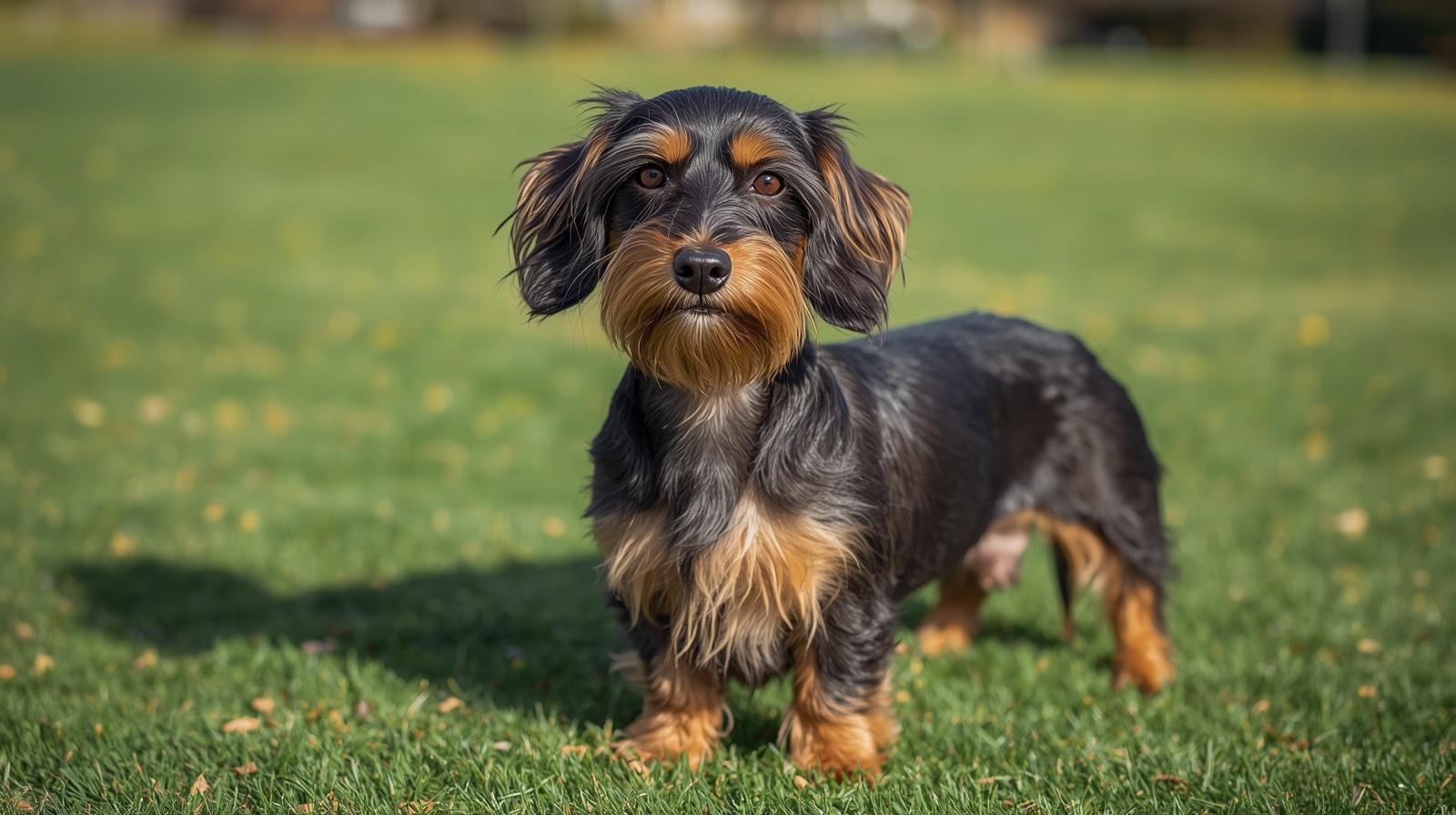
A wire haired dachshund is the dachshund with a rough, hard outer coat over a softer undercoat, plus a beard and bushy eyebrows. The AKC standard shows it in the same two sizes as the smooth and long-haired dogs: standard, usually 16 to 32 pounds, and miniature, 11 pounds and under.
The size you pick matters more than you’d guess. In the UK’s DachsLife 2015 survey, standard wires had the lowest rate of disc disease of all six dachshund varieties, 7.1%, while miniature wires were among the highest at 17.7%.
What makes a coat “wire”?
The AKC breed standard describes a wire’s body coat as “tight, short, thick, rough” and hard, with finer, softer hairs underneath. A wire with no undercoat is faulted.
Ears are almost smooth. And from across a room, the standard says, a good wire should look a lot like a smooth dachshund. It’s the beard and eyebrows that give it away when you get closer.
Color is the other clue. Wild boar, black and tan, and shades of red are the most common wire colors in the standard, and the grizzled wild boar look, where each hair is banded, turns up most often on wires. You’ll find the full list on the dachshund colors page.
What about silky wires?
You’ve probably seen the fluffy “silky wire” puppies online. The same standard calls soft hair anywhere in the outer coat a fault, along with long, curly or wavy hair. So a silky wire is a wire with a coat the standard doesn’t want.

Some are purebred. Others aren’t. In an r/Dachshund thread about a silky wire puppy, one owner shared a DNA result for their own dog of 47.5% dachshund and 36.2% silky terrier.
If you’ve got your heart set on that soft look, it’s worth a DNA test before you pay a premium for it.
Grooming: strip the coat, don’t clip it
You keep a wire coat in shape by hand-stripping, which means pulling out the dead outer hairs so new hard ones grow in. The AKC’s guide to hand-stripping calls it “a pain-free process” when it’s done properly.
Of the three dachshund coats, the AKC notes, only the wire benefits from stripping. Your smooth or long-haired dog doesn’t need it.
Why not just clip it? The AKC piece says clipping a wire-haired coat can affect its color, sheen and texture, and can eventually soften the coat. One owner who stripped their wire for the first time was told it’s “a lot more work than shaving, but for wires it’s the right way.”
No fixed calendar exists for it. How often depends on the dog and how quickly the coat grows, says the AKC. A groomer quoted there warns that a pet strip done without training can be painful.
If you’re new to it, have a groomer who strips terriers show you once. The dachshund grooming schedule covers nails, ears and baths for all three coats.
Temperament: a little more terrier?
The wire coat is usually credited to crosses with rough-coated pinschers and terriers in Germany, though breed historians don’t agree on which breeds were used. Terrier blood is where the reputation for a feistier dog comes from.
I haven’t found a study that compares temperament by coat type. So treat what follows as owners talking, not data.
And owners do talk. In an r/Dachshund thread on stubborn wires, one owner who’d had two smooths before compared their new 8-week-old miniature wire:
“Compared to our smooths he’s significantly more mouthy/bitey, more outgoing, and a bit less cuddly than the smooths… All doxies are stubborn, it’s varying shades of the same theme.”
– r/Dachshund, February 2025
Another owner added a miniature wire puppy to a home with an older long-haired dachshund. They thought they were “a dachshund whisperer” until she arrived, and called her “an undercover terror terrier.”
Is every wire like that? No. But if you’re choosing between coats, expect the same dachshund stubbornness, possibly with a bit more push. The dachshund temperament page has training that works with it, not against it.
How big do wire haired dachshunds get?
The size rules don’t change with the coat. The AKC’s miniature class is 11 pounds and under at 12 months or older, and a standard is usually 16 to 32 pounds. Europe’s FCI adds a smaller rabbit size, explained on the kaninchen dachshund page.
Real dogs don’t always sit neatly in those boxes. In DachsLife 2015, the median standard wire weighed 11.2 kg, about 24.7 pounds, and the median miniature wire weighed 5.5 kg, about 12.1 pounds.
That’s a UK sample, but it means more than half of those miniature wires weighed over the AKC’s 11-pound line. If you’re buying a “mini”, don’t be surprised if your adult dog lands a pound or two over.
Which size is your wire puppy heading for?
Enter your puppy’s age and weight to see the adult weight it’s tracking toward.
Back health: size matters more than the coat
Here’s the number that surprised me most. The DachsLife 2015 survey, published by Packer and colleagues in 2016, found vet-diagnosed disc disease in 7.1% of standard wires, 18 of 252 dogs. That was the lowest of the six UK varieties, and the study used standard wires as its baseline.
Miniature wires told a different story: 17.7%, or 54 of 305 dogs. After the authors adjusted for age and neutering, miniature wires still had 3.1 times the odds of disc disease that standard wires had. Same coat, very different risk.
Part of the answer may be shape. Standard wires had the shortest back length relative to height of the six varieties, though the gaps between varieties were small.
Packer’s paper also points to an earlier study that linked moderate stair climbing to lower disc risk in standard wires. If you’re wondering whether to block your stairs, the dachshund stairs page looks at that evidence.
DachsLife 2021, a later survey, points the same way. Among 910 dogs aged four or over that had had disc disease, miniature wires were the second most common variety, 110 dogs, behind miniature smooths.
So if you’ve got a miniature wire, learn the early signs on the IVDD in dachshunds page. A quick vet visit at the first wobble matters more than anything else you’ll read here.
Lafora disease in miniature wires
Lafora disease is a form of epilepsy that gets worse over time, and among dachshunds it’s linked to the miniature wire. In a 2017 study of 27 affected miniature wires in PLOS ONE, signs started at an average of 6.94 years, anywhere from 3.5 to 12.
The first sign in 77.8% of those dogs was myoclonus: sudden jerks of the head or body, often set off by light, a sound or sudden movement nearby. About half also jerked while drifting off to sleep, and 40.7% had full seizures.
You could easily put that down to a startle or to old age. That’s why the senior dachshund page flags it for older miniature wires.
There’s good news, though. A DNA test sorts dogs into clear, carrier and at risk, and it’s been offered to UK breeders and owners since 2012. A 2018 study by Ahonen and colleagues of 733 tested miniature wires found the at-risk share fell from 10.4% to 2.7% between 2012 and 2017.
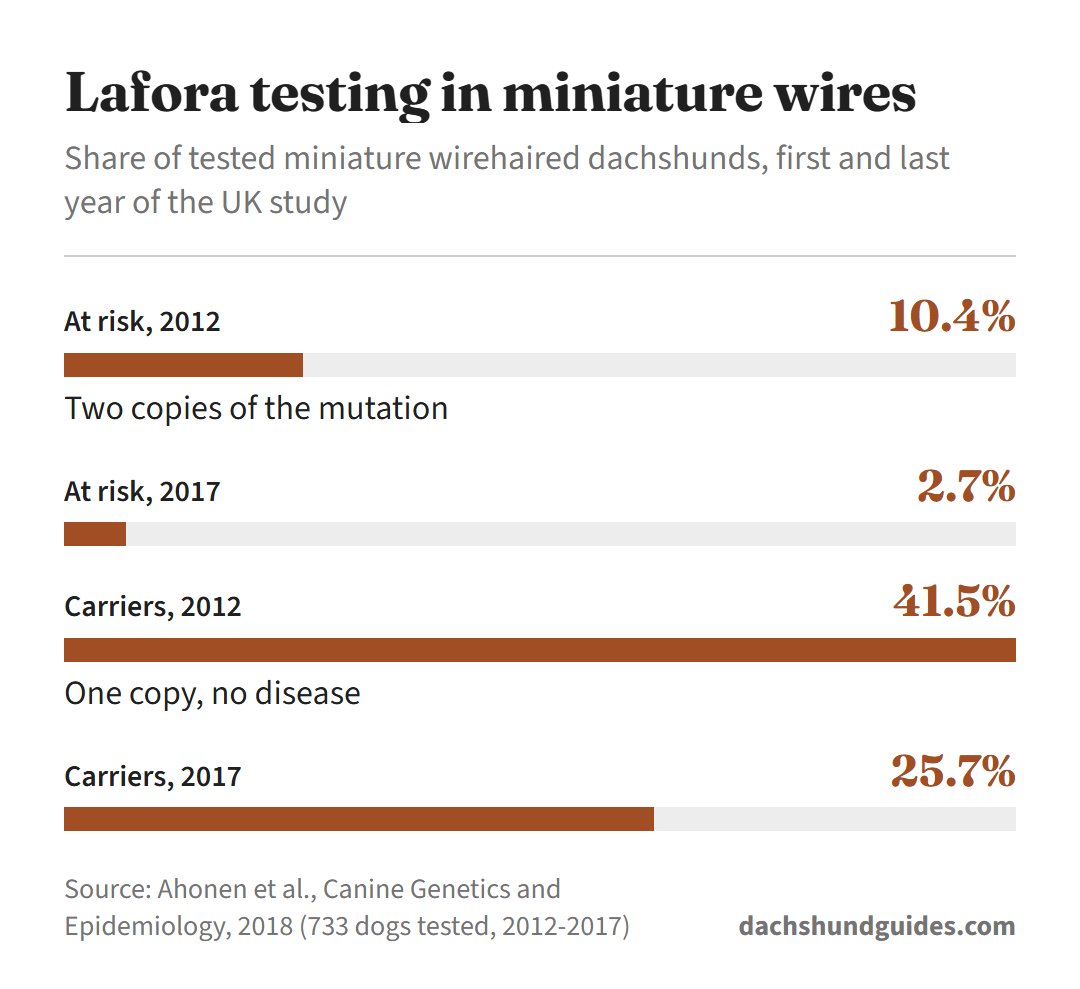
Carriers dropped too, from 41.5% to 25.7%. A carrier won’t get sick, and the authors say the mutation should be bred out slowly to protect the breed’s genetic diversity.
What you want to see is a test result for each parent of the litter. If I were buying a miniature wire tomorrow, that’s the first paper I’d ask the breeder for.
Wire haired dachshund questions
How long do wire haired dachshunds live?
Nobody has published a lifespan for wires on their own. The UK study behind the dachshund lifespan page splits dogs by size: a median of 14.0 years for miniatures and 13.2 for standards. The dog age calculator puts those at about 73 and 72 in human years.
Are wire haired dachshunds good pets?
For the right home, yes. You’ll need to be fine with regular stripping or a groomer who does it, a stubborn streak that owners say can run strong, and a careful eye on the back, especially with a miniature.
Is a wire haired dachshund a different breed?
No. Dachshunds are one breed with three coats, and wires can be shown in either size. The types of dachshunds guide puts all six varieties side by side, so you can see where yours fits.
