
English Cream Dachshund: Rare, Regal & Worth Every Penny

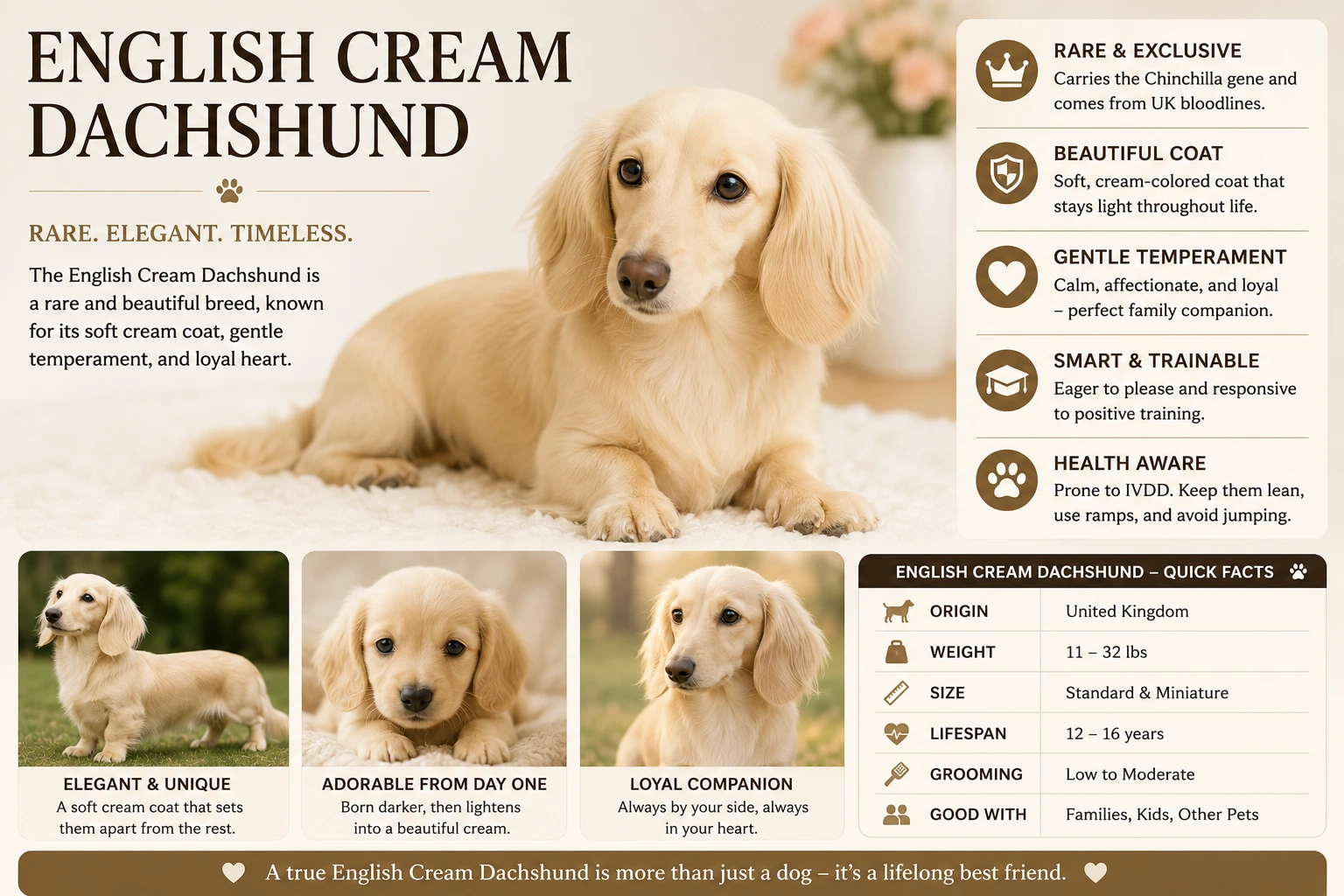
I remember the first time I saw an English cream dachshund in person. It was at a local dog meetup and honestly, I almost walked past her. Then she turned her head and looked at me with those dark, knowing eyes framed by the softest vanilla-gold coat I had ever seen. I stood there for a full minute just staring. Her owner laughed and said, “Everyone does that.”
If you have ever had that moment online, at a park, or scrolling through Instagram at midnight this guide is for you. The english cream dachshund is one of the most beautiful, most misunderstood, and most sought-after dogs in the dachshund world. And there is a lot more to them than a pretty coat.
Let us get into everything: their genetics, personality, price, health, and what it actually takes to bring one home.
What Exactly Is an English Cream Dachshund?
The english cream dachshund is a long-haired miniature dachshund with a soft, pale ivory or golden-cream coat that originates from authentic British breeding lines. The word “English” is not just a style label it is a direct reference to the UK kennels where this distinct coloring was carefully developed and preserved.
According to the AKC, the dachshund breed was formally recognized in 1885, and cream is listed among the standard accepted coat colors. However, not every cream-colored dachshund qualifies as a true english cream dachshund. The distinction matters both genetically and temperamentally.
Every cream dachshund carries two copies of that same intensity variant, English or not. What the word English adds is pedigree: dogs tracing to British and European show kennels. Some breeders dispute the split altogether, since creams go back to a handful of English kennels if you follow the lines far enough. So read “english cream dachshund” as a claim about a bloodline, which paperwork can settle, and not as a claim about a different gene. If you’re paying a premium for the label, the pedigree is what you’re paying for. A pale puppy that reddens as it matures was most likely a light red all along.
The Two Types of English Cream Coat
| Coat Type | Born Appearance | Adult Appearance | Key Feature |
|---|---|---|---|
| Shaded Cream | Dark (almost mousey brown) | Cream with black overlay on ears/tail | Dark overlay hairs present |
| Clear Cream | Very light, pale | Uniform ivory or platinum blonde | No dark overlay |
Both are considered authentic english cream dachshund varieties. The shaded cream develops its color gradually, often not fully clearing until around 8 months of age.
The Genetics Behind the Glow
This is where it gets fascinating. The english cream dachshund owes its coat to a specific genetic chain not just one lucky mutation.
The gene involved is MFSD12, at what color geneticists call the I locus, for intensity. A 2019 study in Genes identified a single missense variant in it that dilutes phaeomelanin, the red and yellow pigment, down to cream or white. It’s recessive: a dog needs two copies to show the diluted coat, and one copy leaves it red. You will also see “shaded” and “clear” cream used for dogs with and without interspersed dark hairs, a variation the AKC standard mentions for both red and cream.
That variant is also why a pigment check works, and it is the single most useful test on this page: the intensity variant has only been shown to reduce red and yellow pigment, leaving black and brown pigment untouched. So check the pigment features. Authentic English creams will always have black nails, black nose, black paw pads, and dark expressive eyes even when their coat is the palest ivory. If those features appear liver-colored or pale, the dog is more likely a dilute red rather than a true cream.
A Brief History: From British Kennels to Global Demand
The dachshund breed itself has roots stretching back to 15th-century Germany, where they were bred to hunt badgers in underground burrows. Their long bodies, short legs, and powerful noses made them extraordinary hunters.
The english cream dachshund emerged much later tracing its specific lineage to a handful of UK kennels that began selectively breeding for both the cream coat and a noticeably calmer temperament. American breeders started importing British cream bloodlines, particularly from the 1970s onward, building what is now a small but dedicated community of specialist breeders in the United States, UK, and Australia.
Today, the english cream dachshund remains rare by design. Reputable breeders deliberately limit litter numbers to maintain genetic integrity, avoid inbreeding, and ensure each puppy receives proper socialization. That intentional scarcity is a big part of why demand and price remain so high.
Temperament: What Is Actually Known, and What Is Owner Report
English creams have a reputation for being the most laid-back dachshunds. That reputation comes from breeders and owners, and it’s worth knowing that no study backs it up.
Here’s what the written sources say, and it’s short. The AKC standard describes one temperament for the whole breed and states plainly that base color “is immaterial”; the Dachshund Club of America’s colors and patterns sheet makes no personality claim about any color. Neither document connects a coat to a character.
There’s a version of the claim that could hold, and it’s got nothing to do with pigment. English creams trace to British show kennels, and show lines and working lines are selected for different things. If these dogs really are steadier on average, the credit belongs to decades of line selection rather than to the color gene, which only changes how red pigment is expressed. Breeders make this argument, but nobody has measured it.
Traits that owners of these dogs commonly report, none of them measured against other colors:
- Affectionate and people-oriented — they bond deeply with their families and can develop separation anxiety if left alone too long
- Gentle with children — their even-keeled nature makes them a reliable choice for family households
- Calm and observant — rather than reactive, they tend to watch and assess before engaging
- Loyal without being clingy — they will follow you room to room, but they also settle beautifully
So how should you use any of this? Not as a shortcut. My Pretzel is a miniature dachshund and he came with separation anxiety that took eight weeks of work to settle, and no coat color would’ve told me that in advance. Meet the parents, watch how the litter behaves with the breeder in the room, and judge the puppy in front of you. A color isn’t a temperament test.
Size and Physical Characteristics
The english cream dachshund is almost exclusively found in the miniature form. Genuine English cream lines are miniature long-haired dogs you will not find a smooth-coat or wire-coat version with authentic English bloodlines.
Standard measurements for the miniature english cream dachshund:
- Height: 5–6 inches (13–15 cm)
- Weight: Up to 11 pounds (5 kg), though some reach up to 20 lbs
- Body: Classic long dachshund frame with short legs
- Coat: Long, silky, and flowing especially on the ears, chest, and tail
Their physical build is all dachshund: the elongated spine, the short powerful legs, the broad chest. What sets the english cream dachshund apart is that unmistakable ivory coat, the heavy-boned structure more typical of UK dog breeds, and those beautifully dark facial features that give them such an aristocratic expression.
Health Considerations Every Owner Should Know
The english cream dachshund shares the health profile of the broader dachshund breed, which means one condition deserves particular attention: Intervertebral Disc Disease (IVDD).
Because of their elongated spines, all dachshunds including the english cream dachshund are prone to IVDD, a condition where spinal discs herniate and cause pain, nerve damage, or in severe cases, paralysis. Keeping your dog at a healthy weight is the single most impactful thing you can do to reduce this risk.
A 2024 UK study found the dachshund’s average life expectancy to be 13.2 years above the 12.7 average for purebred dogs overall. With proper care, many miniature dachshunds live to 15 or even 16 years, which makes the english cream dachshund a long-term companion in the truest sense.
Additional health notes:
- Dachshunds are 2.5 times more likely than other breeds to develop patent ductus arteriosus, a congenital heart condition
- Dilute color dogs can be susceptible to color dilution alopecia but the english cream dachshund, carrying the intensity variant rather than the separate dilution behind blue and Isabella coats, is not the variety that warning is about. The Dachshund Club of America attaches its health note to gray (blue) and fawn (Isabella), not to cream
- Regular vet check-ups, a balanced diet, ramps instead of stairs, and avoiding high-impact jumping are all key preventative steps
For a deeper dive into care across different life stages, the Dachshund Guides section covers breed-specific health, feeding, and exercise in detail.
Grooming: Maintaining That Luxurious Coat
One of the most common questions about the english cream dachshund is whether that silky coat is high-maintenance. The honest answer: it requires regular attention, but it is far from demanding.
Grooming routine for an english cream dachshund:
- Brushing: 3–4 times per week to prevent tangles, especially on the ears, chest, and tail feathering
- Bathing: Every 3–4 weeks, or as needed their coat does not trap odor as heavily as some breeds
- Ear cleaning: Weekly, as their long, floppy ears are prone to moisture buildup
- Nail trimming: Monthly is ideal; their black nails are actually easier to trim accurately than lighter nails
- Professional grooming: Every 8–12 weeks for a light trim and tidy
Because the english cream dachshund is a long-haired variety, their coat does shed but far less than many double-coated breeds. Many owners describe them as relatively low-shedding, which is a genuine bonus for households with allergies or a strong preference for clean sofas.
How Much Does an English Cream Dachshund Cost?
This is usually the part that surprises first-time buyers. The english cream dachshund is not a budget purchase.
Prices for a true english cream dachshund from a reputable breeder typically range from $2,000 to $5,000, with some specialty breeders listing puppies closer to the $5,000 mark for platinum blonde (EE clear) bloodlines with full documentation and health guarantees.
Why the high price?
The cost reflects the difficulty of breeding. Producing genuine English cream puppies requires preserving a specific genetic line without inbreeding. Only certain UK-origin kennels have successfully maintained this over generations, and reputable breeders who import or work from those lines breed limited litters by design. Supply is genuinely small. Demand is genuinely large. The price is the natural result.
Beyond the purchase price, prospective owners should budget for:
| Expense | Estimated Annual Cost |
|---|---|
| Veterinary care (routine) | $500–$800 |
| Food (quality diet) | $400–$600 |
| Grooming | $400–$800 |
| Pet insurance (recommended) | $300–$600 |
| Supplies, training, enrichment | $200–$500 |
Pet insurance is especially worth considering for the english cream dachshund given the IVDD risk profile having coverage before a back episode occurs can save thousands in treatment costs.
Finding a Reputable English Cream Dachshund Breeder
This is where patience pays off. Because the english cream dachshund is rare, the risk of encountering mislabeled puppies dilute reds sold as English creams is real. A few things to look for in any reputable breeder:
- Documented lineage — ask for pedigree papers tracing the puppy back to UK bloodlines
- Health testing — parents should be screened for IVDD risk and other hereditary conditions
- Transparent practices — a good breeder welcomes questions, shares photos of the dam and sire as adults, and screens buyers just as carefully
- Waitlists — nearly all reputable english cream dachshund breeders operate with waitlists; if puppies are immediately available with no vetting process, proceed cautiously
- AKC registration — while not the only marker of legitimacy, it is a meaningful baseline for purebred documentation
Avoid pet stores and unverified online listings. The english cream dachshund is specifically targeted by puppy mills precisely because of its high price point. A legitimate breeder will care about where their puppy goes not just the transaction.
Is the English Cream Dachshund Right for You?
The english cream dachshund is a stunning, gentle, long-lived companion that suits a wide range of households from solo owners to families with children. They thrive with people who are home often, love physical closeness, and can provide consistent routines.
They may not be the right fit if you have a very active lifestyle requiring high-energy exercise, or if you are frequently away for long stretches of time. Their deep attachment to their people is one of their most beautiful traits and also their biggest vulnerability to anxiety.
If you have the patience to wait for the right puppy from the right breeder, and you are ready for a 12–16 year commitment with a dog that will quite literally follow your heart around the house the english cream dachshund is hard to beat.
FAQ: English Cream Dachshund
What makes an English Cream Dachshund different from a regular cream Dachshund?
The difference is pedigree, not genetics. Every cream carries two copies of the same I-locus intensity variant; an English Cream Dachshund is one that descends from United Kingdom and European show lines. Ask for the pedigree rather than a color description, because the coat alone can’t tell you the line. A dog sold as cream that turns reddish as it matures was probably a light red rather than a cream.
Do English Cream Dachshunds stay cream their whole lives?
Yes. One of the defining characteristics of a genuine English Cream Dachshund is that it retains its cream-colored coat throughout adulthood. Shaded cream puppies are born with darker coats that gradually lighten during their first several months, while dilute reds typically become more reddish with age.
How rare is the English Cream Dachshund?
English Cream Dachshunds are considered quite rare. Responsible breeders produce only a limited number of litters each year, and puppies from authentic UK bloodlines are often reserved months in advance through waiting lists.
Are English Cream Dachshunds good for first-time dog owners?
Yes. English Cream Dachshunds are often considered a good choice for first-time owners because they tend to have a calm and affectionate temperament. However, they still inherit the Dachshund’s independent personality, so patience and consistent positive training are essential.
What health issues should I watch for in an English Cream Dachshund?
Like all Dachshunds, the biggest health concern is Intervertebral Disc Disease (IVDD). Maintaining a healthy weight, using ramps instead of stairs, avoiding excessive jumping, and scheduling regular veterinary checkups can help reduce the risk of spinal injuries.
