
Black and Tan Dachshund: The Color Two Red Parents Can Hide


A black and tan dachshund is a black dog with tan markings in set places: above the eyes, on the muzzle and lower lip, inside the ears, on the chest, legs and paws, and under the tail. The Dachshund Club of America names black and tan and red as the most common colors in smooth and longhaired dachshunds.
So if you’ve got a black and tan dachshund, you haven’t got a rarity, and that’s fine. What’s more interesting is how the color travels. It’s recessive to red, so one can turn up in a litter from two red parents.
You’ll find the breed’s other shades in the full list of dachshund colors.
Where the tan goes on a black and tan dachshund
The AKC breed standard places the tan on a black and tan dachshund over the eyes, along the jaw and underlip, on the inner edge of the ear, across the chest, inside and behind the front legs, on the paws, around the anus and under the tail.
That tail stripe runs “about one-third to one-half of the length of the tail,” according to the AKC’s official standard. Look under your dog’s tail and you’ll usually see it.
Black isn’t on its own in that passage; it’s grouped with chocolate, wild boar, gray (blue) and fawn (Isabella) as two-colored dachshunds, each with “deep, rich tan or cream markings.” On AKC registration papers, the color is simply written as Black & Tan.
The standard wants those points kept in proportion. It says “undue prominence of tan or cream markings is undesirable.” A dog whose tan creeps up the sides sits further from the written ideal than one with small, crisp points.
Nose and nails should be black. A little white on the chest happens too, and the standard calls it “acceptable but not desirable.” That’s a show-ring preference. It won’t change a thing about the dog on your sofa.

Black and cream dachshund
A black and cream dachshund has the same layout with pale cream points where the tan would be. AKC registers Black & Cream as a standard color under code 010, right beside Black & Tan at code 018.
Cream points are tan points with the red pigment washed out. A 2019 study in the journal Genes tied that kind of pale red to a variant in a gene called MFSD12 across 15 breeds. Dachshunds weren’t among the breeds it tested, though, so treat the link as likely, not proven, for your dog.
How two red dachshunds can have a black and tan puppy
Two red dachshunds can have a black and tan puppy when both parents carry black and tan hidden under their red. The Dachshund Club of America’s color chart treats black and tan as recessive to red, so it only shows in a puppy that gets a copy from each parent.
The chart comes from the club’s 2020 Dachshund Colors & Patterns sheet. It splits red dogs into two kinds. Some “can only produce the color Red,” and some “carry the recessive Black & Tan gene.” They look identical. You can’t tell which kind you’ve got by looking at the coat.
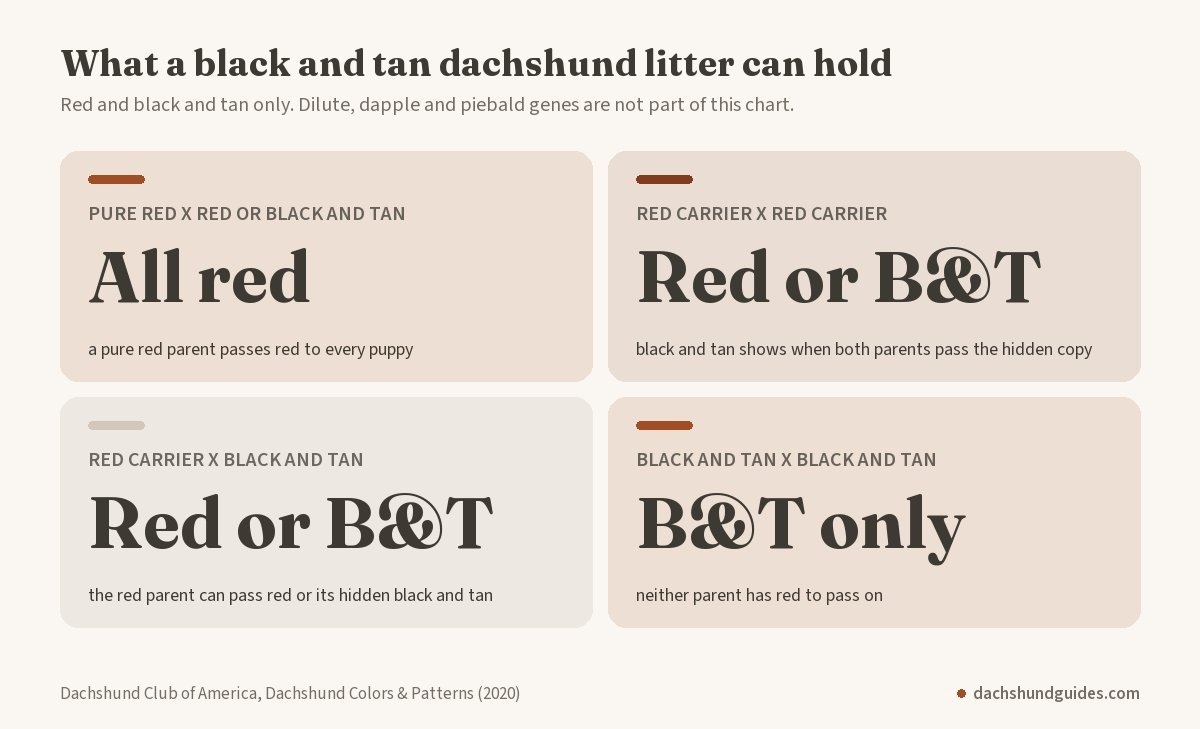
Black and tan never really leaves a line, and the chart shows why. Breed two black and tans and every puppy is black and tan. Breed a black and tan to a pure red and every puppy comes out red, yet each one carries black and tan forward to its own litters.
What’s the gene underneath? It’s ASIP, which decides where a dog makes red pigment and where it makes black.
Dreger and Schmutz genotyped 201 dogs of 35 breeds for a 2011 study in the Journal of Heredity. They found four versions of ASIP, with a dominance order that runs from fawn and sable at the top, through wolf sable, to tan points, and then recessive black at the bottom.
Tan points sit third in that order, so they hide easily. A red coat can mask them another way, too. A 2013 follow-up from the same lab found that a separate recessive red genotype, e/e, masks the tan-point patterns it studied.
Either route leaves you with what the club’s chart shows: a red dog that may or may not be carrying black and tan.
Can you find out before a litter? Yes. The club says “DNA testing can be helpful in identifying a dog’s color or pattern, especially when being used for breeding purposes,” and a color test can show whether a red dog carries it.
Is a solid black dachshund the same thing?
A solid black dachshund isn’t the same color. It has no tan points at all, and AKC files it differently: the breed’s registration list puts Black & Tan among the standard colors but lists plain Black, code 007, as an alternate color, alongside solid chocolate and fawn.
The breed standard points the same way without naming it. Its only black dachshund is the two-colored one with tan or cream markings. A black coat with no markings isn’t described anywhere in the color section.
You can still register a solid black dog; the alternate label just means its color isn’t the one the standard writes down.
Why does a dachshund come out solid black? That hasn’t been pinned down in published research on the breed. In dogs generally there are two routes.
One is the recessive black version of ASIP at the bottom of that 2011 order. The other is a dominant black allele in a different gene, CBD103, which a 2021 Journal of Heredity paper describes as having entered gray wolves from dogs.
Only a DNA test will tell you which one your black dachshund has.
Black and tan in long hair, miniature and dapple dachshunds
Coat type and size don’t change the color rules. The AKC standard says miniatures “are not a separate classification,” and its longhaired section sets color as “Same as for the smooth Dachshund.” So a black and tan miniature dachshund and a black and tan long haired dachshund get the same tan placement as a standard smooth.
Long-haired black and tans can feel scarce when you’re out looking. One r/Dachshund owner put it this way:
“I see short hair black and tans everywhere. It seems like cream and red are the most common long hair dachshunds.”
– r/Dachshund, August 2024
The club’s sheet doesn’t split it that way. It names red and black and tan as the most common colors in smooth and longhaired dachshunds alike.
Wirehairs add wild boar to the mix. The AKC standard’s wirehaired section says “the most common colors are wild boar, black and tan, and various shades of red.” If you’re set on the long coat, the long haired dachshund breakdown goes into the gene behind it and the grooming you’ll be signing up for.
Black and tan dapple dachshund
A black and tan dapple is a black and tan dachshund with the dapple (merle) pattern laid over it. You’ll see lighter patches broken into the black, with the tan points still in place. The club says this coat is “often mistakenly referred to as a ‘Silver’ Dapple.”
It’s also the pairing breeders lean on, and the DCA says so directly: “Most breeders only breed Dapples to Black & Tan (or Chocolate & Tan).”
The reason is safety. A red dapple can be hard to spot, and two dapple parents risk a double dapple, a coat the club links to deafness and small or missing eyes. You’ll find the hearing numbers in the dapple dachshund breakdown.
Does the color change health, price or temperament?
The black and tan color carries no health warning from the Dachshund Club of America. The club’s color sheet attaches health notes to the dilute colors, gray (blue) and fawn (Isabella), and to double dapples, not to black and tan.
That dilute note matters if someone offers you a “rare blue” puppy. The club says dilutes “may also be associated with health issues, such as thin coats, skin sensitivity, vaccine failures and reduced lifespan.” Blue and tan is the dilute of black and tan, so don’t treat the two as interchangeable.
Temperament isn’t tied to color in either document. AKC calls base color “immaterial” and judges temperament in its own section, and the club’s sheet makes no personality claim for any color.
Price comes from breeders, not from the standard. Since the club counts black and tan among the two most common colors, there’s no rarity argument for charging you more. You’ll find typical ranges in how much dachshunds cost.
Curious what your own black and tan carries? The coat shows only part of it. A color DNA test will tell you whether your dog also carries chocolate, dilution or dapple, which matters most if a litter’s ever on the cards.
