Picking Your Perfect Wiener Dog: A First-Timer’s Guide

I waited four months for Bruno, and he came home from his breeder at twelve weeks old. That wait taught me that knowing how to choose a Dachshund puppy isn’t about picking the cutest face in the litter. It’s about matching a personality, a body type, and a set of health traits to the life you actually live.
Search interest around this topic has grown alongside the breed’s popularity, and it’s easy to see why so many new owners want a reliable answer to how to choose a Dachshund puppy before they commit years of their life to one dog.
Dachshunds have quietly become one of America’s favorite companions. According to the American Kennel Club’s 2025 registration data, the breed cracked the national top five for the first time in nearly two decades, climbing from sixth to fifth place and pushing the Poodle out of the top ranks. That surge in popularity means more litters, more breeders, and more decisions for new owners to make. This guide walks you through exactly how to choose a Dachshund puppy the right way, from size and coat type to temperament and breeder vetting, so you avoid the guesswork I didn’t have.
Why Dachshund Popularity Is Climbing So Fast
Before diving into how to choose a Dachshund puppy, it helps to understand why so many people are searching for one right now. Anyone researching how to choose a Dachshund puppy today is entering a much more competitive market than buyers faced even five years ago. The “wiener dog” shape, the big personality packed into a small body, and heavy social media exposure have all contributed to a genuine cultural moment for the breed.
| Trend | Data Point | Source |
|---|---|---|
| AKC national ranking (2025) | Moved from #6 to #5 | American Kennel Club |
| Years since last top-5 appearance | Nearly 20 years | American Kennel Club |
| Most popular US breed overall (2025) | French Bulldog, 4th consecutive year | American Kennel Club |
| Coat varieties available | Smooth, wirehaired, longhaired | American Kennel Club |
| Size categories | Standard and Miniature | American Kennel Club |
This kind of rapid growth in demand is exactly why learning how to choose a Dachshund puppy carefully matters more today than it did a decade ago. Popularity spikes often bring in casual or profit-driven breeders alongside the responsible ones, so buyers need to be more selective, not less. Every serious guide on how to choose a Dachshund puppy will tell you the same thing: rising demand raises the stakes for doing your homework first.
Understanding the Dachshund Personality Before You Choose
Every guide on how to choose a Dachshund puppy should start with temperament, because this breed’s personality is famously bigger than its body. In fact, temperament assessment is arguably the single most overlooked skill in learning how to choose a Dachshund puppy that fits your household. Dachshunds were originally bred in Germany to hunt badgers underground, which explains their stubborn streak, their loud bark, and their fearless attitude toward animals many times their size.
That hunting heritage means:
- They’re independent thinkers who don’t always live to please.
- They can be vocal, which matters if you live in an apartment.
- They bond intensely with their families and can develop separation anxiety.
- They love to dig, burrow under blankets, and chase small animals.
If you’re the kind of owner who wants a dog that follows commands instantly, a Dachshund might test your patience. If you want a loyal, funny, slightly bossy companion, you’re in the right place.
How to Choose a Dachshund Puppy: A Step-by-Step Approach
This is the heart of the matter. Below is the exact process I now recommend to friends who ask me how to choose a Dachshund puppy for their own home. Each step below builds on the last, so by the end you’ll have a clear, repeatable framework for how to choose a Dachshund puppy with confidence.
Decide Between Standard and Miniature Size
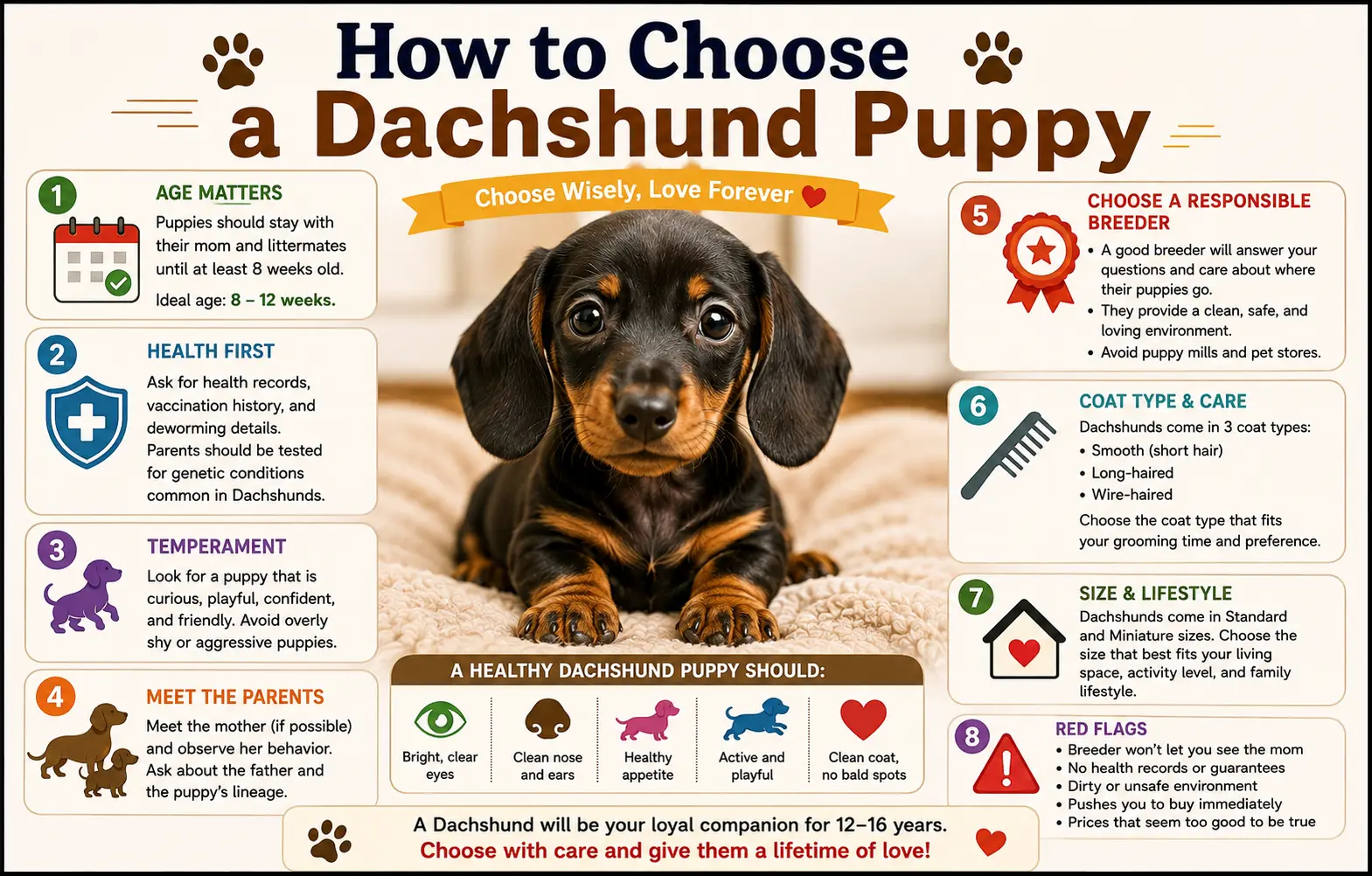
Dachshunds come in two official sizes: Standard (usually 16–32 pounds) and Miniature (typically under 11 pounds at maturity). Miniatures are popular for apartment living, but they can be more fragile with children. Standards tend to be slightly more robust and were historically used for badger hunting, while Minis were bred for smaller game like rabbits. Deciding on size early narrows your search significantly and is one of the first real decisions in how to choose a Dachshund puppy. Get this step wrong, and every later decision about how to choose a Dachshund puppy becomes harder to reverse.
Pick the Right Coat Type for Your Lifestyle
The three coat types, smooth, wirehaired, and longhaired, aren’t just cosmetic. Smooth-coated Dachshunds shed less and need minimal grooming. Wirehaired dogs often have the most terrier-like, mischievous personalities and need occasional hand-stripping. Longhaired Dachshunds are typically the calmest of the three but require regular brushing to prevent mats. Matching coat type to your grooming tolerance is an underrated part of how to choose a Dachshund puppy successfully.
Meet the Parents and Check Health Clearances
Reputable breeders will let you meet at least the mother, and ideally see health testing results for conditions like intervertebral disc disease (IVDD), a condition Dachshunds are genetically predisposed to because of their long spine and short legs. Ask for documentation, not just verbal reassurance. This single step is arguably the most important part of how to choose a Dachshund puppy that stays healthy for years to come.
Observe Temperament and Energy Level
Spend time with the whole litter, not just one puppy. Watch which pups are bold and pushy, which are shy and hang back, and which sit calmly in the middle. A puppy that approaches you confidently but isn’t overly dominant with littermates is often the easiest fit for first-time Dachshund owners. This behavioral observation is a step many buyers skip when learning how to choose a Dachshund puppy, yet it predicts adult personality better than looks ever will.
Questions to Ask Before You Bring a Puppy Home
A responsible breeder should welcome these questions, not dodge them:
- Can I see health clearances for IVDD, patellar luxation, and eye conditions?
- How many litters does the mother have per year?
- Can I meet both parents, or at least the dam?
- What socialization has the litter had so far?
- Do you offer a health guarantee in writing?
If a seller refuses to answer, hesitates on paperwork, or pressures you to decide immediately, treat that as a red flag. For a deeper breakdown of vetting breeders across different breeds, our internal resource on Dachshund Guides covers this in far more detail.
Common Mistakes People Make Choosing a Dachshund Puppy
Even well-meaning buyers get this wrong sometimes. The most frequent mistakes I see include:
- Choosing based purely on coat color or pattern instead of temperament.
- Skipping health documentation because the puppy is “too cute to worry about it.”
- Buying from online listings without ever seeing the puppy in person.
- Ignoring the breed’s spine-related health risks until it’s too late.
- Assuming all Dachshunds have the same energy level regardless of coat or line.
Avoiding these pitfalls is really what separates a smooth process from a stressful one when figuring out how to choose a Dachshund puppy. If you remember nothing else about how to choose a Dachshund puppy, remember that patience beats impulse every single time.
Dachshund Health Considerations at a Glance
No discussion of how to choose a Dachshund puppy is complete without a close look at breed-specific health risks, since these can shape your long-term costs and daily routines.
| Health Concern | What to Watch For | Prevention Tip |
|---|---|---|
| IVDD (spinal disc disease) | Reluctance to jump, back pain | Limit jumping, maintain healthy weight |
| Obesity | Rapid weight gain | Portion-controlled feeding, regular walks |
| Dental disease | Bad breath, tartar buildup | Routine brushing, vet dental checks |
| Patellar luxation | Skipping or limping gait | Ask breeder for clearance documentation |
According to veterinary researchers, Dachshunds carry one of the highest breed-specific risks for IVDD due to their elongated spine, which is why breeder screening matters so much before you commit.
My Honest Take After Living With Two Dachshunds
I’ll be candid: nothing quite prepares you for how much personality fits into eleven pounds of dog. My first Dachshund taught me patience I didn’t know I had, and my second taught me that no two Dachshunds are alike, even from the same litter. If you’re serious about how to choose a Dachshund puppy, spend real time observing before you fall for the first pair of soulful eyes that looks your way. The right match will save you months of frustration and years of joy. Every conversation I have about how to choose a Dachshund puppy comes back to this same piece of advice: slow down and let the puppy show you who they are.
For broader background on the breed’s history and standards, the AKC remains one of the most credible references available.
Frequently Asked Questions About Choosing a Dachshund Puppy
These are the questions I hear most often from people still figuring out how to choose a Dachshund puppy for their family.
How much does a Dachshund puppy typically cost?
Prices vary widely by region, breeder, and lineage. Reputable breeders may charge around $800 to $3,500, depending on coat type, pedigree, health testing, and other factors included with the puppy.
What is the best age to bring a Dachshund puppy home?
Most puppies should remain with their mother and littermates until at least 8 weeks old. Bringing a Dachshund home between 8 and 10 weeks gives the puppy important time for early social development before joining its new family.
Are Dachshunds good with children?
Yes, Dachshunds can be good family dogs, particularly when properly socialized and taught to interact appropriately with children. Because of their long backs and relatively fragile spines, young children should be supervised and taught to handle them gently.
Do Dachshund puppies need a lot of exercise?
Dachshund puppies need moderate, age-appropriate exercise through short walks, gentle play, and mental stimulation. Avoid excessive jumping from furniture, stairs, and other high-impact activities to help protect their backs as they grow.
How do I choose the right Dachshund puppy for my family?
Consider the puppy’s health, temperament, size, coat type, and family lifestyle rather than choosing based on appearance alone. A healthy, confident, appropriately socialized puppy from a responsible breeder or reputable rescue is usually the best starting point for a successful match.
So, once you’ve weighed size, coat, temperament, and health history, which Dachshund puppy in the litter is really calling your name?
