
Pekingese Dachshund Mix: What to Look for in the Puppy’s Face

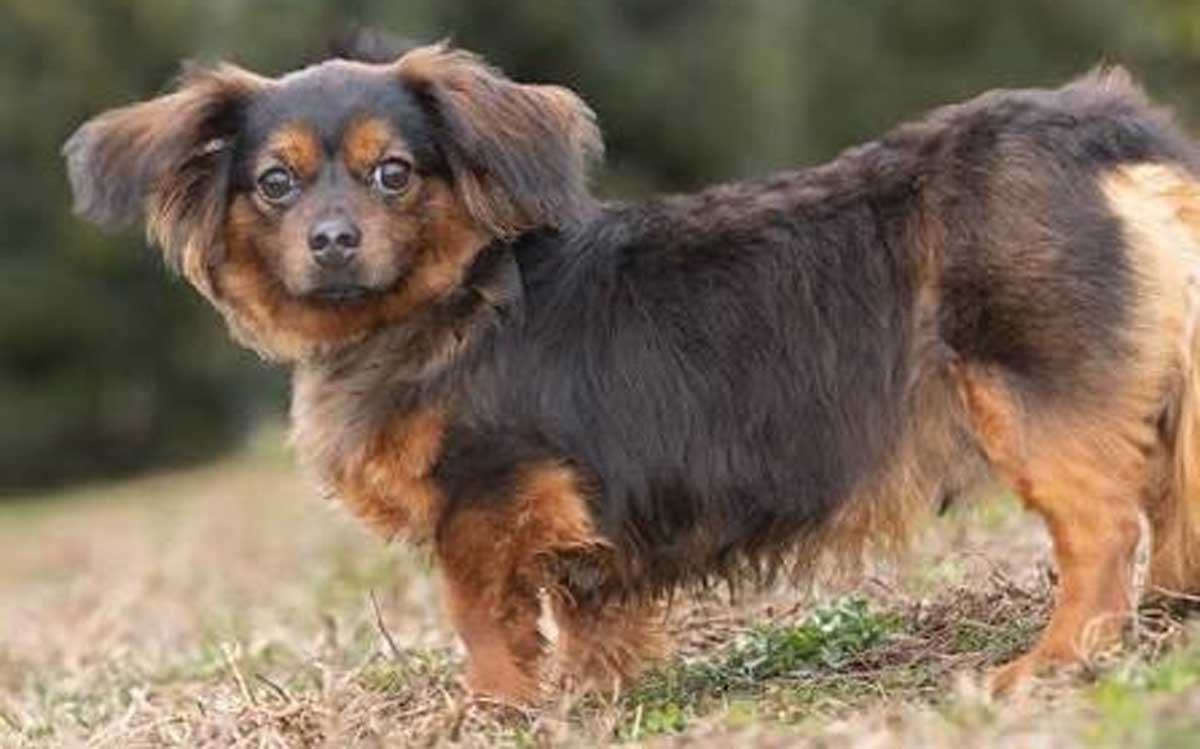
A Pekingese dachshund mix crosses a flat-faced toy breed with a long-nosed hound, so the puppies can come out with almost any face in between. That face is the thing I’d study most closely, because it predicts the eye problems the Pekingese side is known for.
You’ll sometimes see it listed as a Pekehund, and you can expect a small, long-bodied dog with plenty of coat.
What a Pekehund is
There’s no breed standard and nobody has measured a group of these dogs, so I’m not going to hand you a size range for the cross. Here’s what the AKC lists for each parent, which is the only measured data you’ve got to go on:
| Dachshund | Pekingese | |
|---|---|---|
| Height | 8-9 in (standard), 5-6 in (miniature) | 6-9 in |
| Weight | 16-32 lb (standard), 11 lb and under (miniature) | up to 14 lb |
| Life expectancy | 12-16 years | 12-14 years |
Both parents are low to the ground, so you won’t get a tall dog either way. Your puppy’s weight depends mostly on whether the dachshund parent was a standard or a miniature. Ask the breeder which.
The face decides the eye risk
Corneal ulcers are open sores on the clear front surface of the eye, and they hurt. In a study of 104,233 dogs seen by first-opinion vets in England, pain was recorded in 46.2% of the ulcer cases.
That study grouped the Pekingese with other flat-faced breeds, and the group as a whole had 11.18 times the odds of corneal ulcers compared with crossbred dogs. Pekingese didn’t get their own figure, so I can only tell you which group they sit in. Should you take comfort from the word “crossbred” there? I wouldn’t, because it covers every kind of mixed dog, and a separate study shows the risk follows the shape of your dog’s own face rather than the label.
Researchers at the Royal Veterinary College measured the faces of 700 dogs at a referral hospital, 31 of which had corneal ulcers, and looked for the features that went with them:
| Feature | Ulcer risk |
|---|---|
| Muzzle shorter than half the skull length (craniofacial ratio under 0.5) | about 20 times higher |
| A nasal fold (wrinkle) across the top of the muzzle | nearly 5 times higher |
| Eyelid opening 10% wider, relative to the skull | more than 3 times higher |
| White of the eye visible | nearly 3 times higher |
Longer muzzles went with lower risk.
Pekingese turn up in the same paper as one of the breeds reported to have 18 or more eye disorders, and the AKC itself says the breed has no long muzzle to act as a natural barrier protecting the eyes.
Four things to look at on the puppy
So what can you actually do with that? All four features are visible on a puppy. And because one parent is a long-nosed dachshund, your litter has a real chance of a longer face.
- The muzzle from the side. Compare the length of the nose with the length of the skull behind the eyes. The study measured this precisely, so treat your eye as a rough guide only, but a muzzle that’s clearly less than half the skull is the high-risk shape.
- A fold across the top of the nose. The study counted a nasal fold when it could be seen without pulling the skin and was big enough to grasp. Look at the bridge of the nose from the front.
- How wide the eyes open. Wide, prominent eyes were a risk on their own.
- White around the eye. If you can see white showing when the puppy’s looking straight ahead, note it.
Check the nostrils while you’re there. The AKC advises choosing a Pekingese with wide-open nostrils on a moderate-sized nose, and the same advice is sensible for a cross. Our Boston Terrier dachshund mix guide covers what narrow nostrils mean for breathing.
Don’t expect paperwork to do the job for you, either: the AKC says the Pekingese breed club has no recommended health tests, so looking at the face is most of the screening you can do on that side.
The back: both parents carry the disc gene
Your puppy’s long back comes from the dachshund. The gene behind disc disease, though, doesn’t come from the dachshund alone. A 2019 UC Davis study found that an extra FGF4 gene copy on chromosome 12 raises disc disease risk in a dominant way, so one copy is enough.
That copy turned up at an allele frequency of 0.99 in dachshunds and 0.50 in Pekingese. Working from those numbers, which is my arithmetic rather than the study’s, almost every puppy would get at least one copy, and about half (0.99 × 0.50) would get two.
Carrying it isn’t the same as getting sick. Among purebred dachshunds, the DachsLife survey of 2,031 dogs found 15.7% had been affected, and 24.4% of standard smooth-haired dogs. I’ve nursed Bruno through disc surgery, so I’d treat any long-backed cross as carrying the risk. There’s more in our guide to dachshund health problems.
Coat, heat and temperament
The Pekingese has a thick double coat that sheds seasonally, and the AKC recommends brushing for at least an hour a week to stop mats. If your puppy takes that coat, you’re signing up for the brushing too.
Pekes like the cold, and the AKC notes that some owners travel with their dogs on frozen ice packs or an ice pillow, even for car rides, which tells you to take warm weather seriously with a coat like that.
Exercise needs are modest on the Pekingese side, and dachshunds aren’t built for distance running or leaping, so short walks suit both. The AKC calls Pekes opinionated, independent and good little watchdogs that will tolerate children but not roughhousing, and it gives the dachshund a big-dog bark. Expect a confident small dog that announces visitors.
Pekingese dachshund mix: common questions
What is a Pekingese dachshund mix called?
You’ll sometimes see Pekehund, but the name doesn’t come with a breed standard, so it won’t tell you how flat your puppy’s face will be.
How big does a Pekingese dachshund mix get?
Both parents are short. The AKC lists Pekingese at 6-9 inches and up to 14 pounds, standard dachshunds at 16-32 pounds and miniatures at 11 pounds and under. Your dachshund parent’s size matters most.
Will a Pekingese dachshund mix have eye problems?
It depends on the face it gets: a short muzzle, a nasal fold, wide eyes and visible eye-white each raised corneal ulcer risk in the Royal Veterinary College study, and a puppy with a longer dachshund muzzle and no fold is starting from a better place.
What is a dachshund and pug mix?
Another flat-faced cross with the same questions about the face and the back. We cover it in the pug dachshund mix guide, and the rest are on our dachshund mixes page.
