
Weed Killers Safe for Pets: What the Label Is Allowed to Say


No weed killer has been proven safe for pets, and under US rules a registered one isn’t allowed to claim it. What you can control is what you spray and how long your dog stays off it.
Keep pets away until the treated area is completely dry, and longer for granular products, which the National Pesticide Information Center says can need 24 hours or more.
The “pet safe” bottles on the shelf are usually a different kind of product, and it’s worth knowing what that label does and doesn’t promise before you buy one.
Are weed killers safe for pets?
Some are lower risk than others, but none of them comes with a safety guarantee you can count on. Pet Poison Helpline says the signs after exposure depend on the chemical and how concentrated it is.
Stomach upset is the most common, though some herbicides can injure the kidneys or lungs and can be fatal.
The National Pesticide Information Center at Oregon State University gives the same basic routine for any yard product. Take your dog, its toys, chews, bowls and bedding out of the area before you spray.
Then keep your dog away until the product is completely dry and the area has aired out, and if the label says more, you’ll want to follow that too.
If you use a lawn service, ask which products it applies. NPIC recommends that conversation, and the answer tells you what to look up.
What “pet safe” on a weed killer label means
Here’s the part most shoppers don’t see. Federal labeling rules list examples of statements that make a pesticide label false or misleading, and 40 CFR 156.10 includes claims such as “safe,” “harmless” or “nontoxic to humans and pets,” even with “when used as directed” added.
So a registered weed killer, the kind with an “EPA Reg. No.” printed on it, isn’t supposed to tell you it’s safe for your dog at all.
The products that do say it are usually sold as minimum risk pesticides. These are exempt from federal registration if they meet the EPA’s conditions, including using only ingredients from an approved list, such as clove oil, citric acid or salt. Their own labeling conditions rule out the first eight kinds of misleading statement, but not the safety claim.
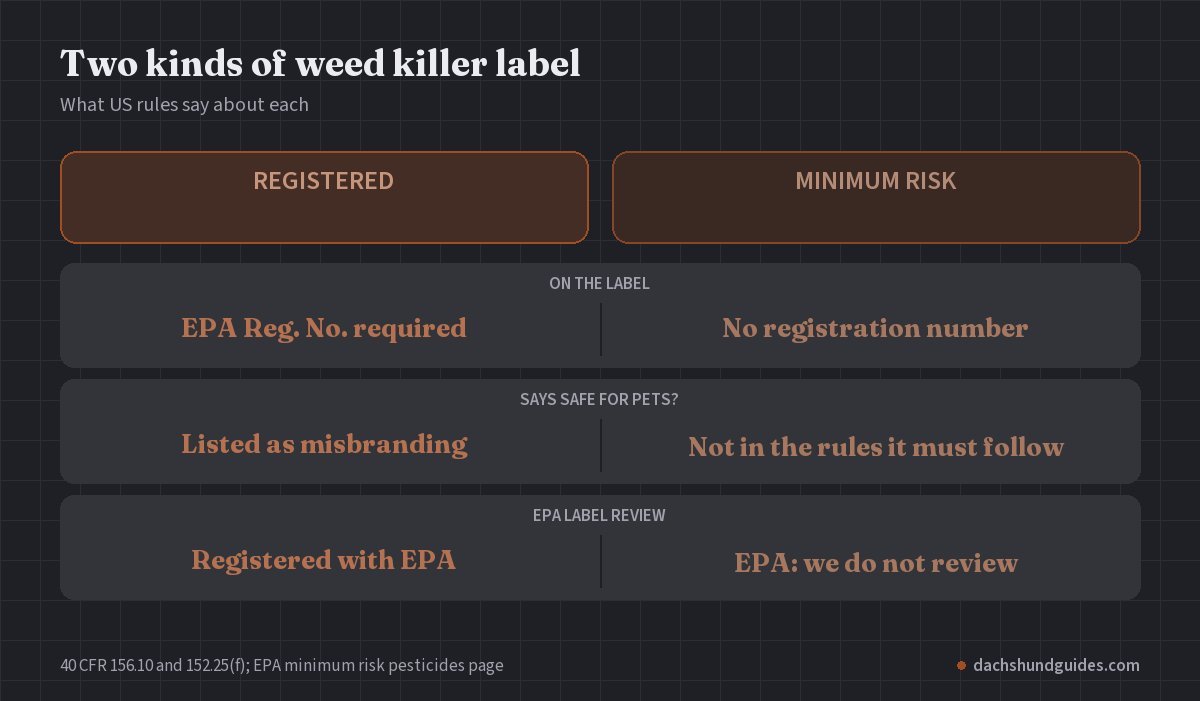
And nobody at the agency checks them. The EPA’s own guidance says it generally doesn’t review products that claim to meet the minimum risk criteria and doesn’t review their labels either. The maker decides whether the product qualifies.
That doesn’t make these products dangerous. What it does mean is that “pet safe” on the bottle is the maker’s word, so read the ingredient list instead. BHG also notes that many natural products take days to show results and need repeat applications.
How long to keep your dog off a treated lawn
Start with the label, then you’ll want to add a margin. NPIC’s baseline is to wait until the spray is completely dry. Granular lawn products can take 24 hours or longer to dissolve and dry.
Is Roundup toxic to dogs after it dries? NPIC’s glyphosate fact sheet says the risk is to pets that touch or eat plants that are still wet with spray. Dogs exposed may drool, vomit, get diarrhea, lose their appetite or seem sleepy.
Dry doesn’t always mean gone, though. A 2013 study by Knapp and colleagues sprayed three common lawn herbicides, 2,4-D, MCPP and dicamba, and measured what could still be wiped off the grass for up to 72 hours. The chemicals lasted significantly longer on dry, brown grass than on green grass, which is worth knowing in a dry summer.
The same study found those herbicides in the urine of dogs from 4 of 8 households that hadn’t treated their lawns at all. Residues on untreated grass pointed to drift from nearby yards. The authors wrote that how long to keep a dog off a treated lawn “remains to be defined.”
That work built on an earlier study of Scottish Terriers by several of the same researchers. Scotties exposed to lawns treated with herbicides alone had 3.62 times the odds of bladder cancer, and 7.19 times with herbicides plus insecticides.
It’s an association in one breed, not proof of cause, and the details are in the guide to the dachshund Scottie mix.
There’s no equivalent study for dachshunds, and nobody’s tested whether the same pattern holds.
A sensible routine is to keep your dog off for longer than the label minimum and wipe its paws after walks past freshly treated lawns, which matters more if your dog already licks its paws a lot.
Pet-friendly ways to kill weeds
The lowest-risk method is the oldest one. In an April 2026 r/gardening thread asking for a good weed killer, the top reply put it bluntly:
“Hands in dirt pulling up weeds is free and pet safe and kid safe.”
– r/gardening, April 2026 (81 upvotes)
Better Homes & Gardens agrees that hand weeding is the surest way to get the root out. Beyond that, here’s what the common alternatives can and can’t do:

- Mulch: a layer 3 to 5 inches deep blocks the light weeds need. Skip cocoa mulch, which is toxic to dogs.
- Vinegar: concentrated vinegar kills young plants but isn’t selective, and it irritates skin, eyes and noses, so keep your dog away until it’s dried.
- Boiling water or a torch: fine for weeds in paving cracks, but neither kills the roots of established weeds, so you’ll be repeating it.
- Salt: BHG calls it ineffective and bad for the soil, and salt is the same ingredient that makes ice melt risky for dogs.
Can vinegar kill weeds permanently? Not reliably. BHG says concentrated vinegar is strong enough for young plants, and that weed killers of every kind can leave roots behind to regrow.
If your dog got into weed killer
If your dog drank from a puddle of spray, licked a wet lawn or chewed a bottle, call your vet or Pet Poison Helpline at (855) 764-7661, where a fee applies.
Keep the container with you so you can read out the active ingredient and the EPA Reg. No.
Watch for vomiting, diarrhea, drooling or a dog that’s quieter than usual, and call straight away if spray got into its eyes, since Pet Poison Helpline notes some herbicides can injure them.
In the end, the back of the bottle tells you more than the front. A registration number, an active ingredient you can look up and a clear re-entry line are worth more than any “pet safe” sticker.
