
Best Flooring for Dogs: Hardness, Water and Grip Compared

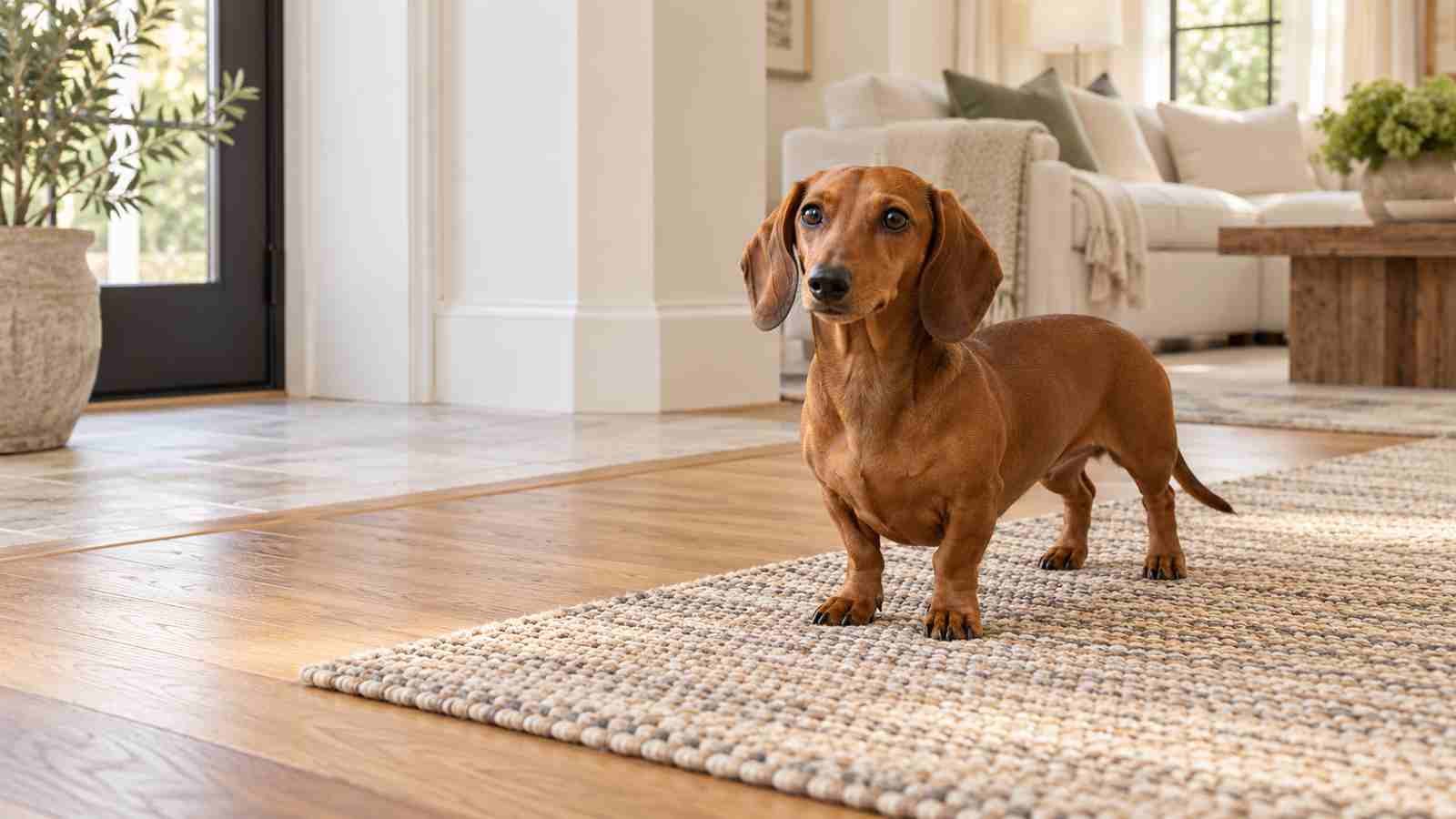
The best flooring for dogs depends on the room. Where accidents and water bowls happen, a waterproof vinyl plank or tile is the practical pick.
Where your dog runs, turns and jumps down from the sofa, it’s the rug on top that gives it grip, whatever the floor underneath.
If you want real wood, choose the species by its hardness number. In the US Forest Service’s Wood Handbook, hickory scores 1,970 and red oak 1,290 on a hardness scale measured in pounds of force, while pine comes in at 690, about half as hard as red oak.
What’s the best flooring for dogs?
There isn’t one floor that wins on every count, so it helps to split the house by what each room has to cope with. Here’s a simple way to decide:
- Kitchen, entry and the potty-training zone: waterproof vinyl plank, sheet vinyl or porcelain tile, because these are the rooms where you’ll be mopping up water and urine.
- Living room and hallways: whatever you like the look of, with washable rugs or runners on the paths your dog sprints along.
- Bedrooms and resting spots: carpet, or a large rug, for a soft place to lie down.
- Anywhere you want wood: a hard species with a tough finish, and short nails on your dog.
Shaw Floors’ vice president Terri Harrington, writing for the American Kennel Club, recommends a similar mix: hard, easy-clean floors in busy areas and carpet where dogs rest.
That article is sponsored by Shaw Floors, and most of the pages ranking for this question come from companies that sell floors.
Hardwood: pick the species by its Janka number
Hardness is one property of a wood floor you can look up from an independent source. The Wood Handbook, published by the Forest Service’s Forest Products Laboratory, defines it as the force needed to press a ball 0.444 inches across halfway into the wood.
A higher number means the board resists dents better. Here’s how the common flooring species compare, using the handbook’s figures for dry wood:
| Species | Janka side hardness (lbf) |
|---|---|
| Hickory (mockernut) | 1,970 |
| Pecan | 1,820 |
| Hard maple (sugar maple) | 1,450 |
| White oak | 1,360 |
| American beech | 1,300 |
| Red oak (northern) | 1,290 |
| Black walnut | 1,010 |
| Black cherry | 950 |
| Pine (loblolly) | 690 |
Against red oak, hickory, pecan and hard maple are clearly harder. Walnut, cherry and pine all sit lower, so you’ll see dents from claws and dropped toys sooner.
Know what the number doesn’t tell you. It’s measured on clear lab samples, and it’s about dents in the wood, not scratches in the finish on top. Engineered boards only have a thin layer of that species over a core.
Armstrong, which makes floors, notes that scratching is one of the biggest problems with pets, “especially if you don’t keep nails trimmed.”
Vinyl, laminate and tile: what waterproof covers
Most of what you’ll read about these floors comes from the companies that make them, so it’s worth knowing what the claims actually say.
Armstrong describes its rigid-core planks as “100% waterproof, so planks won’t swell, buckle or lose integrity when exposed to water,” and points you to the warranty for the details.
Is LVP or laminate better for dogs? On water, the retailer Flooring America says luxury vinyl “generally offers a bit more water resistance” than laminate. It also says waterproof vinyl handles accidents without lasting damage “as long as they’re cleaned promptly.”
That last condition is the one to take seriously if your dog still has accidents. A waterproof plank doesn’t make the joints between planks waterproof. In a May 2026 r/Flooring thread, one owner explained why they’d picked sheet vinyl instead:
“The vinyl planks have seams so if you don’t get the pee up fast enough it’s going to seep through to the underlayment”
– r/Flooring, May 2026 (4 upvotes)
So will dog pee ruin vinyl plank flooring? Not if it’s wiped up quickly, by the makers’ own account. If your dog is still house-training, though, sheet vinyl has fewer seams for urine to reach, and getting the training done protects any floor.
Tile has its own catch. One owner in an August 2026 r/Flooring thread reported two drawbacks: urine smells working into the grout over time, and older dogs slipping on it.
Does flooring matter for a dachshund’s back?
Nobody has shown that it does: no study links home flooring to disc disease in dachshunds, and the dachshund research that exists points to exercise and activity instead.
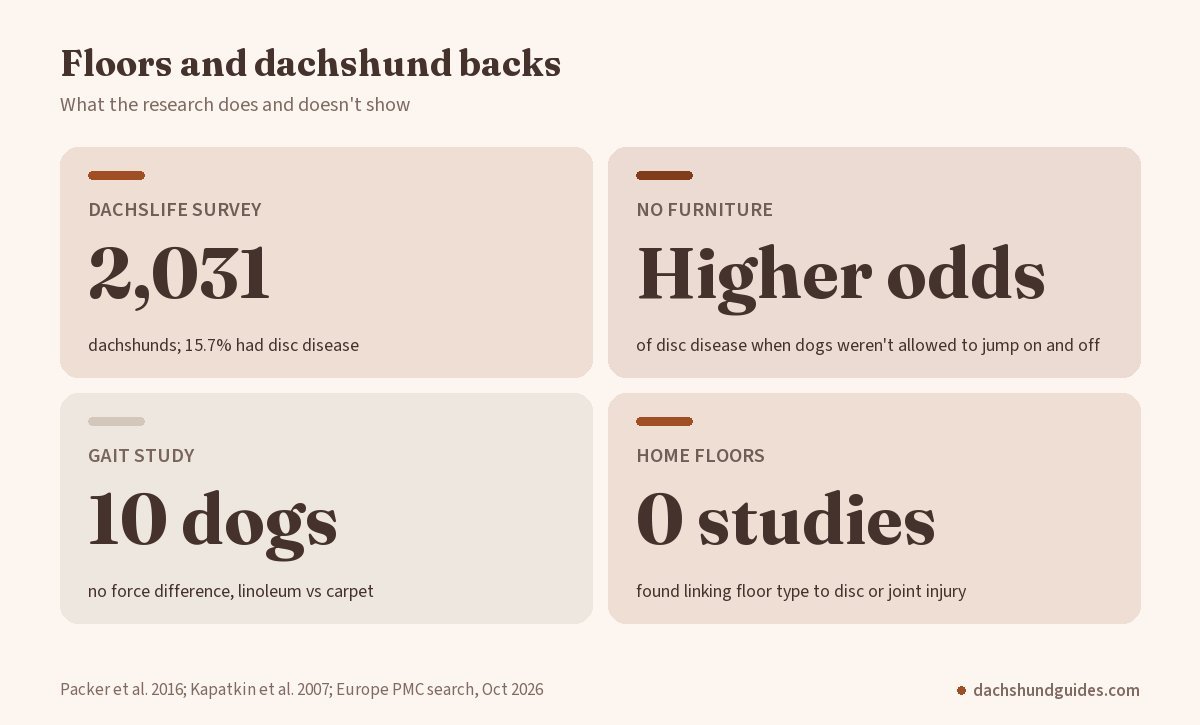
Searching the veterinary literature for floor surfaces and dogs turns up kennel studies from breeding facilities, a nail-grip trial after knee surgery that found no benefit, and one gait study. None of them looks at floors in pet dogs’ homes.
That gait study measured 10 healthy dogs walking on linoleum and on carpet at a controlled speed. The forces through their legs didn’t differ between the two surfaces. It didn’t test running, turning or landing, which is where you’d expect a slip to happen.
The DachsLife 2015 survey of 2,031 dachshunds found that dogs not allowed to jump on and off furniture had higher odds of disc disease, and so did dogs exercised for less than 30 minutes a day.
Dogs exercised for more than an hour had lower odds.
The authors treat those findings as leads for further study, not as proof, and Dachshund Health UK says the same.
Dachshund Health UK also notes that most back cases aren’t directly caused by a single event such as jumping off furniture. Dog Aging Project data on 43,517 dogs, covered in the guide to dachshunds and stairs, found regular stair use went with lower odds too.
Where flooring may matter more is for a dog that’s already had a disc problem. Dachshund Health UK says those dogs are at higher risk of further injury if they’re allowed to jump off furniture, so a ramp, or at least a rug where it lands, is a cheap precaution.
If you’re not replacing your floors
You don’t need new floors to give your dog more grip. The AKC piece suggests area rugs or runners on slippery hardwood or tile, and Harrington adds carpet stair runners for older dogs.
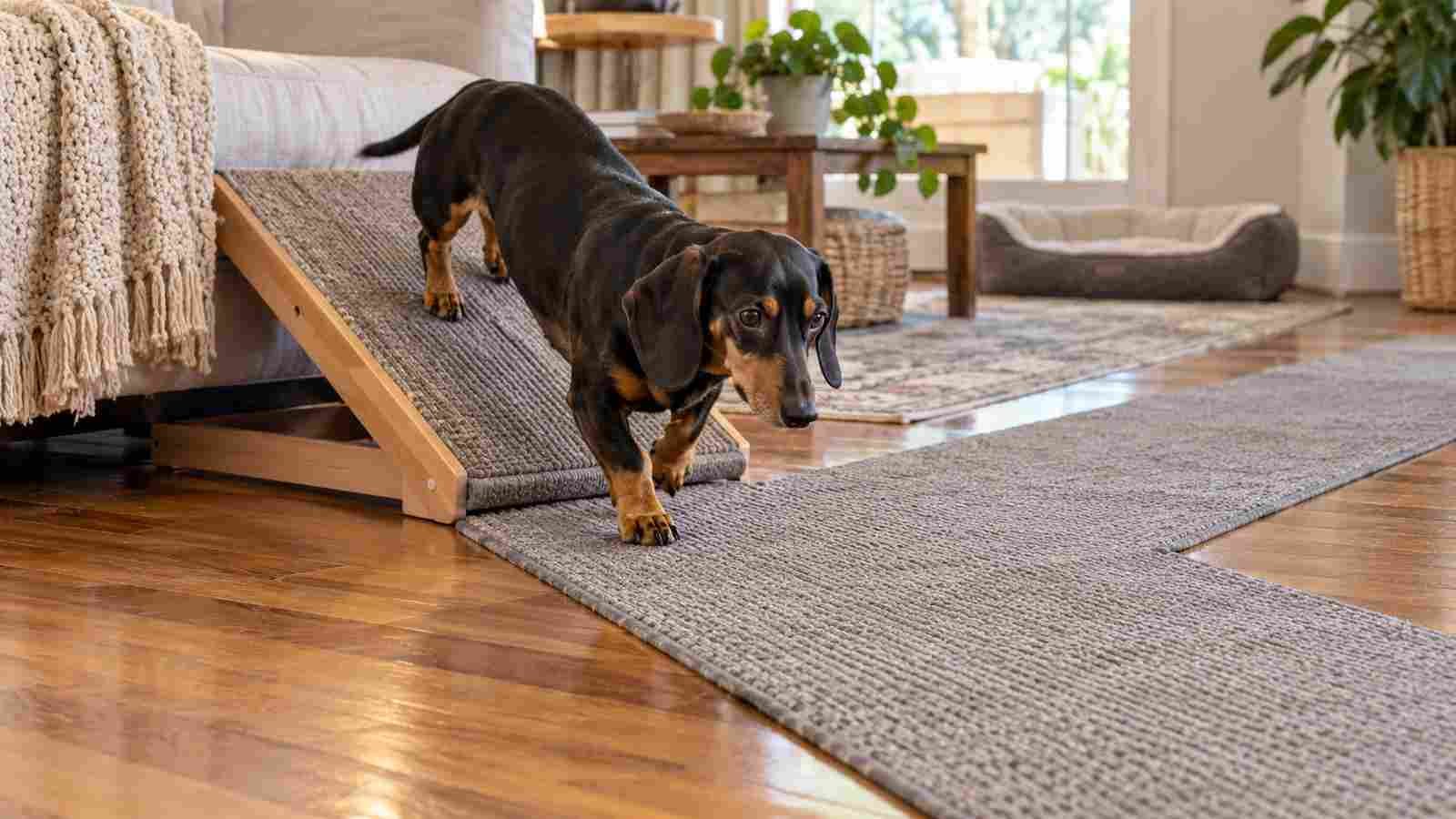
Put them where your dog actually moves fast: the hallway it races down when the doorbell rings, the turn at the bottom of the stairs, and the spot in front of the sofa.
Washable rugs with a non-slip backing are the practical choice in a house with a dog that still has accidents.
Keep your dog’s nails short, too. Long nails are what scratch the finish, and you can do it at home with the guide to cutting dachshund nails.
The floor itself matters less than you’d think. Where the rugs go and how short the nails are will do more for your dog, and for your floors, than any label on the box.
