
Boston Terrier Dachshund Mix: What the Breathing Research Actually Shows


A Boston Terrier, a French Bulldog and a Pug get lumped together as flat-faced dogs, and on breathing they are nowhere near each other. Researchers graded them the same way in 2024 and the Boston came out well ahead.
That changes what a Boston Terrier dachshund mix is buying you, and it changes what you should be looking at when you go to see a puppy.
What a Bo-Dach actually is
A cross between a Boston Terrier and a dachshund, standard or miniature. You’ll see it sold to you as a Bo-Dach, a Boston Weenie or a Boston Doxie, and none of those names is recognized by any registry, so don’t read them as a guarantee of anything.
Here’s what the AKC lists for each parent:
| Dachshund | Boston Terrier | |
|---|---|---|
| Height | 8-9 in (standard), 5-6 in (miniature) | 10-12 in |
| Weight | 16-32 lb (standard), 11 lb and under (miniature) | 12-25 lb |
| Life expectancy | 12-16 years | 11-13 years |
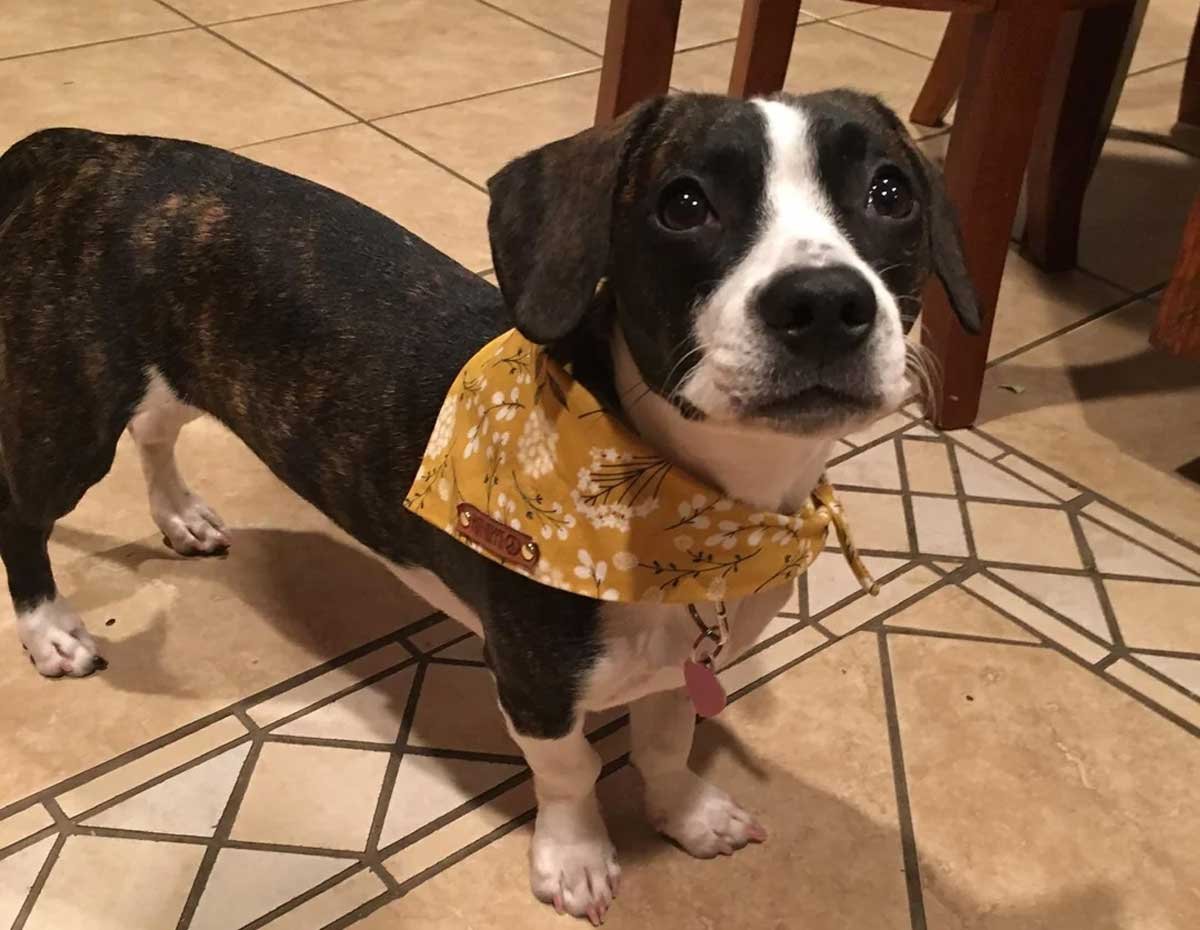
Your adult will usually land under about 25 pounds and somewhere near a foot tall, with the dachshund parent deciding most of it. Pretzel is a miniature, and a miniature parent pulls the whole thing noticeably smaller than a standard one would.
You’ll get a shorter muzzle than a dachshund and a longer back than a Boston. The coat is almost always short and smooth unless your dachshund parent was longhaired or wirehaired, and the Boston’s white markings come through often enough that many of these dogs wear a version of the tuxedo.
The short-face question, and why the breed matters more than the label
Brachycephalic obstructive airway syndrome is the reason people hesitate over any flat-faced cross. A research group graded 104 Boston Terriers on full respiratory assessment and compared them with other screw-tailed breeds graded the same way.
| Breed | Proportion at BOAS Grade 0 (clinically unaffected) |
|---|---|
| Boston Terrier | 37.5% |
| Bulldog | 15.2% |
| French Bulldog | 10% |
That difference was statistically significant at p<0.01. Of the 104 Bostons, exactly one reached Grade 3, the most severe category, which is 0.96%.
And the unaffected ones weren’t merely coping. Their respiratory traces looked like the control dogs’ with normal-length muzzles, so a Grade 0 Boston isn’t a flat-faced dog that’s managing; it’s a dog that breathes normally.
So the Boston really is the healthier end of a difficult group, and your Bo-Dach starts from a better hand than a French Bulldog cross would. That’s genuinely good news, and it’s the reason this pairing is worth a look at all.
Now the part that keeps me honest. Thirty-seven and a half percent clear means more than six in ten weren’t clear, with Grade 1 at 35.6% and Grade 2 at 26.0%.
Best of the group isn’t the same as fine. If you’ve read that table as permission to stop looking, you’ve read it wrong. It buys you better odds at the start, nothing more.
The one thing you can look at on the puppy
Within the breed, the study found two things that raised BOAS risk. One’s a shortened muzzle, measured as a craniofacial ratio. The other’s nostril stenosis, which carried an odds ratio of 2.51.
Nostrils are the useful one, because you can see them. Get down to the puppy’s level and look at the nose straight on. Open, rounded nostrils are what you want. Two narrow slits are the stenosis the study measured, and a dog with them had roughly two and a half times the odds of having BOAS, at an odds ratio of 2.51.
One caution, straight from the authors. There’s considerable overlap in the conformation measurements between the Grade 1 to 3 dogs and the Grade 0 dogs, which means looks alone don’t predict the outcome reliably.
Wide nostrils improve your odds. They don’t issue a guarantee. And no photograph substitutes for sitting with the dog and hearing it breathe while it’s calm.
Two different back problems, from two different directions
This is where the cross stacks rather than dilutes, and the two halves fail by different mechanisms.
The dachshund side brings intervertebral disc disease, which is degeneration of the discs between otherwise normal vertebrae. Dachshund Health UK, the registered charity behind breed health work in Britain, puts the lifetime figure at around one in four.
DachsLife 2015, surveying 2,031 dogs, found 15.7% overall and a large split between varieties:
- Standard Smooth-Haired: 24.4%
- Miniature Smooth-Haired: 17.1%
- Standard Wire-Haired: 7.1%
One thing that survey found is worth carrying with you, because it runs against the usual advice: bodyweight and body condition were not associated with disc disease risk. What that does and doesn’t mean sits alongside the schedule in the guide to dachshund potty training, and the wider picture is in dachshund health problems.
The Boston side brings something structurally different: congenital vertebral malformations, meaning bones that formed the wrong shape before birth. These are well documented across the screw-tailed brachycephalic breeds, and the screw tail itself is a visible marker of the same developmental process.
How common are they in Boston Terriers specifically? I couldn’t find out, and that’s worth telling you rather than papering over.
The published prevalence figures for this group come from French Bulldogs, English Bulldogs and Pugs. The only Boston-specific sample I found ran to four dogs, and its own authors flagged that as too small to mean anything.
You’ll see high percentages quoted for screw-tailed breeds in general. Those are other breeds’ numbers, and given the breathing research showed the Boston is not interchangeable with a French Bulldog, borrowing a French Bulldog figure would repeat the very error that makes those blanket warnings useless.
What to ask the breeder
Ask two questions, and neither rests on my preferences: which variety the dachshund parent was, and whether the Boston parent has had its breathing assessed. Both trace straight back to the figures above, and the answers you get will tell you as much about the breeder as about the dogs.
Which variety was the dachshund parent? Smooth, longhaired or wirehaired, standard or miniature. It’s the only back-related question with a prevalence figure attached, and the gap between 24.4% and 7.1% is a 3.4-fold difference inside one breed.
Has the Boston parent been assessed for its breathing? Respiratory function grading exists and is what produced the numbers above. A breeder who has never heard of it is telling you something, and so is one who has.
Bruno came to us from Sharon after a four-month wait. Waiting’s usually what buys you answers, because a litter you can collect this weekend rarely comes with anything documented attached to it.
Temperament and energy
You’re combining a companion breed with a hunting one. The result is usually more biddable than a straight dachshund, and usually more interested in the garden than a straight Boston. Neither of those is guaranteed in an individual dog.
The Boston was bred to be a city dog and it’s generally easy-going about strangers and other dogs. The dachshund half supplies the stubbornness and the nose, so you can expect training to go well right up until something small moves across your garden.
Energy lands in the middle and stays moderate. Both parents are happy with a decent walk rather than an hour of running, which makes this a reasonable flat dog for you provided the breathing side came out well.
Who this cross is wrong for
Anyone in a hot climate without air conditioning. A dog that’s breathing through a shortened airway loses heat less efficiently than one with a full muzzle. If your summers are severe, that risk isn’t theoretical.
It’s also wrong if you’d rather skip the homework. The evidence here hands you two specific things to check, and a cross that’s adorable at eight weeks can still have a narrow airway and a long back.
Who it suits: someone in a temperate place who wants a small, people-focused dog, is willing to look hard at a puppy’s nostrils, and would rather ask two awkward questions now than find the answers at the vet later.
Bo-Dach: common questions
What is a Boston Terrier Dachshund mix called?
A Bo-Dach most often, though Boston Weenie and Boston Doxie both circulate. No kennel club recognizes the cross, so none of the names is official and they’re used interchangeably by breeders and profile sites.
Will a Bo-Dach have breathing problems?
Less likely than a French Bulldog cross, on the evidence. A 2024 assessment of 104 Boston Terriers found 37.5% were clinically unaffected, against 10% of French Bulldogs and 15.2% of Bulldogs. Only one dog in that group reached the most severe grade. That still leaves the majority somewhere on the scale, so it improves your odds rather than removing the question.
How big does a Bo-Dach get?
Usually under about 25 pounds, at somewhere close to a foot tall. The AKC lists the Boston Terrier at 10-12 inches and 12-25 pounds, and the dachshund at 8-9 inches with 16-32 pounds for a standard or 11 pounds and under for a miniature, so the dachshund parent’s size decides most of it.
What is the life expectancy of a dachshund terrier mix?
Nobody has published a figure for this cross. The parents give you a bracket: the AKC lists 11-13 years for the Boston Terrier and 12-16 for the dachshund. Where an individual lands depends on which side’s health risks it inherited rather than on the crossing itself.
Does a Bo-Dach have back problems?
Both parent breeds carry spinal risk, by different routes. The dachshund contributes disc disease, at around one in four over a lifetime according to Dachshund Health UK. The Boston contributes the congenital vertebral malformations found across screw-tailed breeds, for which no reliable Boston-specific prevalence figure appears to exist. Ask which dachshund variety the parent was, because that one has numbers.
What is the best breed to mix with a Dachshund?
No study ranks them. The comparison that does have evidence behind it is narrower: within the short-faced breeds, the Boston Terrier is measurably less affected by airway disease than the French Bulldog or the Bulldog, so of the flat-faced options it’s the better-evidenced choice.
Is a Bo-Dach a flat-faced dog?
Partly, and it varies between littermates. The muzzle usually ends up longer than a Boston’s and shorter than a dachshund’s. Since muzzle length was one of the two conformational risk factors identified in the research, a puppy that took more from the dachshund side has a structural advantage, though the overlap in that study means you can’t call it from a photo.
