
Crate Training a Puppy: What the Research Says About Nights and Days


To crate train a puppy, make the crate a place they choose to rest, size it so they can stand, turn around and lie down, and never use it as punishment. Then start at night, because a study that followed puppies from early life found a link for night, not for daytime.
Crates are widely said to help with house-training and with being alone. That’s plausible, and one piece of research measured part of it, but what it found is narrower than the advice.
Does crate training a puppy actually help?
Pretzel had separation anxiety, and it took eight weeks of training before he could rest for six or seven hours alone, so I went looking for what predicts that problem in the first place.
The study I found, called Generation Pup, was run by Dale and colleagues, who followed 145 puppies and checked each one at six months for separation-related behaviors, meaning the signs of distress when left alone. They then looked back at what owners had reported from the first 16 weeks.
Puppies were less likely to develop those behaviors if, at 16 weeks or younger, they had been restricted to crates or rooms overnight and had slept at least nine hours a night.
What the study did and didn’t measure
Here’s how the numbers split, from the paper’s model. An odds ratio below 1 means lower odds of the behaviors.
| At 16 weeks or younger | Odds ratio (confidence interval) |
|---|---|
| Enclosed overnight (against not enclosed) | 0.029 (0.00-0.24) |
| Enclosed in the daytime only (overnight not mentioned) | 0.245 (0.03-1.78), not significant |
| Slept 9 hours at night (against 6-8) | 0.142 (0.03-0.72) |
| Slept 10 or more hours | 0.019 (0.00-0.16) |
Three limits matter before you quote any of this.
It shows an association, not a cause. Does that make it useless? No, but the authors say these recommendations derive from correlational longitudinal results, and that interventional data is needed for confirmation. One reading I’d add myself: a puppy that settles easily in an enclosed space might simply be a less anxious puppy to begin with.
The sample is small. With 145 puppies the confidence intervals are wide, so the range of 0.00 to 0.24 tells you the direction and doesn’t tell you how big the effect is.
The unit is a crate or a room, and the study grouped them together, so it can’t say a crate beats a small room or a pen. Dogs Trust goes further and says playpens can be more appropriate than crates for use at night, because they offer more space for movement.
Nights, not days
This is the part I’d keep: overnight enclosure carried a strong association, and daytime-only enclosure didn’t reach significance. That doesn’t prove daytime crating is harmful, because the data simply didn’t show a link either way.
What it does suggest is where to put your effort. A safe, enclosed place to sleep at night, and enough sleep, are the two things in this study that lined up with calmer puppies. They’re also free, and they don’t depend on how long you’re out of the house.
Two other findings are worth knowing, and the first one surprised me. Owners who reported fussing over their dogs at six months in response to bad behavior on their return had dogs six times more likely to show separation-related behaviors, though the direction of cause is unclear, since owners may fuss because the dog is already distressed. And puppies whose owners used more punishment or aversive techniques had higher odds too.
Starting crate training, step by step
None of this changes the basics, and it makes the order clearer. Dogs Trust breaks the process into six steps:
- Prepare the crate or pen and set it up in a calm, quiet place.
- Introduce it in a positive way. Keep the doors fixed open so your puppy can explore going inside, and use small pieces of favorite treats.
- Encourage your puppy to go inside once they seem relaxed around it.
- Reward them for settling.
- Close the door.
- Step away from the crate.
Dogs Trust adds that how quickly you progress depends on how your dog feels, so go at your puppy’s pace.
The AKC suggests keeping a sleeping crate in or near your bedroom if you want your puppy to sleep in one overnight. That fits the 16-week window, and Bruno came home at twelve weeks, which left only four weeks of it, so I’d have the crate ready before the puppy arrives.
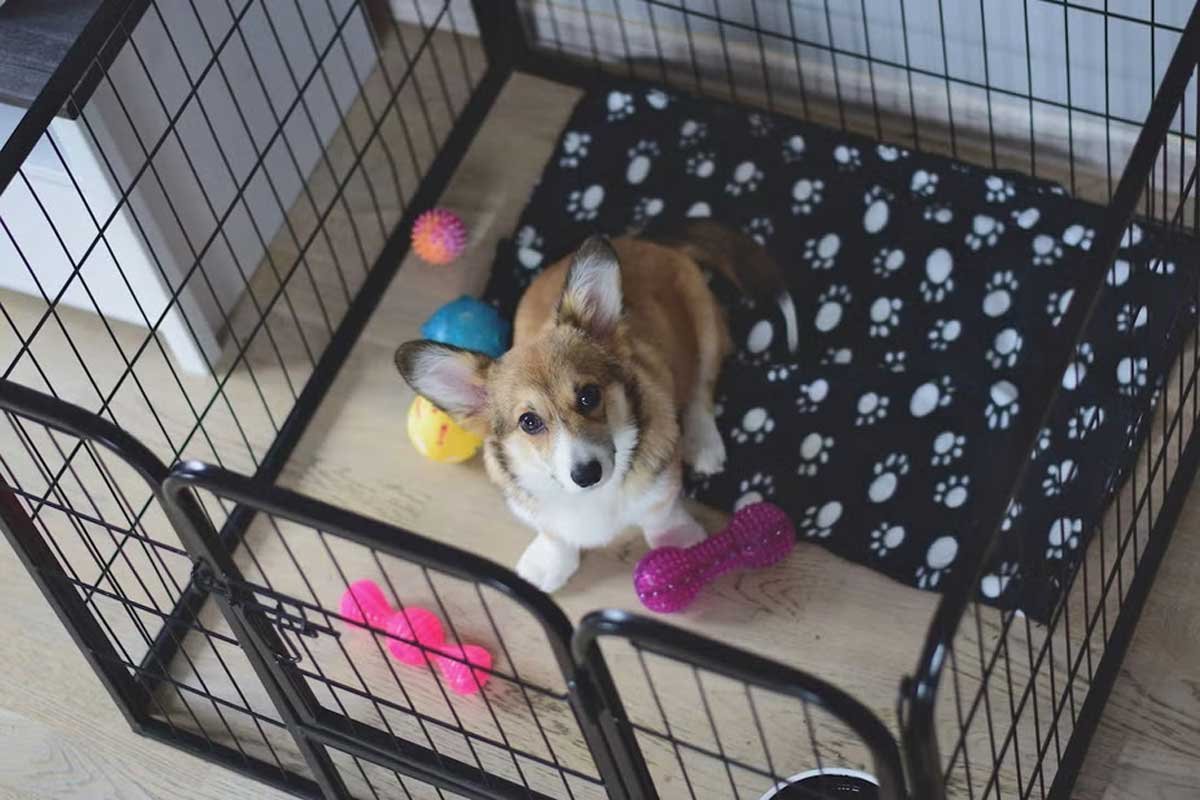
How long can a puppy stay in the crate?
There isn’t one number, and Dogs Trust declines to give one: it says a dog shouldn’t spend too much time inside because they might become stiff and might need the toilet, and asks you to speak to your vet about how long is appropriate.
For nights, the arithmetic of the bladder sets a floor. The AKC says puppies can generally hold their bladder for about as many hours as their age in months, up to about nine months to a year. A two-month-old is looking at roughly two hours, which means an eight-week-old puppy will need trips outside during the night.
Size matters too, and the AKC says a crate should be large enough for your puppy to stand, turn around and lie down comfortably, but not so large that they can go to the toilet in one corner and rest in another. Many crates include adjustable partitions as your puppy grows.
For the schedule that goes with it, including the moments the AKC says to take a puppy straight out, see the dachshund potty training guide.
What not to do
Don’t use the crate as punishment. Dogs Trust is blunt about it: it’s essential that your puppy always enjoys being in the crate or pen, and that’s why you should never use it to punish them.
The AKC puts it the other way round, saying the crate is a personal den, a place to relax, sleep and feel safe, and that crate time should help a dog calm down instead of being a punishment.
I’d also keep your return calm, given the six-times figure above, with the caveat that it shows an association rather than a cause. Greet them quietly, and if you’re building up to leaving them for longer, there’s a fuller approach in the dachshund separation anxiety guide.
Crate training a puppy: common questions
When to start crate training with a puppy?
As soon as your puppy comes home. The Generation Pup finding concerns the first 16 weeks, so there’s no reason to wait, and nights are the place to start.
How do I stop a puppy crying in the crate?
Go back a step. Dogs Trust says progress depends on how your dog feels, so a crying puppy hasn’t yet found the crate comfortable. Why push on? Open the door and reward calm moments.
Is it okay to crate my dog while I’m at work?
I can’t give you a safe number of hours, and neither can the sources I trust. Dogs Trust says dogs shouldn’t be left alone for longer than they can cope with, and asks you to take your vet’s advice. The study I’ve described didn’t test long daytime absences.
Can I use a puppy crate for time out?
I wouldn’t. Dogs Trust says you should never use the crate to punish a puppy, since they may associate going in with negative feelings and stop feeling secure there.
Does crate training prevent separation anxiety?
Not on this evidence. Puppies enclosed overnight at 16 weeks or younger had lower odds of separation-related behaviors at six months, but the authors say the data is correlational. It’s a reason to give your puppy a safe place to sleep, not a guarantee.
