
Teacup Dachshund: What the Label Means Before You Pay for One

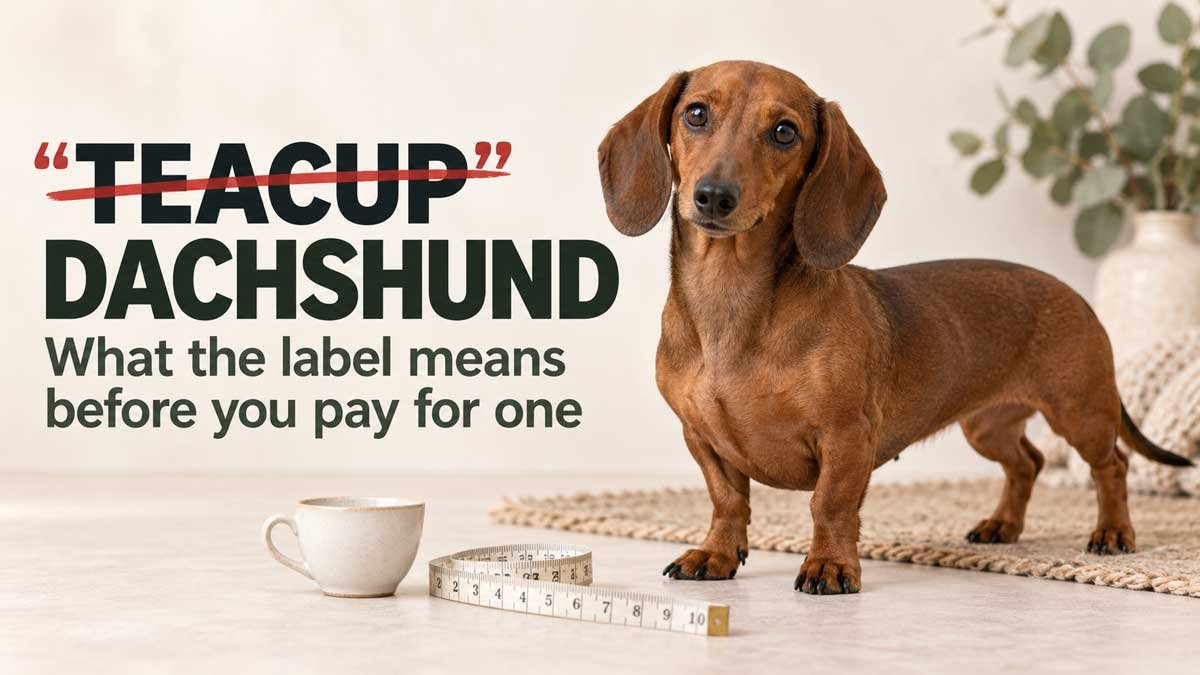
A teacup dachshund isn’t a recognized size or variety. The AKC standard has two sizes, standard and miniature, and a miniature is 11 pounds and under at 12 months or older. The FCI standard used in Europe adds a smaller rabbit (kaninchen) size, defined by chest measurement. “Teacup” and “micro” are seller labels, usually for a small miniature or an undersized dog, and no kennel club defines them.
So if you’re quoted extra for a teacup puppy, you’re paying for a word. The questions worth asking are about the parents’ health and the puppy’s expected adult size.
What the breed standards actually allow
The AKC standard says dachshunds are bred and shown in two sizes. Miniatures “are not a separate classification” but compete in a division for “11 pounds and under at 12 months of age and older.” There’s no smaller division, so you can’t register a dog with the AKC as a teacup.
Europe’s FCI standard has three sizes, defined by chest circumference measured at 15 months or older. Its smallest, the rabbit dachshund, is 27 to 32 cm around the chest for males and 25 to 30 cm for females. Our kaninchen dachshund guide covers it. That’s the smallest size you’ll find in any standard, and it’s still described by a measurement, not by a cute name.
What sellers mean by teacup
What will you actually get? There’s no fixed meaning. A veterinarian writing for PetMD describes teacup dogs in general as significantly smaller than is typical for their breed, sold under names like micro or pocket dogs, with no official weight.
The article says teacup breeders tend to breed the smallest females to the smallest males so they can sell tiny puppies for high prices.
Owners on Reddit tend to put it more bluntly. When someone asked whether teacup dachshunds are real, the top reply said:
“No – anything teacup or ‘ultra mini’ is a backyard breeding fad that produces horribly unhealthy puppies for more $$$. Arguably, 8lbs isn’t that tiny.”
– r/Dachshund, March 2024 (120 upvotes)
That last point matters if you’ve been told your 8-pound dog is a teacup: an 8-pound adult is simply a small miniature, well inside the AKC’s 11-pound limit, and doesn’t need a new label.
How big will a teacup puppy get?
A teacup puppy grows to whatever adult size its own growth curve points to, and you can estimate that from its weight and age together. Weight alone tells you little.
In the growth data behind our puppy weight calculator, toy-size puppies, the group a miniature dachshund fits by weight, weigh about 27% of their adult weight at 8 weeks and about 38% at 12 weeks.
What does that mean for a seller’s numbers? Run them before you pay. An 8-week-old puppy at 2.4 pounds is on track for about 9 pounds as an adult. That’s an ordinary miniature, not a new size.
Don’t treat any one estimate as a promise, though. Puppies differ most at the youngest ages: at 8 weeks, the top of the calculator’s middle range is 46% above the bottom. Even two dogs from one breeder can end up far apart. One r/Dachshund owner with an 8-pound girl got a boy from the same breeder, “supposedly from the same lineage,” and wrote that he’s “easily double the size of our older girl already.”
Check where a puppy’s size is headed
Enter your puppy’s age and weight to see the adult weight it’s tracking toward. Weigh again every few weeks and rerun it.
The health questions
If you’re weighing up a teacup puppy, PetMD’s article lists problems that are seen in very small dogs bred for size. It’s written about teacup dogs in general, not dachshunds specifically:
- Low blood sugar (hypoglycemia) in puppies, which can cause weakness, tremors and seizures.
- Hydrocephalus, fluid pressure on the brain, sometimes linked to a domed head.
- Liver shunts, abnormal vessels that bypass the liver.
- Dental crowding, collapsing trachea, heart valve disease and orthopedic problems such as luxating patella.
- Practical problems: losing body heat, fragile bones, harder anesthesia, and the fact that most common parasite preventives are labeled for dogs of 5 pounds or more.
You should know the caveat, though. The same article says many of these problems occur in small breeds generally, and that research is still ongoing into whether they’re more frequent the tinier a dog is bred to be. What it does say is that poor breeding practices raise the chances of these problems.
Whatever size you choose, dachshunds carry the breed’s own main risk, disc disease. Our guide to dachshund health problems covers it.
Caring for a very small dachshund
If you already have a tiny one, most of the care is ordinary dachshund care. Two things matter more when the dog is small.
Feed a tiny puppy often. VCA Animal Hospitals advises feeding toy-breed puppies often, because very small puppies are prone to hypoglycemia, and says frequent small meals may help guard against it. A small puppy that turns weak, shaky or has a seizure needs a vet straight away.
Keep an adult lean. A small dog needs very little food, and half a pound is about 6% of an 8-pound dog. Another owner, whose vet said their 8-pound dog could lose some weight, fed “a quarter cup of food twice a day” and couldn’t see how “something so loud” needs so few calories. Our dog calorie calculator gives you a daily target from your dog’s weight, and it’s worth checking before you blame the scoop.
If you want the smallest healthy dachshund
If you want a small dog, look for a miniature, or an FCI rabbit dachshund, from health-tested parents. Miniatures aren’t short-lived, either: in the UK study our dachshund lifespan guide is based on, miniatures, a group that included rabbit dachshunds, had a median lifespan of 14.0 years. One owner in the same Reddit thread added:
“My little girl is about 8 lbs and will be 15 this year. She’s always been tiny.”
– r/Dachshund, March 2024 (33 upvotes)
PetMD’s advice is that you talk to breeders of regular-size dogs who run the recommended health tests. Smaller-than-normal puppies turn up from time to time, it says, and reputable breeders place them in homes on the condition that they aren’t bred. Our guide on how to choose a dachshund breeder has more questions to ask.
Teacup dachshund: common questions
Is there such a thing as a teacup dachshund?
Not as a recognized size. The AKC has standard and miniature, and the FCI adds the rabbit (kaninchen) size. “Teacup” and “micro” are sales terms.
How big do teacup dachshunds get?
There’s no standard to say, so you can’t hold a seller to a teacup size. The smallest AKC size, the miniature, is 11 pounds and under at a year old. To estimate where a puppy is headed, see how big a teacup puppy will get.
What is the smallest dachshund breed?
It’s one breed in different sizes. The smallest recognized size is the FCI’s rabbit dachshund; in the US, the AKC’s smallest is the miniature.
Teacup vs miniature dachshund: what’s the difference?
The miniature is a recognized size: 11 pounds and under at 12 months for the AKC. Teacup isn’t, so a dog sold as one is usually a miniature, often a small one, under a label that PetMD says tends to come with a higher price. Our guide to the miniature dachshund full grown covers normal adult sizes.
How long do teacup dachshunds live?
No study has looked at dogs sold as teacups. Miniatures, which in the UK data included rabbit dachshunds, had a median lifespan of 14.0 years, about 73 in human years on our dog age calculator. Dogs bred down for size can carry the health problems listed above.
How much does a teacup dachshund cost?
We don’t have a reliable published figure for teacup prices. Our how much are dachshunds page covers cost in general.
