How to Choose a Dachshund Breeder

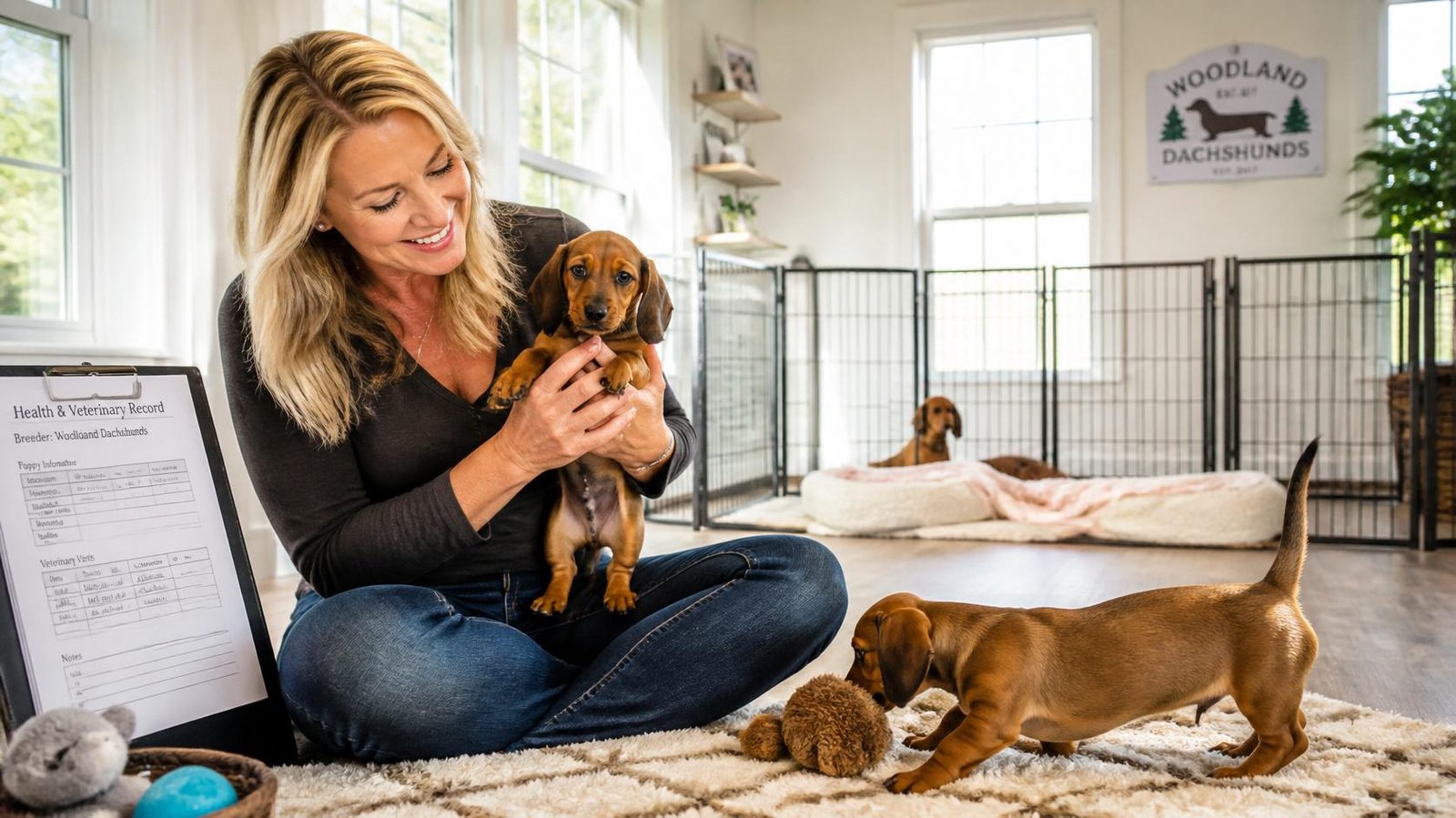
The decision to bring a dachshund into your home is exciting but how to choose a dachshund breeder can feel overwhelming. With over 10,000 puppy mills operating across the United States and approximately 2.6 million puppies sold annually from unethical operations, understanding how to choose a dachshund breeder has never been more critical. Whether you’re searching for a miniature dachshund or a standard-sized companion, learning to distinguish between responsible breeders and profit-driven mills will shape your puppy’s entire future and your family’s experience.
I remember the moment I first considered bringing a dachshund home. Like most people, I was drawn to those adorable photos of long-bodied puppies with soulful eyes. But I quickly realized that impulse buying without doing my homework could support operations that harm animals. After months of research and conversations with veterinarians and breed experts, I discovered that how to choose a dachshund breeder requires patience, questions, and a commitment to ethical practices. This guide shares what I learned and what experts recommend.
Why How to Choose a Dachshund Breeder Matters More Than Ever
Dachshunds consistently rank among the most targeted breeds by puppy mills. According to research from the Humane Society, dachshunds are frequently mentioned alongside Labradors, Chihuahuas, and French Bulldogs as breeds pursued for their popularity and profit potential. When you understand how to choose a dachshund breeder, you’re not just protecting your wallet you’re preventing animal suffering.
The statistics are sobering. Data from the ASPCA reveals that over 800 animal welfare violations were documented at USDA-licensed commercial dog breeding facilities in 2024 alone. Yet despite these documented violations, enforcement remains minimal. Knowing how to choose a dachshund breeder is your most powerful tool for supporting ethical practices and avoiding establishments that prioritize profit over puppy welfare.
Puppies from mills face harsh realities. Research indicates that mill puppies are 41.6% more likely to develop health issues compared to puppies from responsible breeders. Beyond physical health, these puppies often struggle with behavioral and psychological abnormalities, costing owners thousands in veterinary bills and training expenses that could have been prevented by learning how to choose a dachshund breeder wisely.
Red Flags: What to Avoid When Choosing a Dachshund Breeder
Understanding red flags is the first step in how to choose a dachshund breeder effectively. A reputable breeder will welcome your scrutiny; a disreputable one will try to rush you through the process.
Reluctance to Show Their Facility
One of the clearest indicators when learning how to choose a dachshund breeder is the breeder’s transparency. Legitimate breeders take pride in their operation and invite prospective buyers to visit their home or facility. If a breeder offers excuses, provides only photos, or refuses in-person visits entirely, this is a major warning sign. Responsible breeding environments should be clean, well-maintained, and comfortable for both dogs and visitors.
Inability to Provide Health Records
Never overlook this when figuring out how to choose a dachshund breeder. A breeder should provide complete veterinary records documenting vaccinations, deworming, health screenings, and any medical treatments. If a breeder can’t produce these records or claims they don’t exist, walk away. Reputable breeders maintain relationships with local veterinarians and can provide references without hesitation.
Multiple Breeds and Constant Availability
Breeding quality dogs requires focus, expertise, and passion. When you’re learning how to choose a dachshund breeder, watch for operations offering five, ten, or fifteen different breeds. Similarly, if a breeder always has puppies available immediately, they’re likely running a puppy mill prioritizing quantity over health. Responsible breeders maintain waitlists and limited litters often just a few per year.
Pricing Pressure and Lack of Screening
This is perhaps the most telling red flag when determining how to choose a dachshund breeder. Reputable breeders ask YOU extensive questions about your lifestyle, home, experience with dogs, work schedule, and long-term commitment. They want assurance that their puppies are going to loving, responsible homes. If a breeder immediately quotes a price and offers to sell you a puppy without asking anything about your situation, you’ve encountered a profit-driven operation, not a passionate breeder.
Early Weaning and Premature Separation
Puppies should remain with their mother until at least eight weeks of age; some breeders, particularly those breeding toy breeds like miniature dachshunds, hold puppies until ten to twelve weeks. If someone offers to sell you a puppy at six or seven weeks, question their integrity. Early separation interferes with critical socialization and can result in behavioral issues that persist throughout the dog’s life.
Green Flags: Characteristics of Responsible Dachshund Breeders
Now that you understand what to avoid, here’s what to look for when you’re learning how to choose a dachshund breeder who will give your puppy the best start.
Comprehensive Health Testing
Responsible breeders conduct extensive health screenings on parent dogs before breeding. For dachshunds specifically, this includes testing for hip dysplasia, elbow dysplasia, eye conditions, and intervertebral disc disease (IVDD) a condition to which the breed is predisposed due to their elongated spine. When you’re deciding how to choose a dachshund breeder, request documentation from the Orthopedic Foundation for Animals (OFA) or similar registries. A breeder who can’t or won’t provide these records isn’t meeting basic ethical standards.
Detailed Knowledge About Individual Puppies
How to choose a dachshund breeder also means selecting someone who knows their puppies intimately. Ask the breeder to describe each puppy’s personality, energy level, response to handling, and interactions with littermates. A responsible breeder will tell you whether a puppy is bold or cautious, playful or calm, and help match you with the personality that suits your household. If the breeder can offer only vague descriptions or seems indifferent to personality matching, that’s a warning sign.
Written Contracts and Health Guarantees
Every responsible breeder should provide a written contract outlining health guarantees, the puppy’s registration details, and crucially, a “return-to-breeder” clause. This commitment that the breeder will take the puppy back if your circumstances change demonstrates genuine care for the dog’s welfare. This single factor alone is essential when you’re focused on how to choose a dachshund breeder with integrity.
Ongoing Support and Follow-Up
When you learn how to choose a dachshund breeder, look for someone who stays involved after purchase. Ethical breeders check in during the first weeks and months, answer questions about training, nutrition, and health, and remain available throughout the puppy’s life. This ongoing relationship signals that the breeder views their puppies as family members, not products.
Membership in Breed Clubs and Competition
Breeders who actively participate in breed clubs, dog shows, and performance events demonstrate commitment to the breed standard and excellence. Showing dogs in competitions whether confirmation, obedience, or agility validates that the breeder’s dogs meet breed standards and possess sound temperament and structure. This is a strong green flag when determining how to choose a dachshund breeder.
Comparison Table: Responsible Breeder vs Puppy Mill Operations
| Criteria | Responsible Breeder | Puppy Mill |
|---|---|---|
| Facility Access | Welcomes visits; proud of environment | Refuses visits or shows only photos |
| Health Testing | OFA/CERF documentation available | No health screening; records unavailable |
| Breeds Offered | Specializes in one breed | Offers 10+ breeds |
| Puppy Availability | Maintains waitlist; limited litters | Always has puppies ready to go |
| Screening Process | Asks extensive questions about buyer | Rushes to close sale; minimal questions |
| Release Age | 8-12 weeks with socialization | 4-6 weeks; early separation common |
| Contracts | Detailed written agreement; return clause | Vague or no contract offered |
| Post-Sale Support | Stays in touch; provides guidance | No follow-up after sale |
| Price Structure | Consistent pricing; no color premiums | Variable pricing based on appearance |
| Veterinary References | Provides vet contact freely | Refuses or avoids vet references |
Key Questions to Ask When Choosing a Dachshund Breeder
Preparation matters when learning how to choose a dachshund breeder. Come armed with these essential questions:
- Can I meet both parents? (At minimum, you should meet the mother.)
- What health testing have the parents undergone, and can you show me results?
- How many litters do you produce annually?
- Can you provide references from previous buyers?
- What is included in your health guarantee?
- At what age will my puppy go home, and how are they socialized?
- What happens if I can no longer care for my dog?
- Can you provide your veterinarian’s contact information?
- Do you require a spay/neuter agreement for pet puppies?
- What training, diet, and care recommendations do you provide?
Don’t accept vague answers. How a breeder responds to these questions reveals whether they’re genuinely committed to responsible breeding or simply seeking the quickest sale. The same goes for size labels: no kennel club recognizes a “teacup” dachshund, as our teacup dachshund guide explains.
Personal Experience: Why I Chose the Hard Way
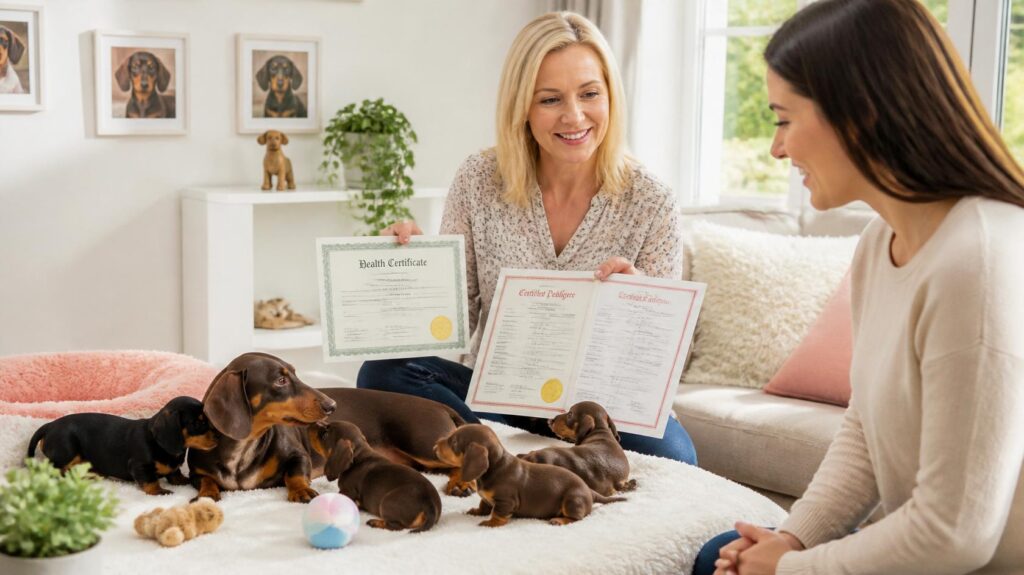
When I finally found my dachshund, Bruno, I’d already interviewed four breeders and turned down three. The first two seemed friendly online but became evasive when I asked about health testing. The third had puppies available immediately a major red flag I almost ignored because I was emotionally invested.
My breeder, Sharon, made me wait four months. She asked me uncomfortable questions about my work schedule, my home setup, and what I’d do if my circumstances changed. She required references from my vet and previous pet ownership. When I finally visited her home, I understood why: her dachshunds lived in a clean, enriching environment, socialized with children and other dogs. Bruno arrived at twelve weeks with complete health documentation, started on training, and a detailed care manual.
Was the wait frustrating? Absolutely. Was the price higher than online offers? Yes. But Bruno is now four years old with no health issues, an excellent temperament, and a breeder I still contact with questions. That peace of mind knowing Bruno came from ethical breeding is worth every extra dollar and every week of waiting.
Discover More About Dachshund Care
Once you’ve mastered how to choose a dachshund breeder, you’ll want comprehensive guidance on every aspect of dachshund ownership. Visit our Dachshund Guides section for articles on training, nutrition, health concerns, and breed-specific needs. Your breeder will be an invaluable resource, but ongoing education ensures your dachshund thrives.
Avoiding Puppy Scams and Fraud
Online puppy scams are exploding in 2025, making it even more critical to understand how to choose a dachshund breeder safely. Scammers use fake websites, stolen photos, and manipulative pricing to lure buyers. When purchasing online:
- Never pay via unprotected methods (Zelle, PayPal, wire transfer). Use credit cards, which offer fraud protection.
- Verify the breeder’s identity through independent sources, not just their website.
- Reverse-image search puppy photos to ensure they’re original.
- Check the Better Business Bureau and International Pet and Animal Transportation Association for complaints.
- Never send deposits before meeting the breeder or puppy in person.
Learning how to choose a dachshund breeder includes understanding these digital dangers. Patience and verification protect both your investment and your peace of mind.
Final Thoughts on Choosing Ethically
The dachshund breed’s charm and popularity make them targets for unethical operations. But every time someone learns how to choose a dachshund breeder responsibly, demand shifts toward ethical breeders and away from profit-driven mills. Your choice to wait, to ask questions, to walk away when something feels off sends a powerful message.
A responsible breeder isn’t a luxury; they’re an investment in a puppy’s health, your family’s happiness, and the future of the breed itself.
FAQ: Choosing a Dachshund Breeder
Is AKC registration a guarantee of a responsible breeder when choosing a Dachshund breeder?
No. AKC registration confirms a puppy’s pedigree and purebred status, but it does not guarantee health testing, ethical breeding practices, or responsible care. Some puppy mills also register their dogs with the AKC. When learning how to choose a Dachshund breeder, treat AKC registration as one factor not the only one.
How long should I expect to wait when choosing a Dachshund breeder?
Reputable Dachshund breeders often have waiting lists that last several months. This is usually a positive sign because responsible breeders produce limited litters, prioritize puppy health, and carefully screen potential owners rather than breeding for high-volume sales.
What’s the typical cost of a Dachshund from a responsible breeder?
A well-bred Dachshund from a responsible breeder typically costs $1,500 to $3,500, depending on location, bloodline, and breeder reputation. This price generally includes health testing, early socialization, vaccinations, and ongoing breeder support.
Should I worry about genetic issues even from a responsible breeder?
Yes. Even responsible breeders cannot eliminate every genetic risk. However, they significantly reduce the chances of inherited diseases by performing health testing, carefully selecting breeding pairs, and providing health guarantees and lifelong support for puppy owners.
