
The Best Dachshund Harness for Safe, Happy Walks

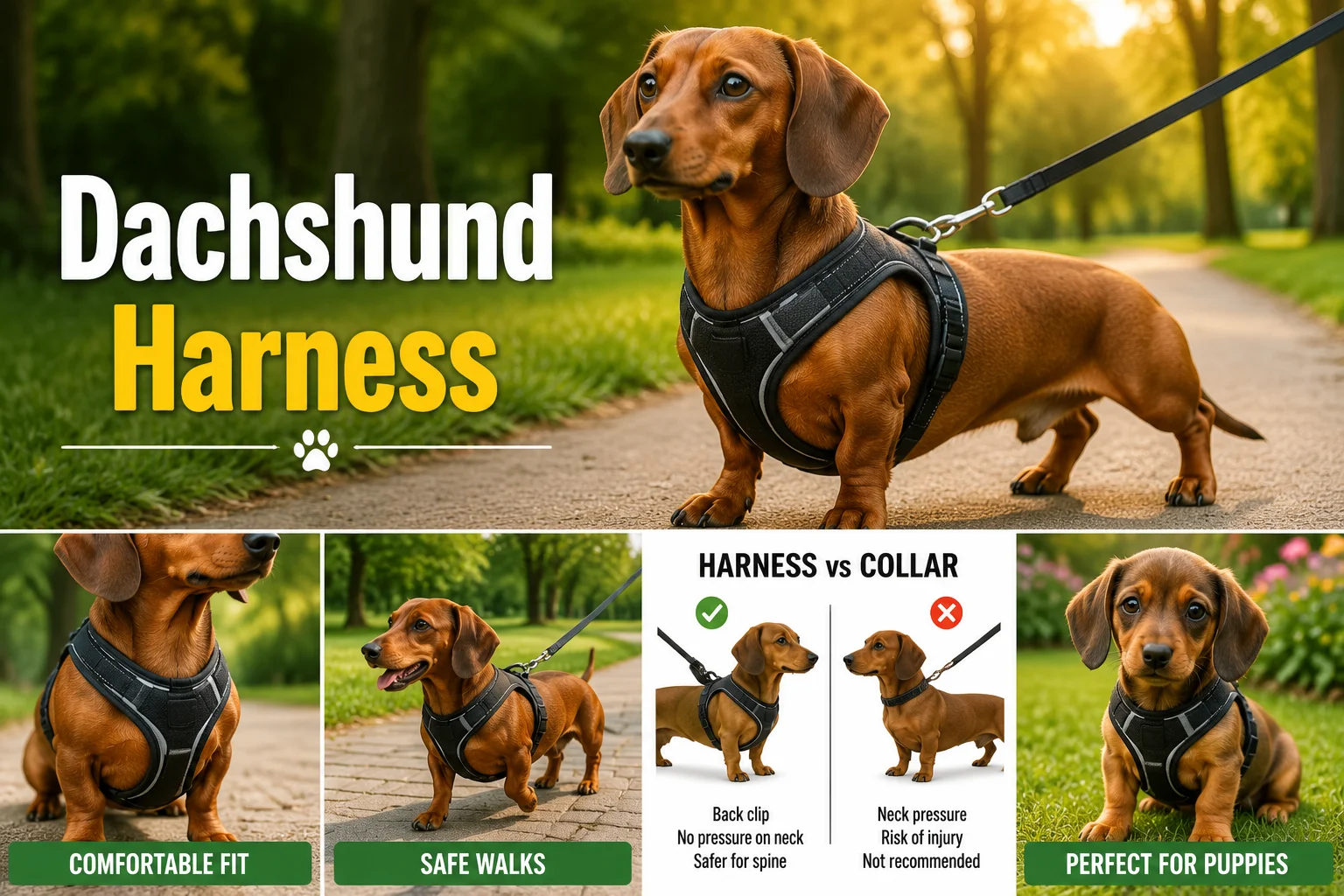
A harness is a sensible choice for many dachshunds, but it is not a back-protection device, and the research does not say every dachshund needs one. Collars measurably press on the neck and raise eye pressure when a dog pulls; there is still no study showing that a harness lowers the risk of IVDD.
That makes the useful question which dachshund benefits from a harness, and which harness does not get in the way of how the dog moves. Both answers are below, with the source for every figure.
Does a Dachshund Need a Harness?
What the Evidence Supports
A dachshund benefits most from a harness when it pulls or lunges, has a condition where eye pressure matters, or has had a disc problem in the neck. For a calm dachshund on a loose lead, the evidence does not show a flat collar raising back risk.
The breed’s concern is real. Dachshund Health UK estimates that around 1 in 4 dachshunds are affected by intervertebral disc disease (IVDD) at some stage, and the dachshund health problems guide covers the early signs. The same charity points out that 90 to 95% of dachshund disc herniations happen in the middle to lower back, not the neck, and concludes it seems unlikely that walking a dachshund on a collar raises its risk of back problems.
Collars do put real pressure on the neck, though. In a 2020 Veterinary Record study from Nottingham Trent University and the University of Nottingham, seven collars and a slip lead tested on a model neck exerted between 83 and 832 kPa, and the authors found that no collar kept the pressure low enough to reduce the risk of injury when the dog pulled on the lead.
Eyes are the second case. A 2006 study in the Journal of the American Animal Hospital Association measured intraocular pressure in 26 dogs pulling against a collar and a harness: pressure rose significantly with the collar and not with the harness, and the authors recommend a harness for dogs with glaucoma, weak or thin corneas, or any condition where higher eye pressure could do harm.
Collar vs. Harness: What the Research Actually Says
The largest dachshund-specific data comes from the DachsLife 2015 survey, published in Canine Genetics and Epidemiology, which collected owner reports on 2,031 dachshunds. Of dogs walked on a collar, 13.7% had a vet-diagnosed IVDD episode; of dogs walked in a harness, 19.3% did. Compared against dogs walked on neither, neither difference was statistically significant (odds ratio 0.70 for collars and 1.06 for harnesses).
Dachshund Health UK, looking only at dogs over 3 in its survey, reports that harness-walked dogs were 2.3 times more likely to have had an IVDD incident. The charity is explicit that this does not imply causation, since dogs that have already had a back problem may simply be moved into a harness afterwards.
Pulling does not explain it either. In DachsLife, dogs that pulled on the lead had IVDD rates of 12.5% on a collar and 17.6% in a harness, and neither was a significant difference from dogs that did not pull.
A survey like this cannot say whether collars or harnesses change IVDD risk, and no trial has tested it. Choose for the dog in front of you.
What to Look For in a Dachshund Harness
Key Features That Actually Matter
Shoulder movement: A 2019 Royal Veterinary College study of nine dogs found that both a Y-shaped harness and a strap-across-the-chest harness reduced shoulder extension compared with no harness. The Y-shaped design, labelled non-restrictive in the study, reduced it more: by 2.6 degrees at a walk and 4.4 degrees at a trot compared with the strap design. The study is small, so treat the label with caution and watch your own dog’s stride.
Adjustment at the neck, chest and belly: a dachshund’s deep chest and long body rarely match a generic small-dog size, and separate adjustment points make a snug fit without rubbing easier to reach.
Clip position: The American Kennel Club notes that front-clip harnesses help with dogs that pull, because forward pressure turns the dog back toward the handler, while back-clip harnesses suit dogs that already walk well. Dual-clip designs let you start at the front and move to the back clip as training improves.
Easy on and off: step-in and side-buckle designs avoid pushing the head through a tight opening, which helps with a dog that dislikes being handled around the neck.
Dachshund Harness Types Compared
| Harness type | What the evidence says | Check before buying |
|---|---|---|
| Y-front (strap splits around the chest) | Reduced shoulder extension more than a strap design in the 2019 RVC study of nine dogs | Watch the trot; the V should sit on the breastbone, not across the shoulder joint |
| Strap across the front of the chest | Also reduced shoulder extension versus no harness in the same study, by less | The strap should not ride up onto the throat |
| Front-clip or no-pull | AKC: useful for dogs that pull; no dachshund-specific study | Whether the dog walks straight or twists toward the clip |
| Car safety harness | Center for Pet Safety 2013 crash tests: only one brand tested offered crash protection | Look for the CPS Certified mark, not a maker’s own crash claim |
How to Measure Your Dachshund for a Harness
Getting the Fit Right the First Time
Measure before ordering, because size labels vary between brands:
- Chest girth: the widest part of the chest, just behind the front legs. Most harness size charts are built on this number.
- Neck circumference: at the base of the neck, where a collar would sit.
- Weight: as a cross-check against the size chart.
Weight alone will not settle the size. The AKC breed standard puts standard dachshunds at 16 to 32 pounds and miniatures at 11 pounds and under, and two dogs of the same weight can have different chest depths.
For the fit itself, the AKC article quotes veterinarian Dr. Attas: put the harness on slightly loose, then tighten until you have to squeeze two fingers under the straps without it being uncomfortable. Recheck after the first walk for rubbing behind the front legs.
When a Harness Is the Better Choice
Situations Where the Evidence Favours One
Dogs that pull or lunge: none of the collars in the 2020 model-neck study kept pressure low enough to reduce the risk of injury when the lead was pulled.
Eye conditions: glaucoma, thin or weak corneas, or any condition where eye pressure matters, per the 2006 intraocular pressure study.
Car Travel: a collar provides no restraint in a crash, but most harnesses did not either: in the Center for Pet Safety’s 2013 crash tests, only one of the brands tested offered crash protection, and CPS warns that extension tethers and zipline-style products increase the risk of injury. What the tether attaches to matters too; the dachshund car seat guide weighs boosters, crates and harness restraints against each other.
Post-IVDD Recovery: After surgery or conservative management, a harness is often the vet’s choice, and Dachshund Health UK notes it may be recommended over a collar after a neck (cervical) disc problem. Follow the vet’s or rehabilitation therapist’s instructions on when walks restart. On days the dog has to be carried instead of walked, a carrier that lets it lie flat keeps the spine supported.
At home: a ramp takes the jump out of getting onto a bed or sofa, and the evidence on household stairs is less alarming than the usual advice suggests.
Caring for Your Dachshund Harness
Simple Habits That Extend Harness Life
- Wash to the label: follow the manufacturer’s care instructions; many fabric harnesses can be hand-washed or put through a gentle cycle in a mesh bag.
- Check hardware regularly: replace the harness at any sign of fraying webbing or a cracked buckle.
- Refit when weight changes: a harness that fit before a diet, or before a winter of extra treats, may not fit now.
- Dry it before storing: damp webbing grows mildew and weakens stitching.
- Never lift your dog by the harness: Dachshund IVDD Support Australia advises lifting with one hand under the chest and one under the rump, keeping the body level.
Smart Shopping: What to Avoid
- Crash-protection claims without independent testing. The Center for Pet Safety states it does not agree with the crash-protection claims made by the makers of the harnesses that failed its 2013 tests; check the CPS Certified list instead.
- Sizing given only as small, medium or large with no chest-girth measurements.
- Designs your dog can back out of when it stops and pulls backwards.
- Sellers with no exchange policy, since dachshunds often fall between sizes.
Building a Harness Routine That Actually Works
Making the Dachshund Harness Part of Daily Life
Start with short sessions indoors. Put the harness on for a few minutes while the dog is calm, pair it with a treat, and take it off before the dog gets restless.
Increase the time gradually. Move to short walks once the dog ignores the harness indoors.
Check for rubbing after walks. Part the fur along the strap edges; pink skin in the same spot usually means a strap needs adjusting.
Train loose-lead walking either way. The pressure findings above come from pulling, so a dog that walks without tension on the lead takes the strain off whatever it is wearing.
Frequently Asked Questions
Should a Dachshund always wear a harness instead of a collar?
No. A harness is the better choice for a dachshund that pulls, has an eye condition such as glaucoma, or has had a neck disc problem, but no study shows that a harness protects a calm, healthy dachshund’s back better than a flat collar. Pick the one the dog walks comfortably in, and teach loose-lead walking either way.
What type of harness is safest for a Dachshund with IVDD?
No study has compared harness designs in dogs with IVDD, so the safest harness is the one your vet or rehabilitation therapist approves for that dog. After a neck (cervical) disc problem, Dachshund Health UK notes a vet may recommend a harness over a collar. Never lift a recovering dog by the harness straps.
How do I know if the Dachshund harness fits correctly?
A harness fits when you have to squeeze two fingers under the straps without it feeling tight, the dog cannot back out of it, and it does not rub behind the front legs. Watch the dog trot as well: a strap that shortens its stride needs adjusting or a different design.
Can a Dachshund harness prevent IVDD?
No. No study shows that a harness prevents IVDD. In the DachsLife 2015 survey of 2,031 dachshunds, dogs walked in harnesses had a higher raw rate of IVDD than dogs walked in collars, which Dachshund Health UK says may reflect owners switching to a harness after a back problem, not the harness causing one.
At what age should I start using a harness on my Dachshund puppy?
A puppy can get used to a harness as soon as lead training starts. Put it on for short, calm sessions with treats, lengthen them gradually, and recheck the fit often, since a growing puppy outgrows straps quickly.
