
Dog Chasing Cat: Why It Happens and What Actually Helps


A dog chasing a cat is acting on a heritable trait, one that differs a great deal between breeds. What the research can’t tell you is whether your dog’s chase is play or hunting, and that’s the question that decides what you do next.
You’ll hear that any dog can do it, which is true of individual dogs, but the research is more specific than the folk wisdom, and it points to the safest next step.
Why does my dog chase the cat?
Chasing is a measured behavior, and the questionnaire researchers use to compare dogs, called C-BARQ, defines it as a dog that “pursues cats, birds and/or other small animals, given the opportunity”.
A team led by MacLean in 2019 combined that questionnaire data from more than 14,000 dogs across 101 breeds with genetic data. Chasing came out with an among-breed heritability of 0.62, the third highest of the traits they measured.
Here’s what that number means, and doesn’t: it’s the share of the difference between breeds that tracks their genetic similarity, so it describes breeds and can’t predict what your particular dog will do. But it does tell you that breed isn’t a footnote.
If you have a dachshund, the AKC’s description is blunt: bred to be an independent hunter of dangerous prey, they can be brave to the point of rashness, and a bit stubborn. International Cat Care says the same thing about terriers and other chasing breeds, which may be more driven by their instinct to chase than some other types of dog.
I looked for a figure for dachshunds in particular and didn’t find one. The study doesn’t report breed-by-breed chasing scores in its main text, so I won’t invent one.
Is it play or is it hunting?
You’ll see this called “predatory drift”, a term trainers use for play that turns into a predatory chase. I searched for peer-reviewed work on it and found none. It’s a useful description of something people have watched, but it isn’t an established mechanism. So what can you actually go on, if not a label? Signs you can see.
American Humane lists four for the dog. My rule is that any one of them is a reason to separate the animals:
- The dog stays intensely focused on the cat.
- It lunges or snaps.
- It ignores your attempts to redirect it.
- It reacts sharply when the cat moves.
The third one is easy to talk yourself out of. If you can’t redirect your dog, don’t read its silence as calm.
Watch the cat too. American Humane notes that a cat that stops eating, drinking, using the litter box or interacting with the family, or that spends most of its time hiding, may be living in an environment that’s causing ongoing stress. That’s often the first sign a chase has gone from occasional to constant.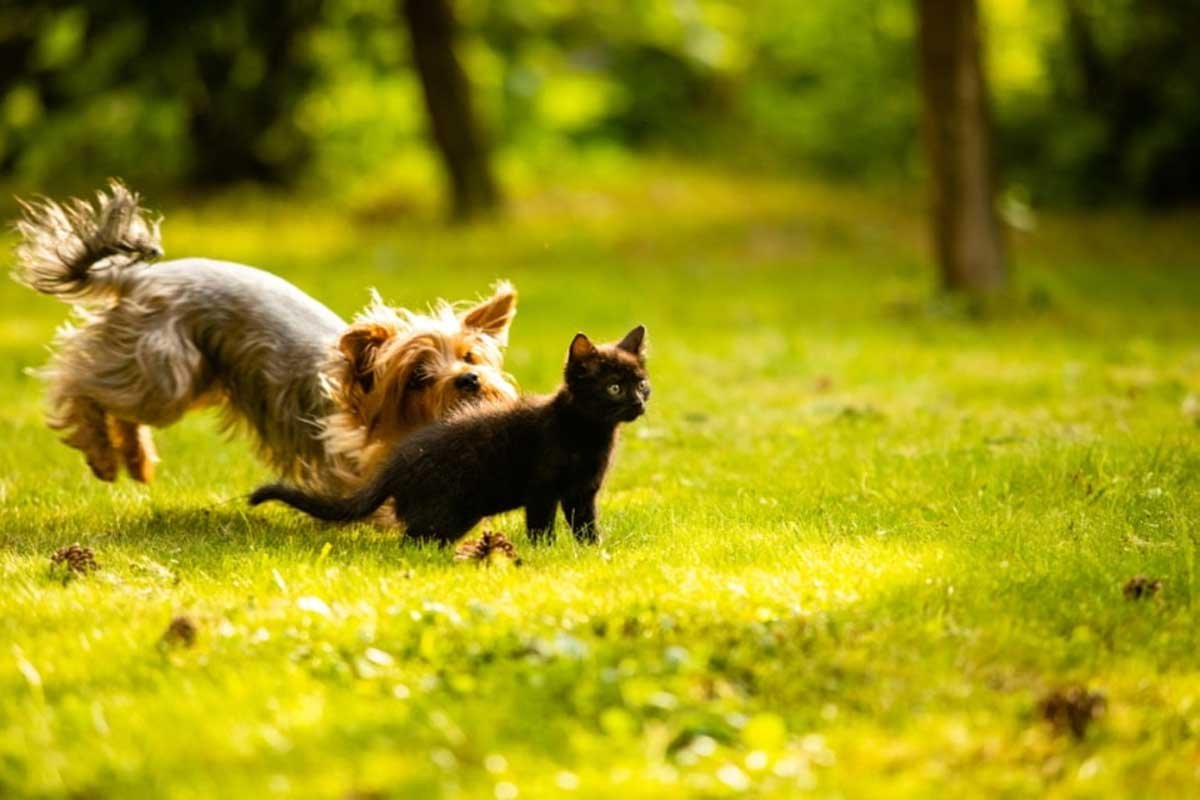
What to do today
Where do you start, and do you need a trainer on day one? You don’t, but the cat has to be physically safe and the dog has to stop practicing.
- Separate them when you can’t watch. Use a tall baby gate across a door so the cat has a room with its litter box, food, water and toys. Best Friends Animal Society describes exactly this setup.
- Give the cat height. International Cat Care recommends multiple safe, elevated perches so the cat has a choice to get away.
- Keep the dog on a lead during any shared time. The point isn’t to hold the dog back. As International Cat Care puts it, the lead is “not there to provide restraint, but as a ‘just in case’.” If you’re hauling the dog away from the cat, you’ve moved too fast.
- Redirect, then reward. Best Friends suggests getting the dog to focus on something else, and the American Veterinary Society of Animal Behavior says management can include avoiding the situations that lead to the unwanted behavior while keeping everyone safe.
What not to do
Don’t punish the chase, because the AVSAB’s position statement says training works best when it teaches the animal what to do, instead of punishing it for what it shouldn’t. So give your dog somewhere better to look.
The same statement points out that common problems such as barking and housetraining can be managed by arranging the environment and reinforcing the behavior you want. A chase can be more serious than that. The AVSAB says more serious concerns such as aggression, anxiety and fear need a plan with environmental management, behavior modification and sometimes medication. If your dog’s chase is that kind, it’s a job for an evidence-based vet or behavior consultant.
When it may not be fixable
Some dogs never settle, and Best Friends says so plainly. It’s possible your dog might not ever be able to safely share space with a cat, and if you can’t trust your dog around your cat, you should keep them apart.
On timing, the same source says a dog may lose interest in the cat within a couple of hours, but it can take days, weeks or even months.
That isn’t a counsel of despair. A house where the cat has the upstairs and the dog has the downstairs, with a gate between them, is calmer than one where both animals are on edge.
What about dachshunds?
They’re not a special case in the research, but they’re a good example of why breed matters. If you’re thinking of bringing a dachshund into a home with a cat, or the other way round, I’ve covered the breed-specific side in dachshunds and cats. The step-by-step introduction is in introducing a cat to a dog.
Dog chasing cat: common questions
How do I stop my dog from chasing my cat?
Manage first: gate the cat’s room, give it high places, and keep the dog on a lead during shared time. Then reward the dog for looking away from the cat. Don’t punish the chase, because the AVSAB finds punishment less effective than teaching what to do instead.
Is it normal for a dog to chase a cat?
It’s common enough to have its own measure in dog research. The C-BARQ includes it as a trait, and breeds differ on it a great deal. Normal doesn’t mean safe, though, so treat any chase where the cat flees as a risk.
Can a dog that chases cats live with one?
Sometimes, with management, though Best Friends says it can take hours or months and that some dogs never can. If you don’t trust the dog around the cat, keep them apart.
How can I tell play from hunting?
Look for the American Humane signs: intense focus on the cat, lunging or snapping, ignoring your redirection, and sharp reactions when the cat moves. Any of those means stop and separate them. If the cat is hiding or off its food, assume the chase is not play to the cat.
What is the 3-3-3 rule of cats?
It describes how a newly adopted animal settles in: three days to adjust, three weeks to build a routine and three months to build trust. It isn’t about introducing two animals, and I explain the difference in the guide to dachshunds and cats.
