
Dachshund Stairs: Safe or Not, and What Matters More

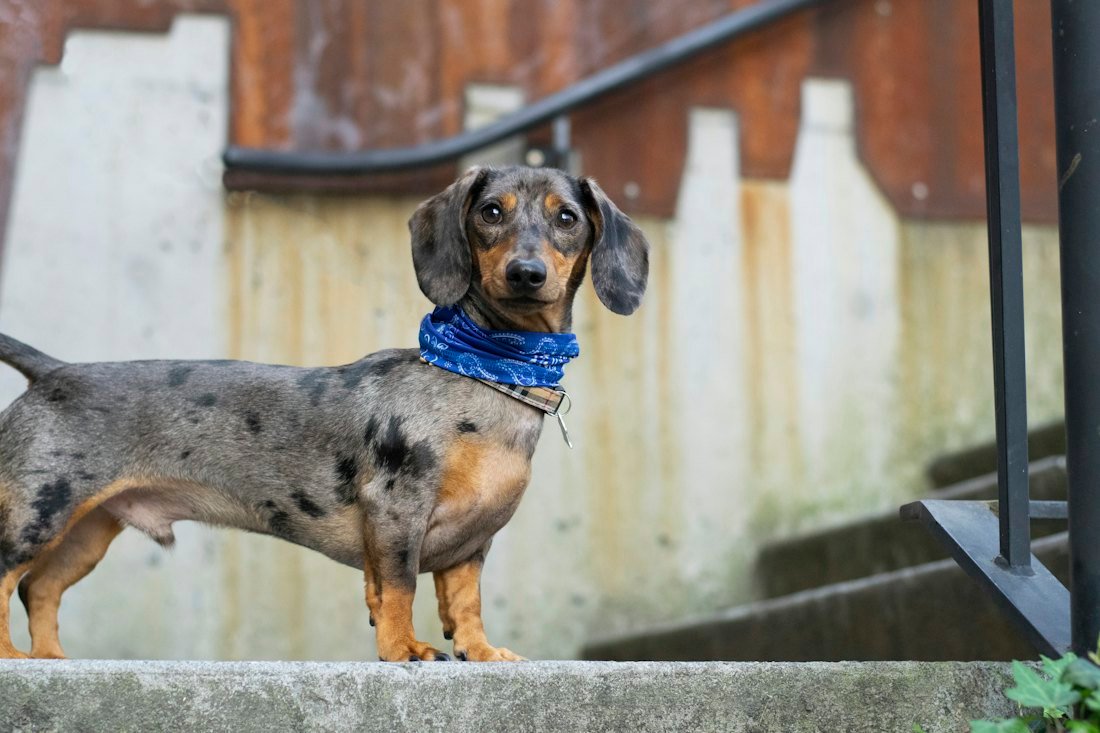
Dachshund stairs are not the risk owners assume. The advice to block every staircase has hardened into breed folklore, and the two largest datasets on dachshund back disease both point the other way.
That leaves the household decision looking different. The gate at the top of the stairs is the easiest thing to install and the smallest variable available, while the factor with a measured effect size is the one in the food bowl.
Blocking stairs still makes sense for four specific dogs, and those cases are worth separating from the general finding before anyone acts on either.
Are dachshunds OK with stairs?
A healthy adult dachshund at a correct weight is fine on a household staircase. In the two largest datasets on dachshund back disease, regular stair use lines up with lower rates of IVDD, not higher. The exceptions are puppies, seniors with hind-end weakness, and dogs with a disc history.
The folklore has a reasonable origin. Intervertebral disc disease is the breed’s defining problem, Dachshund Health UK puts the lifetime risk near one in four, and a long spine over short legs does look like something that should be protected from repeated impact. The reasoning is sound. The data has just repeatedly failed to support this particular application of it.
Are dachshund stairs the same as a staircase?
The phrase dachshund stairs covers two different things. One is the household staircase the dog climbs every day. The other is the set of small padded pet steps sold for getting onto a bed or a sofa, which is a furniture-access product and a separate decision.
The studies answer the first question. For the second, a ramp sized to the furniture beats steps for a long-backed dog, because steps still ask the front end to drop onto each tread.
What the two largest studies found
The larger of the two is a 2025 paper in the Journal of the American Veterinary Medical Association, drawing on 43,517 US companion dogs enrolled in the Dog Aging Project. Dachshunds carried the highest lifetime prevalence of owner-reported IVDD of any breed in it, 15.3%, against 1.2% for the whole population.
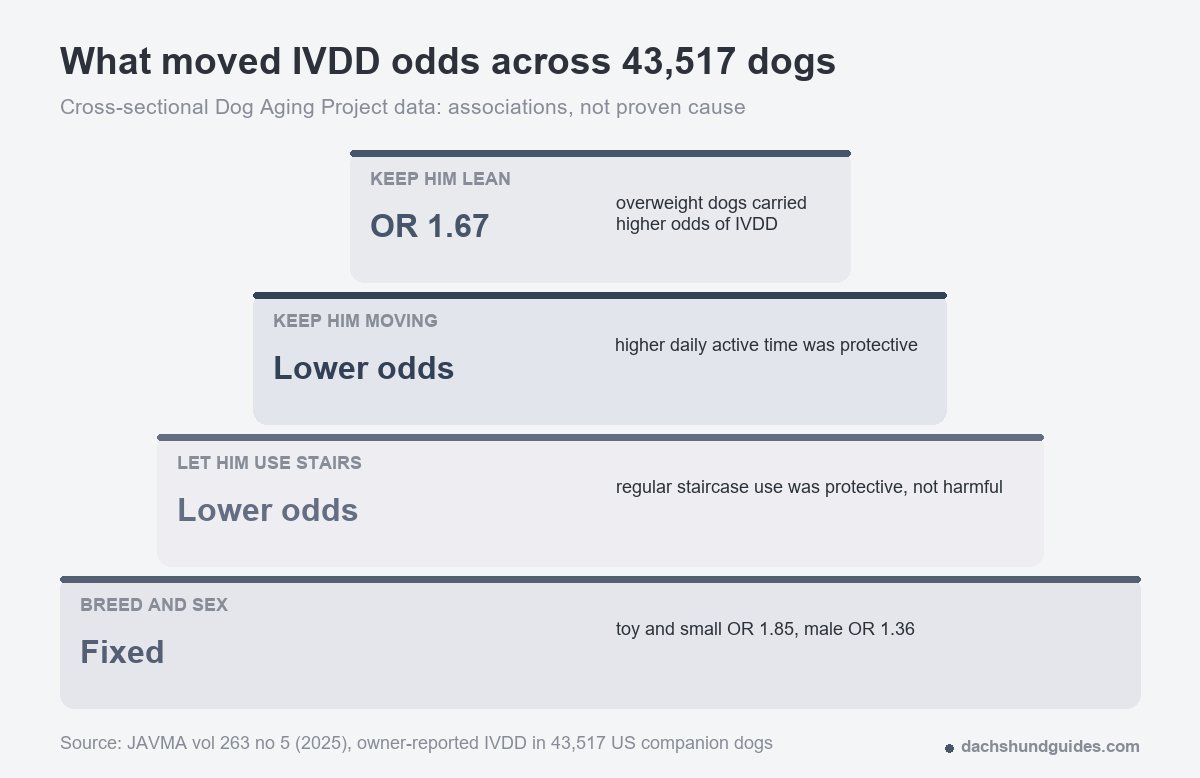
Its adjusted analysis lists three lifestyle factors associated with reduced odds of IVDD: higher daily active time, being on a commercial diet, and regular use of a staircase. The factors that raised the odds were being male, purebred, toy or small, and overweight.
The second dataset is DachsLife 2015, a survey of 2,031 dachshunds by Packer and colleagues. Its stair rows are specific: 12.3% of dogs that went up and down a flight of stairs every day had a veterinary IVDD diagnosis, against 17.0% of dogs that used no stairs daily and 18.5% of dogs that managed only one step in and out of the house.
Packer and colleagues describe that pattern as a trend and note it was not significant at their own threshold, so it is a signal pointing the same direction as the 2025 study, not a second proof. Both are cross-sectional and both rest on owner-reported diagnoses. They show association, and neither design can show cause.
Why these studies cannot settle the stairs-versus-ramp question
Neither dataset compared stairs with a ramp. Both compared dogs that used stairs against dogs that used none, so the findings can say stair use is not the villain and still leave the ramp comparison untested. An owner in r/Dachshund spotted this before the discussion got going:
“This study seems to compare stair use versus none rather than stair use versus ramp, which is the discussion I always see.”
– r/Dachshund (30 upvotes)
That objection holds.
There is a second reading no one can rule out either. Dogs allowed on stairs every day may be the dogs that were already fit and sound enough to manage them, which would produce exactly these numbers with the stairs contributing nothing, and a cross-sectional survey has no way to separate the two.
The furniture version of the question is a different problem with a different answer, because a jump down from a bed is a single drop rather than a sequence of controlled steps. That one is covered on the ramp sizing page.
The lever that moves more than the stairs do
Only one changeable factor in the 2025 study carries a printed effect size, and it has no connection to the staircase. Overweight dogs had an odds ratio of 1.67 for owner-reported IVDD, with a 95% confidence interval of 1.38 to 2.01. Every other lifestyle factor is reported as a direction with no odds ratio attached.
| What you are deciding | What the 43,517-dog study reports | How firm |
|---|---|---|
| Whether to keep the dog lean | Overweight dogs had higher odds of IVDD | Odds ratio 1.67, CI 1.38 to 2.01 |
| Whether to keep daily activity up | Higher daily active time went with lower odds | Direction reported, no odds ratio given |
| Whether to let the dog use a staircase | Regular staircase use went with lower odds | Direction reported, no odds ratio given |
| Nothing you can change | Toy and small dogs, males and purebreds carried higher odds | Odds ratios 1.85, 1.36 and 1.66 |
An owner in the same thread had the point relayed to them by their own vet, who said it is far more important for a dachshund to be lean and at the right weight than to avoid stairs and furniture. The study puts a number beside that advice, and there is no equivalent number on the other side of the argument.
Body condition is also the harder job. A stair gate is bought once. Keeping a food-motivated hound at a visible waistline is a daily decision with no finish line, which may be part of why the conversation keeps drifting back to the gate.
The risk marker you can measure
Behind all of this sits a physical trait that neither stairs nor diet creates. Dachshunds are chondrodystrophic, the group the JAVMA authors single out as particularly prone to disc disease, and their discs calcify early. Counting those calcifications on an X-ray is what the breed’s own health body screens for.
Dachshund Health UK runs that screening initiative, with a protocol and consent form an owner can take to their own vet.
For a pet owner the result changes little about the staircase. A dog carrying heavy calcification carries it whether the gate is open or shut, and a dog with little of it is not made fragile by a flight of stairs. Where the number does change decisions is in breeding, and in how fast an owner reacts to a first yelp. It also gives a vet something concrete when the conversation moves from the breed in general to this dog in particular.
When to block the stairs anyway
Four dogs sit outside the general finding, and for them a gate earns its place: puppies that are still growing, seniors with hind-end weakness or muscle wasting, dogs with a diagnosed disc history, and any dog showing symptoms right now.
- Puppies still growing. Growth plates and supporting muscle are unfinished, and the population studies are describing adult dogs.
- Seniors with hind-end weakness or muscle wasting. A dog whose back legs already slip is managing the descent on strength it no longer has.
- Dogs with a diagnosed disc history. One episode changes the calculation, and that call belongs to the vet who treated it.
- Any dog showing current signs. A hunched back, a refused jump that used to be routine, or a yelp on turning means the staircase decision is postponed and the disc symptoms come first.
The last one is the only true emergency in the list. A dachshund dragging a back leg needs a vet the same day, and no household arrangement substitutes for that.
Making a staircase safer when the dog uses it
Traction does more than supervision. Bare wooden treads are where a dachshund’s rear feet slip on the way down, and a carpet runner or stick-on treads change the surface at the point the dog is carrying its own weight downhill.
Gating one end is usually enough. Owners who fit gates at both the top and the bottom tend to step over them a dozen times a day until one gets left open, which produces an unsupervised staircase instead of a blocked one.
Carrying is the option to use sparingly. It removes the stairs and the muscle-building both, and the dogs in these datasets with the lowest IVDD rates were the active ones.
Frequently asked questions
Can dachshunds go up stairs?
Healthy adult dachshunds can go up and down household stairs. In a study of 43,517 dogs, regular staircase use was associated with lower odds of intervertebral disc disease, alongside higher daily activity.
Is a ramp or stairs better for dachshunds?
No study has compared ramps against stairs for dachshunds, so there is no evidence-based answer. For furniture, where the alternative is a jump down, a ramp removes a real impact; for a household staircase, the research supports leaving it open to a sound adult dog.
Are stairs bad for miniature dachshunds?
Size does not change the finding. Both datasets covered miniature and standard dachshunds, and neither reported stair use as a risk factor for either variety; body condition and activity level carry the measured effects.
What are the first signs of IVDD in dachshunds?
Early IVDD signs include a hunched or tense back, reluctance to jump or climb, yelping when turning or being lifted, and wobbly or dragging back legs. Any of these needs a vet promptly, and the full symptom list covers the progression.
