
Dachshund Car Seat: The Part That Has to Hold in a Crash

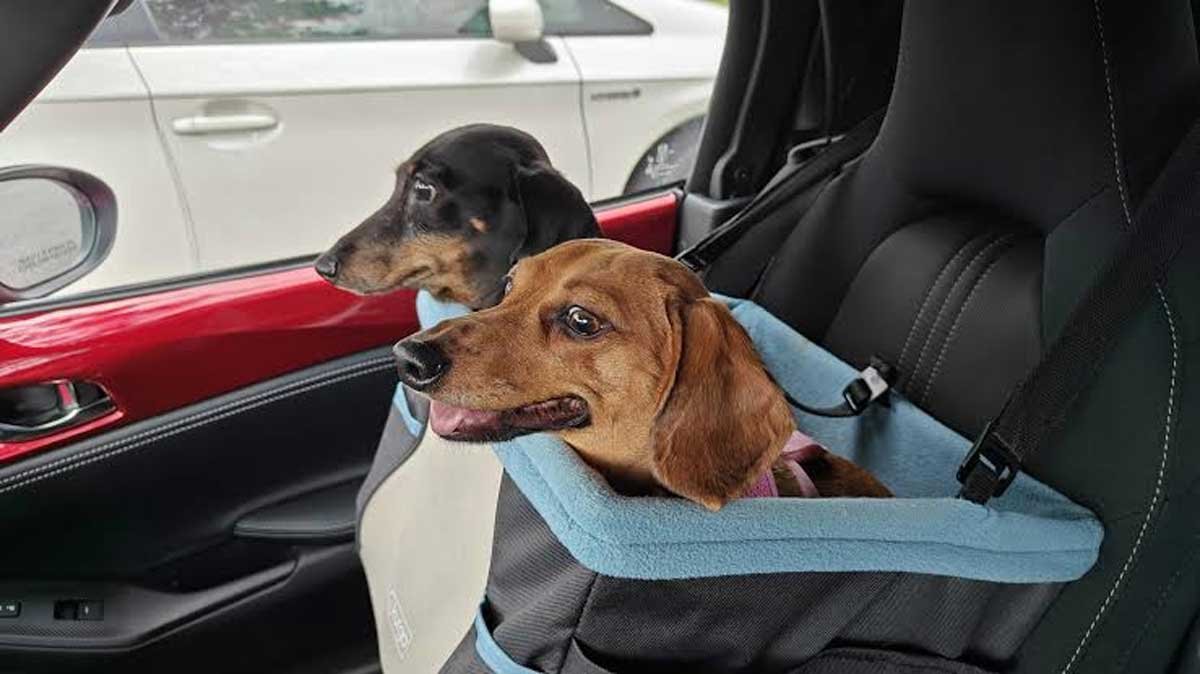
A crate or carrier does more for a dachshund in a car than a booster seat does. Most dachshund car seats sold today are boosters, and a booster is a chair with a strap: it lifts the dog to window height and keeps it roughly in place while you drive.
In 2015 the Center for Pet Safety crash-tested four of them. Every one lost the dog at the connection between the seat and the harness, and one seat turned into a projectile on its own. The padding was never the part that failed.
Two things hurt a dachshund on a drive. One happens in a hard stop, when a loose dog keeps moving after the car has stopped. The other happens after you park, when the dog jumps down from a raised seat onto a long back that veterinary teaching hospitals write specific guidance about.
Which car restraint a dachshund should ride in
A dachshund should ride in a crate or carrier that matches its body length, or in a harness that has passed a crash standard. A booster suits a miniature that sits inside the seat’s published weight limit, and the strap you clip to decides whether the dog stays in it.
Three kinds of dachshund car seat get sold for this breed, and they do different jobs.
- Crates and carriers put the dog inside a structure. The dog can lie flat, and nothing depends on a clip holding under load. A carrier does the same job on the way to the car; in the car the shell has to be one the dog stays inside.
- Harnesses with a seatbelt loop keep a dog on the seat without a shell around it. They work only as well as the harness, and the Center for Pet Safety certifies harnesses on that basis. Harness fit is the same question on a walk as in a car.
- Booster seats raise the dog so it can see out. They contain a dog that is already calm, and they hold it only as well as their anchor strap holds.
The Center for Pet Safety publishes certified products in three categories: safety harnesses, pet travel carriers and travel crates. Its current list runs through carriers such as the Diggs Passenger Carrier, a set of Gunner and Lucky Duck kennels, and safety harnesses. The organisation’s instruction to shoppers is to look for the certified mark on the product.
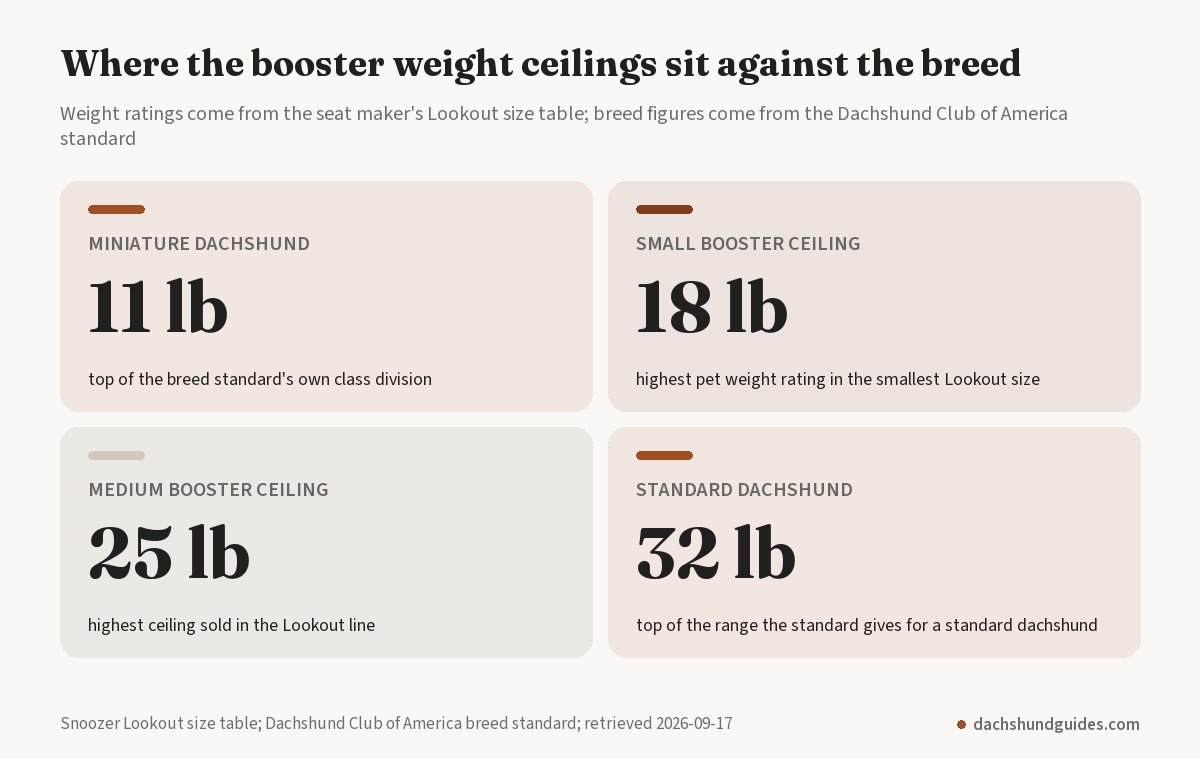
Weight decides the size, and the size decides whether the dog is a candidate for a booster at all. The breed standard puts a miniature at 11 lb and under, and a standard dachshund usually between 16 and 32 lb. The largest size in Snoozer’s Lookout line is rated to 25 lb. Sorting boosters by brand comes down to sorting them by the strap that broke in every test.
What the crash tests found
In 2015 the Center for Pet Safety crash-tested four booster seats with instrumented dog simulants. In each one, the connection between the seat and the dog failed, two dogs finished the run unrestrained, and one seat became a projectile.
The four seats were the PupSaver, the Snoozer Lookout I in medium, the PetSmart Top Paw and the Kurgo Skybox. The PupSaver rolled onto its side on impact and released an anchor strap when a plastic buckle gave way, and the Lookout I was secured to the test bench by its anchor strap, which failed and left the 25 lb test dog unrestrained and rebounding off the bench frame.
The other two failed at their hardware. The Top Paw held its position on the bench while its wire connection deformed and its 30 lb test dog came free, and the Kurgo Skybox lost its seat connections and travelled as a projectile with the dog still attached to it.
Four seats, one shared failure point. In every case the shell, the fabric and the padding survived the run; the anchor strap or its hardware did not. The Center for Pet Safety describes the whole category in its own summary of the study: a pet travel seat is built to hold or elevate a dog, and it “does not offer full containment.” The organisation also names the weak link at the far end of the strap, noting that where a dog moves in its seat, “the collar or walking harness would be loaded, and these are not designed for crash protection.”
The study is from 2015 and tested the versions sold then. Seats get revised, and a new model has no result attached to it until someone tests that model. What the pilot establishes is where to look on any booster you pick up: the strap, its buckle, and the clip that meets the harness.
“I’ve had the pup saver one since I got my mini ~3 years ago. It’s been great for her and is crash tested. My only complaint is that they didn’t have a washable cover when I got it and she peed it in a few times before we got the hang of car travel. I eventually made a cover for it that’s worked well. Definitely recommend the pup saver! ETA: looking at their website, they also have replacement parts and pieces, which is really nice.”
– r/Dachshund, January 2026 (1 upvotes)
That owner’s three years of daily use are real, and the recommendation rests on two words printed on a box. The test result is what the product did on a sled at the one moment the box cannot describe.
Which booster size a dachshund car seat fits
Snoozer’s own size table rates the small Lookout to 18 lb and the medium to 25 lb. The breed standard puts a miniature at 11 lb and under and a standard dachshund usually between 16 and 32 lb, so the largest booster in that line covers a standard dog through the bottom half of the breed’s range.
A miniature is inside the small seat’s ceiling with room to spare. A standard dachshund at 20 lb is inside the medium seat’s rating by 5 lb. A standard dachshund at 28 lb has no booster in the line rated for it, and that dog needs a crate or a carrier cut to its length instead. The weight ceilings come from Snoozer’s Lookout size table, and the breed figures come from the Dachshund Club of America standard, which puts a standard dachshund at 16 to 32 lb and a miniature at 11 lb and under.
| Your dachshund | What fits | Why | What to check |
|---|---|---|---|
| Miniature, 11 lb and under | A small booster rated to 18 lb, or a small carrier | Inside the seat’s own ceiling, and a short drop at the door | The ceiling printed on the box, and the anchor strap’s buckle |
| Standard, 16 to 25 lb | A medium booster rated to 25 lb, or a carrier the dog can lie flat in | The weight is inside the rating, and this is the size that lost its strap in the 2015 test | Whether the product carries a certification, not a slogan |
| Standard, over 25 lb | A crate or carrier sized to the dog’s length | No booster in the line is rated for that weight | The interior depth, since a dog that lies down needs the length |
| Puppy, still growing | A carrier it can stretch out in at 18 months | A booster sized to a puppy’s weight is outgrown inside a year | Where the dog’s weight will land, not where it is today |
The ceiling is not the only dimension that fails a dachshund. These seats are built around a width and a depth: the small Lookout measures 12 inches wide by 14 inches deep inside, and the medium 18 by 14. A dachshund lying down occupies length, and the depth is the figure that has to fit a dog that sleeps on the move.
“What are your recommendations for a sturdy and safe car seat? Our guy loves the one we have but as you can see.. he’s outgrown it. He’s great in the car and we are looking for a structured seat he can comfortably lay down to sleep or look out the window. Thank you for the help! 🙂”
– r/Dachshund, January 2026 (65 upvotes)
That thread is the weight ceiling arriving in a living room. The dog did not break the seat; it grew past a number nobody read at the till.
The jump down is the injury you are most likely to see
The Riney Canine Health Center at Cornell lists two things an owner can change for a dog with disc disease: keep it at an ideal body condition, and “modify activities to put less stress on the spine such as providing steps or ramps to reduce jumping on and off objects.”
A booster seat works against the second item. It exists to raise the dog, and every raised position adds height to the drop when the car door opens and the dog launches. A dachshund that has ridden at window height for two years has made that jump several thousand times.
The fix costs nothing to decide. A carrier or crate that sits on the seat keeps the dog low and gives it something to step out of onto the ground, or onto a ramp placed at the door. Owners who already use a ramp for the boot of the car have the piece they need; the seat height is the only thing to change.
Weight belongs in the same section, because Cornell puts it first. A dachshund carrying extra pounds loads its own spine with every landing, and the seat cannot compensate for that. The dog’s ribs should be easy to feel with light pressure.
Short trips and long drives are different problems
An hour in the car is a containment problem. Five hours is a lying-down problem: the dog needs to stretch out flat, and you need to stop often enough for that to happen. The seat that lifts a miniature into the window for the school run is the wrong piece of equipment for a drive to another state.
The threads on this are specific. One owner was bringing a five-month-old mini home from a rescue on a five-hour drive, with a bed, a car seat, a hammock, water and pads packed. Another was training a 15-week-old for a 12-hour trip in October and had already watched her chew and dig at a soft carrier. Both dogs are the same size as an adult dachshund’s chest and head; neither trip is short enough for a booster.
What changes over hours:
- The dog has to be able to lie flat, which rules out an elevated seat and favours a carrier or crate it can stretch out in.
- You stop every couple of hours, take the dog out, offer water and let it walk. A dog that stays in one position for a long drive stiffens the same way a person does.
- A puppy that chews gets a carrier it cannot chew through. A plush booster with a strap inside is a chew toy with a seat attached.
The two-hour figure belongs to babies. For a dog, the judgement is yours, and it is easier to make with a dog that can lie down than with a dog braced upright against a strap for six hours.
Frequently asked questions
What is the best car seat for a dachshund?
A miniature of 11 lb and under fits a booster rated to at least 18 lb. A standard dachshund, 16 to 32 lb, is better served by a crate or carrier, because the booster sizes sold stop at 25 lb.
Is it safe to put a dog in a car seat?
A booster contains a dog and lifts it, and it is not crash protection. All four booster seats in the 2015 pilot lost the dog at the anchor strap, so a certified harness, carrier or travel crate is the stronger category.
What is the 2 hour car seat rule?
It is a rule for babies. The NHS advises that an infant should not be in a car seat longer than two hours at a time, because of breathing risk. No pet body publishes a matching limit for dogs.
The weight ceiling is printed on the box. What the anchor strap does in a crash is not, and that is the question to ask before paying.
