
Can Dogs Have Cinnamon? A Pinch Is Fine, the Oil Isn’t


Yes, dogs can eat cinnamon in small amounts. Ground cinnamon isn’t toxic to dogs, and AKC, citing Pet Poison Helpline, puts the trouble point at more than a teaspoon of powder for most pets. Cinnamon oil is the form that can do real harm.
So if your dog licked the cinnamon sugar off your toast, you can relax. Can dogs have cinnamon every day, though, as a spoonful in the food bowl? That’s a different question.
The liver warnings you’ll run into trace back to one compound, and its numbers are worth seeing for yourself before you decide.
Can dogs have cinnamon in the amounts you cook with?
Cinnamon is safe for dogs in the amounts used to flavor food. AKC reports that Pet Poison Helpline puts the problem dose at more than one teaspoon of powder for most pets, and it adds that small breeds may react to less.
What does “a problem” look like? PetMD lists mouth redness and irritation from powder or a chewed stick. If your dog breathes the dust in, you might see coughing or choking.
A much bigger overdose can bring vomiting, diarrhea, changes in heart rate, low blood sugar and liver trouble, according to AKC. That’s a spilled-jar scenario. It isn’t a dusting on a treat.
If you’d like to add a little on purpose, Chewy’s vet-reviewed guide suggests no more than 1/8 teaspoon for dogs between 2 and 10 pounds and 1/4 teaspoon for 11 to 20 pounds.
A miniature dachshund, which the AKC standard caps at 11 pounds, sits right where the 1/8 and 1/4 rows meet. A standard, at 16 to 32 pounds, straddles the 1/4 and 1/2 teaspoon rows, so you’d go by your own dog’s weight.
Chewy also keeps all treats, cinnamon ones included, under 10% of daily calories. It’s the same rule you’d use for anything from the treat jar.
Why the warnings mention the liver
Coumarin is the reason the liver keeps coming up. It’s a natural compound that cassia cinnamon carries in real quantity and Ceylon cinnamon barely carries at all.
Its safety limit also rests on dog data. When the European Food Safety Authority set its coumarin limit for people, it built it on dogs.
As the agency’s 2022 feed additive opinion on cassia oil restates, long-term feeding studies found liver damage in dogs, the most sensitive species tested, and no adverse effect at 10 mg of coumarin per kilogram of body weight a day. EFSA divided that by 100 to get the 0.1 mg/kg daily limit for people.
How much coumarin is in your jar? A 2025 study of 104 cinnamon samples bought from EU shops found a median of 269 mg of coumarin per kilogram in the cassia samples and 3.49 mg/kg in the Ceylon ones.
That’s roughly a 77-fold gap between two spices sold under the same name, so it’s worth checking which one you’ve got.
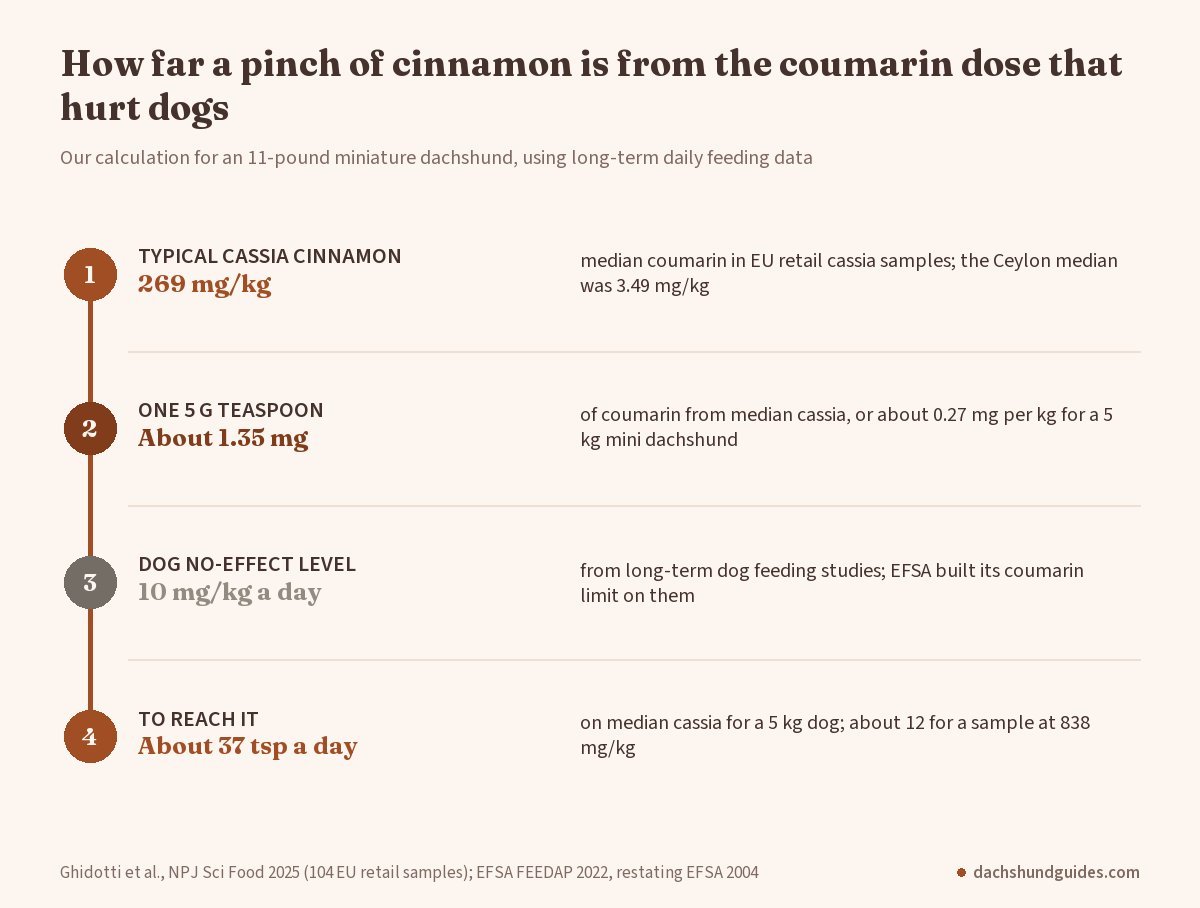
Here’s what those numbers mean for a small dog, worked out by us. Using the study’s own 5 g teaspoon, one teaspoon of median cassia carries about 1.35 mg of coumarin.
For an 11-pound miniature dachshund, which is about 5 kg, that’s about 0.27 mg per kilogram. It would take about 37 teaspoons a day to reach the level that left dogs unharmed in those studies.
Thirteen of the study’s cassia samples tested above 838 mg/kg. One of those would still need about 12 teaspoons a day.
That arithmetic has limits. The samples came from European shelves, not American ones, and the 10 mg/kg figure comes from daily feeding over a long stretch, not from one big binge.
Coumarin also isn’t the only thing in cinnamon that can upset your dog. The powder and the oil irritate on their own, whatever their coumarin content.
What the math does settle is that the liver risk is about habit, not a sprinkle. A daily teaspoon of median cassia would put a 5 kg dog at 0.27 mg/kg, nearly three times the limit EFSA allows a person of the same weight, though it’s still far below what harmed dogs.
If you’re going to add cinnamon regularly, Ceylon is the kind with almost no coumarin in it.
Cinnamon oil, sticks and loose powder
The oil is the form to keep out of reach. The Merck Veterinary Manual’s chapter on essential oil poisoning, written by a Pet Poison Helpline veterinarian and reviewed in March 2025, lists cinnamon oil and cassia bark oil among the oils that are potentially toxic to the liver.
PetMD reports the helpline’s warning that “just a small drop” of the oil can lead to serious toxicity.
Merck also points out that ultrasonic and nebulizing diffusers put fine droplets into the air, where they can settle on your dog’s fur. A cinnamon diffuser in the room your dog sleeps in isn’t a harmless swap. If a cat shares the room, the risk is higher still, for reasons covered in the guide to whether cats can have cinnamon.
Sticks and loose powder are a smaller worry. A chewed stick can redden the mouth, and a dog who noses into a dusting of powder may cough for a bit. If yours is a counter-surfer, the spice rack’s the shelf to move up.
Can dogs eat cinnamon rolls?
Cinnamon rolls aren’t a good idea for dogs, although the cinnamon in one is rarely the problem. The danger sits in the other ingredients: sugar and butter, raisins in some recipes, xylitol in sugar-free versions, and nutmeg in many spice blends.
Xylitol is the urgent one. Pet Poison Helpline says it can cause life-threatening low blood sugar, sometimes within 10 to 15 minutes, and acute liver failure.
Check the label of anything sold as sugar-free before your dog gets a bite. You’ll want to treat raisins as seriously as you would grapes, too.
Then there’s the fat. One roll is a lot of calories for a 10-pound dog, and dachshunds can’t afford to carry extra weight: the Dog Aging Project found overweight dogs had 1.67 times the odds of disc disease.
If your dog’s already heavy, fixing the diet matters far more than any spice question you’ll ever have.
Can dogs have nutmeg?
Nutmeg is the spice to worry about in a cinnamon roll or a pumpkin pie mix. AKC explains that it contains myristicin, which in large amounts can cause hallucinations, a fast heart rate, disorientation, high blood pressure and seizures, with signs lasting up to 48 hours.
The small amount baked into a pastry is generally safe. A dog who’s eaten from the nutmeg jar, though, needs a call to your vet.
Cinnamon is no substitute for insulin
Cinnamon’s reputation for lowering blood sugar comes from people, and AKC points out that even in humans those benefits haven’t been proven conclusively.
For dogs, the 2018 diabetes guidelines from the American Animal Hospital Association are blunt: insulin therapy is the mainstay of treatment.
That hasn’t stopped the idea from spreading. In an August 2026 thread in r/diabetes_t1 titled “The cinnamon epidemic is hitting dogs too,” commenters worried that a dog owner was leaning on cinnamon in place of insulin. One wrote:
“With the rise in vet costs, I have a horrible feeling that this will become the next big grift and so many animals will suffer for it.”
– r/diabetes_t1, August 2026 (18 upvotes)
There’s a second reason to be careful here. Large cinnamon overdoses are linked to low blood sugar, AKC reports, and blood sugar is exactly what a diabetic dog’s insulin is there to manage.
If your dog is diabetic, talk to the vet who manages the insulin before you add anything to the bowl. That goes for cinnamon. It goes for any supplement you’ve read good things about, too.
What to do if your dog ate cinnamon
If your dog ate cinnamon, work out the form and the amount first. A lick of a cinnamon treat needs nothing, while a spilled jar of powder, a chewed-up stick or any cinnamon oil is worth a call to your vet or Pet Poison Helpline at (855) 764-7661.
Have these answers ready when you call:
- What it was: powder, stick, oil, a diffuser refill or a baked good.
- Roughly how much, compared with a teaspoon.
- What else was in it, especially xylitol, raisins, chocolate or nutmeg.
- Your dog’s weight, since a 10-pound dachshund and a large Lab aren’t the same case.
- Any signs so far: coughing, drooling, vomiting, diarrhea, lethargy or wobbly walking.
Is cinnamon bad for dogs, then? Only in the forms and amounts above. Keep the wrapper or the jar, because the ingredient list answers most of what your vet will ask.
