
Can Cats Have Cinnamon? The Spice Is Fine, the Oil Isn’t

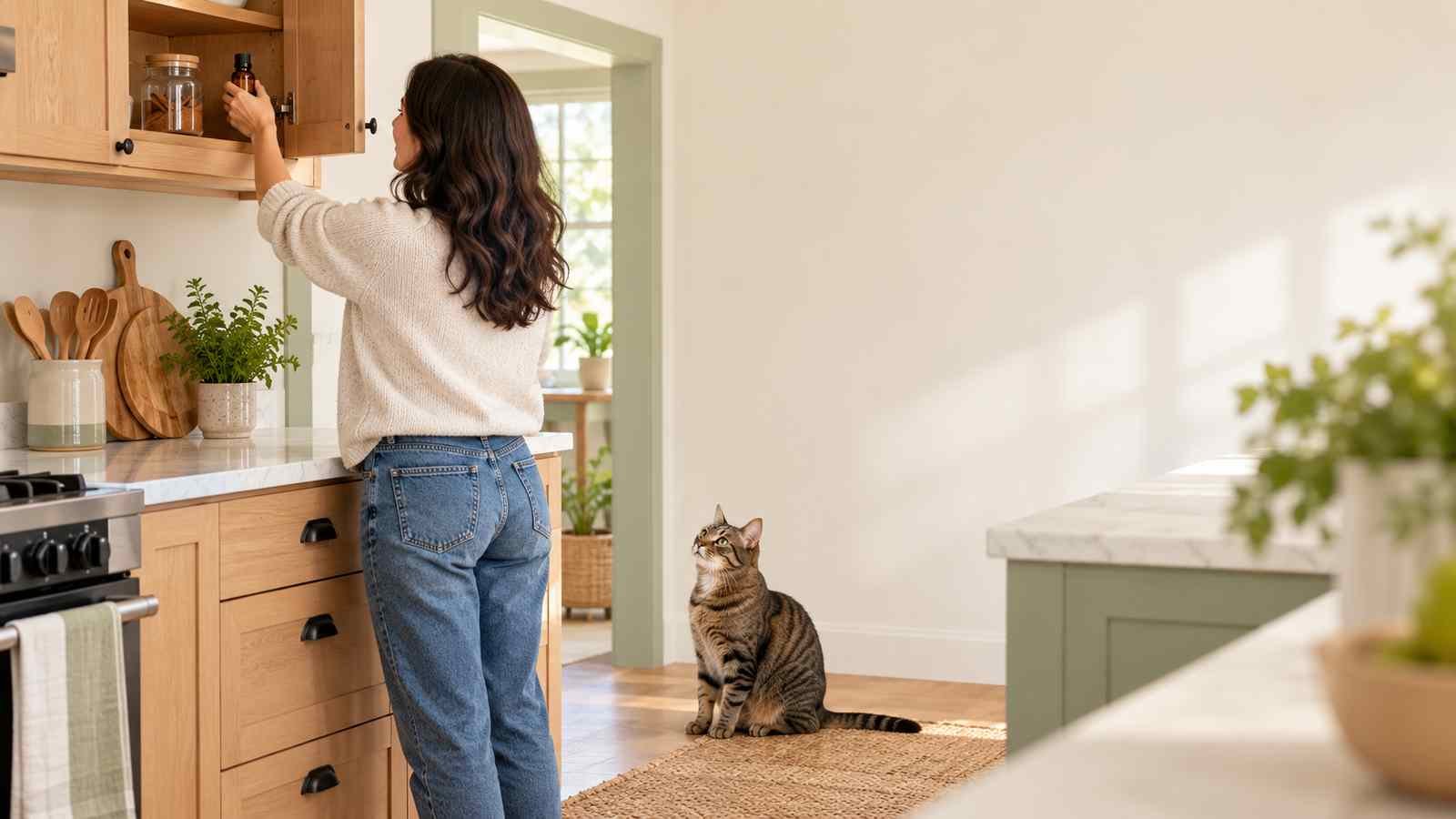
Cats can survive a lick of cinnamon, but it isn’t a treat to share. The ASPCA lists cinnamon as non-toxic to cats, and a little ground spice isn’t poisonous.
Where you need to be careful is cinnamon oil, in diffusers, sprays and potpourri, because cats can’t clear those compounds the way dogs and people do.
So if your cat sniffed the spice jar or licked a bit of cinnamon toast, you can probably relax. If it got into an oil or a diffuser, that’s a different call, and the sections below explain why.
Can cats have cinnamon?
Not as a treat, though a small amount isn’t toxic. The ASPCA’s plant database lists cinnamon as “Non-Toxic to Cats,” along with dogs and horses. Chewy’s vet-reviewed guide agrees that a small amount of plain cinnamon isn’t considered toxic, but says it still isn’t something to share on purpose.
Which cinnamon is that, though? The ASPCA entry is for Cinnamomum zeylanicum, Ceylon cinnamon.
Cassia, the other common type, carries far more coumarin: a 2025 study of 104 cinnamon samples found a median of 269 mg/kg in cassia against 3.49 mg/kg in Ceylon.
You’ll also want to watch the powder itself. Chewy notes that cinnamon powder and oil can irritate a cat’s mouth and stomach, and its airways if the powder is inhaled. The simplest rule is to keep it on your plate, not theirs.
Why cats handle cinnamon oil worse than dogs
Cats are short of an enzyme that most mammals use to clear phenolic compounds, including some found in essential oils. The Merck Veterinary Manual’s chapter on essential oils says cats “are deficient in the enzyme glucuronyl transferase,” which “makes cats very sensitive to phenol and phenolic compounds, which some oils contain.”
Researchers worked out the genetics in 2000. They found that the gene for UGT1A6, an enzyme that handles phenolic compounds in other species, is a non-working pseudogene in the domestic cat. That leaves cats with what the authors called “a significantly lower capacity” to process these substances than most other mammals.
That’s why you’ll find the warnings aimed at concentrated oils, not the spice jar.
Regulators build the same weakness into their numbers. When the European Food Safety Authority assessed cassia oil as a flavouring in animal feed, it used a safety margin of 100 for most species but raised it to 500 for cats, citing their “unusually low capacity for glucuronidation.”
Is the coumarin in cassia the bigger worry for cats, then? The same EFSA opinion shows that cats send 12 to 19% of coumarin down the less harmful breakdown route, compared with 0.3 to 5% in dogs. That’s one reading of EFSA’s figures rather than a measured cat limit, but it suggests the coumarin in the spice isn’t where cats are uniquely exposed. The oils are.
Grooming makes it worse. Merck points out that a cat’s grooming habit adds risk from both skin and oral exposure, so oil that lands on a cat’s coat doesn’t stay there. It ends up swallowed.
Cinnamon in your home, form by form
What you’re holding matters more than the word “cinnamon” on the label. Here’s how the main sources describe what you’re likely to have in the house:
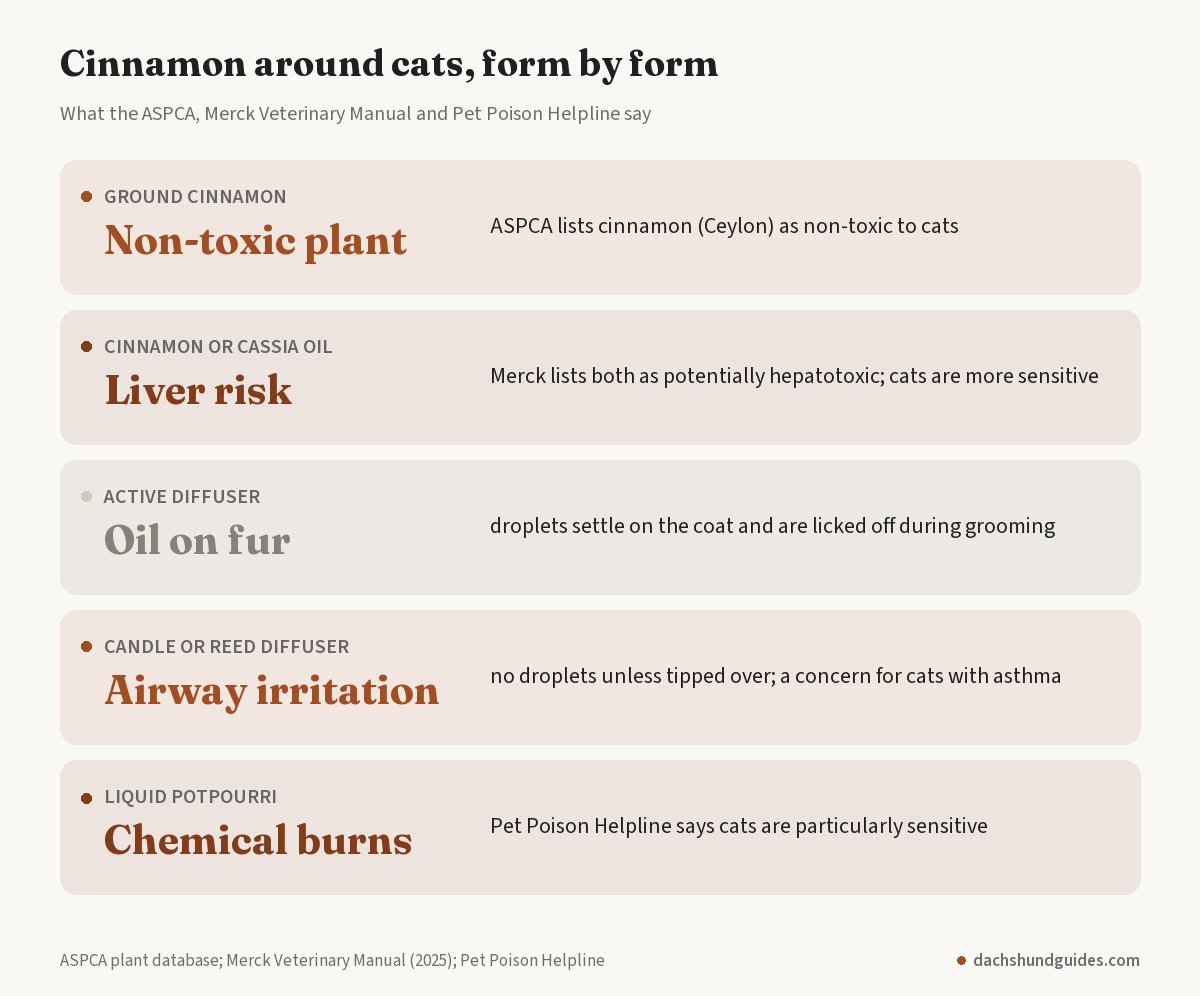
Cinnamon and cassia oils are the clearest danger. The Merck essential oils chapter lists “cassia bark” and “cinnamon oil” among the oils that are potentially toxic to the liver, and says concentrated oils should never be applied directly to pets.
Active diffusers, the nebulizing or ultrasonic kind, are next. Merck says they release tiny droplets of oil that can collect on fur, where a cat absorbs them through the skin or licks them off.
Merck’s advice is to keep your pets out of the room while one runs, keep sessions under 30 minutes and air the room out afterward.

Liquid potpourri is a separate hazard, whatever its scent. Pet Poison Helpline says it can cause chemical burns to the lips, tongue, gums and throat, and that “cats are particularly sensitive” to the corrosive chemicals in some products. A simmering pot within reach of a curious cat is a bad mix.
Are cinnamon candles safe for cats?
They’re lower risk than oils or active diffusers, as long as your cat can’t reach them. Merck says passive sources like candles and reed diffusers don’t release actual droplets of oil, so “unless the diffuser is tipped over, the main hazard to animals is respiratory irritation.”
That irritation matters more for some cats than others. Merck singles out animals with existing breathing problems, including feline asthma, as the ones for whom inhaled oils are hazardous. If your cat wheezes or has asthma, skip scented candles in the rooms it uses.
Some owners have given up on candles altogether. In a September 2026 r/cats thread about keeping nice-smelling things with a cat, the poster explained the hesitation:
“I keep seeing that cinnamon is toxic to cats and that is often an ingredient in some of the pet safe candles, which makes me doubt their safe-ness”
– r/cats, September 2026 (68 upvotes)
The sources above suggest a middle path rather than a ban. Keep the candle where your cat can’t knock it over or brush past the flame, burn it for short stretches, and give the room some air afterward.
If you’ve also got a dog, the rules for the spice differ a little. The guide to whether dogs can have cinnamon covers the coumarin math for dogs, and the one on dachshunds and cats covers sharing a home. Around the holidays, the holiday plant guide lists which seasonal plants are dangerous for cats.
What happens if your cat eats a little cinnamon?
Usually not much. A lick of spice or a crumb of cinnamon toast isn’t toxic by the ASPCA’s listing, though Chewy says small amounts may cause mild stomach upset. If your cat vomits, drools or seems off afterward, call your vet.
Breathing trouble is the exception. Chewy’s guide says a cat that coughs, gags or struggles to breathe after cinnamon should be treated as an emergency, most likely from inhaled powder.
Oil is a different situation. Merck says signs of essential oil poisoning can appear within minutes to hours and include vomiting, drooling, lethargy, wobbliness and loss of appetite.
If your cat licked cinnamon oil, got it on its fur or spent time near an active diffuser and seems unwell, call your vet or Pet Poison Helpline at (855) 764-7661.
Don’t try to make your cat vomit. Merck warns that vets shouldn’t induce vomiting after essential oil exposure because of the risk the oil gets into the lungs. If oil is on the coat, keep your cat from grooming it off and ask your vet how to wash it.
That’s the line to remember: the jar in your spice rack is a nuisance for a cat at worst, while the bottle of oil next to it is the real danger.
