
Can Cats Eat Dog Food? A Few Bites, Yes. A Diet, No


Yes, a cat can eat a few bites of dog food without harm, since nothing in it is toxic to cats. It can’t be your cat’s diet, though. Dog food is made to a dog’s standards, and those don’t require taurine or arachidonic acid, two nutrients a cat has to get from its food.
So can cats eat dog food for weeks at a time? I wouldn’t let it happen. A cat that runs short of taurine can develop heart failure and lose its sight, and a growing kitten needs more protein than any adult dog food is required to carry.
If your dachshund shares a kitchen with a cat, the fix is about where and when the bowls go down.
What dog food is missing for a cat
Taurine and arachidonic acid are the two real gaps. The Merck Veterinary Manual says cats, unlike dogs, need both from their diet, along with ready-made vitamin A. The standards dog food is built to set no minimum for either.
Those standards come from the Association of American Feed Control Officials (AAFCO), whose nutrient profiles complete pet foods in the US are formulated to meet. Here’s how the adult minimums compare:
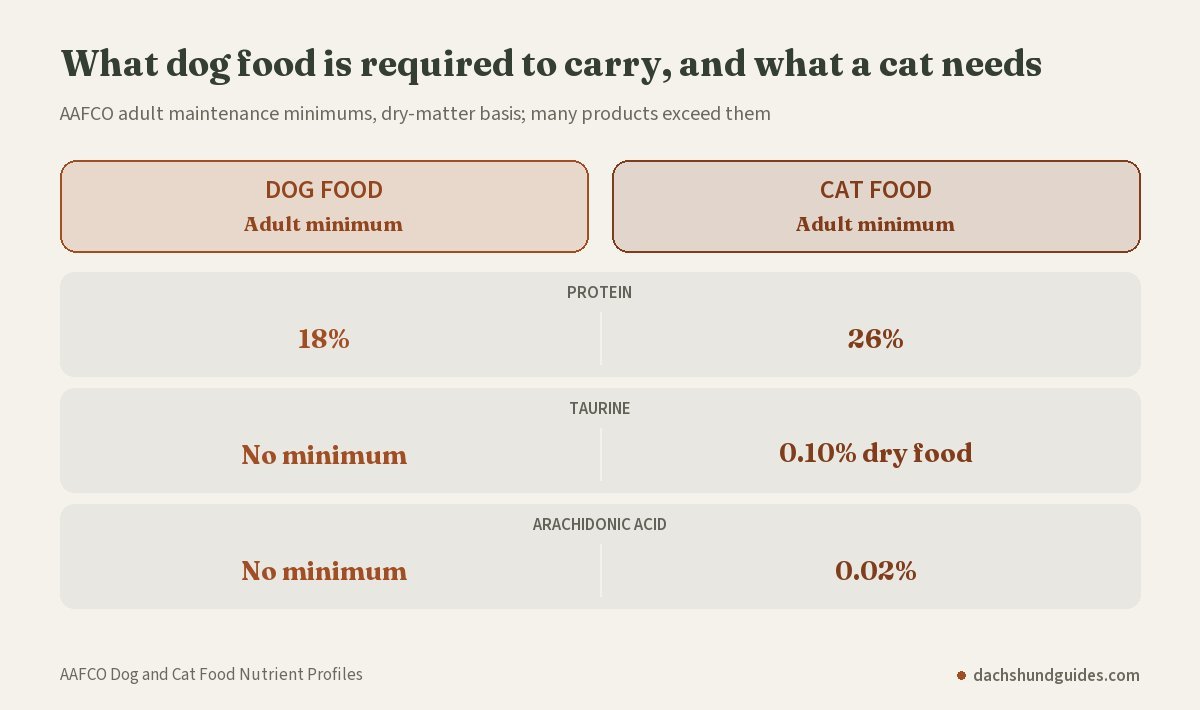
The rest of the gap is about how much. Adult cat food has a 26% protein minimum against 18% for adult dog food, a 9% fat minimum against 5.5%, and a niacin minimum of 60 mg/kg against 13.6. Its arachidonic acid minimum is 0.02%, and its taurine minimum is 0.10% for dry food. Dog food has no minimum for either.
If you wonder why niacin matters, Merck explains it: cats can’t make much of it from the amino acid tryptophan, so the whole requirement has to come from food.
You’ll also read that dog food never has enough vitamin A for a cat. On paper, the amount isn’t the problem.
AAFCO’s adult minimum for dog food, 5,000 IU per kg, is higher than the cat minimum of 3,332. The catch is the form: cats can’t turn beta-carotene into vitamin A, so they need it ready-made, from sources like liver, fish oil or synthetic vitamin A, and the label number alone won’t tell you which form you’re getting.
These are minimums, and plenty of dog foods go above them. A high-protein dog food still isn’t formulated to the cat standard, though, so the line you want to check on any bag is the nutritional adequacy statement. For a cat it should name the AAFCO Cat Food Nutrient Profiles.
What happens to a cat that lives on dog food
The serious risk is a slow taurine shortage. Merck says taurine deficiency can cause dilated cardiomyopathy, a weakened and enlarged heart, and central retinal degeneration, which damages vision. Neither shows up after one stolen meal, and nobody has published how long it takes on dog food.
The heart link was found the hard way. In a 1987 study in Science, researchers found low blood taurine alongside heart muscle failure in 21 cats eating commercial cat foods of the time.
They found it too in 2 of 11 cats fed a diet only marginally low in taurine for four years. Taurine supplements brought heart function back to normal in both groups.
Four years, on a diet that was only slightly short.
That’s the timescale the 1987 study shows. Do you want to find out how your own cat does on dog food? I wouldn’t. A veterinarian writing for PetMD notes that all commercially available cat food today has taurine added, which makes a complete cat food the simplest protection you have.
Can cats eat dog food for a day or two?
Yes, if it’s all you have tonight. A veterinarian writing for PetMD says a cat can eat a small amount of dog food without any toxicity or lasting effects. There’s no published safe number of days, so I’d treat it as a one-off and get cat food as soon as the store opens.
If you’re caught short, any complete cat food is a better stopgap than more dog food, even a small bag or a few cans from a grocery or convenience store.
Kittens are a different case
A growing kitten needs more than an adult cat. AAFCO’s minimum protein for kitten food is 30%, against 18% for adult dog food, which makes a kitten filling up on kibble a bigger worry than an adult cat sneaking a few pieces.
One r/cats post asking exactly this, “Help: new kitten keeps eating my dogs kibble, is that ok?”, drew more than a thousand upvotes. The top reply covered both problems:
“A tiny bit now and then, no. But kittens need kitten food. Kitten food is high in calories so they can grow like they should. An other issue is that cats need Taurine added to their food, most dog food won’t contain that.”
– r/cats, November 2022 (478 upvotes)
Why your cat keeps eating the dog’s food
It’s less common than dogs raiding the cat bowl. The PetMD veterinarian says most cats find dog food unappetizing, but some clearly don’t, and no study explains why. What you can control is access, and with a dachshund in your house that usually means the dog’s bowl.
One reply in a r/Catownerhacks thread about keeping dogs out of cat food summed up the flip side:
“Have it in a room with a gate. My issue is I can’t get the cat to stop eating dog food”
– r/Catownerhacks, June 2025 (24 upvotes)
- Feed your dachshund on a schedule. Put the bowl down at mealtime and pick it up when your dog walks away, so there’s nothing left out for the cat.
- Feed the dog behind a door or in a crate. A cat can hop a baby gate, so a closed door works better for this direction.
If you’re still setting the house up for both, our guides to dachshunds and cats and introducing a cat to a dog cover the rest, and cat breeds that do well with dogs helps if you haven’t picked a cat yet.
Can cats eat dog food? Quick answers
Can cats eat dog food every day?
No. It’s fine as a stopgap and it isn’t toxic, but it’s made to dog standards that set no minimum for taurine or arachidonic acid, which cats have to get from their food. For everyday feeding, choose a food whose label names the AAFCO Cat Food Nutrient Profiles.
Do all cat foods have taurine?
Complete cat foods made to the AAFCO cat standard do. AAFCO sets a taurine minimum of 0.10% for dry cat food and 0.20% for canned, and the PetMD veterinarian says all commercially available cat food now has taurine added.
