
Is Catnip Safe for Dogs? The Herb Is Rarely the Problem


A sniff or a mouthful of catnip is unlikely to hurt your dog, but don’t count on it doing anything useful either. The ASPCA lists catnip as toxic to cats, mainly for vomiting and diarrhea, and doesn’t list it for dogs at all. What’s actually been documented as a danger to dogs is the cat toy the catnip comes in.
If your dog just raided the cat’s stash, you probably don’t need to panic. If it swallowed the toy, or a toy with string attached, that’s when you call the vet.
Is catnip safe for dogs?
In small amounts, it’s probably fine, though there’s no published dog study to back that up either way. The ASPCA’s plant database lists catnip (Nepeta cataria) as “Toxic to Cats,” naming nepetalactone as the active compound and vomiting and diarrhea as the signs.
For dogs, the same entry is silent. Catnip isn’t called toxic to dogs there, and it isn’t called non-toxic either. It’s easy to read “not listed” as “proven safe,” but that’s a step further than the evidence goes.
So what does that mean in practice? A dog that licks up some dried catnip may get a mild stomach upset, if the cat signs are any guide.
What does catnip do to dogs?
There’s no good answer yet, because it doesn’t appear to have been studied. You’ll often read that catnip has the “opposite effect” in dogs and makes them sleepy or calm, but none of the articles making that claim point to a dog study.
Europe PMC, the large life-science literature database, turns up four records for catnip and dogs. One is a 2024 lab study testing catnip oil against bacteria and fungi from canine skin infections, in a dish rather than in a dog. The rest are two pet-toy patents and a 1961 study of cat brains. None looks at how catnip affects a dog’s behaviour.
The cat side is much better understood. A 2021 study in Science Advances found that nepetalactol, the main active compound in silver vine and a close chemical relative of catnip’s nepetalactone, raised beta-endorphin levels in cats, and that blocking the body’s opioid receptors stopped the classic rubbing response.
Even in cats it isn’t universal: when researchers offered catnip to 100 domestic cats in a 2017 study, one in three didn’t respond to it at all.
So if you’re hoping catnip will settle an anxious dog, there’s no dose to follow and no evidence it works. Your vet is a better starting point for anxiety, and that conversation won’t involve guesswork about a cat herb.
Catnip toys are the bigger risk
The herb inside a catnip mouse is a small concern next to the mouse itself, because dogs chew toys apart and the pieces that get swallowed can lodge in the stomach or intestines.
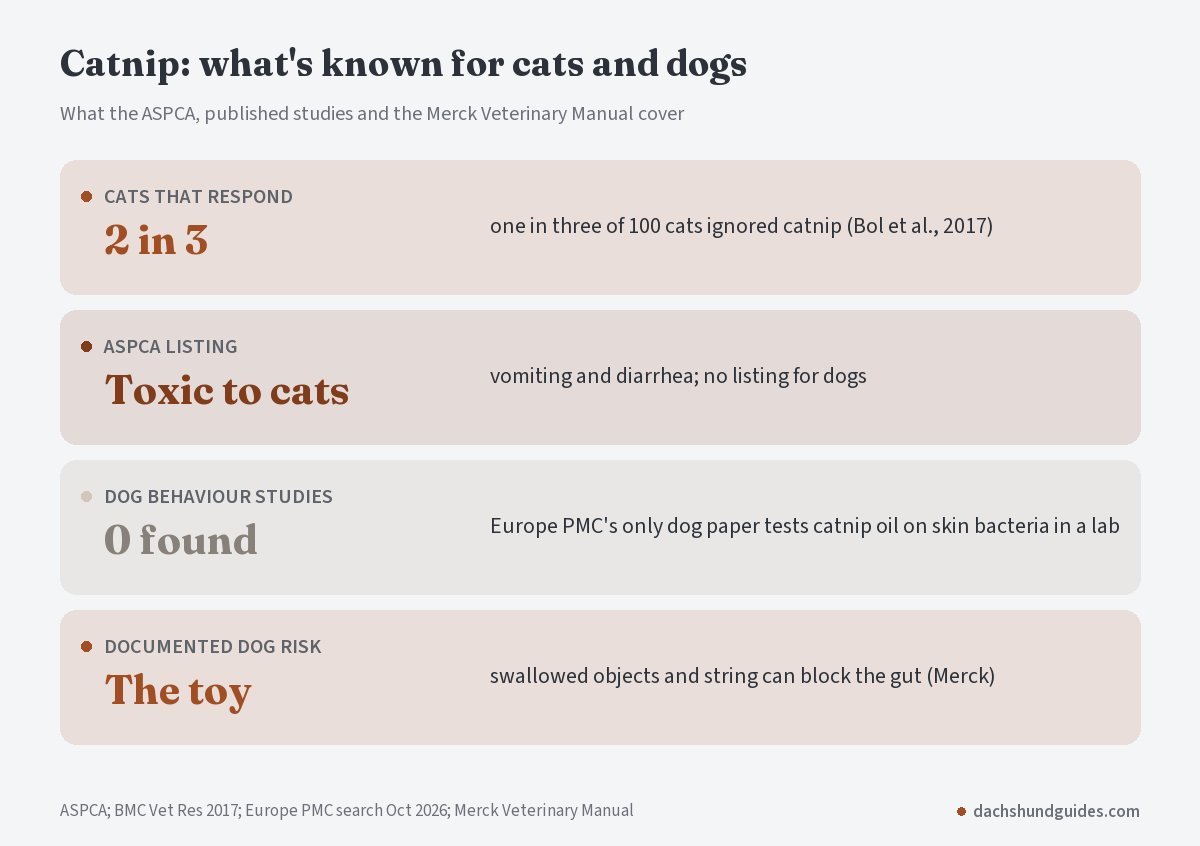
Merck’s Veterinary Manual for dog owners lists foreign objects among the causes of intestinal blockage. A blockage close to the stomach, it says, tends to cause more severe and more frequent vomiting, and that surgery is usually needed to fix it.
String deserves its own warning. Why string? Many cat toys come with string, ribbon or feathers on a cord, and Merck notes that swallowing long, thin objects like string is far more common in cats than dogs. When a dog does swallow one, though, it “can cause more damage than other types of foreign material.”
One reply in an August 2026 r/Pets thread about catnip and a new puppy put it plainly:
“the real worry is them eating the toy itself, not the herb”
– r/Pets, August 2026 (2 upvotes)
Keep cat toys somewhere your dog can’t get to, especially wand toys and anything with a cord. If you’re working out how a dachshund and a cat can share a home, the guide to dachshunds and cats covers giving the cat its own space, and the one on dogs eating cat food deals with the other thing dogs steal from cats.

Catnip oil and sprays
Catnip spray and catnip oil are a different product from the dried leaf. In the 2024 lab study, the oil was made up almost entirely of nepetalactones, so it’s a far more concentrated form of the compound the ASPCA flags for cats.
There’s no dog study on the oil either, but Merck’s chapter on essential oils is clear on the general rule: concentrated essential oils “should never be directly applied to pets.” Don’t spray catnip on your dog’s bed or toys to try to calm it, and keep the bottle where it can’t be chewed.
If a cat shares the house, keep it away from the oil too, since cats are short of an enzyme that clears some oil compounds, as the guide to cinnamon and cats explains.
What to do if your dog ate catnip
Did your dog only eat the herb? Then keep an eye on it. Vomiting or loose stool would match what the ASPCA lists for cats. If it keeps going, or your dog seems unwell, call your vet.
If it swallowed the toy, or part of one, call your vet sooner. Merck says that if a toy is missing from your home, that’s worth telling the vet, and that dogs with a swallowed object tend to do well when it’s caught and treated quickly. Repeated vomiting is a reason not to wait.
If your dog got into catnip oil, call your vet or the ASPCA Animal Poison Control Center at (888) 426-4435. A consultation fee may apply.
Most of the time, the herb is the least of it. It’s the mouse, the string and the bottle you’ll want to keep out of reach.
