
White Dachshund: Piebald, Double Dapple or Cream?


A white dachshund isn’t a color of its own. Neither the AKC breed standard nor the Dachshund Club of America lists white, and the AKC disqualifies a pure white dog with no body spots.
A dachshund that looks white to you is almost always one of three dogs: an extreme piebald, a double dapple or a very pale cream.
Those three aren’t equal. The double dapple is the one with a documented hearing and eye risk. So if you’re looking at a white puppy, which of the three you’ve got counts for far more than the shade.
Here’s how I’d tell them apart, and what I’d ask for before you pay a deposit.
Three dachshunds that get called white
You can sort them fastest by the eyes, the ears and where the white sits. Every row in this table comes from the AKC standard’s pattern rules and the Dachshund Club of America’s colors and patterns sheet.
| What you see | Extreme piebald | Double dapple | Pale cream |
|---|---|---|---|
| Where the white comes from | White spotting over a base color | Two copies of the dapple (merle) gene | Not white at all: red pigment faded to pale cream |
| Eyes | Dark, never blue | Often blue; can be small or missing | Dark |
| Ears and around the eyes | Colored, by the standard’s own rule | No rule | Cream |
| Where the white sits | Clean white; small flecks (ticking) allowed | Big patches on feet, belly and sides, uneven, never ticked | At most a little on the chest |
| Nose and nails | Match the base color | Same rule as the base color | Black |
| In the AKC standard? | Yes, within limits | Not named | Yes, as cream |
| Health flag | White spotting genes are linked to deafness; no dachshund figure | Deafness, reduced eye size, missing eyes | None tied to the color |
An extreme piebald still has a colored head. The AKC standard says the head can’t be more than 50 percent white, and that color “must cover both ears, back and front, and extend without interruption from the ears over both eyes.”
The DCA adds that piebalds typically have symmetrical head markings and a white-tipped tail. So a piebald with a lot of white on the body still looks back at you with dark eyes from a colored face. The standard allows piebald white over any one- or two-colored dog, which is why a white dachshund with brown spots is usually a chocolate or red piebald. Our piebald dachshund page lists every marking that rules a dog out.

A double dapple comes from breeding two dogs that both carry dapple, which is why you need to know both parents. The DCA describes them as marked unevenly, with large areas of white on the feet, belly and sides, and says they never have ticking.
Veterinary neuroscientist George Strain goes further in an article on congenital deafness that the Orthopedic Foundation for Animals (OFA) publishes. Dogs with two merle copies, he writes, “usually have a solid white coat and blue irises, are often deaf and/or blind.”
A pale cream is a one-colored dachshund. The AKC standard lists cream next to red, with black nose and nails, and allows only a little white on the chest.
In photos, a clear cream can pass for white. How do you tell? Look at the face, as one r/Dachshund commenter did for an owner who’d been worrying about a double dapple:
“He’s just a cream! The perfect little black nose and eyes and everything. A very desirable color. He probably doesn’t have any dapple in him at all tbh”
– r/Dachshund, October 2026 (161 upvotes)
The same commenter added that you can’t be sure a dog has no dapple genes just by looking, and you’ll see why below. Our English cream dachshund page explains shaded and clear creams.
Is there an all-white dachshund?
Not one the breed standard accepts. The AKC standard says “pure white dogs with no body spots except on the head are to be disqualified,” and the DCA lists “a pure white body” among a piebald’s disqualifications.
A piebald can carry a lot of white, then, but it can’t go all the way. So what is a dachshund that’s white nearly nose to tail? The description that fits best is the one Strain gives for two merle copies: a solid white coat, often with blue eyes.
That’s why a mostly white puppy with light eyes deserves a DNA test before you trust any label on it.
It works the other way too. Not every double dapple is white, and not every dog with a lot of white is a double. One r/Dachshund owner put it plainly:
“You cannot tell if a dog has a dapple gene (or double dapple genes) just by looking at it. A dog with obvious dapple has at least 1 gene but may have two. White markings are an indication of double dappling but not a guarantee of such.”
– r/Dachshund, July 2023 (24 upvotes)
The same owner described a family dog, a black and tan dapple with very little dapple and no white, whose DNA test came back as a double. Her parents were a red and a cream.
That fits the DCA’s warning that a red dapple can be hard for you or a breeder to see, which our red dachshund page goes into. It’s why most breeders only pair dapples with black and tans or chocolate and tans.
Are white dachshunds deaf?
Not automatically, but white raises the odds. In the OFA article, Strain says congenital deafness can appear in any breed “but especially those with white pigmentation,” and he names the dappled dachshund among the merle breeds where it’s seen.
Why would coat color reach the ear? Strain explains that this deafness follows the loss of part of the cochlea’s blood supply, the stria vascularis, and that the loss seems tied to missing pigment cells. Where the skin makes no pigment, the ear may lack those cells too.
For dapples there’s real data. A 2009 study in the Journal of Veterinary Internal Medicine by Strain and colleagues tested 153 merle dogs from several breeds with an electrical hearing test.
Among single merles, 2.7% were deaf in one ear and 0.9% in both. Among double merles, 10% were deaf in one ear and 15% in both.
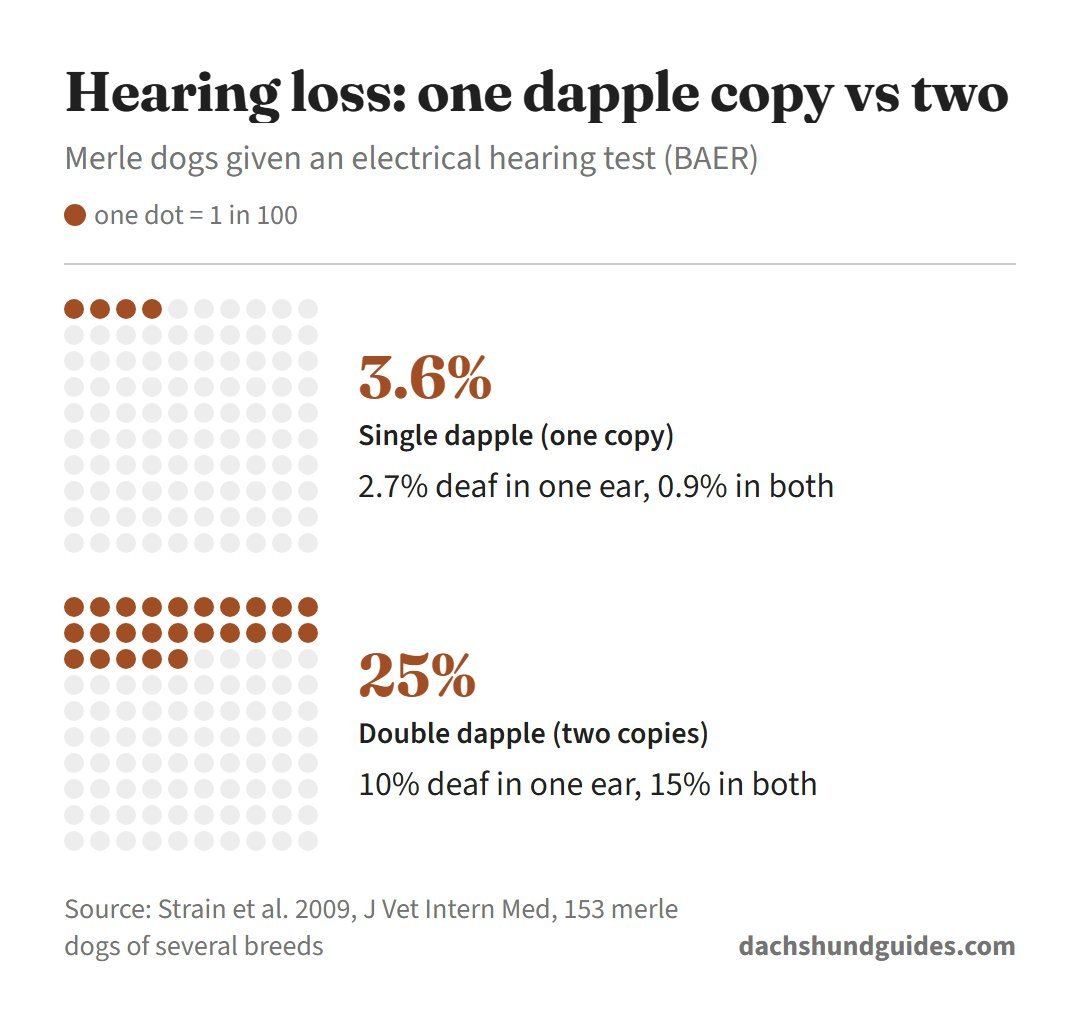
That’s a quarter of the double merles with some hearing loss, against 3.6% of single merles. It’s a big jump, but it isn’t “most”.
One owner whose double dapple is deaf wrote on r/Dachshund in December 2024 that she’s “deaf like most double dapples are.” You’ll hear that a lot, and the study doesn’t support it. It also found no link between eye color and deafness, so a blue eye alone doesn’t mean your dog is deaf.
One limit on those numbers: the dogs came from several breeds, not just dachshunds. Our dapple dachshund page has the same figures by genotype.
For piebalds, Strain lists the piebald gene as a deafness link in breeds like the Dalmatian, but I haven’t found a deafness rate for piebald dachshunds. For creams, I found no deafness data at all, and cream isn’t a white-spotting pattern. If you’ve got a cream, the hearing risk above isn’t yours to worry about.
Checking a white puppy before you pay
Five of the eight related searches Google shows for this term are about puppies, prices or sales. If you’re buying, these are the checks I’d want done before any money changes hands:
- See both parents, and ask what they are. Two dapples is the risk. So is a dapple bred to a red or cream nobody has tested, because a red dapple can look plain red.
- Look at the eyes and ears. A blue eye means the puppy isn’t a standard piebald. White ears or white around the eyes put it outside the piebald rules too.
- Look for ticking in the white. Part the coat if you need to. The DCA says double dapples never have it. Ticking points toward piebald, though it doesn’t prove it.
- Ask for a merle DNA test. Strain’s LSU deafness site notes a merle test your vet can order through IDEXX. A test of the puppy, or of both parents, says how many dapple copies you’re dealing with.
- Ask for a BAER hearing test. The OFA calls it the only accepted way to diagnose deafness, tests puppies at least 35 days old, and says one test lasts the dog’s life. Strain’s LSU site keeps a list of BAER testing sites if your vet doesn’t offer it.
That last one is the check people skip. Strain notes that a dog deaf in one ear seems to hear normally unless it’s tested, so you can’t spot it at home.
In an August 2024 r/Dachshund post, a buyer described an extreme piebald puppy whose father was a long-haired cream and whose mother was a piebald. The breeder’s reassurance was that vet checks had found no signs of deafness or blindness. But a routine vet check can’t catch one deaf ear. A BAER test can.
If the breeder won’t share the parents, a merle result or a hearing test for a mostly white puppy, I’d walk away, however pretty the puppy is.

White fur, pink skin: sun care
If the skin under your dachshund’s white patches is pink, it can burn. VCA Animal Hospitals says sun damage of this kind occurs mainly in dogs with white or pale, unpigmented skin, and is more common in short-coated, white-haired dogs.
VCA lists the flanks, groin, armpits, top of the nose and eyelids as the usual spots. It also notes that if your dog lies on one side, the side facing the sun gets the worst of it. Over time the damage can turn into a skin cancer called squamous cell carcinoma.
Its advice is simple. On sunny days, keep your dog in between 10 a.m. and 4 p.m., and put sunscreen on thinly haired spots your dog can’t lick. Does your white dachshund love the sunny patch of floor by the window? That counts too.

If you’re worried about heat rather than skin, see our page on keeping your dachshund cool in summer.
White dachshund questions
What is the rarest dachshund color?
White isn’t a dachshund color, so it can’t be the rarest one. Of the patterns that can make a dachshund look white, piebald was the scarcest in the DachsLife 2021 owner survey: 80 of 9,807 dogs, about 0.8%, against 969 dapples.
Our dachshund colors page names the rarest colors and why the club warns about them.
Can a white dachshund have long hair?
Yes. The AKC standard gives longhaired and wirehaired dachshunds the same colors as smooths, so a piebald, a dapple or a cream can come in any coat. A pale long-haired cream, often sold as an English cream, is easy to mistake for white in photos.
How much does a white dachshund cost?
I haven’t found a reliable price figure for white dachshunds, and if you’re asked to pay extra for white, I’d say no. A puppy that’s white nearly all over fits the double dapple description best. Our dachshund price page explains what actually moves the cost.
Whatever the asking price, it shouldn’t buy you out of a hearing test.
