
Pepto-Bismol for Dogs: Check the Bottle Before the Dose

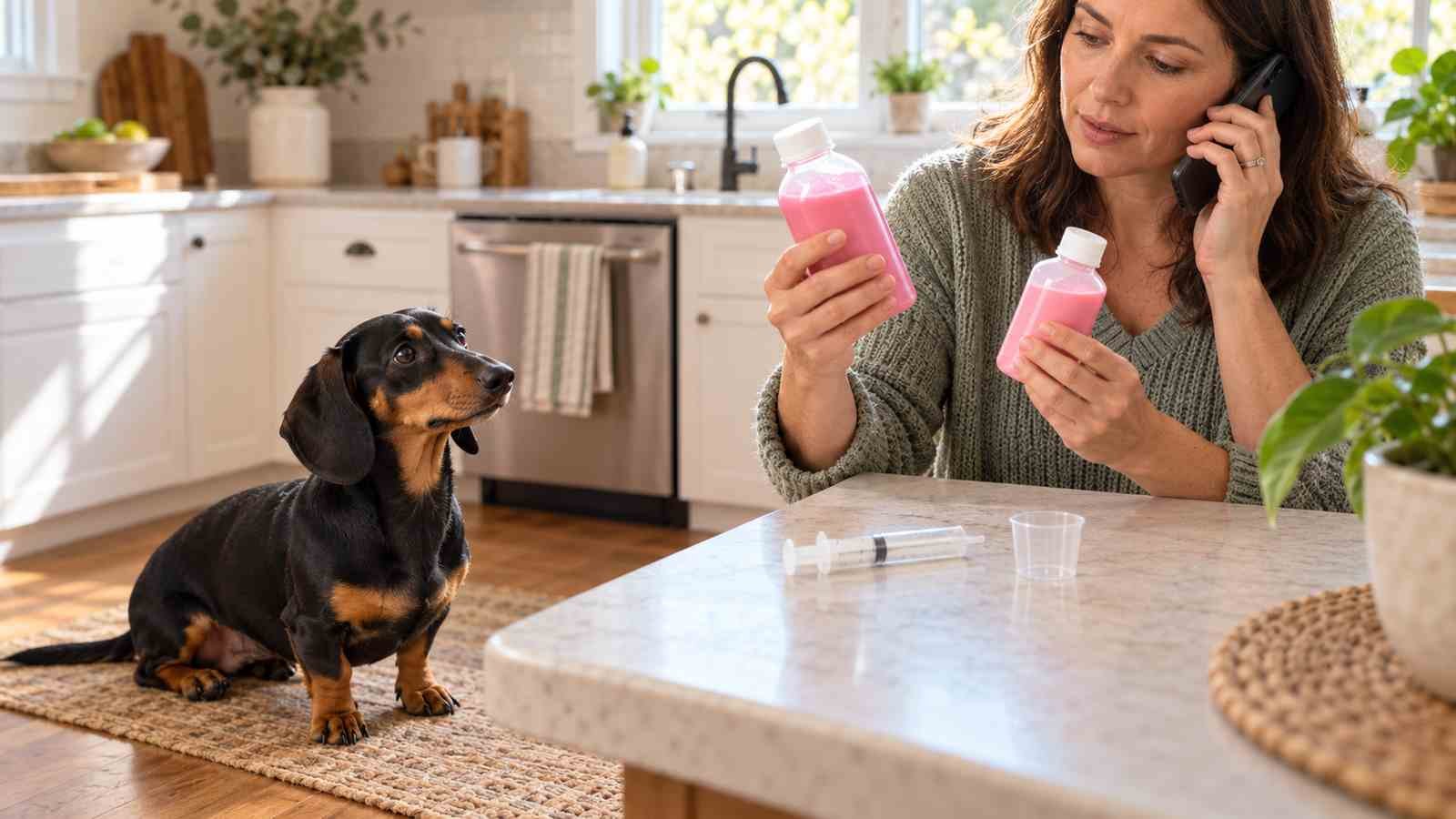
Pepto-Bismol for dogs can be used for mild, short-lived diarrhea, but only after you’ve talked to your vet. Its active ingredient, bismuth subsalicylate, is in the Merck Veterinary Manual’s list of antidiarrheal drugs for dogs. It’s never safe for cats, or for dogs on certain other medicines.
Before you pour anything, look at which bottle you’re holding. The products sold as Pepto don’t all carry the same strength, and one of them doesn’t contain bismuth subsalicylate at all.
Can I give my dog Pepto-Bismol?
You can give your dog Pepto-Bismol for an occasional bout of mild diarrhea if your vet agrees. PetMD notes it’s meant for mild cases only, not for long-term or recurring problems, which can point to something more serious underneath.
Some dogs shouldn’t have it at all. Here’s who the sources rule out:
- Dogs on NSAIDs such as Rimadyl or Deramaxx. AKC says they shouldn’t take any form of bismuth subsalicylate.
- Dogs with a clotting disorder, or on aspirin or other salicylates, unless the vet says otherwise, per PetMD.
- Puppies younger than 12 weeks, and pregnant or nursing dogs without the vet’s go-ahead.
- Dogs on tetracycline or ciprofloxacin, since PetMD says Pepto can interfere with those antibiotics.
Cats are a hard no.
Merck warns that salicylate toxicosis is possible, “especially in cats,” and AKC says Pepto should never be used in cats under any circumstances. If your dachshund lives with a cat, keep the bottle out of the cat’s reach, too.
Pepto Bismol for dogs: why the bottle matters
The dose depends on which Pepto product you have, because the FDA Drug Facts labels show different strengths under the same name.
Regular Pepto-Bismol liquid carries 525 mg of bismuth subsalicylate in a 30 mL dose. Pepto-Bismol Ultra packs the same 525 mg into 15 mL, so it’s twice as strong per millilitre.
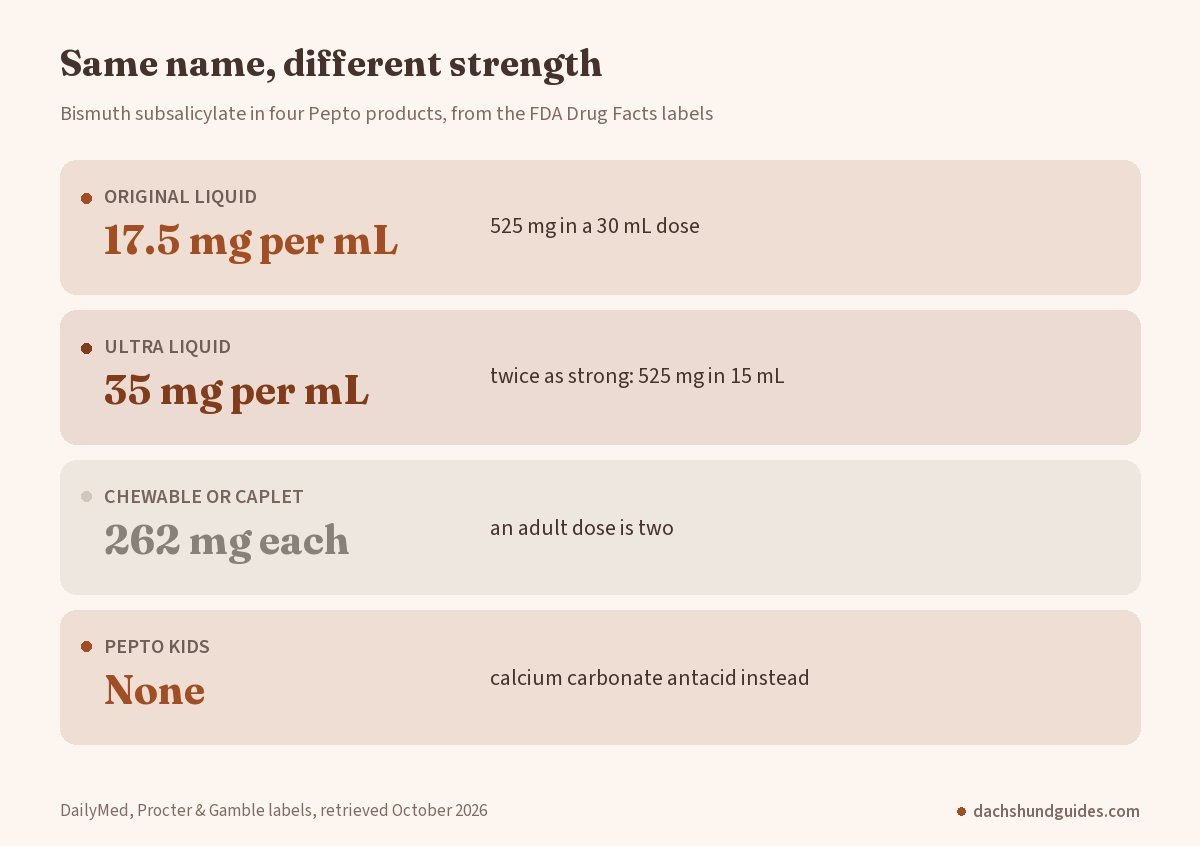
The chewable tablets and caplets hold 262 mg each. Then there’s Pepto Kids, which the label lists as a calcium carbonate antacid. It has no bismuth subsalicylate, so it won’t do what you’re reaching for it to do.
How much does a small dog get, then? The Merck Veterinary Manual’s antidiarrheal table gives 1 to 3 mL per kilogram for dogs, across a whole day, split into smaller doses.
It’s written in millilitres, and the salicylate content Merck quotes, about 9 mg/mL, fits the regular-strength liquid. That’s an inference, though, so check it with your vet.
For an 11-pound miniature dachshund, about 5 kg, that range works out to 5 to 15 mL of regular liquid for the entire day. That’s roughly 88 to 263 mg of bismuth subsalicylate.
One adult dose, whether it’s a 30 mL cup of regular, 15 mL of Ultra or two chewables, is 525 mg. That’s two to six times a mini’s whole-day range in a single pour.
A standard dachshund, at 16 to 32 pounds, has more room, but not that much: Merck’s range comes to about 7 to 44 mL of regular liquid a day across that weight span.
These numbers aren’t a home dosing guide. They’re here so the scale is clear before you call, and so you don’t measure Ultra as if it were regular. Your vet will set the amount and the schedule for your dog.
If your dachshund is on medication for its back
This is the part that catches dachshund owners. The Merck Veterinary Manual names the dachshund first among the small breeds where disc disease is a common cause of spinal cord problems. It also notes that dogs with mild to moderate signs often recover with rest, and that anti-inflammatory or pain medication can be used alongside it.
If that medication is an NSAID, such as Rimadyl (carprofen) or Deramaxx, AKC says your dog shouldn’t take any form of bismuth subsalicylate. Merck adds that practically all of the salicylate in it is absorbed into the body in dogs, so that part of the drug reaches the whole body, not just the gut.
Not sure what your dog’s back medicine is? Read the label, or call the clinic that prescribed it before you reach for the pink bottle. The overview of dachshund health problems covers disc disease and its treatment in more detail.
Black stool after Pepto-Bismol
Black stool after Pepto-Bismol is expected and usually harmless. Merck says owners should be warned that bismuth subsalicylate turns the feces black, and the human label calls the darkening of stool and tongue “temporary, but harmless.”
The trouble is that dark stool can also be a sign of bleeding. AKC points out that Pepto’s color change can make it hard to spot bloody feces, and bloody feces need prompt veterinary care, so the color you were told to expect can hide the one you shouldn’t ignore.
The human label itself says not to use the product if you already have black or bloody stool.
So watch the texture as well as the color. WebMD’s pet medication guide says gray-black or green-black stool is the drug, while poop that looks dark black and tarry is a reason to call your vet right away. A black tongue is the drug too, and it fades once you stop.
When to stop and call your vet
Stop and call your vet if the diarrhea lasts more than two days or gets worse, PetMD advises. Call sooner if the stool looks tarry, or if your dog is a puppy, pregnant or on any of the medicines listed above.
Pepto can also turn up where you didn’t put it. In a May 2026 post in r/husky that drew more than 1,100 upvotes, an owner found a chewed-up bottle and couldn’t tell which of their dogs had eaten it. One reply had the practical answer:
“Just wait until one of them has nice solid poops”
– r/husky, May 2026 (72 upvotes)
That’s funnier for a husky than for a miniature dachshund. Even one adult dose is several times a mini’s daily range, so if your dog gets into the bottle or a strip of chewables, call your vet with the label in hand.
If you’re dealing with diarrhea after your dog raided the cat’s bowl, the same rules apply. Ask first, use the right bottle, and expect a black stool, not a tarry one.
