
Dachshund Pregnancy: How Long It Lasts and How Many Puppies to Expect


A dachshund pregnancy lasts about 62 to 64 days, or roughly nine weeks, according to the Merck Veterinary Manual. Expect around four puppies from a miniature and around five from a standard, going by recent registry data. And most dachshunds give birth without help, despite the breed’s reputation.
The short legs worry a lot of owners, but they shouldn’t drive your plans. A 2026 study of 115 breeds found that short legs didn’t change litter size, and a Swedish study of dachshunds found few caesareans. What matters more is the calendar, the x-ray and knowing when labor has gone on too long.
How long is a dachshund pregnancy?
A dachshund pregnancy runs about 62 to 64 days, the same as in other dogs, Merck says. Dachshund Health UK, a breed health site, puts it at around nine weeks, from 63 to 65 days. A Swedish study of four dachshund varieties, summarized by the reproduction site Canirep, found gestation was a normal length in all of them.
Why can’t you pin down the exact day? Merck explains that the date of breeding doesn’t always match the date of conception, and that the length of pregnancy also varies with breed and litter size. So a due date worked out from the mating is a window, not a day.
There’s an outer limit, though. Merck’s chapter on difficult births treats a gestation longer than 70 days from a known breeding date as prolonged. If she’s past that point with no labor, it’s time to call your vet.
Dachshunds are only receptive to males during part of each heat cycle. If you’re trying to work out when she could’ve been bred, the guide to how often dachshunds go into heat walks through the stages and how long each one lasts.
How many puppies do dachshunds have?
Dachshunds have about four to five puppies per litter on average. Miniatures averaged just under four and standards about five in a 2026 analysis of litters registered with the Danish Kennel Club between August 2022 and July 2023, published in Acta Veterinaria Scandinavica.
That study is unusually handy for dachshund owners, because its supplementary table lists each dachshund variety on its own line, split by size and coat:
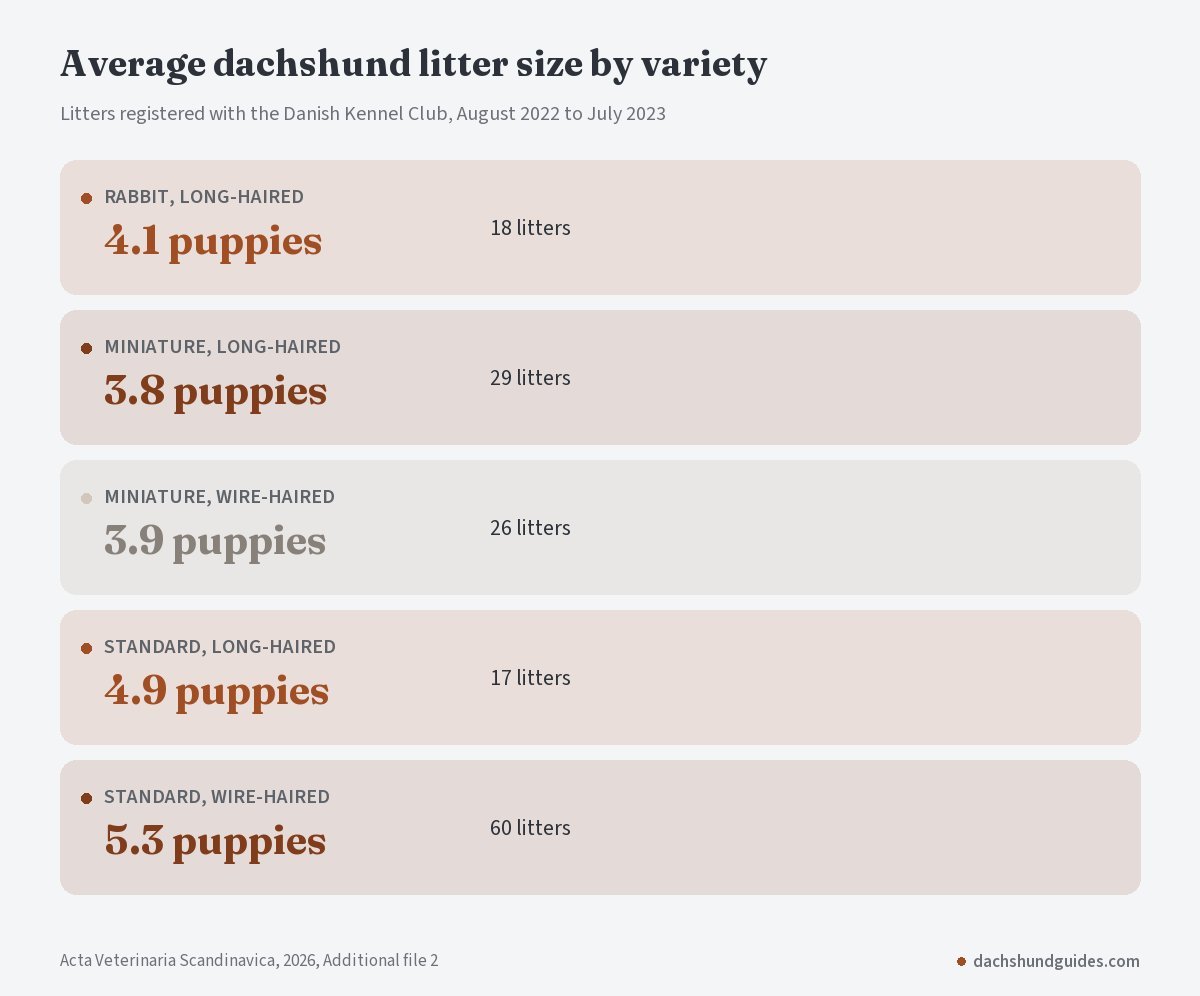
Long-haired miniatures averaged 3.8 puppies across 29 litters, and wire-haired miniatures 3.9 across 26. The rabbit size, the smallest in the table at a median 3.5 kg against 4.5 kg for miniatures, averaged 4.1 over 18 litters, which is a small sample and probably shouldn’t be read as rabbits outdoing minis.
Standards had bigger litters: 4.9 puppies for long-haired and 5.3 for wire-haired, across 17 and 60 litters.
So for a mini dachshund litter size, plan on about four puppies. Those are averages, not limits. The table doesn’t give the range within each variety, and smooth-haired dachshunds weren’t listed at all, since fewer than 10 of their litters were registered that year.
What about the short legs? The authors found that body size and litter size were strongly related, and that litter size “was unaffected by chondrodysplasia,” the short-legged build dachshunds share with corgis and basset hounds. The gap between minis and standards follows body size, which is the pattern the study describes across all 115 breeds.
Coat type seems to play a part as well. In the Swedish study, long-haired dachshunds had smaller litters than smooth and wire-haired ones, and the Danish averages lean the same way.
Is a first litter smaller? It’s a common question, but neither the Danish table nor the Swedish summary splits litters by whether it’s the mother’s first, so there’s no honest number to give you.
Your vet’s late x-ray will.
If you’re planning a litter rather than expecting one, check the parents’ coats first. Two dapple parents can produce double dapples, which carry a risk of deafness and eye problems, as the guide to dachshund colors explains.
How do you know your dachshund is pregnant?
You can’t be sure from her belly or her nipples. A vet can confirm it, and Merck lists four ways to do that, each working at a different point in the pregnancy:
- About day 21: a vet may be able to detect it by feeling the uterus during an exam.
- Days 25 to 35: ultrasound can reliably detect the pregnancy and confirm the puppies are alive.
- Days 30 to 35: a blood test for the hormone relaxin can pick it up.
- After about day 45: the puppies show up on x-rays, and an x-ray after day 55 is the best way to count them.
Dachshund Health UK suggests a scan at the vet from around four weeks. That late x-ray matters more than it sounds. It tells you how many puppies to expect, and that number is what you’ll check against on the day.
Pregnant, or a phantom pregnancy?
Swollen glands and even milk don’t prove anything. Canirep’s summary of the Swedish study notes that many dachshunds that aren’t mated “show apparent signs of pseudo pregnancy,” and false pregnancy is one of the things that can happen in the weeks after a heat.
In a January 2026 r/Dachshund thread, an owner asked about swollen mammary glands in an 11-month-old, three months after her first heat. One reply had been through it:
“Same happened with our Nellie, she was producing milk too. She was due to be spayed but had to postpone due to her having a phantom pregnancy. They gave her some medication and it went away pretty fast. Poor little dogs.”
– r/Dachshund, January 2026 (4 upvotes)
If she wasn’t with a male, or you aren’t sure, the ultrasound or blood test will settle it. Your vet can then decide whether a phantom pregnancy needs treating, and whether it changes the timing of a planned spay.
Do dachshunds need a C-section?
Most don’t. According to Canirep’s summary of the Swedish study, “most births proceed without dystocia,” meaning without a difficult birth, and dachshund mothers had a low rate of caesarean sections.
That might surprise you, because the general veterinary advice points the other way. The Merck Veterinary Manual’s dystocia chapter puts difficult births at about 5% of pregnancies overall. It adds that the rate “may approach 100%” in some breeds, especially short-legged (achondroplastic) and flat-faced types.
It’s easy to read that as a warning about dachshunds, but that sentence doesn’t name the breed, and the dachshund data doesn’t bear it out. The Swedish study also found that newborn deaths weren’t common in the breed. More puppies died in larger litters and in longer pregnancies.
One risk you can manage is her weight. Dachshund Health UK says a pregnant dog’s energy needs only rise in weeks five to nine, and that her weight shouldn’t climb more than 30% above where it was before she was bred. It links overweight mothers with difficult births.
Extra weight is hard on a dachshund’s back, too, as the guide to dachshund health problems explains.
When a dachshund C-section does happen, it’s usually the fallback. Merck describes it as the step vets take when medication can’t get stalled labor moving again.
Signs of labor and when to call the vet
The clearest sign labor is close is a drop in her rectal temperature, which usually comes 8 to 24 hours before delivery, per Merck. You’ll only notice the drop if you know her normal reading, so ask your vet how and when to take it in the last week or so.
Early labor lasts 12 to 24 hours. Merck says she may get restless, nest, hide, refuse food, vomit, pant or tremble, and she may have a clear, watery discharge. Contractions have started, but you can’t see them yet.
Then the visible contractions start and the puppies arrive, usually less than one to two hours apart, though that varies a lot. There should be a placenta for each puppy, but they don’t always come out together.
Give her a quiet, familiar spot. Merck notes that unfamiliar surroundings or strangers can hold up delivery, especially for a dog having her first litter.
Merck’s dystocia chapter lists the points where whelping is taking too long. Call your vet if:
- There’s no puppy 24 to 36 hours after her temperature dropped.
- More than 30 minutes pass between puppies while she’s clearly straining.
- More than 2 hours pass between puppies with no contractions at all.
- She’s been in active or weak labor for more than 4 hours without a puppy.
- The whole whelping has gone on for more than 24 hours.
- You see dark green or foul-smelling discharge before the first puppy, which can mean a placenta has separated.
The risks don’t end with the last puppy. Merck says an abnormal drop in blood calcium during nursing is most common in dogs under 45 pounds, which covers every dachshund, and a very large litter or a poor diet can make it worse. Ask your vet what to watch for while she’s feeding them.
And keep the number from that late x-ray on hand.
When the puppies stop coming, count them against it. If you’re short and she’s still straining, call your vet. Merck notes that vets use an exam, and sometimes another x-ray, to make sure every puppy is out.
