
Is Neosporin Safe for Dogs? Yes, but Not on Bites or in Ears


Neosporin is safe for dogs on a minor cut or scrape, in a thin layer, once your vet has said yes. Pet Poison Helpline says a small amount isn’t considered dangerous if your dog licks it, so most of the risk lies elsewhere: using it on the wrong wound, putting it in an ear, or letting your dog eat the tube.
So before you reach for it, look at two things: which tube you’re holding, and what kind of wound you’re looking at, because the wound matters more than the tube.
Is Neosporin safe for dogs?
Yes, for small surface wounds. Pet Poison Helpline, a veterinary poison control service, says Neosporin “is considered safe to use to treat minor cuts and scrapes,” and that you can apply it to your dog with your vet’s permission and instructions.
The same page is just as clear about licking. Small doses aren’t considered dangerous, but you’re expected to take steps so your dog doesn’t eat it. That’s the practical problem with any ointment on a dog: it sits right where a tongue can reach.
Can you put Neosporin on a dog’s wound the way you would on your own? Mostly, yes: the human label says to clean the area first, then apply an amount about the size of a fingertip, one to three times a day, and it may be covered with a clean bandage.
Your label doesn’t call for more than that, and on a dog a thicker layer just gives them more to lick.
Which Neosporin is in your cabinet?
“Neosporin” covers several products, and the FDA Drug Facts labels show they aren’t the same ointment. Here’s what four of them contain:
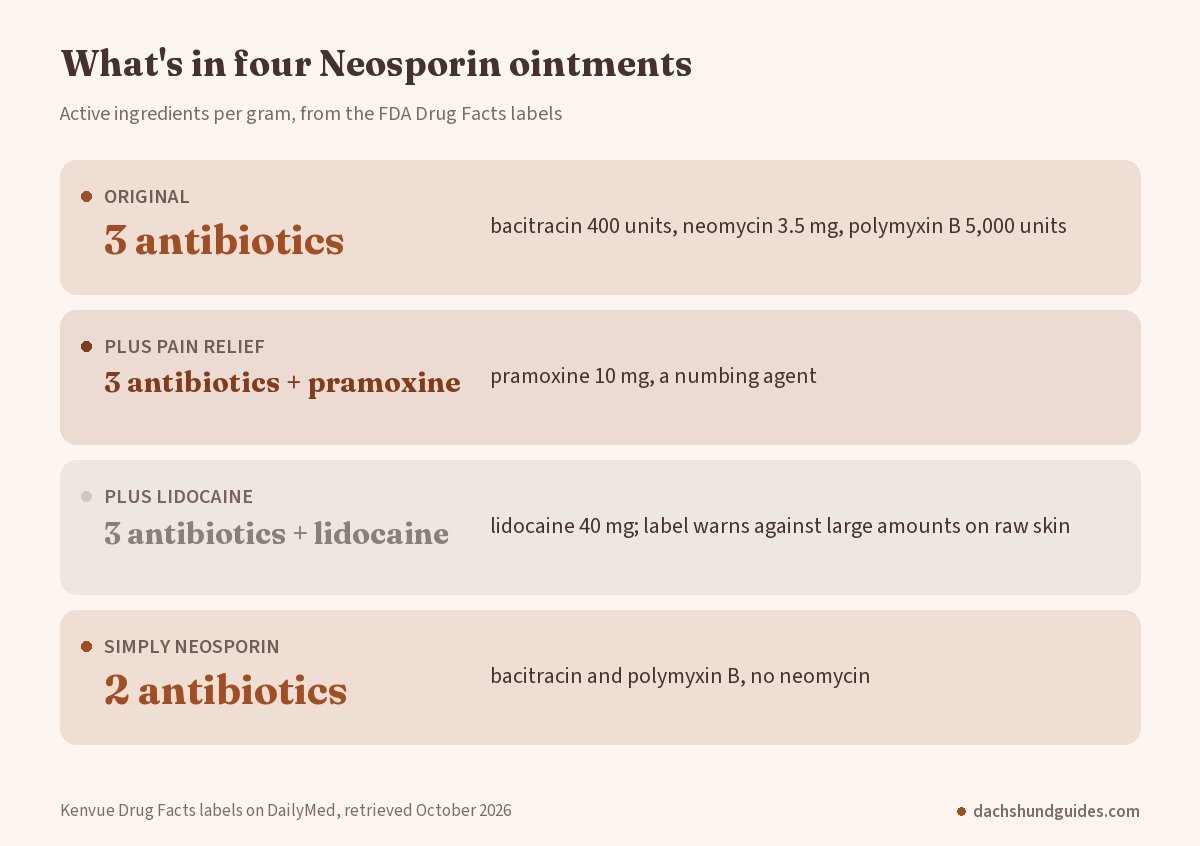
Neosporin Original has three antibiotics: bacitracin, neomycin and polymyxin B. The Pain Relief version adds pramoxine, a numbing agent, and the Lidocaine version adds lidocaine at 40 mg per gram. Its label carries an extra warning against using it in large quantities, especially over raw or blistered skin.
Simply Neosporin is the odd one out, with bacitracin and polymyxin B only; its carton says it’s free from neomycin. That difference matters if the problem is anywhere near an ear, as you’ll see below.
None of these labels is written for dogs. If you’re not sure which one you’ve got, read the active ingredients box, or take the tube along to your vet.
Wounds Neosporin can’t treat
What does the tube itself say? Its label already lists the wounds it isn’t meant for: it says to ask a doctor before using it on deep or puncture wounds, animal bites or serious burns. It also says not to use it over large areas of the body.
Those are exactly the wounds dogs come home with after a scuffle. And with bites, what you see on the surface can badly understate the damage.
The Merck Veterinary Manual’s wound chapter says the major tissue damage from a dog bite “is usually found beneath the surface of the wound.” Only small puncture marks or bruising may show on the outside, while ribs may be broken or organs damaged underneath. Cat bites are small punctures that frequently become infected, Merck adds, and vets treat them as an abscess.
An ointment can’t reach any of that. Merck notes that topical antibiotics have a limited ability to penetrate deeper tissue, so when an infection goes deeper, dogs need antibiotics given by mouth or injection instead.
So if your dog has been bitten, or has a puncture, a deep cut, a burn or a wound that keeps bleeding, skip the tube and call your vet. A neat little hole can hide a lot.
Never put Neosporin in your dog’s ears
Don’t put Neosporin in your dog’s ear canal. One of its antibiotics, neomycin, belongs to a drug family called aminoglycosides, and the Merck Veterinary Manual’s aminoglycoside chapter says their potential to damage hearing “is greatest for gentamicin, sisomicin, and neomycin.”
Merck says aminoglycosides shouldn’t go into the ear at all unless the eardrum is intact, which isn’t something you can check at home. Merck’s ear chapter notes that the eardrum often can’t even be seen until a vet has cleaned or flushed the canal, and it lists decreased hearing, a head tilt and vertigo as signs of ear damage to watch for.
The outer flap is a different matter, since a scratch on the outside of the ear is a skin wound like any other. It’s the canal that’s off limits, and an itchy, smelly or painful ear needs a vet’s look, not an ointment. For routine care, the grooming guide covers weekly ear cleaning with a vet-recommended cleaner.
Keep it out of the eyes, too: every Neosporin label in the comparison above says not to use it in the eyes.
What if your dog licks it off?
A lick or two of a thin layer isn’t an emergency. Pet Poison Helpline says small doses of Neosporin aren’t considered dangerous.
Eating a lot of it is different, and the helpline lists diarrhea, vomiting, tremors, excessive drooling, skin lesions, seizures and loss of appetite among the signs after a large amount. And if your dog chews up the tube itself, the helpline warns it could cause a blockage in the gut. If your dog has licked or eaten Neosporin and is showing symptoms, Pet Poison Helpline says to call them and your vet rather than treating it yourself.
The more common problem is that the ointment never stays on long enough to do anything. In a March 2026 r/Indiedogs post about a wound that wasn’t healing, the owner summed it up:
“I apply neosporin powder but he licks it off.”
– r/Indiedogs, March 2026 (112 upvotes)
If that’s happening, ask your vet about a cone or a covering that suits the spot, because by then the licking is a bigger problem than the ointment.
What about paws? Your dog walks on them all day and can reach them easily, and constant licking keeps the skin damp, which can lead to a secondary infection, as the guide to why dachshunds lick their paws explains. A sore that keeps getting licked is worth a vet visit sooner rather than later.
What to use instead of Neosporin
Neosporin isn’t the only option, and it may not add much. Merck’s chapter on topical wound agents says flatly that “topical antibiotic usage has limited benefit in wound healing,” and warns that overuse may add to antibiotic resistance.
Human studies point the same way: a 2018 review of wound trials in people found topical antibiotics cut infections compared with a placebo, but the absolute benefit was small, about 3 percentage points. The authors suggested antiseptics as a reasonable alternative. That’s human data, though, so ask your vet which antiseptic suits your dog.
You may see a 1989 dog study quoted as proof that Neosporin’s bacitracin prevents infection. It’s real, but it tested bacitracin rinsed into deliberately contaminated bone wounds in a lab, as a model for human orthopaedic surgery, not ointment on a scraped leg.
If your vet is happy with a dab of ointment, that’s fine. If they’d rather use a pet product or leave the wound open to air, go with them. They’ve seen the wound, and the tube hasn’t.
Whatever you use, the label’s own limit is a good rule. If you’d need Neosporin for more than a week, or the spot isn’t getting better, it’s time for the vet.
