
Pomchi (Pomeranian Chihuahua Mix): Size, Coat and Risks

Seven pounds is the adult ceiling PetMD and Chewy give a pomchi, the Pomeranian and Chihuahua cross, and both parents sit at or under it on the AKC’s breed pages. The cross isn’t an AKC-recognized breed, though, so a puppy’s coat and final size depend on which side it takes after.
It’s one of the smallest mixes you can bring home, and its name gets misused all the time. Shelters tag small, fluffy, pointy-eared dogs as a pomchi on sight, and owners then ask strangers online to confirm it.
Coat, health and price all trace back to two very different parents.
How big does a pomchi get? Size and lifespan at a glance
A full grown pomchi weighs no more than 7 pounds and stands no taller than 8 inches, according to PetMD, and Chewy puts its lifespan at 12 to 16 years. Daily Paws gives a slightly wider frame of 6 to 9 inches and 3 to 7 pounds.
- Adult weight: up to 7 pounds (PetMD, Chewy), 3 to 7 pounds (Daily Paws)
- Adult height: no taller than 8 inches (PetMD), 6 to 9 inches (Daily Paws)
- Lifespan: 12 to 16 years (Chewy), 12 to 15 years (Daily Paws)
- Parents on the AKC: Pomeranian 3 to 7 pounds and 6 to 7 inches, Chihuahua up to 6 pounds and 5 to 8 inches
- Recognized by the AKC: no (PetMD)
- Other names: Chipom, Pomahuahua, Chiranian (Daily Paws)
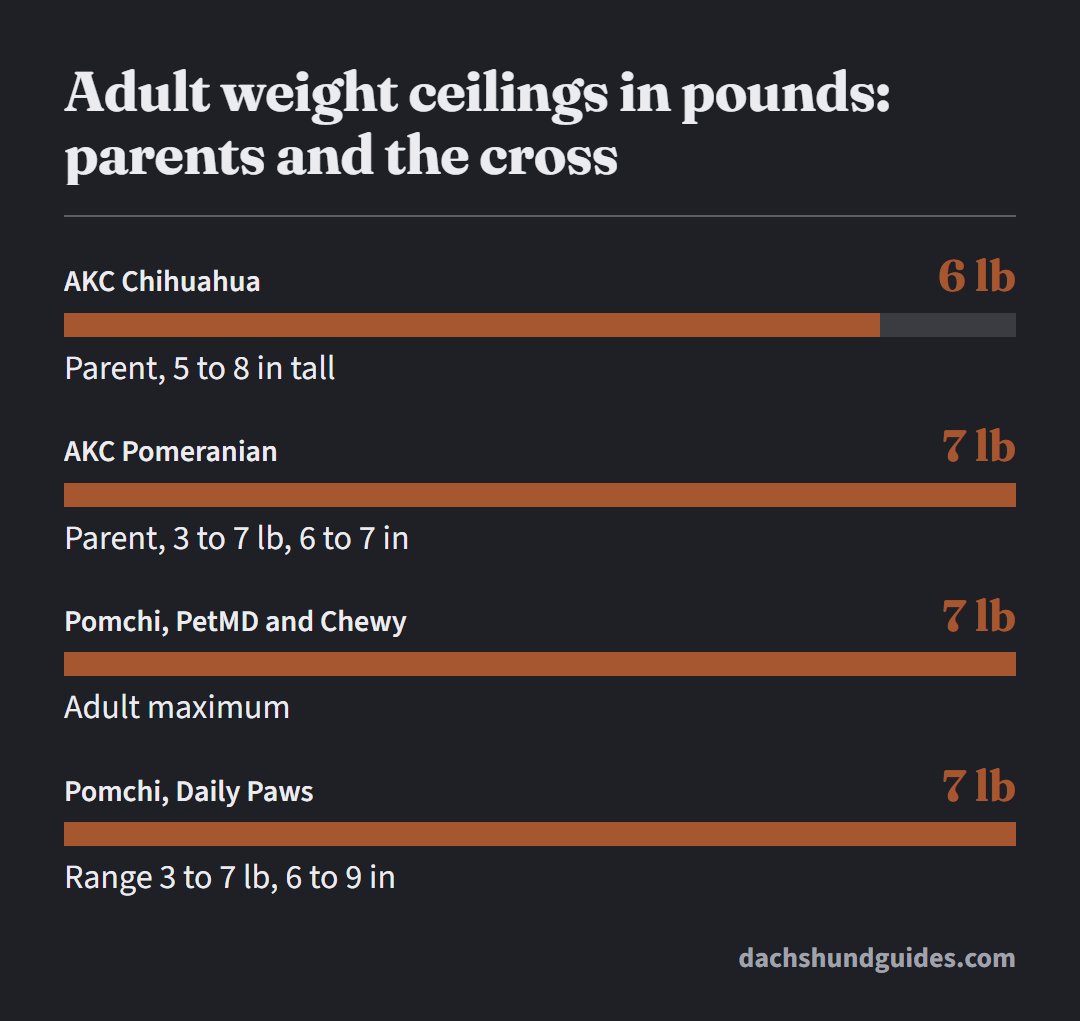
Start with the parents, since they set the frame. The AKC’s Pomeranian page lists 3 to 7 pounds and 6 to 7 inches, while its Chihuahua page lists 5 to 8 inches and a weight that doesn’t exceed 6 pounds. PetMD gives the parents’ lifespans as 12 to 16 and 14 to 15 years and expects a pomchi to land inside them.
Notice that none of those three profiles gives the cross a ceiling above 7 pounds, the same ceiling as the Pomeranian parent. Where your puppy lands between 3 and 7 depends on which side it takes after, and you can’t get that from a profile. So don’t guess; ask the seller for the mother’s and father’s actual weights.
Does a teacup pomchi exist?
No, according to PetMD, which answers the teacup question on its pomchi page with a flat no. A separate PetMD article by Jennifer Coates, DVM, names teacup pomchis among the dogs sold under that label and says buying one supports unethical breeding.
That article also lists the risks. They include low blood sugar that can mean feeding every two hours until the dog is a year old, plus hydrocephalus, liver shunts, dental crowding and a collapsing trachea. It gives ideal weights of 3 to 7 pounds for a Pomeranian and 3 to 6 for a Chihuahua. If a pomchi’s sold as far smaller than that, you’re right to ask harder questions.
It’s a word that shows up on other tiny breeds too, and the teacup dachshund page takes on the same label.
Is your dog really a pomchi? Shelter labels versus DNA tests
Possibly, but a label can’t confirm it. PetMD says the AKC doesn’t recognize the pomchi as a breed, so a shelter tag, a seller’s listing or a groomer’s guess is an opinion about looks, and a breed-ID DNA test is the check that looks at ancestry.
Reddit threads make the guesswork visible. An r/Pomeranians post titled “The shelter said Pomchi, what do you think?” drew 465 upvotes, and its owner said a DNA test was planned later. One reply came from a Pomeranian owner who was still looking for the Chihuahua in their own dog:
“Lady is technically a pomchi but I’m still trying to find the chi somewhere in all the pom 😅 so yours could very well be a pomchi too…”
– r/Pomeranians reply (52 upvotes) [excerpt, shown in part]
Over in r/Pomchi, a thread that began “I adopted this little dude 3 weeks ago, they claimed he is a Pomchi, can anyone confirm?” pulled 380 upvotes. The answers went by looks, like this one with 15 upvotes:
“Mine looked like a potato as a pup. Could be yours is a Pomchi 🙂 More Chi than Pom maybe ☺️”
– r/Pomchi reply (15 upvotes)
Another reply went by the dog’s fox face and ears. Those are only looks, and that’s what a DNA test exists to look past. A third owner in r/Pomchi had already ordered an Embark breed ID test after people kept asking whether their Pomeranian puppy was a pomchi, even the groomer.
So how do you decide? If the cross matters to you, ask a seller for both parents’ breeds and weights, and try to meet at least the mother.
Adopting a dog that’s already labelled one is different. Plan around its real size, coat and health, which you can see and measure, and don’t treat the breed name as more than a guess until a test says otherwise.
Pomchi coat, colors and grooming
A pomchi’s coat can be short like a Chihuahua’s or long and double-layered like a Pomeranian’s, and the length sets your workload. Chewy says a Pomeranian-type coat needs brushing several times a week, a long-haired Chihuahua-type coat about once a week, and a short coat less than that.
You can’t read a puppy’s adult coat from its name. Daily Paws says the coat can be short or long, and Chewy says colors vary, with sable and merle among those it lists.
Chewy doesn’t promise a shade, so a color like black is a question for the puppy’s own parents.
- Brushing: several times a week for the Pomeranian-type coat, about weekly for a long-haired Chihuahua type (Chewy); PetMD also advises brushing multiple times a week
- Baths: about once a month (Chewy)
- Shedding: low, according to PetMD, which also says the pomchi isn’t commonly thought of as hypoallergenic
Does a low-shedding dog suit an allergic home? Not automatically. You’ll want time with the dog before you commit, since PetMD doesn’t call it hypoallergenic.
When you visit a litter, look at both parents’ coats. A fluffy Pomeranian parent means you’ll probably be signing up for the brush-heavy weeks, and a smooth Chihuahua parent points to an easier routine.
Health problems a pomchi can inherit
A pomchi can inherit the health problems of both parents. PetMD lists periodontal disease, patellar luxation, tracheal collapse and patent ductus arteriosus, and a vet quoted by Daily Paws also names heart valve degeneration and epilepsy as more common in both breeds.
That vet, Stacy Choczynski Johnson, DVM, of Pumpkin Pet Insurance, advised looking at the diseases on both sides of a mix. For a pomchi, that’s two breeds’ lists at once:
- Periodontal disease: gum disease that PetMD puts first on its list. Its owner checklist asks whether you can brush your dog’s teeth daily.
- Patellar luxation: the kneecap slips out of its groove, which can show up as skipping or limping on a back leg.
- Tracheal collapse: a weakened windpipe that causes a honking cough. PetMD says it gets worse with exercise, heat and excitement.
- Patent ductus arteriosus: a heart defect present from birth. PetMD says surgery works best before congestive heart failure develops.
- Valve degeneration and epilepsy: both named by the Daily Paws vet as more common in the two parent breeds.
- Legg-Calvé-Perthes disease: VCA Hospitals describes it as a hereditary condition of small breeds, including Chihuahuas and Pomeranians, that causes slowly worsening lameness in a hind leg in young dogs.
Heat’s the trigger to plan around. Bruno, my dachshund, had heat exhaustion his first summer, so if your dog develops a honking cough that gets worse on a warm day, it’s one you’ll want a vet to hear quickly rather than one you wait out.
Teeth are the one item you can act on from week one. The routine in the dachshund teeth guide carries over to any small mouth, and PetMD lists dental disease first for this cross.
Alopecia X on the Pomeranian side
Alopecia X is a hair-loss condition of unknown cause, and the University of Minnesota’s dermatology handbook says Pomeranians are over-represented. Nothing in the sources used here measures it in pomchis, so treat it as a Pomeranian-side risk to ask the breeder about.
The handbook says it typically starts between 1 and 3 years of age. A dull, dry coat and thinning guard hairs come first. Bald patches over the trunk follow, often with darkened skin, and none of it itches. Affected dogs are otherwise healthy, so the coat is the change you’d notice. Hair can regrow within 3 to 4 months after neutering, though a relapse after a year or two is possible, and because the dogs feel fine, the handbook says leaving it untreated is an option to discuss with your vet.
Barking, strangers and time alone
A pomchi is typically wary of strangers and quick to bark, according to PetMD, and Daily Paws agrees on the frequent alert barking. Daily Paws and Chewy both flag anxiety when the dog is left alone for long stretches.
Early work helps. PetMD says to expose a puppy to animals, people, places and objects during its first 16 weeks, with rewards for calm behavior. If you’re starting with a young puppy, that window’s yours to use.
Pretzel, a miniature dachshund, barked at everything and tried to escape the backyard fence as a youngster. Practicing a treat hand-off with strangers at the park is what settled him. The steps in the dachshund puppy socialization guide work for any puppy.
Can you leave one alone all day? Probably not, and you shouldn’t plan on it. Pretzel needed eight weeks of training before he could rest six to seven hours by himself, and that’s a dachshund, so don’t borrow his schedule. What carries over is the pace, and it’s weeks, not days.
The dachshund separation anxiety guide lays out a gradual approach.
PetMD adds two outdoor risks for a dog this small, hawks and owls and escape through small holes in a fence. It also says very small children and larger pets can be a risky mix, since a dog this small is easy to hurt by accident.
Feeding and exercise for a dog under 7 pounds
PetMD says pomchi puppies need three or four meals a day to guard against low blood sugar, while adults do fine on two or three. Small, frequent meals matter more here than any chart on the bag.
Weight gets away from you on a dog this small. PetMD says the pomchi is prone to obesity and that treats shouldn’t pass 10% of the daily diet. One extra pound on a 5-pound dog is 20% of its body weight, and you won’t see that from across the room.
Bruno was about 40% overweight before his vet-supervised diet change, so extra food adds up fast. Weigh your dog on a kitchen scale every few weeks and you’ll catch a drift early.
Exercise is gentler. Chewy suggests short walks of about 20 minutes, which you can easily fit into an apartment day. Keep them shorter when it’s hot, given the windpipe risk above.
Pomchi price and breeder red flags
PetMD puts a pomchi puppy at hundreds to thousands of dollars, and Chewy says several hundred to several thousand. Lancaster Puppies, a seller, lists an average of about $797 for pomchi puppies in the US, a number that comes from its own listings.
That’s a wide range, and a price alone won’t tell you how the puppy was bred. Before you buy, Daily Paws names three red flags to check first:
- You can’t meet the puppy’s parents.
- There are no health screenings for both parents.
- The puppy is under 8 to 10 weeks old.
Add one more from earlier: walk away from anyone selling a “teacup” pomchi.
The questions in the dachshund breeder checklist apply to any small-breed seller, so borrow them freely.
Are pomchis good pets? Choosing between small mixes
A pomchi suits an adult household that’s home most days, can keep up with coat and tooth brushing, and accepts alert barking. It’s a poorer fit for homes with very young children, long hours alone or a need for a hypoallergenic dog, going by PetMD, Daily Paws and Chewy.
If that sounds like your home, a pomchi is a good match for a small apartment and a calm routine. If one of those doesn’t fit your life, pick another small mix. The table pairs each priority with a sibling cross and the guide that covers it.
| If you want | Look at | What the guide covers |
|---|---|---|
| A Chihuahua cross without a Pomeranian coat | Chihuahua Jack Russell mix | Size, health and traits of the Jack Chi |
| A small cross with a flat face | Pug Chihuahua mix | Size, breathing and risks of the Chug |
| A Chihuahua with a dachshund’s build | Chiweenie | Temperament, size and lifespan |
| A Pomeranian cross with a dachshund | Pomeranian mix with dachshund | The Dameranian |
Not sure you want a Chihuahua parent at all? The Chihuahua vs dachshund comparison sets that side against a dachshund.
Whichever cross you pick, ask for the parents’ weights, meet the mother and don’t skip the vet check in the first week.
