
Chorkie (Yorkie Chihuahua Mix): Size, Health and Care


A Chorkie is a Yorkshire Terrier and Chihuahua cross that usually weighs 4 to 10 pounds and stands 6 to 9 inches tall, according to Adopt-a-Pet’s breed profile. The parents’ AKC lifespans run 11 to 15 years for the Yorkie and 14 to 16 for the Chihuahua. The AKC doesn’t recognize the cross as a breed, PetMD notes, so a puppy’s size and coat depend on which side it favors.
The spread looks small until you remember what a pound means on a dog this size, and neither parent gives you a fixed answer to lean on.
How big does a full grown Chorkie get?
A full grown Chorkie typically weighs 4 to 10 pounds and stands 6 to 9 inches tall at the shoulder, according to Adopt-a-Pet, and it stops growing around 12 months. PetMD describes a typical adult as about 8 inches tall and about 7 pounds.
- Adult weight: 4 to 10 pounds (Adopt-a-Pet)
- Adult height: 6 to 9 inches at the shoulder (Adopt-a-Pet)
- Typical adult: about 8 inches and about 7 pounds (PetMD)
- Full size reached: around 12 months (Adopt-a-Pet)
- Lifespan: 12 to 15 years (Adopt-a-Pet), 11 to 16 years (Chewy)
- Recognized by the AKC: no (PetMD)
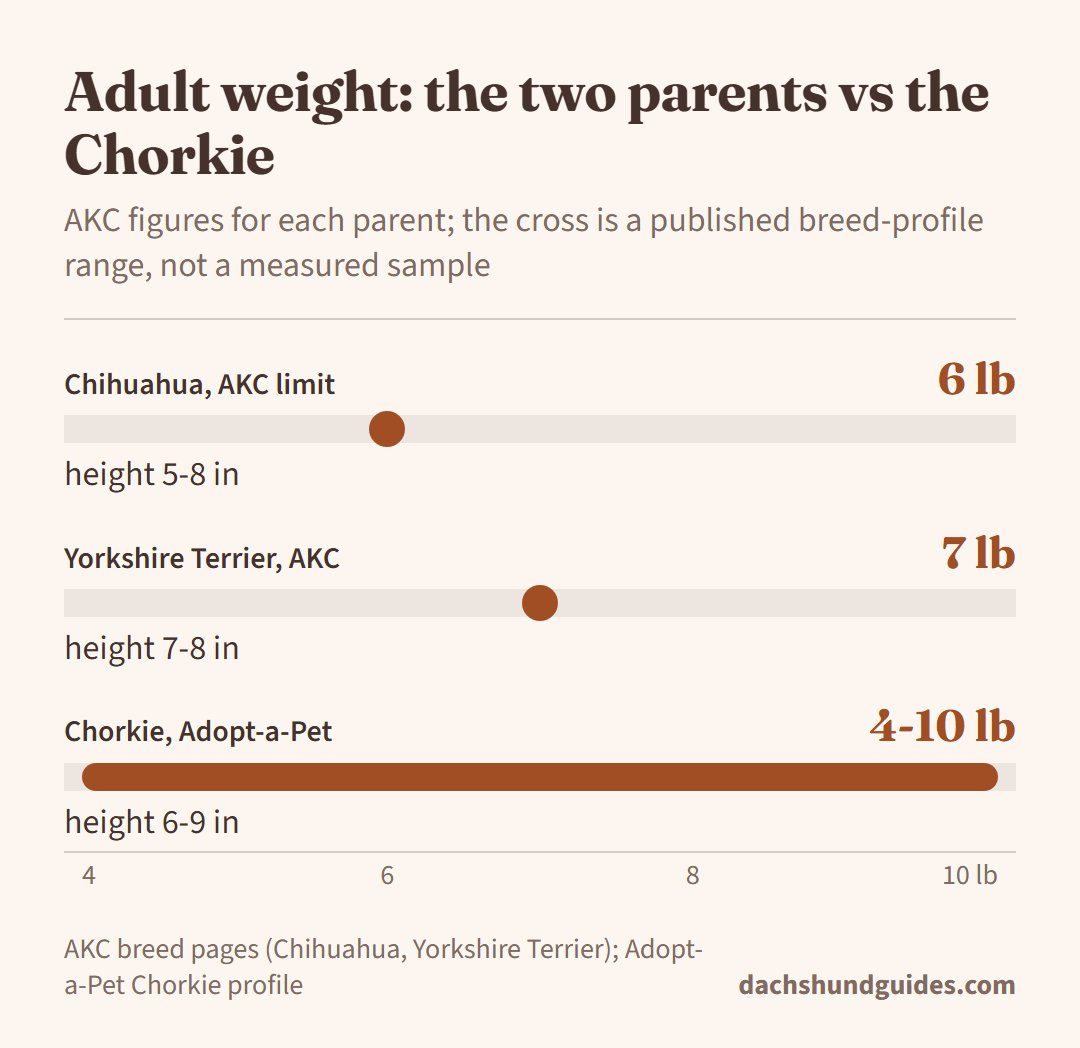
Start with the parents, since they set the frame. The AKC’s Chihuahua page lists 5 to 8 inches and a weight not exceeding 6 pounds. Its Yorkshire Terrier page lists 7 to 8 inches and 7 pounds.
Chewy’s Chorkie page puts a full grown adult under 10 pounds and under 10 inches. Now compare the ends: the 10-pound top of the Adopt-a-Pet range sits above both parents’ AKC figures, so going by the published ranges, the puppy you bring home can finish heavier than either one.
Should you expect a big one? Not really, since the typical figures cluster around 7 pounds. What you can’t do is read your puppy’s adult weight off a breed profile.
So ask the breeder for the actual weights of the puppy’s mother and father. Those two numbers narrow the question in a way a general range can’t.
Teacup Chorkie: a label, not a size
Lancaster Puppies, which sells puppies itself, tells you to avoid breeders who produce extra small “teacup” puppies because of increased health risks.
The Chihuahua parent’s AKC figure already stops at 6 pounds, so a puppy sold as smaller than that sits at the bottom of an already tiny range. Until a seller shows you the parents’ weights, treat the word as a sales label.
What a Chorkie looks like, and how much coat care to expect
Adopt-a-Pet describes a dog whose coat can resemble the silky, medium-length hair of a Yorkie or the smooth, short coat of a Chihuahua. Which coat your puppy has decides your week, and you can’t tell from a photo. PetMD says Yorkie-type hair needs a daily brush and regular baths, while a Chihuahua-type coat gets by with a weekly brush.
Haircuts follow the same split. Adopt-a-Pet says Chorkies need one every month or two, more often when the coat is long and silky. PetMD adds a chore for every coat length: trim the hair around the eyes so it doesn’t irritate them.
A short cut has a catch. PetMD says it can leave a Chorkie needing help to stay warm in cold weather, which is where a sweater earns its place.
What about shedding? PetMD calls it fairly minimal whatever the coat length.
Ask to see both parents when you visit, because PetMD says the grooming load depends on which parent the dog favors. A Yorkie-coated parent means you’re probably signing up for the daily brush.
Do Chorkies have health problems?
Chorkies can inherit the health problems that run in Chihuahuas and Yorkshire Terriers. PetMD lists four to watch: patellar luxation, patent ductus arteriosus (a heart defect present from birth), periodontal disease and tracheal collapse. The cross is still long-lived, with Adopt-a-Pet giving 12 to 15 years.
- Patellar luxation: the kneecap slips out of its groove, and PetMD says it’s more common in small breeds like Chihuahuas and Yorkies. Limping, bunny-hopping and a popping knee are the signs, and severe cases may need surgery.
- Patent ductus arteriosus: a blood vessel that should close after birth stays open, and PetMD says both parent breeds carry increased risk. Surgery works best before the dog develops heart failure.
- Periodontal disease: gum disease that PetMD says small and toy breeds are especially prone to. Its prevention advice is brushing at least three times a week plus professional cleanings.
- Tracheal collapse: a flattened windpipe that causes a recurring cough PetMD compares to a goose honk, worse with exercise, heat, excitement and stress.
Teeth are the one item on that list you can act on from the first week. A thread titled “6 weeks old and first time chorkie owner! Any advice ?” drew this reply from an owner whose dog is now 13:
“O boy, do i have notes for you guys! 1) Early and frequent dental care is essential. Our Chorkie is 13 and has had about 16 teeth removed even with fairly regular brushing. These dogs have notoriously bad teeth and the decay can lead to weight loss and severe…”
– r/Chorkies reply (7 upvotes) [excerpt, 1,482 characters in full]
It’s one owner’s account, not a rate, though it fits what PetMD says about small breeds.
If your dog’s breath is already a problem, the page on why dachshunds have bad breath walks through the usual causes and the brushing routine. Much of it carries over to any small mouth.
None of the four is a disc problem. Bruno’s IVDD episode, surgery and long recovery were a dachshund problem, and PetMD’s list for the cross doesn’t include spinal disease.
If you’re also weighing a dachshund, you’ll find that other set in the rundown of dachshund health problems.
How long will a Chorkie live? Adopt-a-Pet says 12 to 15 years and Chewy says 11 to 16. PetMD points to the parents’ ranges of 14 to 16 and 11 to 15 years and says the cross falls within them.
Temperament: barking, strangers and time alone
PetMD calls the Chorkie’s temperament terrier-like, with plenty of sass and spunk and a need for company. Both parents can have watchdog instincts, which means wariness of strangers and the nonstop barking that goes with it.
Bored, lonely Chorkies are more likely to bark and chew, and wariness of strangers is what owners write in about.
A 2-year-old Chihuahua Yorkie mix named Peach barks at people, dogs and sometimes her own reflection, her owner wrote in r/DogTrainingTips. They hadn’t known a dog should be socialized a lot when it’s young. One reply with 30 upvotes laid out what to do:
“That kind of strong reaction means she’s too stressed to even think. You’ll need to figure out her effective distance, the point where she notices someone else, but before she starts barking or lunging, and t hen practice rewarding her just for looking at the…”
– r/DogTrainingTips reply (30 upvotes) [excerpt, shown in part]
The idea is to find the distance at which the dog notices someone but hasn’t started barking, then practice rewarding her there. You can run the same drill with any dog that doesn’t cope with strangers.
PetMD’s advice comes earlier: expose a puppy safely to animals, people, places and objects during the first 16 weeks, and train with rewards. If you’re starting with a young puppy, that window is yours to use.
Pretzel, my miniature dachshund, barked at everything and tried to escape the backyard fence when he was young. Socializing him at the park with the treat hand-off technique was my fix.
Can a Chorkie be left alone? PetMD says yes, but not for long, because these dogs don’t like being apart from you.
Pretzel had separation anxiety, and it didn’t clear overnight: teaching him to rest six to seven hours alone took eight weeks. He’s a dachshund, so don’t borrow his schedule. The useful part is that the work took weeks, not days.
PetMD also says a Chorkie may not suit a home with very young children or very large dogs, since its toylike size makes accidental injuries easy.
Feeding a Chorkie puppy and keeping the weight steady
PetMD says Chorkie puppies need three or four meals a day to avoid hypoglycemia, which is low blood sugar, while adults can be fed less often, typically two or three times.
Choose a small kibble, since PetMD notes Chorkies have tiny teeth, and you’ll find there’s no one-size feeding chart for the cross, so the bag’s guide and your vet’s number for your dog’s weight and age matter more than any breed table.
Weight creeps up on a dog this small, and you wouldn’t see it from across the room. PetMD says the Chorkie can be prone to obesity and that treats shouldn’t make up more than 10% of the daily diet.
Bruno was nearly 40% overweight before his vet-supervised diet change, and he was moving well within three months. On a Chorkie the gain shows up fast: one extra pound on a 7-pound dog is about 14% of its body weight.
Chorkie puppy price and what to check before you buy
Lancaster Puppies, a puppy marketplace, says a Chorkie from a reputable US breeder typically costs $400 to $800, depending on pedigree quality, health testing and the breeder’s reputation.
It’s a seller’s figure, and the page notes that designer crosses like the Chorkie fluctuate in price because they aren’t an officially recognized breed.
A price tells you little about how the puppy was bred. These checks tell you more:
- Ask whether both parents were genetically tested for the conditions common in Yorkies and Chihuahuas. PetMD recommends a breeder who is committed to health over profit and tests before breeding.
- Ask for the mother’s and father’s actual weights, since no profile can promise how heavy your puppy will finish.
- Walk away from extra small “teacup” puppies. Lancaster Puppies lists increased health risks as the reason.
- Treat a merle litter as a red flag. Lancaster says responsible breeders don’t breed Chorkies with the merle gene because of vision and hearing disorders.
If you’re pricing a Chorkie against a dachshund, the dachshund price guide lays out what a dachshund costs from a breeder.
Choosing between a Chorkie and other small Chihuahua or Yorkie crosses
The AKC lists the Chihuahua at no more than 6 pounds and the Yorkshire Terrier at 7, against 11 pounds and under for a miniature dachshund and 16 to 32 for a standard. Those parent ceilings shape each cross, so match the cross to the size you can live with:
- Smallest frame, no dachshund: the Chorkie, whose parents top out at 6 and 7 pounds.
- Chihuahua plus dachshund: the Chiweenie. Its ceiling depends on which dachshund size is in the mix, and the Chiweenie guide covers size, lifespan and the disc gene the cross carries.
- Yorkie plus dachshund: the Dorkie, covered in the dachshund Yorkie mix guide. It shares the Chorkie’s Yorkie side and adds the dachshund side.
- Chihuahua plus pug: the Chug, whose guide focuses on breathing and risks.
- Chihuahua plus Jack Russell: the Jack Chi, in the Chihuahua Jack Russell mix guide on size, health and temperament.
Not sure you want a cross at all? The Chihuahua vs dachshund comparison sets the Chorkie’s Chihuahua side against a dachshund.
Quick answers about Chorkies
Is a Chorkie hypoallergenic?
No, a Chorkie isn’t hypoallergenic, according to Adopt-a-Pet, though it sheds very little. Dander and saliva proteins can still trigger a reaction, so spend time with the dog before you bring one home.
Is a Chorkie good with children?
A Chorkie can suit a family, but PetMD says it may not be the best choice for very young children or very large dogs, since its toylike size makes accidental injuries easy. Supervise every introduction.
How much exercise does a Chorkie need?
Chewy’s breed page recommends a few short walks a day of about 15 to 20 minutes each. PetMD adds that short walks and indoor games of fetch can cover a Chorkie’s mental and physical needs, which is why the cross suits apartments.
