
Chiweenie Guide: Size, Lifespan and the Disc Gene It Carries

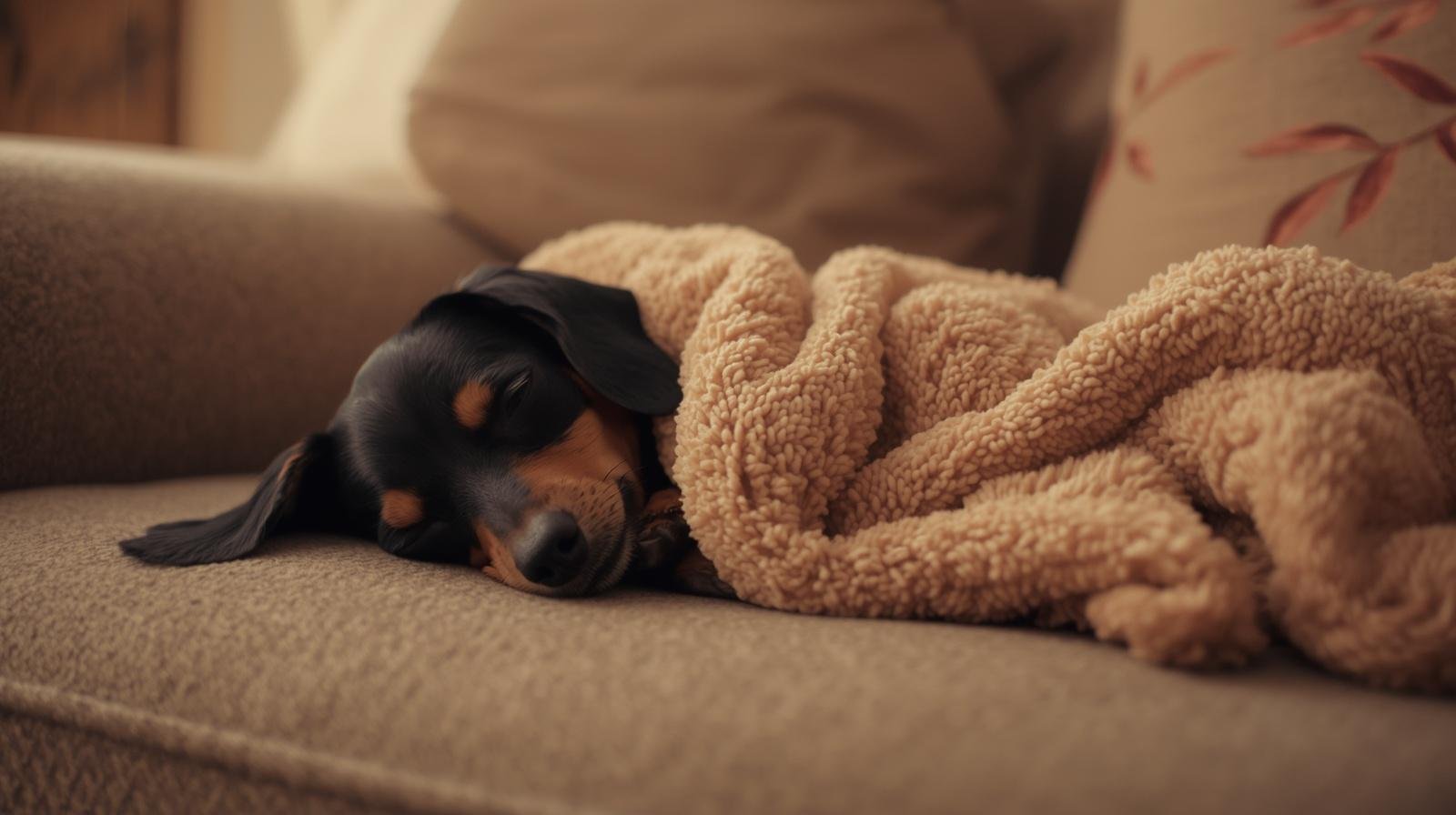
A Chiweenie is a Chihuahua dachshund mix, and the dachshund parent can be a miniature or a standard. It’s a crossbreed, so no kennel club writes a standard for it. Its size, coat and temper land somewhere between two very different parents.
What you can predict is the health side. A first-cross Chiweenie almost always inherits the dachshund’s disc-disease gene, and the Chihuahua half brings that breed’s dental problems. Those two things matter far more than coat color if you’re deciding whether a Chiweenie suits your home.
You’ll also hear it called a Choxie, or simply a Chihuahua mixed with a wiener dog, and the names all describe the same cross.
How big a full grown Chiweenie gets
A full grown Chiweenie usually weighs somewhere between its two parents. It’s the dachshund parent that sets the ceiling: the AKC standard puts miniature dachshunds at 11 pounds and under and standard dachshunds at 16 to 32 pounds, while show Chihuahuas top out at 6 pounds.
Pet Chihuahuas don’t stick to the show standard, though. In VetCompass records for 11,647 Chihuahuas under UK veterinary care, the median adult weight was 3.4 kg, about 7.5 pounds.
So the first question to ask a breeder is which dachshund was used. A pup from a miniature dachshund and a Chihuahua will most likely stay small, while one from a standard dachshund can grow well past the 5 to 10 pounds you’ll often see quoted. No study has weighed Chiweenies as a group, so treat any single number as a guess.
If you’re watching a puppy fill out, our guide on when dachshunds stop growing covers the dachshund side of the timeline.
Chiweenie temperament: what living with one is like
Chiweenie temperament borrows from two breeds that were both bred to be bold. The AKC standard asks a Chihuahua to project “terrier-like” self-importance, confidence and self-reliance, and it calls the dachshund “clever, lively and courageous to the point of rashness.” A Chiweenie can land anywhere between the two, but bold and attached is the mix owners describe most.
Ask owners to name the most Chiweenie behavior and the same answer keeps coming back. In a 2025 r/chiweenie thread with 150 upvotes, the top reply was short:
“Cuddling and always wanting to be touching”
– r/chiweenie, April 2025 (55 upvotes)
The next most popular answers were constant petting and tunneling under blankets, and “velcro dog” turns up in thread after thread.
Research on small breeds points the same way, and at the harder side too. A 2013 study in PLOS ONE by McGreevy and colleagues matched owner questionnaires for 8,301 dogs from 49 breeds against each breed’s average height. The shorter the breed, the more often owners reported attachment and attention-seeking, separation-related problems, touch sensitivity and aggression toward the owner. Lighter breeds were also rated more excitable.
That’s a pattern across breed averages, not a measurement of Chiweenies, and plenty of small dogs show none of it. It does tell you where to put the effort. Get a Chiweenie used to short spells on its own while it’s young, and handle its paws, ears and mouth from puppyhood so nail trims and tooth brushing don’t turn into a fight.
Expect a busy puppy. In a 2024 r/chiweenie thread asking whether they ever settle down (382 upvotes), one owner said hers calmed at around 7 to 8 months, while others posted dogs of 3 and 7 that still tear around the house every evening.
Chiweenie coat and colors
A Chiweenie can be smooth, long-haired or, less often, wiry, and the parents decide which. The AKC recognizes smooth and long coats in the Chihuahua, and smooth, long and wire coats in the dachshund.
A long-haired Chiweenie can come from two smooth parents. Long hair in dogs is recessive: a dog needs two long-hair copies of a gene called FGF5, and a 2026 study in the journal Animals notes that any combination of the known long-hair variants gives the long coat. So a smooth Chihuahua and a smooth dachshund that each carry one hidden copy can have a long-haired pup, and two long-haired parents will have long-haired puppies. The long-haired dachshund guide walks through the same rules on the dachshund side.
A wire-haired dachshund parent adds a third look. Wire dachshunds carry the RSPO2 variant behind the beard and eyebrows, so a pup can inherit that scruffy face.
Color is wide open. The Chihuahua standard allows “any color – solid, marked or splashed,” and dachshunds come in red, cream, black and tan, chocolate and patterns such as dapple and piebald, so you’ll see black, black and white, cream and red Chiweenies and plenty in between. The dachshund colors guide covers the dachshund side.
One pairing deserves a question before you buy: two dapple, or merle, parents. A puppy from that pairing can inherit two copies of the merle gene, and double merles had much higher rates of hearing loss in the study our dapple dachshund guide covers. If either parent is dapple or merle, ask what the other one is.
The dachshund disc gene nearly every Chiweenie carries
Nearly every first-cross Chiweenie carries at least one copy of FGF4L2, one of the two genes behind the dachshund’s short legs and the one tied to its high rate of disc disease. Worked out from published breed frequencies, the odds come to about 97%, and one copy is enough to raise the risk.
The dachshund side does almost all the work. A 2026 study in the journal Genes tested 488 dachshunds registered with the German Dachshund Club and found the FGF4L2 insertion on 96.5% of their gene copies. That’s why a dachshund parent nearly always passes it on.
The Chihuahua side adds a little more. In a 2019 UC Davis study of dogs treated surgically for disc disease, Chihuahuas aged 10 or older with no disc problems carried the gene at a frequency of 0.10, so about 10% of their copies.
Put the two together and a pup has roughly a 97% chance of carrying at least one copy: 1 minus 0.035 times 0.90.
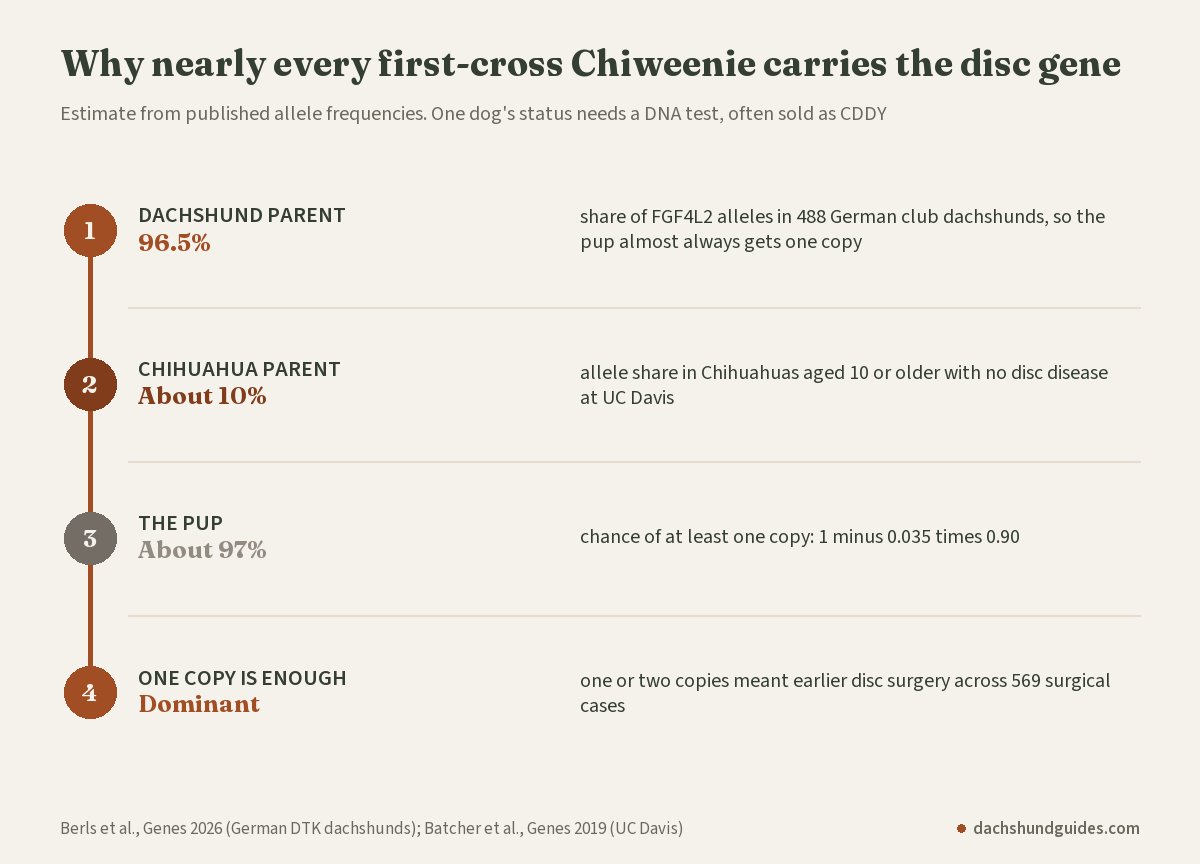
That 97% is our own calculation, not a measured Chiweenie result.
It assumes each parent passes a random copy at its breed’s published rate, and it pairs German club dachshunds with a US hospital sample of Chihuahuas. It also only holds for a first cross. A Chiweenie bred from two Chiweenies, or from a standard wire-haired dachshund (89% in the German data), can come out differently.
Why does one copy matter? The UC Davis team found the gene acts in a dominant way: dogs with one or two copies had their first disc surgery at a younger age. Chihuahuas that carried it had 5.5 times the risk of disc surgery of those that didn’t. The range around that figure was wide, 1.7 to 18.2, because only 60 older Chihuahuas were in the comparison, so don’t read it as precise.
Lowering the disc risk at home
You can’t change the gene, but you can control your dog’s weight. In the Dog Aging Project’s survey of 43,517 dogs, 15.3% of dachshunds had owner-reported disc disease, the highest of any breed, and overweight dogs had 1.67 times the odds. The guide to dachshunds and stairs goes through what that study found about stairs and daily activity.
Keeping a Chiweenie lean is the part you’ll control every day. A dog ramp for the sofa or bed helps if yours likes to leap down.
If you’d rather know than guess, the gene can be tested.
It’s often listed as a CDDY test, the informal name for FGF4L2. The result tells you whether your own dog carries one copy, two or none.
Teeth are the Chihuahua side’s weak spot
Gum disease is the most common problem vets record in Chihuahuas, and a Chiweenie gets half its genes from that side. A VetCompass study found periodontal disease in 13.5% of UK Chihuahuas in a single year, ahead of every other disorder.
The same records show 5.7% had retained baby teeth, where a puppy tooth stays put after the adult tooth comes in. Obesity (5.9%), anal sac impaction (4.9%) and aggression (4.2%) made up the rest of the top five.
For you, that means brushing from puppyhood and asking the vet to look for leftover baby teeth at the puppy checkups. It’s the least exciting part of owning a small dog. It’s also the one the records point at most clearly.
How long do Chiweenies live?
There’s no study that’s followed Chiweenies, so the 12 to 16 year Chiweenie lifespan you’ll see quoted is a borrowed estimate, although the parent data does point to a long-lived small dog: miniature dachshunds had a median lifespan of 14.0 years in a UK study of 584,734 dogs.
That study, published in Scientific Reports in 2024, gave crossbred dogs as a whole a median of 12.0 years. It’s a figure for every kind of mix, big and small, so it isn’t a Chiweenie number either.
The Chihuahua numbers aren’t as bad as they look. VetCompass put the median age at death for UK Chihuahuas at 8.2 years, but the breed’s population there was young and growing fast, which likely drags the figure down. Females lived to a median 10.2 years and males to 6.9.
Heart disease (18.8%), lower respiratory disorders (16.3%) and traumatic injury (13.8%) were the most common causes of death in those Chihuahuas. The dachshund lifespan page covers the other parent in more detail.
Is your dog really a Chiweenie?
Plenty of dogs called Chiweenies are labeled by looks, often at a shelter. A long body and big ears aren’t proof, since other breeds carry them too, and a DNA breed test is the way to know whether a dachshund chihuahua mix really has both parents in it.
It happens more than you’d think. One r/chiweenie post titled “There’s no weenie in my chiweenie” drew 615 upvotes after a test result came back:
“He looks like a classic chiweenie, like so many posted here. But there’s no weenie at all! Half Chihuahua (expected) then poodle! Which is funny because he seems to particularly dislike large poodles”
– r/chiweenie, December 2025 (615 upvotes)
That matters for more than curiosity.
If your dog has no dachshund in it, the 97% estimate doesn’t apply. If it does, a test that reports FGF4L2 tells you whether your own dog carries the disc gene. That’s worth knowing before you let it fly off the couch every evening.
Still choosing between a mix and a purebred? The Chihuahua vs dachshund comparison sets the two parent breeds side by side, and the dachshund mixes guide covers the other crosses.
Chiweenie questions owners ask next
Is a Chiweenie a good dog to have?
A Chiweenie is a good dog to have if you want a small, affectionate companion and someone is home for much of the day. Owners describe them as cuddly velcro dogs, and small breeds on average show more separation-related problems, so a house that’s empty from morning to evening is a harder fit. Budget for back care and dental care, the two health costs the parent breeds point to.
What does a full grown Chiweenie look like?
A full grown Chiweenie usually has a body longer than it is tall, legs on the short side, and the Chihuahua’s large ears, which can stand up or fold over. Its size depends mostly on whether the dachshund parent was a miniature or a standard, and its coat can be smooth, long or wiry, as covered in the coat section above.
How much does a Chiweenie cost?
Chiweenie prices are set by each seller, since there’s no breed club tracking them. Greenfield Puppies, a US puppy listing site, showed Chiweenie puppies at $795 to $895 in October 2026, and a rescue or shelter charges its own adoption fee instead.
What are the downsides of having a Chiweenie?
The two predictable downsides of a Chiweenie are back trouble and teeth: nearly every first cross carries the dachshund disc gene, and gum disease is the top recorded problem in Chihuahuas. Aggression showed up in 4.2% of UK Chihuahuas in the same vet records, more often in males, so early socializing pays off. The guide to socializing a dachshund puppy works for a Chiweenie too.
