
Isabella Dachshund: Blue, Chocolate and the Dilute Gene

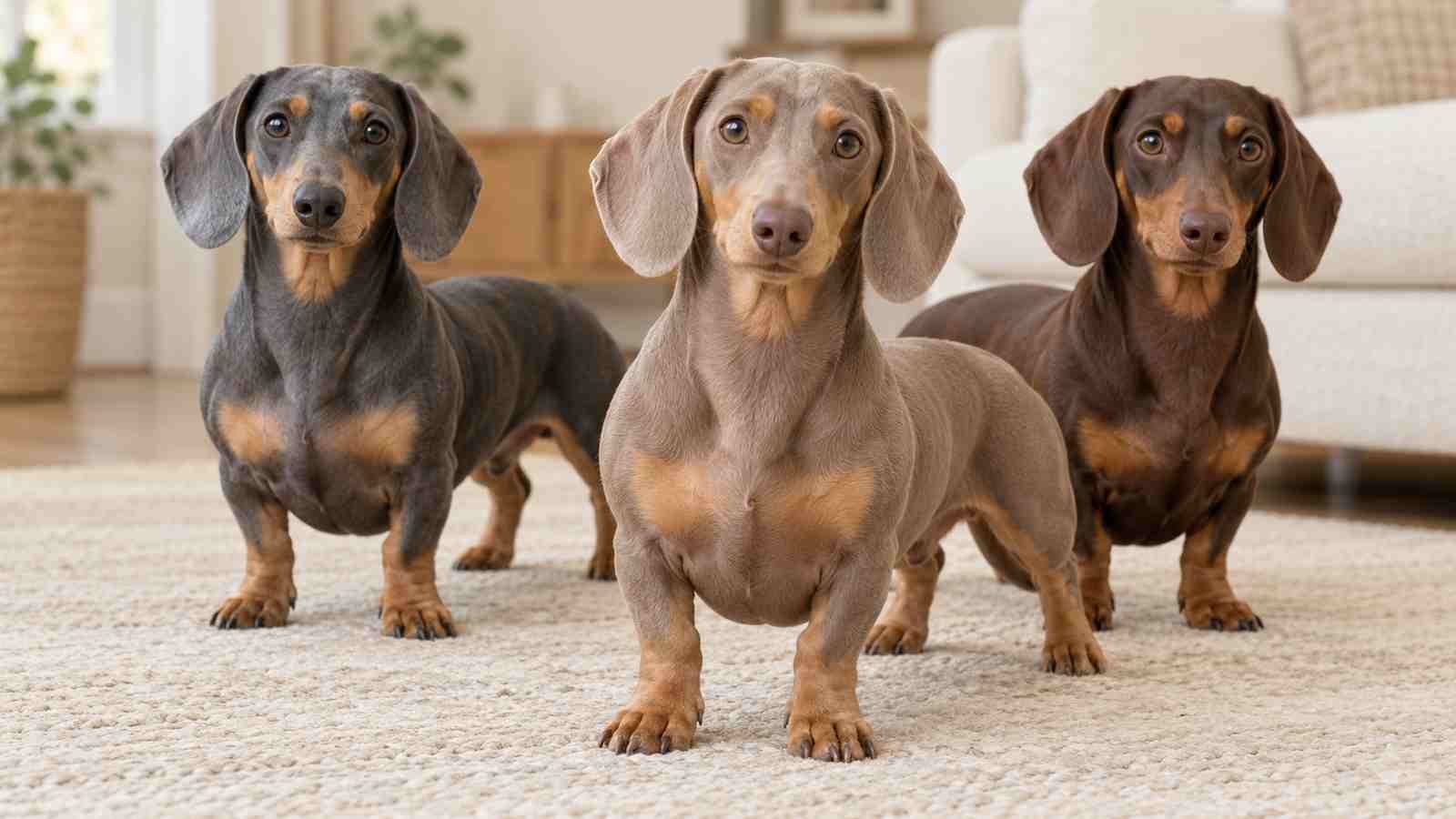
An isabella dachshund is a chocolate dachshund carrying two copies of the dilution gene, which fades the brown to a pale, milky fawn. The AKC breed standard lists it as “fawn (Isabella)”, one of its two-colored dachshunds alongside chocolate and gray (blue), each with tan or cream markings.
Blue works the same way on black. A blue dachshund is a black and tan with the same two dilute copies, so if you’re looking at either color, you’re looking at the same gene and the same coat warning. Chocolate doesn’t carry that warning.
If you’ve got a puppy whose color nobody can agree on, or you’re being quoted extra for a “rare” one, this is what I’d want you to know first.
Isabella, blue and chocolate: two genes make four colors
Two genes decide which of these colors your dachshund ends up with. The brown gene turns black pigment into chocolate, and the dilution gene fades whatever pigment is there. The Dachshund Club of America’s color sheet puts it plainly: gray (blue) and fawn (Isabella) are “dilutes of Black & Chocolate, respectively.”
| The dog you’re looking at | Brown gene (B locus) | Dilution gene (D locus) | Nose and nails in the AKC standard |
|---|---|---|---|
| Black and tan | Not brown | Not dilute | Black |
| Chocolate and tan | Two brown copies | Not dilute | Dark brown, or self-colored |
| Blue (gray) and tan | Not brown | Two dilute copies | Dark brown, or self-colored |
| Isabella (fawn) and tan | Two brown copies | Two dilute copies | Dark brown, or self-colored |
The brown half of that table comes from a 2002 study in Mammalian Genome by Schmutz and colleagues. All 43 brown dogs they tested carried two variants of the TYRP1 gene, and none of the 34 black dogs did. In the red and yellow dogs they also tested, a brown nose matched those same variants perfectly.
Why does that matter to you? A brown nose is a decent first clue that you’re looking at a chocolate-based dog.
The dilute half is recessive. Drögemüller and colleagues, writing in the Journal of Heredity in 2007, described coat color dilution as a “Mendelian autosomal recessive trait” of the MLPH gene. One variant they found matched the dilute look in 65 dilute dogs from seven breeds.
Neither study was about dachshunds, so treat this as general dog genetics.
Recessive means a dog can carry one dilute copy and look completely normal. Two black and tans that each carry one can have a blue puppy, and an isabella needs two copies of the brown gene on top of that.
Dachshund Health UK warns that even a dilute dog’s “normal” colored puppies may carry the gene, which is why it asks owners not to breed from dilute lines at all.
Isabella or chocolate? Check the nose, then test
An isabella dachshund’s coat looks like faded, milky chocolate, which Dachshund Health UK compares to a Galaxy bar, while a chocolate dachshund is a deep, rich brown. Puppy photos aren’t reliable either way, so you’ll only know for sure from a DNA test of the dilution gene.
Owners get this wrong all the time, and so does software. One r/Dachshund owner posted that their breeder called the puppy isabella while Google’s AI said chocolate. The most upvoted answer was blunt:
“Puppy photo looks Isabella to me. Please educate yourself on the risks and problems for dilute coats. Alopecia and allergies are a big one and are often frustrating and painful for the poor thing. Hopefully she’s just a chocolate but won’t know unless you test her.”
– r/Dachshund, September 2026 (21 upvotes)
Another isabella owner in that discussion said the color seems to shift depending on how the light hits it. That’s exactly why a photo can’t settle it.
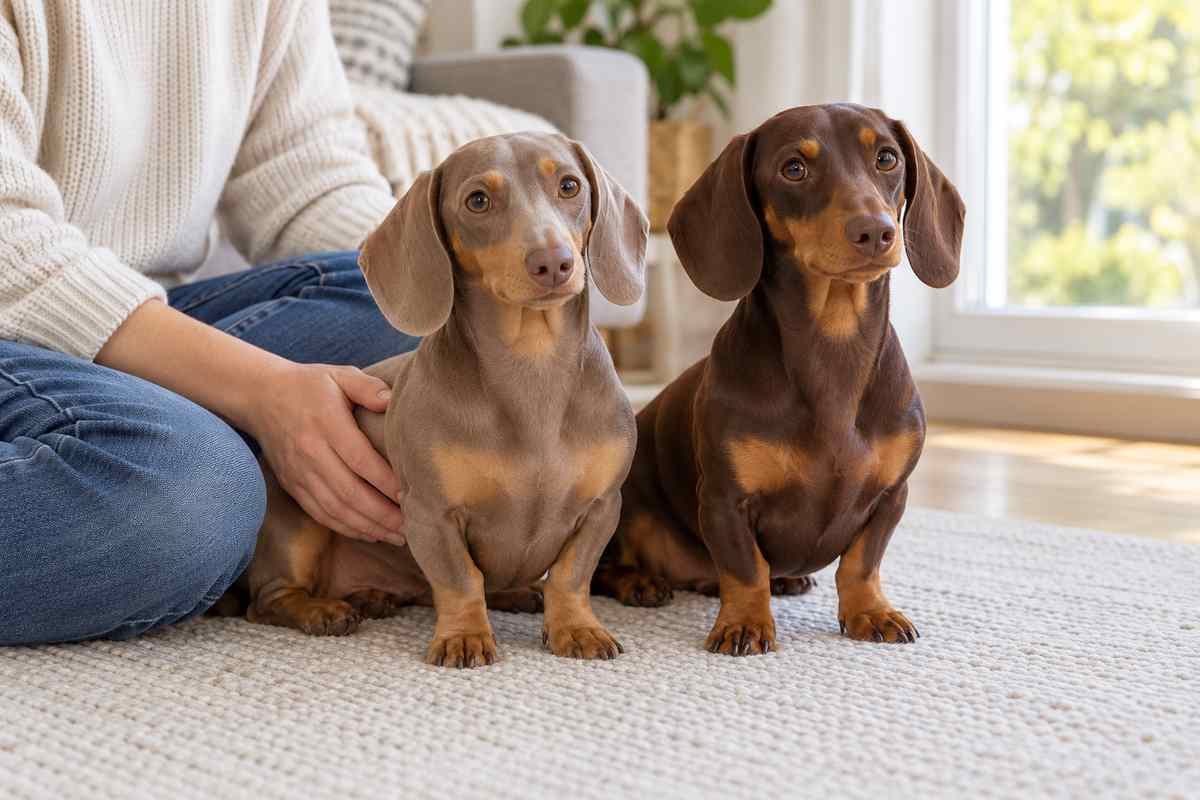
So what can you check at home? Look at the nose. A black nose rules out chocolate and isabella, while a brown one leaves both open, and then you’re down to a test.
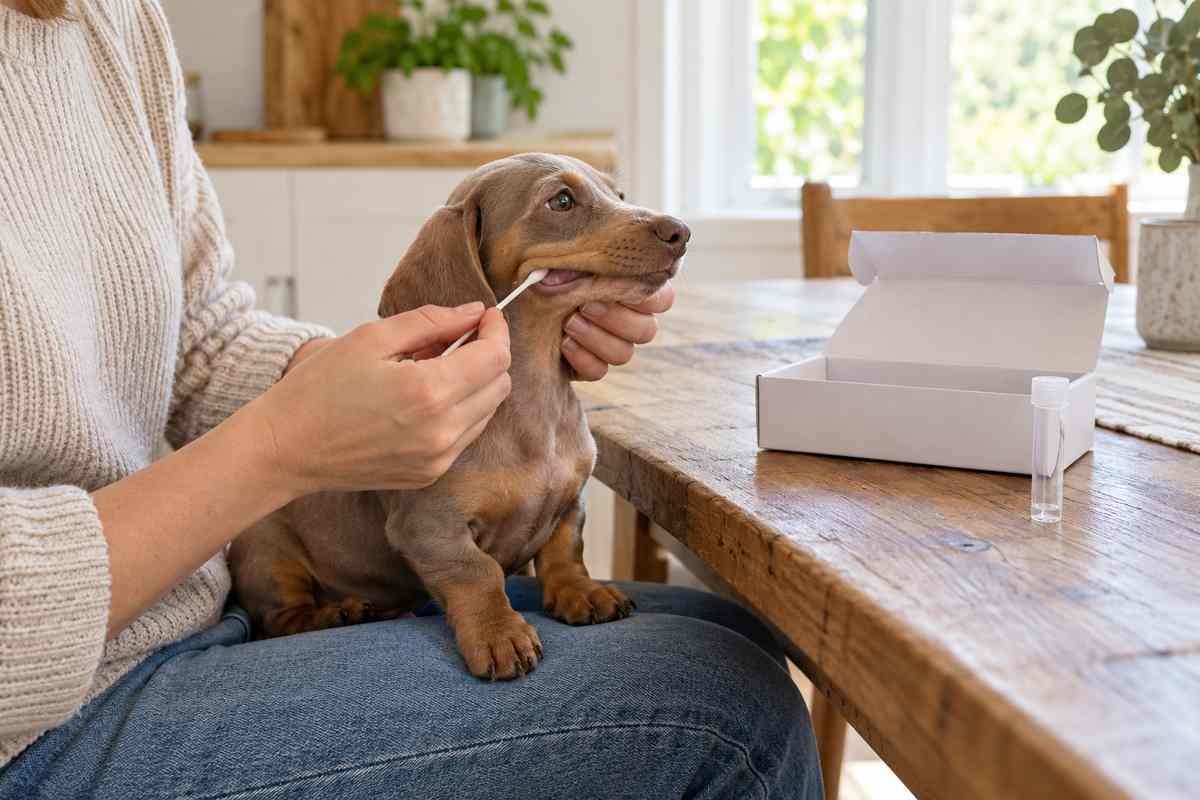
A color test that reads the D locus tells you whether your dog has two dilute copies. One caution: a 2020 paper in Genes by Van Buren and colleagues found a third dilution variant, d3, in several breeds, and said labs need to allow for more than one variant when they read results. Before you pay, ask the lab which dilution variants its panel covers.
You’ll also see isabella called fawn or lilac. Fawn is the standard’s own word, and owners on r/Dachshund describe lilac as the name other breeds use for the same dilute chocolate.
Blue dachshund: a diluted black and tan
A blue dachshund is a black and tan whose black has been diluted to gray, which the AKC standard writes as “gray (blue)”. Its tan points stay tan. Philipp and colleagues, in a 2005 BMC Genetics paper, described the dilute shades as “silvery grey (blue) instead of black” and a sandy isabella fawn in place of brown.
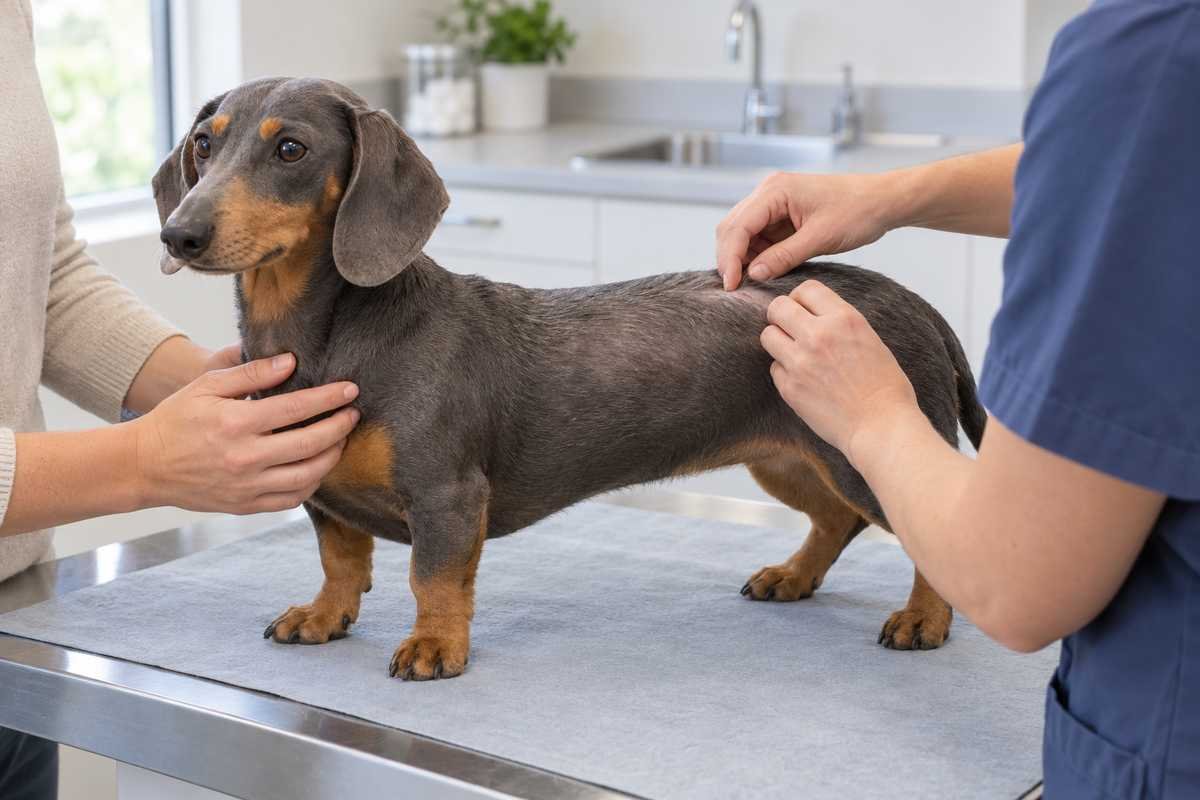
That split between gray and tan matters for the coat. Drögemüller’s paper notes dilution is sometimes accompanied by hair loss and recurring skin inflammation, called color dilution alopecia (CDA). One blue and tan piebald owner described how it stayed in the gray:
“I have a blue and tan piebald dachshund and his CDA didn’t start showing until he lost his puppy coat. Only the areas with the blue fur were affected by CDA, his white and tan fur areas do not have any hair loss at all.”
– r/Dachshund, September 2024 (27 upvotes)
So a blue puppy with a full coat at eight weeks doesn’t tell you much yet.
If you want the black and tan side of the picture, our black and tan dachshund page explains where those points sit on the body.
Do isabella and blue dachshunds have more skin problems?
Yes, on the best data available. In the DachsLife 2021 survey of UK owners, dilute dachshunds were significantly more likely to have a skin or coat condition, with an odds ratio of 1.78. Blue stood out most: 55.4% of blue dachshunds (36 of 65) had at least one.
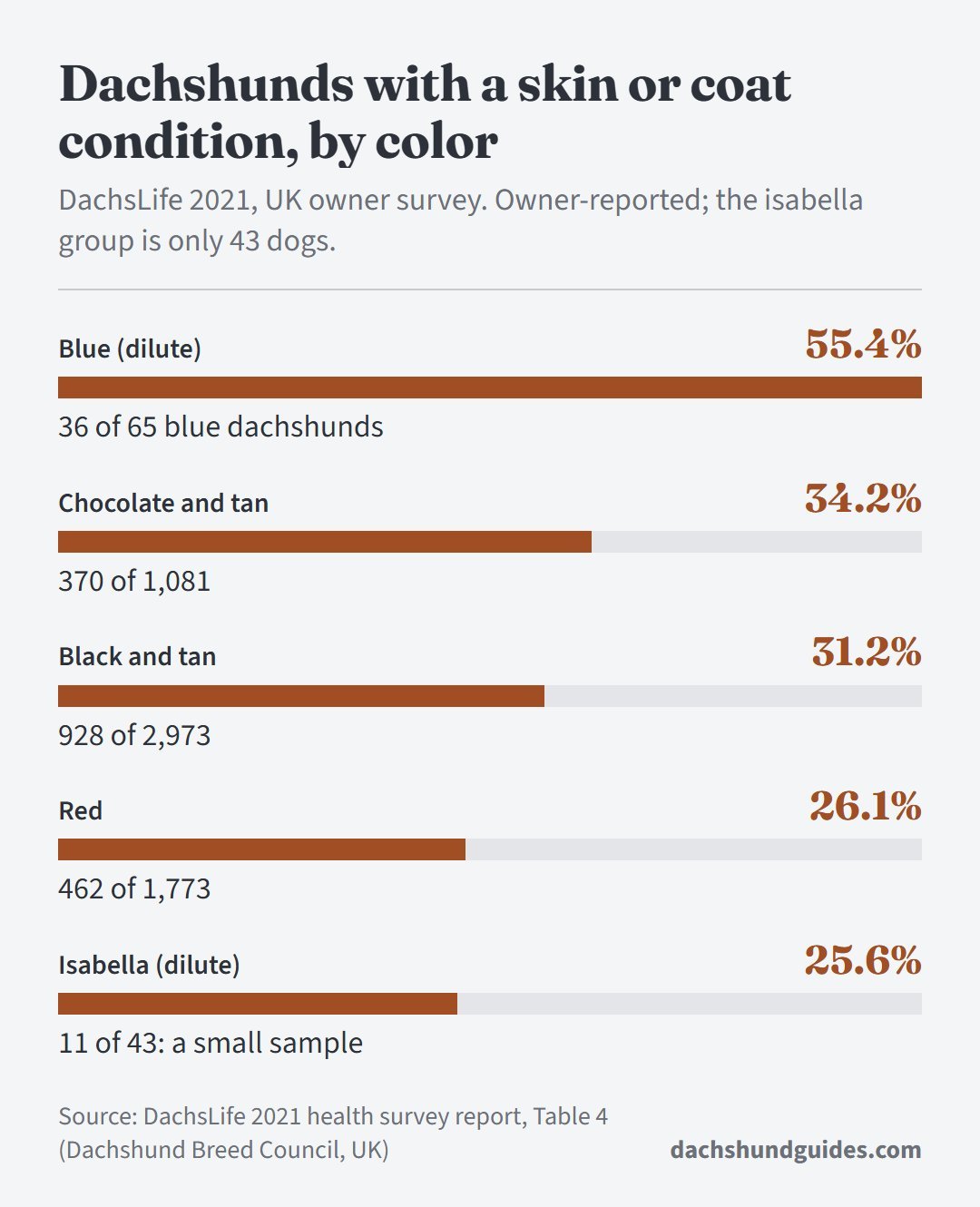
The isabella number needs care. Only 43 isabellas were counted for that question, and 11 had a condition, no higher than red.
The survey’s patterned baldness results point the other way, though. Six of 8 isabellas and 16 of 28 blues were affected, and dilutes had 3.77 times the odds of other colors. With samples that small, I’d read the direction rather than the exact percentages.
I wouldn’t let the 25.6% reassure you about an isabella puppy.
The report also found dilutes were more likely to have color dilution alopecia and autoimmune conditions, but not more likely to have allergies, dermatitis or ear fissures. Chocolate and tan, at 34.2%, isn’t a dilute, and the club sheet attaches no health note to it.
The Dachshund Club of America goes further, saying the dilutes “may also be associated with health issues, such as thin coats, skin sensitivity, vaccine failures and reduced lifespan.” Its sheet doesn’t cite a study for the last two. DachsLife 2021 measured skin and coat, not lifespan, so I haven’t found data behind those.
Dachshund Health UK says there’s no DNA test for CDA itself, and that the test for the dilution gene can’t tell a version that causes CDA from one that doesn’t.
Its advice to you as a buyer is direct: “Do not be tempted to buy ‘rare’ coloured Dachshunds such as Blue or Isabella.”
If your dilute is already losing hair, don’t assume it’s CDA. In the same r/Dachshund discussion as the blue piebald owner above, the top comment (181 upvotes) came from someone whose dog’s similar hair loss turned out to be a food allergy.
Our dachshund hair loss page sets out what your vet will check.
Are isabella and blue dachshunds recognized?
In the US, yes: the AKC standard names gray (blue) and fawn (Isabella) among its two-colored dachshunds. In the UK, no. The Royal Kennel Club’s breed listing for the miniature smooth haired dachshund puts Blue & Tan and Isabella & Tan among its non-breed-standard colours, while Chocolate & Tan is a standard one.
Patterns split the same way. The AKC standard says a dapple’s base “may be any acceptable color”, so an isabella or blue dapple fits its wording, while the Royal Kennel Club lists Isabella & Tan Dapple and Blue & Tan Dapple as non-standard. If you’re looking at a dapple, our dapple dachshund page explains the risk of breeding two dapples together.
How rare are they, then? In the DachsLife 2021 color count, 52 of 9,807 dogs were isabella and 78 were blue, roughly 0.5% and 0.8%, against 1,241 chocolate and tans. That’s a UK owner survey, and the AKC doesn’t publish counts by color, so nobody has a US figure.
For every color and pattern side by side, you can compare them on our dachshund colors overview.
Isabella dachshund questions
How much does an isabella dachshund cost?
There’s no price survey for isabella dachshunds. Dachshund Health UK mentions one dilute puppy advertised in the UK for £6,500, but a single advert isn’t a market price. Our dachshund price page explains what actually moves the cost.
Can an isabella dachshund have long hair?
Yes. Coat length comes from a different gene than color, and the AKC standard gives the longhaired and wirehaired varieties the same colors as the smooth. An isabella and tan longhair is simply an isabella with the long coat, which our long haired dachshund page explains.
Is a chocolate dachshund a dilute?
No. Chocolate comes from the brown gene, not the dilution gene, and the Dachshund Club of America lists chocolate and tan as a base color with no health note. Your chocolate can still carry one hidden dilute copy, though, which is how two chocolates can produce an isabella puppy.
