Wild Boar Dachshund Color Is Common on Wirehairs, Says AKC

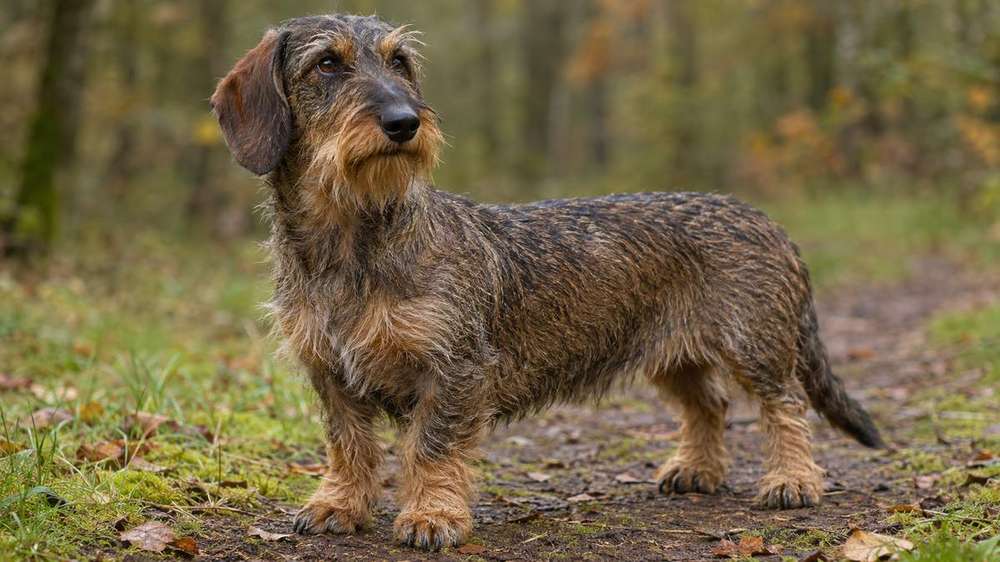
A wild boar dachshund has banded hairs that give the coat a grizzled look. On wirehairs it isn’t rare: the AKC standard names wild boar first in its list of the most common wirehaired colors, next to black and tan and the reds.
I pulled the AKC standard and the Dachshund Club of America (DCA) colors sheet on November 16, 2026, and read every line either one gives to wild boar.
Both are short, and neither uses the word rare. If a seller tells you otherwise, you now know where to check.
How the wild boar coat reads up close
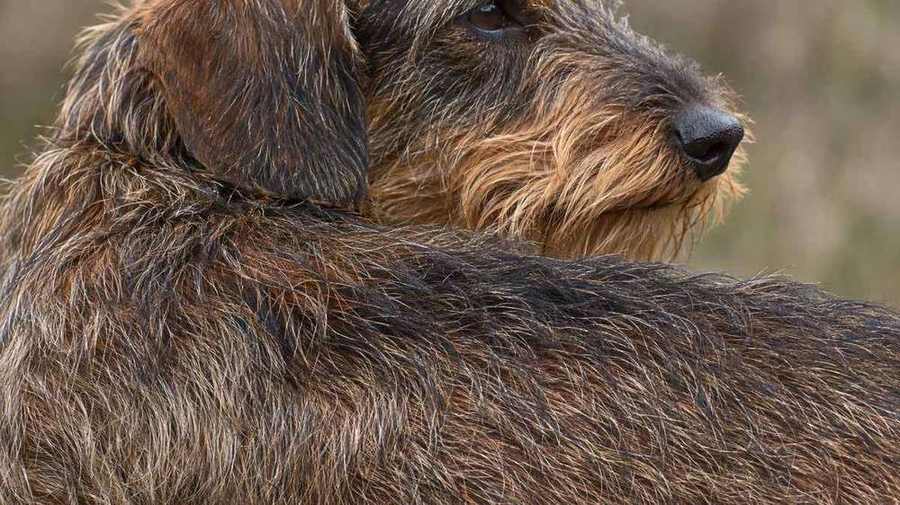
Wild boar isn’t one flat shade. Per the AKC standard, it is agouti, the banded-hair pattern: banding on each individual hair gives the whole coat a grizzled effect.
Part the coat and you’d find the base color closest to the skin, according to the DCA sheet.
Tan points work differently than on a black and tan dog. Black and tan carries them in set places: over the eyes, on the sides of the jaw, inside the ears, on the chest, on the legs and paws, and under the tail.
On a wild boar wirehair, the standard says tan points “may or may not be evident.” So a dog with no obvious tan can still be wild boar, and you shouldn’t rule it out for that reason.
Two variations get names in the standard: red boar and chocolate-and-tan boar. Nose, nails and eye rims are black on wild boar and red boar. On chocolate-and-tan boar they’re self-colored, meaning they match the coat, the darker the better.
When a seller uses either name, you can check the nose, nails and eye rims against that line.
Is a wild boar dachshund rare?
Not on wirehairs. In its wirehaired section, the AKC standard says the most common colors are wild boar, black and tan, and various shades of red. For smooth coats, the DCA sheet says wild boar shows up only “sometimes.”
Here is the wirehaired sentence in full: “While the most common colors are wild boar, black and tan, and various shades of red, all colors and patterns listed above are admissible.” Wild boar comes first on that list.
Smooth coats are the other story. The DCA sheet calls wild boar “more likely a pattern in Dachshunds, seen most typically in Wirehaired Dachshunds (and sometimes in Smooths).”
I found no color counts in either document, so “sometimes” is as precise as the clubs get.
Rarity, then, is a question about coat type. If you’re looking at a wirehair, wild boar is a headline color for its variety. If you’re looking at a smooth, it’s the less usual case.
So what would a seller mean by rare on a wire coat? Nothing the standard backs up.
Hepper’s wild boar article calls the color among the rarest in the breed and says wild boar dachshunds have no red in the coat.
If you’ve read either claim, compare it with the standard: red boar is its own named variation, and the wirehaired wording doesn’t fit “rarest.” In its smooth section the standard says “base color is immaterial,” a line about judging dogs that doesn’t rank colors by value.
If a listing tells you the color is rare, ask which coat it means and read that wirehaired sentence back to the seller.
Smooth, wire or long: where wild boar shows up
The AKC puts wild boar in two places, and the two descriptions don’t match. In the smooth section it sits in the two-colored group with black, chocolate, gray (blue) and fawn, each with tan or cream markings.
In the wirehaired section it’s banding, and tan is optional. Keep that difference in mind when you read a listing.
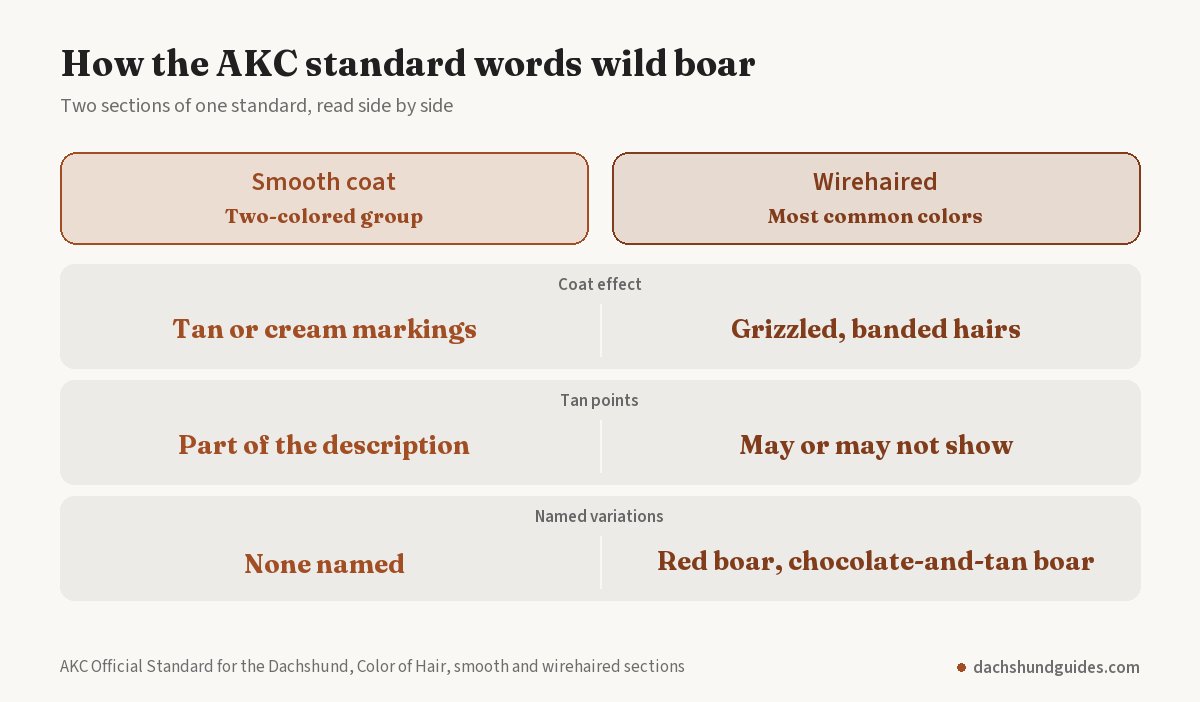
Per the standard, the grizzled effect is “most often seen on wirehaired Dachshunds, but may also appear on other coats.”
Longhaired color is listed as the same as smooth, so a longhair can carry the name too. You’ll find all seven colors and four patterns on the dachshund colors page, and you can read about the coat itself in the wire haired dachshund breakdown.
One r/Dachshund poster had a two-week-old puppy from smooth parents, a red mom and a black and tan dad, and asked how common smooth-coat wild boar is. A reply gave the textbook answer:
“Wild boar is usually associated with wire haired dachshunds. Any photos of the little guy?”
– r/Dachshund reply (1 upvote)
That matches the standard, but it can’t name the puppy’s color. From a description alone, I can’t either.
If you’re in the same spot, you need photos and parent colors, not a guess.
Telling wild boar from black and tan, sable and brindle
Three look-alikes get mixed up with wild boar. The standard’s own definitions are the best tiebreaker you have.
Black and tan
Black and tan has a dark body with tan points in fixed places. On wild boar the hairs themselves are banded, and tan may not show at all.
You can compare a listing photo point by point with the fixed places mapped on the black and tan dachshund page.
Brindle
Brindle, per the standard, is black or dark stripes over the entire body, though in some dogs the stripes show only in the tan points.
Wild boar is banding along each hair, not stripes across the body. Another reply in that same thread put it this way:
“Brindle is more of a striped pattern than what you get in a wild boar coat.”
– r/Dachshund reply
A parentage rule from the DCA also applies: at least one parent must be brindle to produce the pattern.
A different reply asked whether the puppy was just a brindle. Could it be, with a red dam and a black and tan sire? That rule says no. You can see what the stripes look like on the brindle dachshund page.
Sable and red boar
Sable is the confusing one. Per the standard, it is a uniform dark overlay on red dogs, with the tip of each hair much darker than the base color.
Red boar gets named as a wild boar variation without any line on how the two differ, and the DCA says sable is thought to share a gene with wild boar.
A true sable must have a sable parent, the DCA also says. If a seller labels a red dog sable or red boar, you should ask which parent carries it. Shaded reds and sable get their own section on the red dachshund page if you want the full picture.
Wild boar puppies: what you can and can’t know early
I couldn’t find AKC or DCA text on how a wild boar puppy’s coat changes as it grows, so I won’t give you a timeline.
If a breeder gives you one, they are working from their own dogs. That can be useful to you, but it isn’t a rule.
What the documents do give you is the pedigree route. The DCA says color comes down to which pigments a dog’s genes express, and it names only two basic pigments, black and red.
DNA testing gets called helpful for identifying a color or pattern, especially for breeding, which is a fair question to put to a breeder.
I brought Bruno home at twelve weeks, after a four-month wait for the litter. What can a photo of a two-week-old, like the one that Reddit poster saw, tell you? Far less than a twelve-week-old you can meet in person.
Before you reserve anyone, ask for the color of both parents in writing, with photos taken in daylight.
Buying one without paying extra for “rare”
When you read breeder pages, look at how they write the color when they aren’t selling it.
Willow Springs Dachshunds lists its standard wirehairs one line each, such as “She is Wildboar and weighs 23 pounds.” Color sits next to the weight, with no premium language around it, and that’s what you want to see.
Classified adverts read differently. When I pulled the Pets4Homes UK search for wild boar dachshund puppies on November 16, 2026, it returned seven adverts.
Three featured ones were all wire-haired, and one was titled “rare standard wire haired dapple dachshunds.” The word rare was attached to dapple, not to wild boar. If you meet that word in an advert, read it as a sales word, not a color grade.
Then look at what the color actually carries. DCA health notes cover the dilutes, gray (blue) and fawn (Isabella), and double dapples. Wild boar isn’t in either group.
No health note is attached to it, so a seller can’t use the sheet to justify a premium, and you shouldn’t read the silence as a health guarantee.
Here are the questions to put to a seller before you send a deposit:
- Which coat is it, wirehair, smooth or longhair? The DCA calls wild boar most typical on wirehairs.
- What are the registered colors of both parents, and can you see photos taken outdoors?
- Is “rare” standing in for a pedigree? The standard says base color is immaterial when judging dogs, so what does the extra money buy?
- Does the registration paperwork list the color, or only the seller’s description?
To see what you should expect to pay for any dachshund puppy, start with how much dachshunds cost and compare the wild boar quote against that.
For everything that has nothing to do with color, work through the breeder checklist.
Tomorrow morning I’d email the breeder one question: what are both parents’ registered colors? Price talk can wait until you have the answer.
Short answers before you contact a breeder
Are wild boar dachshunds rare?
On wirehairs, no. The AKC standard lists wild boar among their most common colors. On smooth coats the DCA says it appears only sometimes, so if you see it on a smooth, ask more questions.
What is the rarest kind of dachshund?
I found no color counts from the AKC or the DCA, so any ranking is a seller’s opinion. The DCA does flag health concerns for gray (blue), fawn and double dapples. That’s a reason for you to ask more questions, not a reason to pay more.
What does a wild boar dachshund look like?
Per the AKC standard: banded hairs with a grizzled overall effect, black nose, nails and eye rims, and tan points that may or may not show. You should see a grizzled coat, not stripes or clean tan markings.
Can a wild boar dachshund be smooth or long haired?
The standard says the grizzled effect is most often seen on wirehairs but may also appear on other coats, and longhaired color follows the smooth list. If you see it on a smooth or long coat, expect it to be the less usual case.
How much does a wirehaired dachshund cost?
Pets4Homes puts the UK average for a purebred dachshund puppy at approximately £824, and it doesn’t split that by coat or color. Neither the AKC nor the DCA ties price to color, so if you get a wild boar quote far above a breeder’s other colors, ask for the reason in writing.
