
Husky Dachshund Mix (Dusky): Where the Blue Eyes Come From

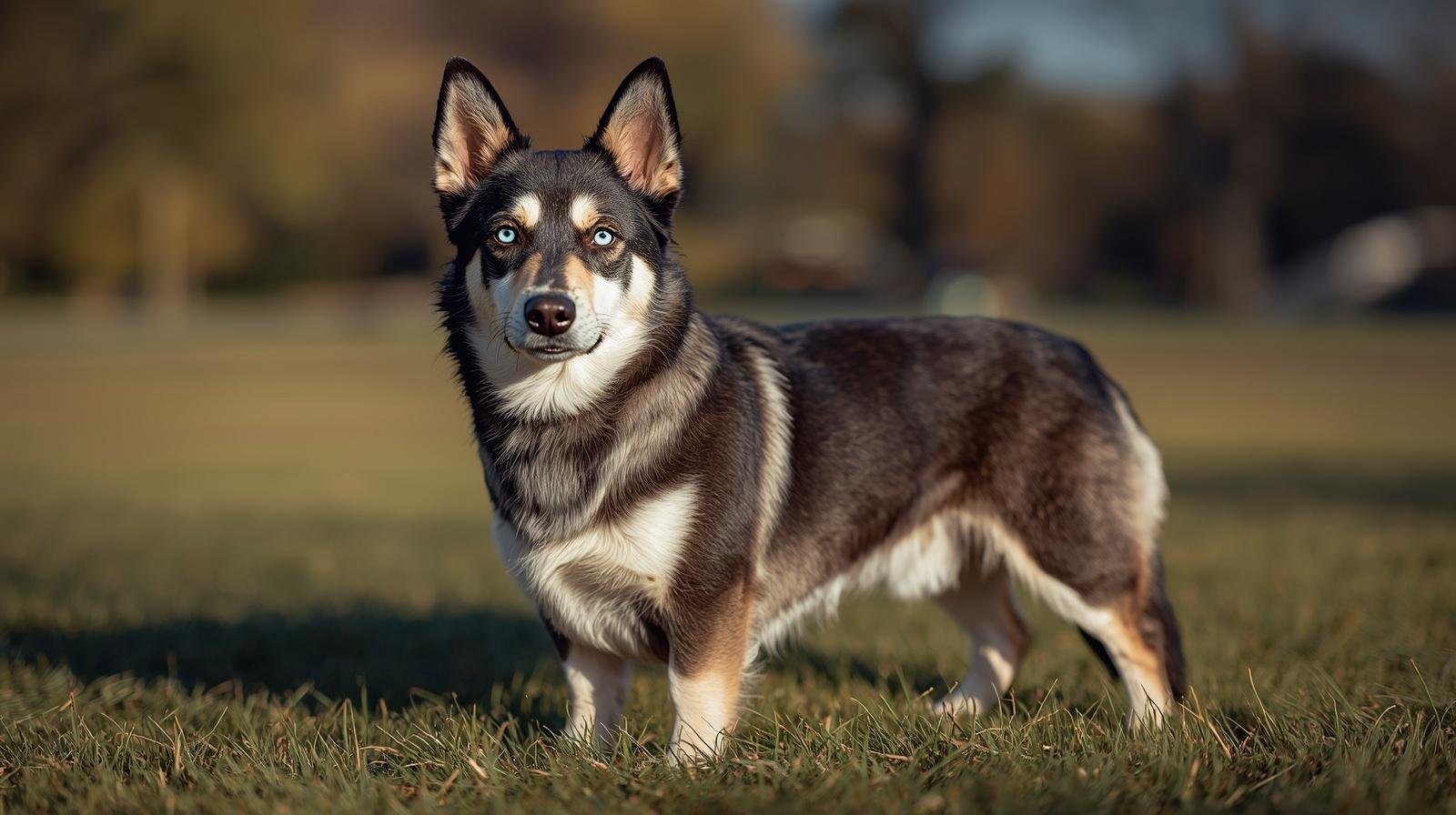
Cross a Siberian Husky with a standard or miniature dachshund and you get a husky dachshund mix, which most sellers call a Dusky. Yours can land anywhere from small to medium, and the blue eyes you’ve probably seen in photos can come from either parent, by two completely different routes.
Which route matters. One is a stretch of Husky DNA that’s been linked only to eye color. The other is the dachshund’s dapple pattern, and that one carries a known risk when two dapples are bred together.
What a Dusky is
Picture a medium-sized sled dog crossed with a short-legged hound, and you’ll see why the range of what you could get is unusually wide. There’s no breed standard and no measured sample of Duskies, so we’ll give you what the AKC lists for each parent instead of inventing a range for the cross:
| Dachshund | Siberian Husky | |
|---|---|---|
| Height | 8-9 in (standard), 5-6 in (miniature) | 21-23.5 in (male), 20-22 in (female) |
| Weight | 16-32 lb (standard), 11 lb and under (miniature) | 45-60 lb (male), 35-50 lb (female) |
| Life expectancy | 12-16 years | 12-14 years |
You’re looking at a spread from an 11-pound miniature to a 60-pound male Husky. Ask which size the dachshund parent was and which sex the Husky was, because those two answers tell you more about your puppy’s adult size than the name does.

Where the blue eyes come from
Researchers pinned down the Husky route in 2018, when they ran a genetic study of eye color on 6,070 dogs whose owners had DNA-tested them and reported their eye color. It’s the largest study of its kind, and it found something none of the breed write-ups mention.
Blue eyes in Huskies track a 98.6-kb duplication on chromosome 18, sitting just upstream of a gene called ALX4 that plays a role in eye development. Largely restricted to Siberian Huskies, the duplication turned up in every one of the 22 blue-eyed purebred Huskies in the study.
Two details matter for a cross. First, the duplication appeared to act dominantly in Huskies, so a single copy was usually enough, and your Dusky can have blue eyes with only one Husky parent. Second, it’s highly but not completely penetrant. The study found a brown-eyed Husky carrying one copy, and dogs with the dominant black mask allele were more likely to have brown eyes despite carrying it. So a Husky parent with blue eyes doesn’t guarantee a blue-eyed puppy.
What the study doesn’t say matters too: it links the duplication to eye color and nothing else, and we’re not going to tell you it’s harmless or harmful, because it didn’t test that.
The dapple route, and the one pairing to avoid
Before the 2018 study, the only known genetic causes of blue eyes in dogs were merle and piebald coat patterns. In dachshunds, merle is called dapple, and the AKC breed standard says partial or wholly blue eyes are as acceptable as dark ones in a dapple.
Piebald won’t give you blue eyes in a dachshund. The Dachshund Club of America says piebalds never have blue eyes, so if your dachshund parent is piebald, any blue in the puppy came from the Husky side.
Here’s where you should pay attention.
The Dachshund Club of America warns that breeding two dogs that both carry dapple can produce double dapples, which are more likely to have deafness, reduced eye size or missing eyes.
Most dachshund breeders, it says, only breed dapples to black and tan or chocolate and tan for that reason.
A first cross between a Husky and a dapple dachshund isn’t that pairing. But a second-generation litter from two Duskies can be, if both came from dapple dachshunds. Can you tell from a photo which route a puppy’s blue eyes took? You can’t, so ask what color pattern each parent and grandparent had.
Our dachshund colors guide covers how to recognize dapple and piebald on the dachshund side.
Health: what each side brings
Nobody has studied the health of this cross, so the only honest way in is through the parents. On paper the two sides look quite different, and you may find the Husky side better than you expected.
The AKC describes the Siberian Husky as a generally healthy, long-lived breed, and says the incidence of hip dysplasia and eye disease is relatively low. The national breed club still recommends hip and ophthalmologist evaluations, plus DNA tests for two neurologic conditions, SPS1 and SHPN1. You can reasonably ask a Husky breeder about all four.
Your dachshund parent contributes the long back. For purebred dachshunds, the DachsLife survey of 2,031 dogs found 15.7% had been affected by disc disease, rising to 24.4% in standard smooth-haired dogs. Dachshund Health UK puts the lifetime risk at around one in four.
These are purebred dachshund numbers, and your Dusky may or may not inherit the long back. If yours does, we’d treat it as carrying the risk. There’s more in our guide to dachshund health problems.
The exercise problem: a runner’s drive on a long back
This is where the parents really pull in opposite directions. The AKC says Siberians were bred to run and will do so at every opportunity, and that they have an overwhelming desire to run.
That’s why the AKC wants them on leash or in a securely fenced area at all times.
Dachshunds, the same organization says, aren’t built for distance running, leaping or strenuous swimming, which means a Dusky can easily end up with all of the Husky’s urge to run packed into a body that was never meant to do it.
So how much exercise does a Dusky need? If yours has the long back, let the back set the limits rather than the energy. Keep it on a leash, because the AKC also says Huskies can’t resist chasing small animals, and it describes the dachshund as bred to be an independent hunter of dangerous prey.

Coat and temperament
Siberians have a double coat, with an undercoat that sheds twice a year and needs raking out with a pin brush and metal comb.
Dachshunds come in smooth, longhaired and wirehaired coats and are moderate shedders, so a Dusky that takes the Husky coat will shed heavily twice a year.
On temperament, the AKC calls Siberians friendly, social and indifferent watchdogs that aren’t suited to being left alone all day. It gives dachshunds a big-dog bark and a watchdog streak.
You’ll probably get a sociable dog that doesn’t like being alone, and whether it barks at strangers depends on which side you got more of.
One owner’s first days show how hard that is to predict. Under an October 2025 r/Dachshund post about bringing home a Dachshund Husky mix (2,486 upvotes), the owner wrote:
“this litter was the first I’ve ever seen of this combo and she was the last of the litter available, I expect her to be talkative but, so far, she hasn’t vocalized at all.”
– r/Dachshund, October 2025 (131 upvotes)
A puppy’s first days won’t tell you its adult voice, but it’s a reminder that a mix doesn’t come with a guaranteed temperament.
Husky dachshund mix: common questions
What is a dachshund husky mix called?
Usually a Dusky, and you’ll also see Dachsky. Neither name comes with a breed standard, so it doesn’t tell you the size, coat or eye color.
How big does a Dusky get?
It depends on the parents. The AKC range runs from 11 pounds and under for a miniature dachshund to 45-60 pounds for a male Husky, and a Dusky can fall anywhere in between. Ask about both parents.
Will my Dusky have blue eyes?
Maybe. One copy of the Husky duplication is usually enough, but it isn’t fully penetrant, and the dachshund side can add blue only through dapple. If both parents of your puppy were Duskies, ask whether either line was dapple.
What’s the best dachshund mix breed?
There isn’t one best cross, because each parent breed brings its own risks along with its looks. Our dachshund mixes page compares the common ones.
