Dachshund Basset Mix (Basschshund): Two Short-Legged Parents, One Back Risk

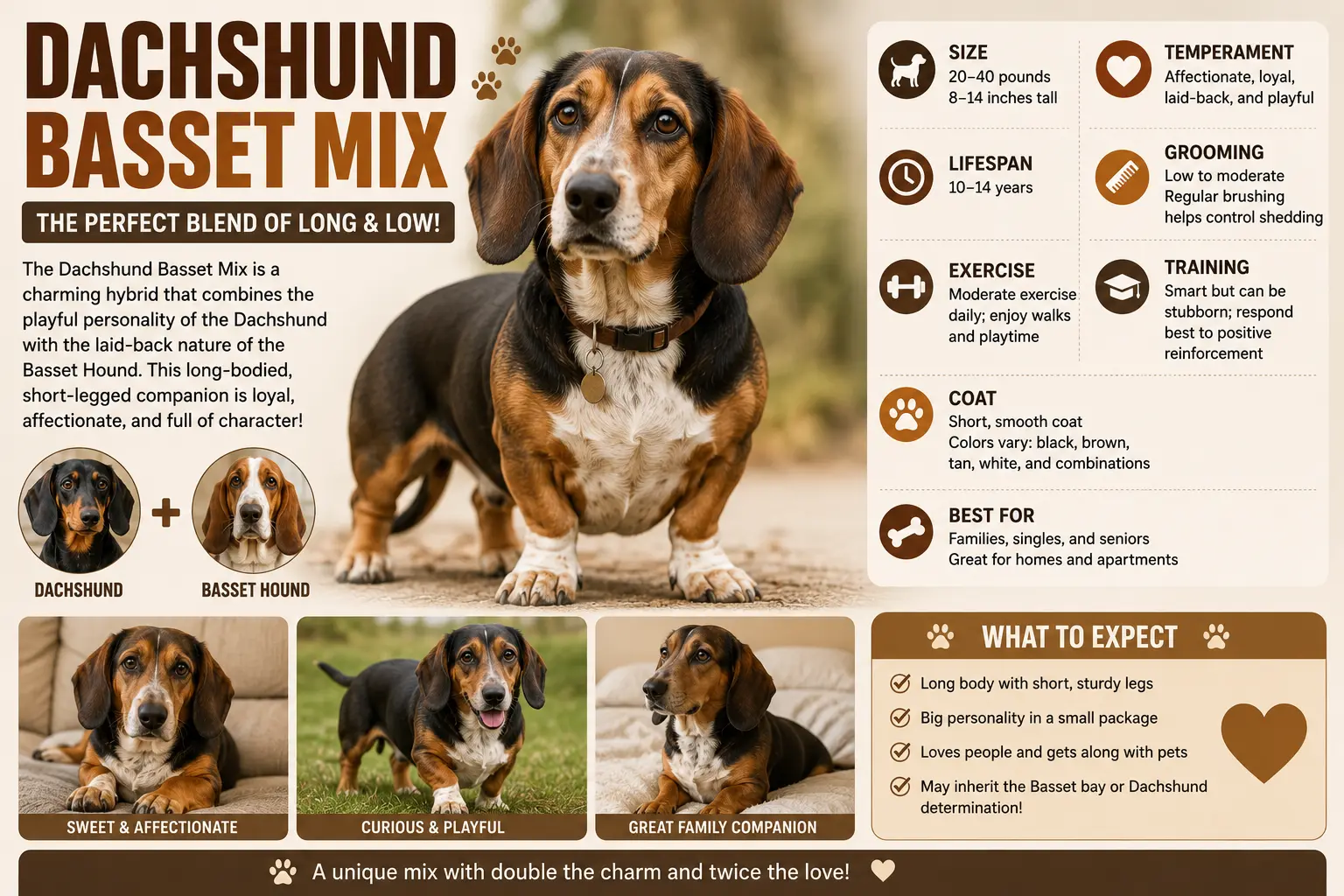
A dachshund basset mix pairs a Basset Hound with a standard or miniature dachshund, and sellers usually call the result a Basschshund. Expect a low, long, heavy-boned hound with a serious nose and a loud voice.
There’s one thing to understand before anything else. Both parents carry the same gene behind disc disease, and that gene is dominant, so crossing them doesn’t water the risk down.
What a Basschshund is
There’s no breed standard and nobody has measured a sample of these dogs, so I won’t give you a size range for the cross. Here’s what the AKC lists for each parent, which is the only reliable data you’ll find:
| Dachshund | Basset Hound | |
|---|---|---|
| Height | 8-9 in (standard), 5-6 in (miniature) | up to 15 in |
| Weight | 16-32 lb (standard), 11 lb and under (miniature) | 40-65 lb |
| Life expectancy | 12-16 years | 12-13 years |
If you look at the weight column, you’ll see a Basset outweighs either size of dachshund, so your puppy’s adult size depends heavily on which dachshund you start with. Ask the breeder which one it was.
If you’re trying to choose between the two purebreds rather than the cross, our Basset Hound vs dachshund comparison is the better page.
Are basset hounds and dachshunds related?
They share the genetics behind their short legs, which is a different thing from sharing ancestors. A 2019 UC Davis study of disc disease describes two extra copies of a growth gene called FGF4, one on chromosome 12 and one on chromosome 18, that each shorten a dog’s legs.
The most severe short-legged build, the authors write, is seen in breeds that carry both copies, and they name dachshunds, Basset Hounds and Corgis. So the two parents look alike for the same genetic reason, whatever their family history.
Why this cross doesn’t dilute the back risk
Here’s the bit that matters to you: only one of those two copies, the one on chromosome 12, is tied to disc disease, and the study found it works in a dominant way. So a single copy is enough to raise your dog’s risk.
Among mixed-breed dogs, carrying it was linked to disc herniation with an odds ratio of 18.42. Within the breeds and mixes where it varies, the relative risk of disc surgery ran from 5.5 to 15.1. Dogs with one or two copies also had their first disc surgery significantly younger.
Now you can see how common it is in each parent:
| Breed | Chromosome 12 copy (disc disease) | Chromosome 18 copy (short legs) |
|---|---|---|
| Dachshund | 0.99 | 0.99 |
| Basset Hound | 0.83 | 1.00 |
Those are allele frequencies from the study’s breed samples, and what they tell you is that a dachshund almost always has the disc-disease copy to pass on to a puppy, while most Bassets have it to pass on as well.
What that means for one puppy
I ran the arithmetic from those frequencies, so treat it as my estimate rather than the study’s finding. With the dachshund parent at 0.99, roughly 99 puppies in 100 will get at least one copy. The chance of a puppy getting two, one from each side, works out to about 0.99 × 0.83, or roughly 82%.
Why does two matter if one is already enough? The study found the copy had an additive effect on disc calcification seen on X-rays, so a second copy isn’t neutral. Cross a dachshund with a breed that doesn’t carry it, and the puppies get at most one; a Basschshund will usually get two.
Still, if your puppy carries it, that isn’t the same as your puppy getting sick. Among purebred dachshunds, the DachsLife survey of 2,031 dogs found 15.7% had been affected by disc disease, and 24.4% of standard smooth-haired dogs. I’ve been through disc surgery and recovery with Bruno, so I’d plan for the possibility from day one rather than hope the cross skipped it.
There’s more on spotting and managing it in our guide to dachshund health problems.
What to ask about on the Basset side
The Basset parent brings its own list, so which tests should you ask a breeder about? The AKC says the breed club recommends an eye exam by an ophthalmologist plus DNA tests for primary open angle glaucoma, MPS I, thrombopathia and Lafora disease, and you can fairly ask to see the results.
The AKC also flags the ears. Long, droopy ears restrict air circulation, so check them often; head shaking or scratching at the ears can mean an infection. If your puppy gets the Basset ears, that check becomes part of your week.
You’ll also want to watch the food bowl, since the AKC says some Bassets are prone to getting overweight and warns that too many training treats can cause obesity, which is worth knowing before the treats start piling up.
Nose, voice and shedding
The Basset’s nose is, in the AKC’s words, second only to the Bloodhound’s in trailing accuracy, and the breed is stubborn on the trail. A dachshund was bred as an independent hunter too. Put those together and you get a dog that’ll follow a scent and ignore you, so keep it on a leash. You should plan for noise as well, because the AKC says the Basset barks in a loud, ringing voice, and it gives the dachshund a big-dog bark.
On exercise, the good news for you is that the two parents agree. Bassets need regular, moderate exercise, and the AKC says a daily walk at a moderate pace usually fills the bill, while dachshunds aren’t built for distance running or leaping.
One owner of the cross describes a calmer puppy than they expected. In an April 2026 r/basset post (347 upvotes), the owner of a 19-week-old Basset and long-haired dachshund mix wrote:
“He is such a dream compared to all the dachshund puppies I’ve raised. Any tips on basset quirks are appreciated. He seems to be especially chill for a puppy.”
– r/basset, April 2026 (347 upvotes)
You’ll be living with hair, too. The Basset’s short coat can shed profusely, according to the AKC, and dachshunds are moderate shedders, so plan on brushing your dog at least once a week.
Dachshund basset mix: common questions
What is a basset hound dachshund mix called?
You’ll most often see it called a Basschshund. The name doesn’t come with a breed standard, so it won’t tell you the size or coat.
How big does a Basschshund get?
It depends on the parents. The AKC lists Bassets at up to 15 inches and 40-65 pounds, standard dachshunds at 16-32 pounds and miniatures at 11 pounds and under, and a cross can land anywhere in that span.
Is a Basschshund less likely to have back problems than a dachshund?
Not on the genetics, as far as you can tell from the parents. Both parents usually carry the dominant copy linked to disc disease, and a Basschshund will often carry two. No study has measured disc disease in the cross itself.
What are some popular dachshund mix breeds?
Our dachshund mixes page compares the common crosses and what each parent brings.
