Can Dogs Eat Cheez Its? Yes, but the Flavor Is the Catch

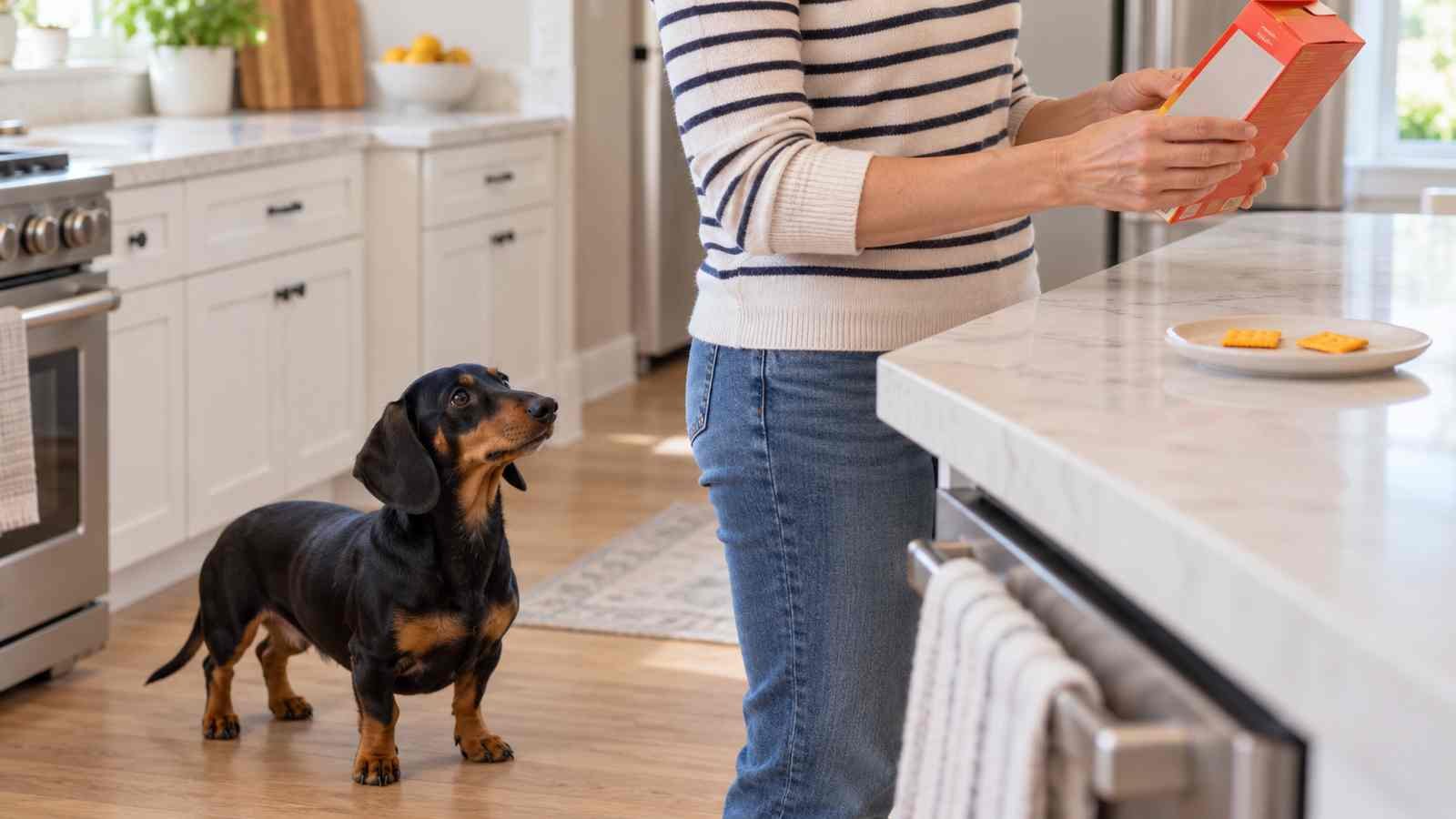
Can dogs eat Cheez Its? A healthy dog can eat one or two plain Cheez-It Original crackers without harm, though they’re a salty, fatty snack your dog doesn’t need.
The bigger risk is flavor, since 12 of the 21 Cheez-It flavor labels I went through on the brand’s own site list onion or garlic.
So if your dog just snatched one off the kitchen floor, you can relax. If it was a Cheddar Jack, a Hot & Spicy or most of a big box, the answer shifts, and the back of the box tells you how far.
Can dogs eat Cheez Its in every flavor?
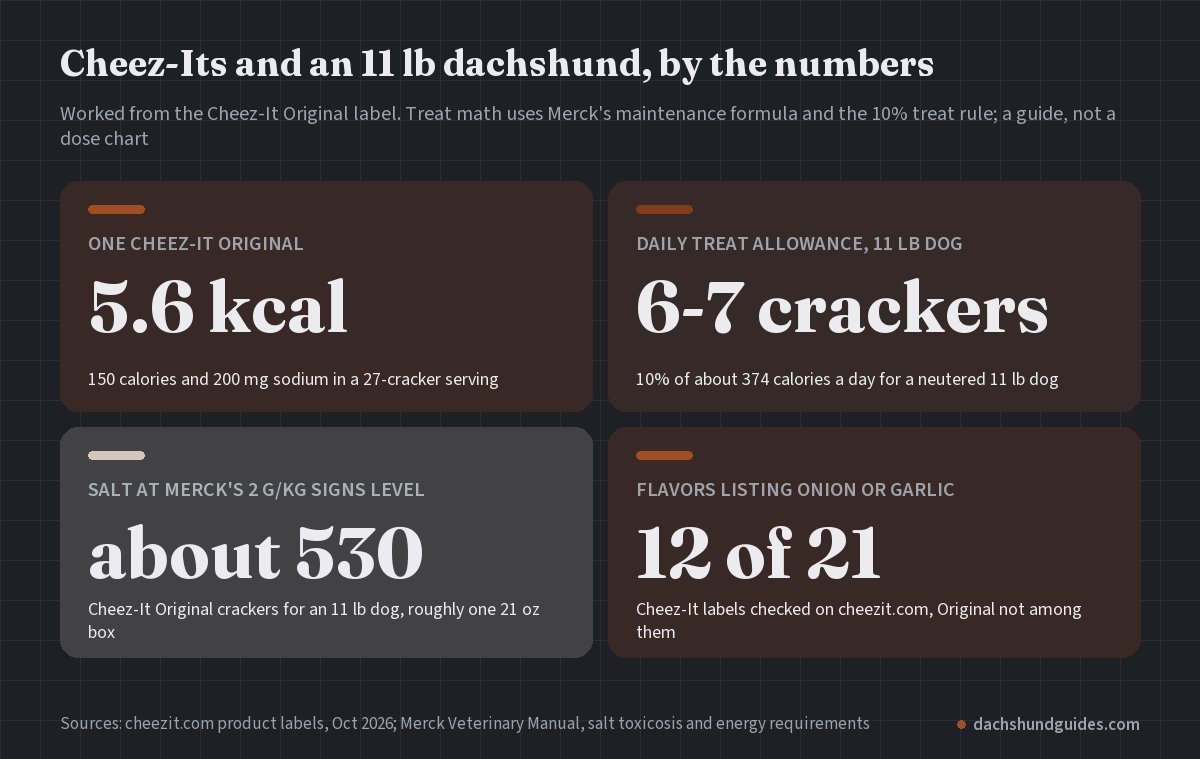
Dogs shouldn’t eat every Cheez-It flavor, because 12 of the 21 cracker flavors I went through on cheezit.com list onion or garlic, including Cheddar Jack, Hot & Spicy, Buffalo Wing and Italian Four Cheese. Original, White Cheddar, Pepper Jack and Reduced Fat list neither, going by the brand’s own ingredient panels.
| Lists onion or garlic | Lists neither |
|---|---|
| Cheddar Jack | Original |
| Italian Four Cheese | White Cheddar |
| Hot & Spicy | Pepper Jack |
| Buffalo Wing | Whole Grain |
| Smoked Cheddar | Reduced Fat |
| Smoked Gouda | Extra Toasty |
| Extra Cheesy | Extra Cheesy White Cheddar |
| Extra Crunchy Bold Cheddar | Extra Big |
| Extra Toasty Cheddar Jack | Grooves Sharp White Cheddar |
| Grooves Zesty Cheddar Ranch | |
| Grooves Bold Cheddar | |
| Grooves Loaded Nacho |
The names won’t always warn you. Smoked Gouda and Extra Cheesy sound like plain cheese crackers, yet Smoked Gouda lists onion powder and Extra Cheesy lists garlic.
Snap’d chips, Duoz and the snack mixes weren’t on my list, so turn those bags over yourself.
Why does a little powder matter? The Merck Veterinary Manual ties onion poisoning in dogs mostly to concentrated forms “such as dehydrated flakes, powders, or dry onion soup mixes.” It also puts garlic at three to five times more toxic than onion.
On all 12 labels, the onion or garlic sits after the line “Contains 2% or less of.” That caps it at a small share of each cracker. But the label doesn’t say how small, so you can’t turn a handful into a dose.
A single seasoned cracker probably carries very little, but I’d still keep those flavors away from a small dog altogether.
The damage can also arrive late. Merck notes that signs of red blood cell damage, such as weakness, paleness, yellowing and collapse, develop several days after a dog eats onion or garlic. A dog that seems fine that evening isn’t in the clear yet.
Original Cheez-Its don’t carry that problem. The Cheez-It Original ingredient panel is short: enriched flour, vegetable oil and cheese made with skim milk, then salt, paprika, yeast, paprika extract color and soy lecithin. If my dogs ever raid a box, that’s the one I’d want it to be.
How many Cheez-Its can a dog eat?
A small dog can have about six Cheez-It Original crackers in a day before the snack breaks the 10% treat rule. An 11 lb neutered dog needs roughly 374 calories a day by the Merck Veterinary Manual’s formula, and each cracker is about 5.6 calories.
The label math is simple. Cheez-It lists 150 calories and 200 mg of sodium for 27 crackers, so one cracker is about 5.6 calories and 7.4 mg of sodium. AKC and Purina both keep treats at or below 10% of a dog’s daily calories.
For your dog’s daily number, Merck works from body weight: 70 times the weight in kilograms to the power of 0.75, then times 1.6 for a neutered adult.
The AKC breed standard puts miniatures at 11 pounds and under, and an 11 lb dog comes out near 374 calories.
Ten percent of that is about 37 calories, or 6 to 7 crackers. If your vet says your dog is obesity prone, Merck’s lower multiplier brings it closer to 6. A 25 lb standard dachshund lands near 692 calories, which leaves room for about 12.
Treat that ceiling as the whole day’s treats, not a cracker allowance on top of them, because Merck also says any calorie formula is a starting point and your dog can need as much as 30% more or less than its weight suggests.
I count treats now because Bruno was nearly 40% overweight before his vet moved him onto Hill’s w/d. He still begs at the stove for chicken with a face that could sell anything.
Six crackers look like a snack to me, but they’re a tenth of a small dog’s whole day. If your dog’s carrying extra weight, the food for overweight dachshunds that worked for us is a better place to spend those calories.
Can Cheez-Its kill a dog?
Cheez-It Original crackers are very unlikely to kill a dog through salt alone. The Merck Veterinary Manual puts the first signs of salt poisoning in dogs at 2 to 3 g of salt per kg of body weight, which for an 11 lb dog works out to about 530 crackers, roughly a whole 21 oz box.
Here’s how that comes together. Each 30 g serving has 200 mg of sodium, which is about 0.51 g of salt. An 11 lb dog weighs about 5 kg, so 2 g per kg is 10 g of salt, or about 20 servings.
A 25 lb dachshund would need around 45 servings, more than two of those boxes.
That’s the point where signs can start, not a safe amount, and water matters. Merck says salt poisoning is unlikely as long as a dog’s sodium control works normally and fresh water is available. So after a raid, keep your dog’s bowl full.
Fat is the nearer problem with a big helping. The Original label lists 8 g of fat per 150 calories, about 53 g per 1,000 calories. Merck’s feeding advice for dogs with pancreatitis stays under 20 g of fat per 1,000 calories, and it lists dietary indiscretion as a common risk factor in dogs.
Has your dog had pancreatitis before? Then a raided box is worth a call to your vet, even when the salt math looks comfortable.
My dog ate Cheez-Its: what should I do?
If your dog ate a few plain Cheez-Its, give fresh water and watch for vomiting or diarrhea. If it ate a flavor that lists onion or garlic, or most of a box, call your vet or ASPCA Animal Poison Control at (888) 426-4435 with the bag in your hand.
Find the bag before you dial. The flavor name and the ingredient panel are what a vet will ask about first, along with roughly how many crackers are gone and what your dog weighs. ASPCA asks owners to note the amount eaten, and its poison line says a consultation fee may apply. It’s worth saving that number in your phone; it’s the same line I’d ring if a dog got into grapes or raisins.

Expect your dog to drink more. ASPCA links excess salt to increased thirst and urination, and it lists vomiting, diarrhea, tremors and seizures among the signs of salt toxicity. With an onion or garlic flavor, you’ll want to keep watching for several days, since Merck places the anemia signs well after the meal.
Can dogs eat crackers like Ritz and Goldfish?
Dogs can have a plain cracker now and then, but Ritz and Goldfish aren’t better swaps for Cheez-Its. Ritz Original carries about 26 mg of sodium per cracker in USDA’s FoodData Central record, and the Goldfish Cheddar record lists onion powder among its ingredients.
A Ritz is bigger than a Cheez-It, which is where that sodium gap comes from. Five Ritz crackers weigh 16 g and come to about 80 calories, roughly the same as 14 Cheez-Its. The Ritz Original record lists no onion or garlic, so one dropped on the floor is about as harmless as an Original Cheez-It.
Goldfish are the ones I’d keep out of reach. Your dog can vacuum up a lot of tiny fish before you notice, and 55 pieces come to about 140 calories and 250 mg of sodium. That’s more salt per gram than Cheez-It Original, before you count the onion powder.
Cheese crackers from any brand follow the same rule. Plain cheddar is a salty snack, while anything sold as ranch, nacho, sour cream and onion or garlic is the box you’ll want to keep closed.
Why is my dog obsessed with Cheez-Its?
Dogs who fixate on Cheez-Its are probably reacting to the smell of baked cheese and to a crinkly box they’ve learned to connect with food. Some owners put that to work. One r/puppy101 owner keeps White Cheddar Cheez-Its as a high-value training reward:
“this dood will stare at the Cheez Itz box or race into the pantry when we go in there just to see if they are still there.”
– r/puppy101, June 2022
If your dog’s that kind of fan, a broken piece of an Original or White Cheddar cracker saved for big moments, like a recall at the park, is a fair use of it, as long as you count it toward the day’s treats.
ASPCA notes that pets don’t make much lactase, so a dog that gets loose stools from dairy may not handle cheesy snacks well.
Before you share from any box, turn it over and find the “Contains 2% or less of” line. If onion or garlic is sitting there, that box stays on the counter.
