Are Elevated Dog Bowls Good for Dogs? For a Few, Yes

Elevated dog bowls are good for a short list of dogs: dogs with megaesophagus, dogs healing from a neck disc, and stiff seniors who struggle to lower their heads. If your dog is healthy, a raised bowl won’t change much, and in large, deep-chested breeds a Purdue study linked raised bowls to more cases of bloat.
I live with two dachshunds, and Bruno has already been through a spinal disc episode and surgery, so I don’t treat mealtime posture as a small question. So are elevated dog bowls good for dogs built like him and Pretzel, my miniature? Mostly they’re beside the point, because the right bowl height for a dachshund lands a couple of inches off the ground at most.
What did the Purdue bloat study find?
The Purdue study, published in JAVMA in 2000, followed 1,637 large and giant breed dogs and found that a raised feeding bowl was one of four factors tied to more bloat, alongside older age, a close relative with bloat and fast eating.
Bloat in this study means gastric dilatation-volvulus, or GDV. The stomach fills with gas and can twist on itself, and it’s an emergency you can’t wait out at home. Lawrence Glickman’s team recruited dogs at shows, measured their chests, then checked in with owners about once a year. Over the study, 6% of the dogs developed GDV.
The number you’ll see quoted is the next one. The team estimated that about 20% of the GDV cases in the large breeds and 52% in the giant breeds were attributable to a raised bowl.
In plain English, attributable means that if those bowls had sat at ground level and nothing else had changed, the study’s math expects that share of cases not to happen. It’s an estimate from one group of dogs, not proof that a stand twists a stomach. You can find the full abstract on PubMed if you’d like the original wording.
Look closely at who was in it, though. The 1,637 dogs came from eleven breeds: Akita, Bloodhound, Collie, Great Dane, Irish Setter, Irish Wolfhound, Newfoundland, Rottweiler, Saint Bernard, Standard Poodle and Weimaraner.
There wasn’t a dachshund among them, or any small breed. So the study can’t tell you a raised bowl is risky for your dachshund, and it can’t tell you it’s safe either.
Owners remember the old advice going the other way, and one comment on r/DogAdvice sums up the shift better than I can:
“I wouldn’t recommend an elevated dog bowl, unless your dog is older/less mobile and really needs it to make it easier to access. For a long time we thought elevated dog bowls would decrease the risk of bloat, but newer studies indicate that it possibly does the opposite and increases the risk (I believe primarily large and giant breeds were looked at since those are the breeds most at risk).”
– r/DogAdvice, June 2026 (48 upvotes)
Eating speed showed up as its own risk factor in the same study. For a big dog that inhales dinner, I’d slow the meal down before I touched the bowl height, since that’s the lever the Purdue numbers point to.
When are elevated dog bowls good for dogs?
Elevated dog bowls earn their place when lowering the head hurts the dog or works against it: megaesophagus, a neck disc that’s healing, and arthritis that makes the dip to the ground painful. Each case needs its own setup, and you’ll find a store-bought stand only fits some of them.
Jenna Beyer, a Petco veterinarian answering an owner of a 105-pound dog, put it this way: raised bowls don’t help or hurt the average large dog, but they may be needed for megaesophagus or neck or back issues.
Megaesophagus
Megaesophagus is a stretched, weak esophagus that can’t move food down, so your dog brings food back up soon after eating.
Merck’s guidance for owners is specific: feed with the upper body raised at least 45 degrees, with the dog standing on a ramp or with its front legs on a platform, then keep the dog upright for at least 15 minutes. It’s all on Merck’s esophagus disorders page.
That’s a posture, and a short stand under the bowl doesn’t create it. Some owners use an upright feeding chair, known as a Bailey chair, to hold the angle.
Merck lists the inherited form in Wire-haired Fox Terriers and Miniature Schnauzers, with family tendencies in German Shepherds, Great Danes and a few others. Dachshunds aren’t on that list, although adult dogs of any breed can develop it alongside other diseases.
Neck disc recovery
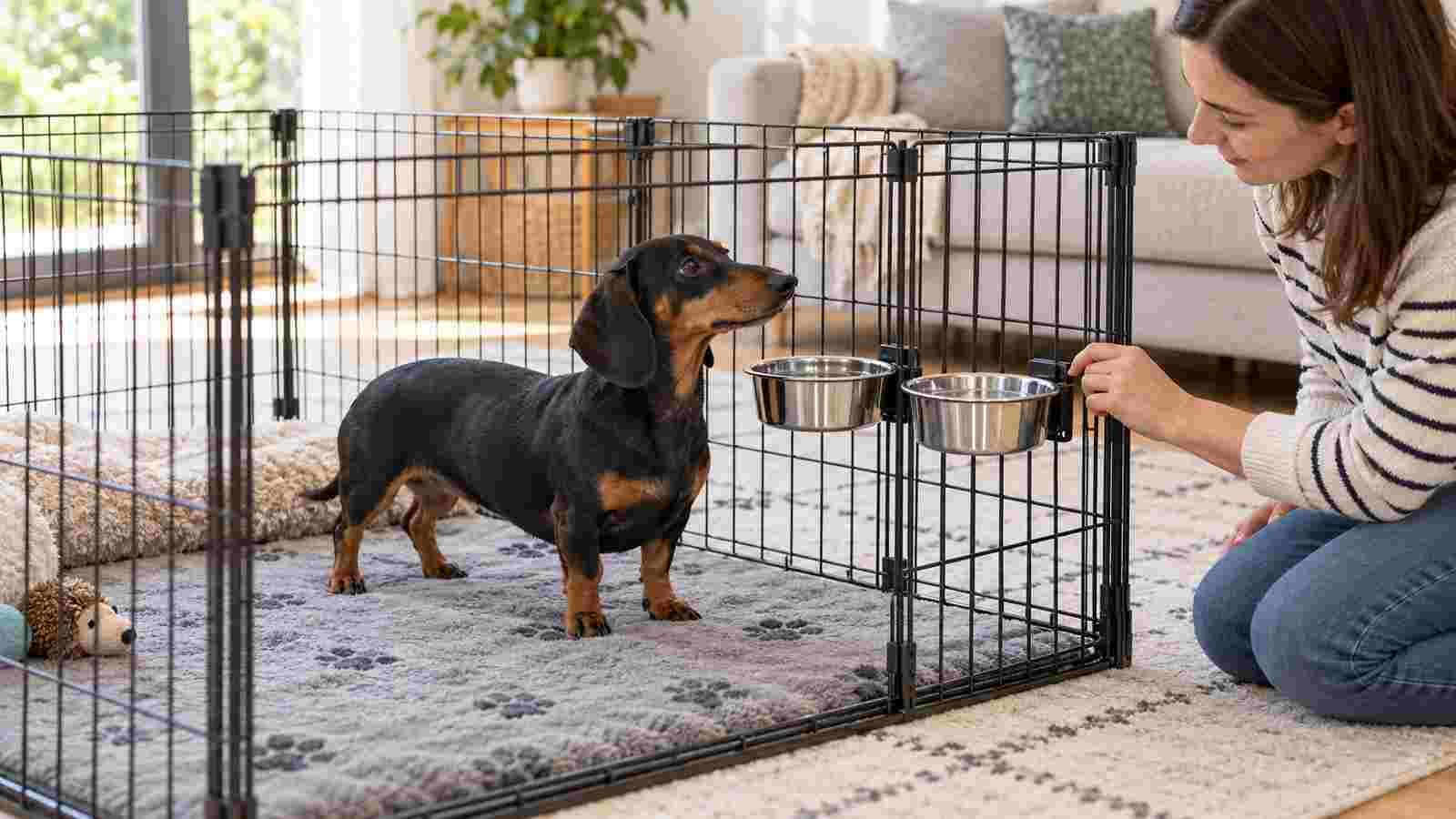
This is the case that matters most for dachshunds, because the breed is the poster dog for IVDD and other back problems. Dodgerslist, a long-running IVDD home-care site, tells owners on strict rest to attach the food and water bowls to the recovery pen at head height so the dog doesn’t bend down. It calls that especially helpful for neck discs.
That advice is for a dog in recovery. Once your vet clears the dog, ask whether the raised bowl should stay, the same way you’d ask about stairs and jumping.
Stiff seniors and messy drinkers
Beth Walker, a registered veterinary nurse writing for The Pet Carpenter, gives joint pain in older dogs as the main reason to raise a bowl. It’s a comfort call, and no trial has measured whether it changes pain or mobility.
So watch your dog eat. If you see the front legs splay, or your dog drops onto the elbows to reach the bowl, a small lift is worth trying.
Then there’s mess. A Toller owner on r/tollers switched to a raised water bowl because the puppy kept splashing a paw in it, which is a fair reason with no health claim attached.
How high should a dachshund’s bowl be?
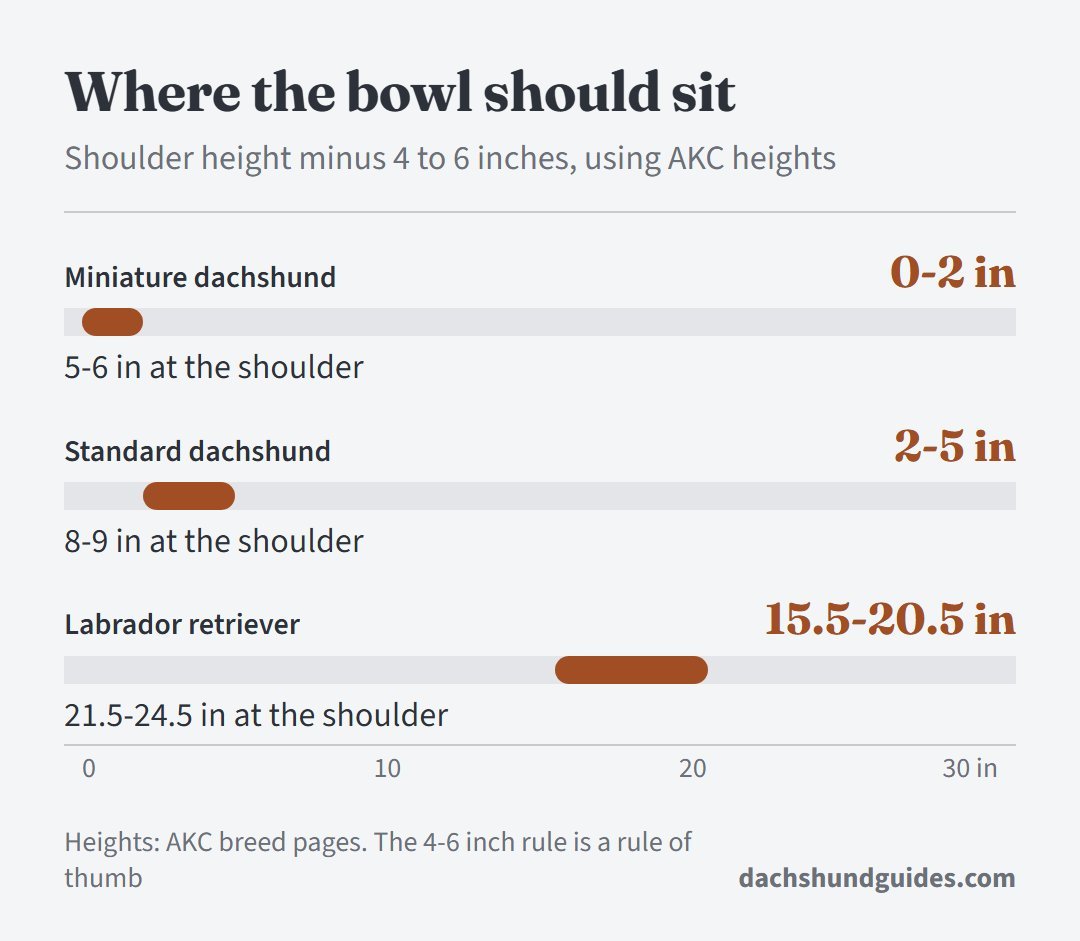
A dachshund’s bowl should sit about 0 to 2 inches up for a miniature and 2 to 5 inches up for a standard. That comes from the common rule of shoulder height minus 4 to 6 inches, applied to the AKC’s heights of 5 to 6 inches and 8 to 9 inches at the shoulder.
The usual rule of thumb for raised feeders is to measure from the ground to the top of the shoulder and subtract four to six inches, which puts the rim around the lower chest. I’d treat it as a rule of thumb, not a veterinary standard.
What happens when you run it on a dachshund? The elevated bowl almost disappears. A miniature at 5 to 6 inches gets a bowl between ground level and 2 inches up, and a standard at 8 to 9 inches gets 2 to 5 inches.
A Labrador, which the AKC puts at 21.5 to 24.5 inches, comes out at 15.5 to 20.5 inches, and that’s the size of dog a tall feeder makes sense for.
Pretzel is a miniature, so by this math his ideal bowl height is somewhere between zero and two inches. A stand sold as 5.5 inches tall would put a mini’s food at shoulder level, and he’d be reaching up to eat. Is that harmful? Nobody has studied it, but it’s the opposite of what the rule is trying to do.
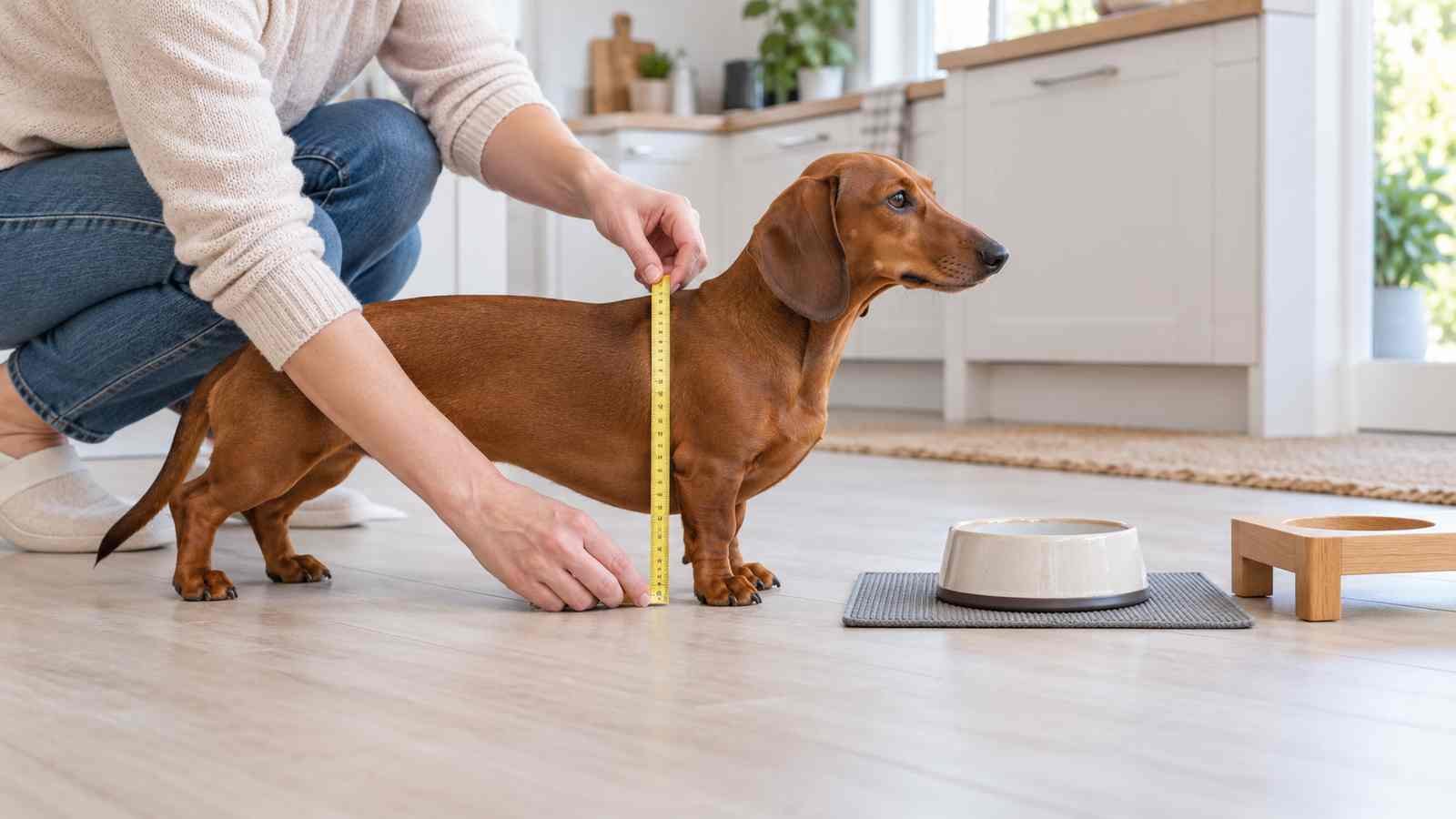
To measure, stand your dog square on a hard surface and run a tape from the ground to the top of the shoulder blade, then subtract four inches for the top of the range.
Then watch the first meal. You want the neck angled slightly down, with no stretching up and no splayed front legs.
Is it better for dogs to eat off the ground or elevated?
For a healthy dog, eating off the ground is fine, and for large, deep-chested breeds it’s the safer default given the Purdue findings. Raise the bowl when your vet names a reason, such as megaesophagus or a healing neck disc, and pick the height by measuring your dog.
If your worry is speed, a slow-feeder or puzzle bowl at ground level goes after the factor the study flagged. If it’s a bowl that slides around the kitchen, a non-slip mat or a heavy ceramic bowl stops it without changing your dog’s posture.
And if your dachshund’s still on a recovery plan, the same care that goes into stairs and ramps for a dachshund’s back applies to the bowl.
Elevated bowl questions owners ask next
Do vets recommend elevated dog bowls?
Vets recommend elevated dog bowls for specific conditions, mainly megaesophagus and neck or back problems, not as a routine upgrade. Petco veterinarian Jenna Beyer says raised bowls don’t help or hurt the average large dog.
Are elevated dog bowls good for dogs with IVDD?
Elevated dog bowls help dogs with IVDD during recovery: Dodgerslist advises bowls at head height for dogs on strict rest and calls it especially helpful for neck discs. After recovery, ask your vet.
Can you put a slow feeder on an elevated stand?
A slow feeder can sit on an elevated stand if the stand’s ring fits the bowl, and that pairing suits a dog that needs height and also gulps its food.
Measure your dog before you buy a stand. For most dachshunds, the tape will tell you to leave the bowl where it is.
