What a Dachshund DNA Test Can and Can’t Tell You About IVDD

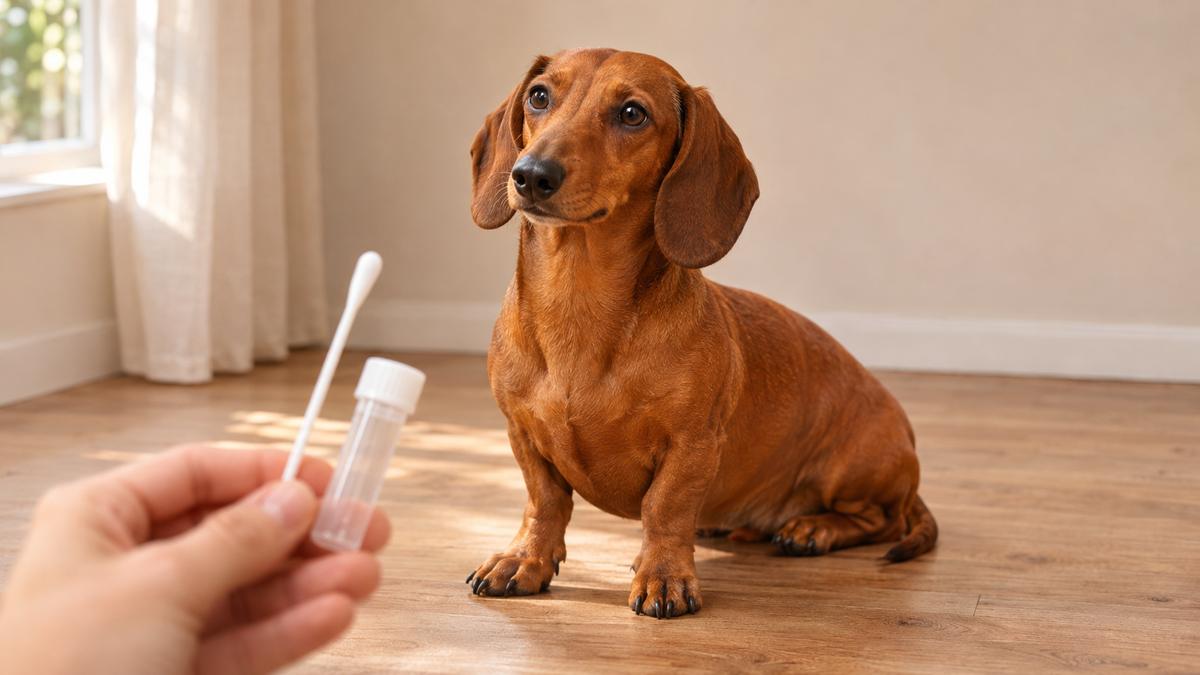
A Dachshund DNA test reads specific gene variants: the FGF4 retrogene tied to disc disease (CDDY/IVDD), eye genes like PRA-cord1, and coat genes such as dilute and merle. The result lists what your dog carries, which makes it a risk marker rather than a diagnosis or a forecast.
Bruno, my male dachshund, had a disc episode, surgery and a long recovery before he got his full mobility back. So on any Dachshund report, the disc line is the first one I read. It’s also the one I’d ask you not to over-read, and the numbers below show why.
The short version: if your dog is a purebred, read the eye and trait lines to make decisions. If your dog is a mix, the disc line is the one that tells you something new.
What a Dachshund DNA test checks
You swab your dog’s cheek at home, mail the kit back, and the lab sorts the results into health variants and trait variants. Embark lists nine Dachshund-specific health tests among 270-plus conditions. Orivet’s Dachshund profile names 18 disease and risk entries, and the AKC files 12 Dachshund tests under “other DNA tests identified in breed.”
Why do the lists differ? Because the labs differ, and you’ll see that the moment you compare two product pages. The UC Davis Veterinary Genetics Laboratory shows ten Dachshund listings on its breed page, mostly retinal tests, coat and trait tests, and parent verification. That page doesn’t list CDDY/IVDD.
Names matter more than they look. UC Davis lists rcd4-PRA, which it describes as a rod-cone degeneration. Embark’s Dachshund result is crd4/cord1, a cone-rod condition tied to the RPGRIP1 gene.
Both get shortened to “PRA,” yet they’re named as different conditions. So how do you know a kit covers what you want? Match the exact name against the lab’s page before you order.
| If you want to know | Look for this result | Who lists it for Dachshunds (as of November 2026) |
|---|---|---|
| Whether a short-legged mix carries the disc-disease variant | CDDY/IVDD (FGF4 retrogene, chromosome 12) | Embark, Orivet and AKC list it; UC Davis’s Dachshund page doesn’t |
| Whether eyesight could be at risk later | PRA-crd4/cord1 | Embark and Orivet list it, AKC lists it as cone-rod dystrophy 4; UC Davis lists a different retinal result, rcd4-PRA |
| Which coat genes your dog carries | D (dilute) and M (merle/dapple) loci | Orivet lists both loci; UC Davis lists merle and intensity dilution |
| Whether puppies match their listed parents | DNA profile or parent verification | Orivet includes a DNA profile; UC Davis lists parent verification |
Lab lists change, so confirm on the product page the day you order.
Does a CDDY result mean my Dachshund will get IVDD?
No. CDDY is a risk marker for disc disease, not a diagnosis. In Batcher et al. 2019, the retrogene came with a relative risk of disc surgery between 5.5 and 15.1 within breeds and mixed breeds, but that describes groups of dogs, not the odds for yours.
CDDY is short for chondrodystrophy, the long-back, short-leg build, and the test is usually labeled CDDY/IVDD. The variant is an FGF4 retrogene on chromosome 12. Brown et al. reported in PNAS in 2017 that it segregates with limb length and carries an odds ratio of 51.23 for IVDD across breeds. An odds ratio compares two groups of dogs. It doesn’t say that 51 in 100 dogs will herniate a disc.
Embark adds a useful detail: several variants can produce a markedly chondrodystrophic look in Dachshunds and Corgis, but this is the only one known to also raise disc risk.
Now the part that surprises owners. In Embark’s Dachshund data, 5.3% of dogs tested clear, 32.4% carried one copy and 62.2% carried two.
Add the last two and about 95 of every 100 tested Dachshunds carry at least one copy. Those dogs opted into Embark’s research, so they aren’t the whole breed, but you can’t miss the pattern.
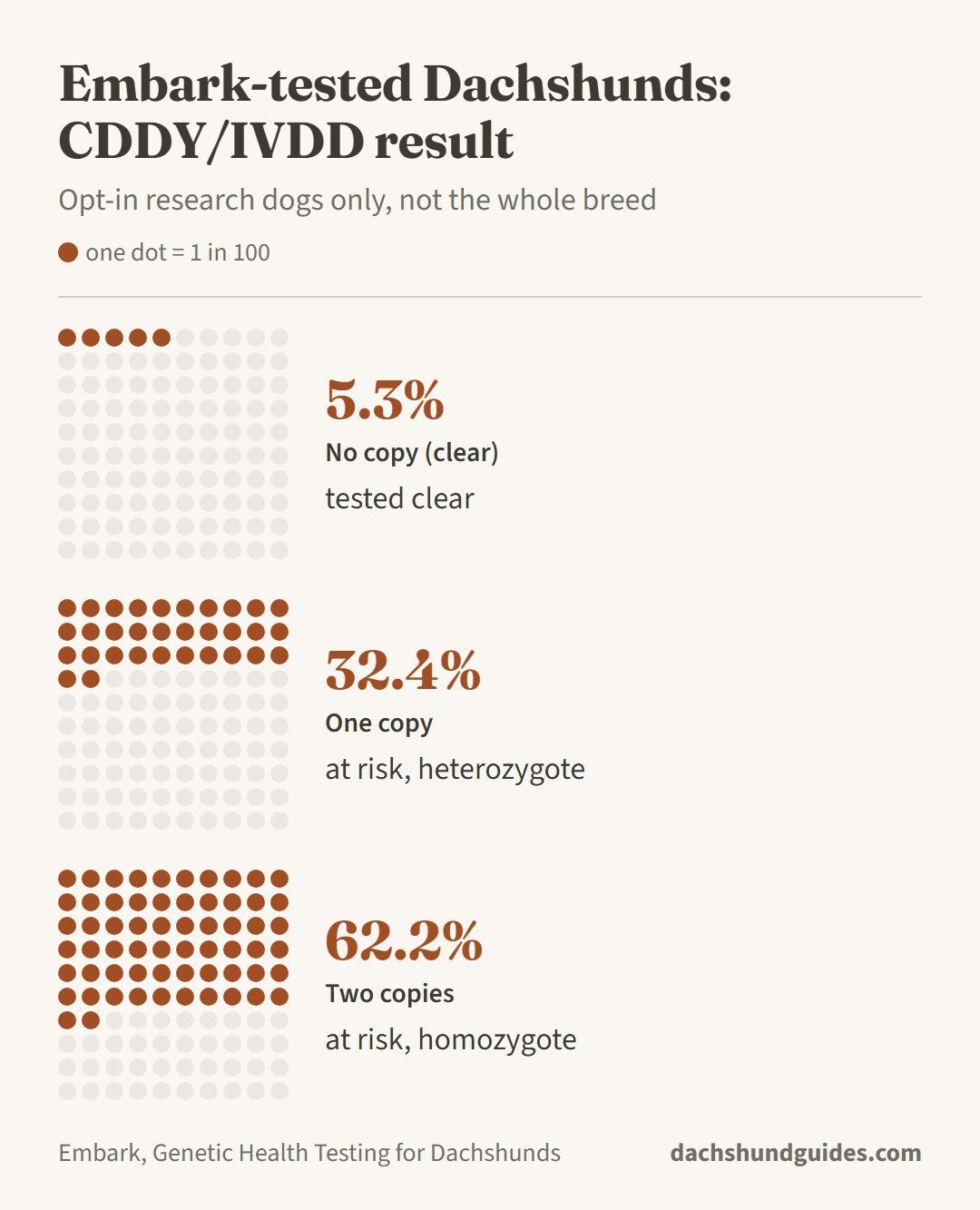
For a purebred, then, “at risk” on this line is close to the default. It adds little that your dog’s long back and short legs hadn’t already hinted at. A clear result is the rare one, and if you get one, it’s worth a quick word with your vet about what it does and doesn’t cover.
Does one copy count? Yes. Batcher’s team studied 569 dogs that had surgery for IVDD. One or two copies of the chromosome 12 retrogene went with surgery at a younger age, in a dominant pattern.
A dog with a single copy isn’t safe just because it doesn’t have two.
Bruno’s surgery doesn’t change that arithmetic. A dog that carries the variant and a dog that herniated a disc are two different groups, and the test speaks only to the first. Tomorrow morning I’d put a report like this next to his surgery records and ask our vet one question: does anything here change how we watch his back? The IVDD guide covers symptoms, treatment and costs, so I won’t repeat them here.
What does a CDDY result mean for a Dachshund mix?
In a mix, the CDDY line is the one that tells you something new, since you can’t judge it by looking at your dog. Batcher et al. found the chromosome 12 retrogene highly associated with disc herniation in mixed-breed dogs, with an odds ratio of 18.42, and one copy was enough.
Here’s the inheritance logic. A Dachshund with two copies passes one to every puppy, and a Dachshund with one passes it to about half.
If the other parent is a breed without the retrogene, a puppy from a two-copy Dachshund gets exactly one copy, and that’s enough for an at-risk result. Since 62.2% of Embark-tested Dachshunds carried two, a lot of first-generation mixes would test at risk even when they look more like the other parent. Does your mix look nothing like a Dachshund? The test can still find the variant.
Legs are a poor guide. Batcher’s paper also describes a second FGF4 retrogene, on chromosome 18, that contributes to short legs. In dogs with one copy it had only a minor effect on age at first surgery, and it had no effect on disc calcification.
So a short-legged mix can get its legs from either retrogene, and only the chromosome 12 one is tied to disc disease. Orivet and AKC both list a separate chondrodysplasia result, CDPA, next to CDDY, so check which of the two lines you’re reading.
Corgi crosses are where this matters most, since Embark names Corgis alongside Dachshunds for the short-legged build. If you’re sizing up a specific cross, the corgi dachshund mix and golden retriever dachshund mix pages cover size and temperament, and this line is how you’d check the back.
The eye result and the rarer conditions
PRA-crd4/cord1 is the other line I’d read closely. Embark describes a retinal disease that takes sight over one to two years without pain, with day blindness arriving before night blindness.
It’s recessive, so a dog needs two copies to be at risk. Mellersh and colleagues traced it in miniature longhaired Dachshunds in 2006 to a 44-nucleotide insertion in the RPGRIP1 gene.
In Embark’s data, 59.1% of tested Dachshunds were clear, 34.4% were carriers and 6.3% were at risk. A carrier isn’t expected to lose vision itself, but it can pass the variant on, which matters if you breed.
The other seven health tests on Embark’s Dachshund list are rarer. Degenerative myelopathy and osteogenesis imperfecta came back clear for 98.6% and 98.9% of tested dogs. The remaining five, including narcolepsy and two forms of neuronal ceroid lipofuscinosis, sit above 99% clear.
Coat colors and parentage
Coat results are the calmest lines on a report. UC Davis lists merle, which it describes as an incompletely dominant pattern of diluted patches against solid color. It also lists coat length, with five recessive FGF5 variants behind long hair, and the furnishings gene behind wirehaired mustaches. Orivet lists the D (dilute) and M (merle/dapple) loci, so the M line is the one to read if you want to confirm what a dapple carries.
“With all this talk about double dapple dachshunds, I’d like to get mine tested. I’m assuming not all tests are created equal (but maybe they are) so I was looking for some recommendations.” [excerpt, 2640 characters in full]
– r/Dachshund (92 upvotes)
That owner’s hunch is right: the labs don’t list the same things, which is what the table above is for. If you’re after a gene name for a coat you can see, you’ll want the M and D lines.
The dachshund colors page and the dapple dachshund page cover what each pattern looks like and how it’s named.
If you bought a puppy with papers and want to check them, UC Davis lists a parent verification test, and Orivet’s Dachshund profile includes a DNA profile for parentage verification.
How accurate is a Dachshund DNA test?
Accuracy depends on the type of result. Embark calls its CDDY result a linkage test, which it says predicts a dog’s true genotype less well than the direct assays it uses for most other conditions. Embark also states that genetic health testing is not a diagnosis, so read each line as a risk marker.
“Look into Embark, but can’t comment on any of these companies being 100% reputable due to lack of available reliable, audited and reported data.”
– r/dogs (40 upvotes)
Breed percentages are a separate matter. In one r/DoggyDNA thread an owner ran Embark, Wisdom Panel and Darwin’s Ark on the same mixed dog, and a reply pointed out that the top breeds sat within 1-4% of each other across two of the kits.
The product type matters too. Orivet states that its Full Breed Profiles aren’t for breed identification, so a health-focused Dachshund panel won’t tell you whether a rescue is purebred. Embark’s own cart lists Breed ID and Breed + Health as separate kits.
Cost, kits and a few last checks
How much does a Dachshund DNA test cost?
Orivet lists its Dachshund Full Breed Profile at $139.00 with free shipping as of November 2026, though the page names no currency. Other kits are priced on their own pages and move with sales, so check the kit page the week you order. The how much are dachshunds page covers the costs of buying and keeping one.

Do all Dachshunds carry the IVDD gene?
No, but nearly all of the Embark-tested ones do. In its data, 5.3% tested clear for the CDDY/IVDD variant and about 95% carried at least one copy. Carrying the variant isn’t the same as having disc disease.
Can a DNA test tell me if my Dachshund is purebred?
Only a breed identification kit can, and a health panel like Orivet’s Full Breed Profile isn’t one by its own description. Parentage is a separate test: UC Davis lists parent verification for checking puppies against their listed parents.
Will a DNA test explain my Dachshund’s seizures?
Not by itself. Embark states that genetic health testing is not a diagnosis, and seizures have many possible causes, so the dachshund seizures page and your vet come first.
