
Blue Dachshund Coat Color and the Hair Loss Risk

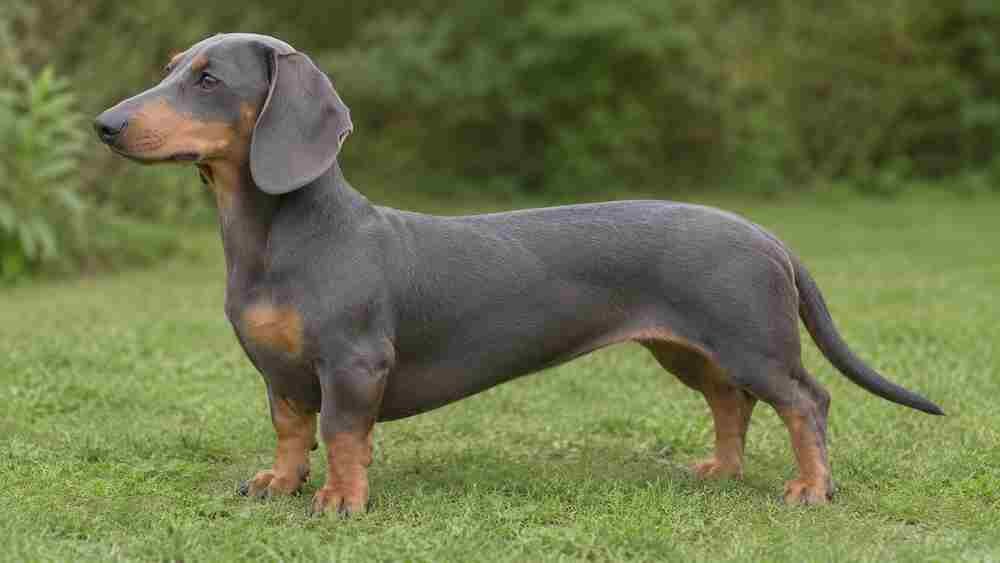
A blue dachshund is a black dog with the dilution gene from both parents, which turns the black pigment gray. The Dachshund Club of America breed standard lists gray (blue) as an accepted color, so the coat itself isn’t a fault.
The risk is the skin, and you should know the numbers before you fall for the color. In a UK owner survey of 9,908 dachshunds, 23 of 28 blue ones were reported with color dilution alopecia, a hair-thinning condition.
That’s a small sample, so read it as a warning flag rather than a verdict. Here’s what makes the coat blue, how to tell it from silver dapple and Isabella, what the numbers say, and what you should ask before you pick a puppy.
What makes a dachshund blue?
Blue isn’t a base color of its own, just black with the pigment diluted. According to VCA Animal Hospitals, a dilute dog carries two copies of the recessive dilution gene (dd), and its lips, nose and eyelids look blue, bluish gray, lavender or flesh-colored.
A 2007 study in the Journal of Heredity by Drögemüller and colleagues reported dilution in dachshunds as an autosomal recessive trait linked to the MLPH gene, which means both parents have to pass it on. So two black-based parents can each be carriers and still produce a gray puppy.
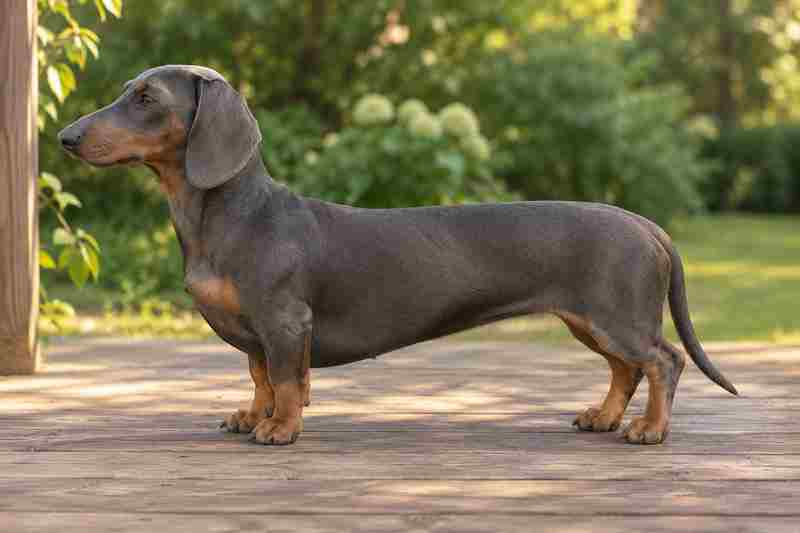
The same gene dilutes chocolate into fawn, which dachshund owners call Isabella. The Dachshund Club of America’s colors sheet (September 2020) reports plainly that gray (blue) and fawn (Isabella) are dilutes of black and chocolate, respectively. For the fawn side, see the Isabella dachshund guide.
The breed standard describes two-colored dachshunds, blue included, as carrying tan or cream markings, and the DachsLife survey files a blue and tan dachshund under the same dilute blue category. If you want the undiluted version of the same pattern, that’s the black and tan dachshund.
Blue, silver dapple, blue dapple or Isabella: which gray dachshund is it?
Is your dog blue, or just gray? Plenty of gray-looking dachshunds aren’t blue, so this table sorts the four you’re most likely to meet, with how many of each turned up among 9,807 dogs in the DachsLife 2021 survey.
| Color | What it is | What to look for | Dogs in survey |
|---|---|---|---|
| Blue | A dilute of black (dd) | Even gray coat with tan markings; gray, lavender or flesh-toned nose and eyelids | 78 |
| Silver dapple | A black and tan dog with the dapple pattern, not a dilute | Lighter patches over a darker base | 542 |
| Blue dapple | The dapple pattern over a blue base | Patches plus the dilute nose | 15 |
| Isabella | A dilute of chocolate (fawn) | A warm fawn tone instead of gray | 52 |
According to the Dachshund Club of America’s colors sheet, a black and tan dapple is often mistakenly called “silver.” With 542 silver dapples against 78 blues in that survey, a gray dachshund with a patchy coat is far more likely to be a dapple. The standard describes dapple as lighter areas contrasting with a darker base color, and the base can be any accepted color, blue included.
Dapple has its own cautions. That colors sheet also says double dapples are more likely to carry deafness or reduced eye size, which the dapple dachshund guide goes through.
Hair loss in blue dachshunds: what the numbers show
Color dilution alopecia, or CDA, thins the coat in patches. VCA calls it a genetic, recessive, inherited condition. Puppies are born with a normal-looking coat, and signs may begin at six months of age or older, so a puppy that looks perfect when you meet it at eight weeks tells you very little.
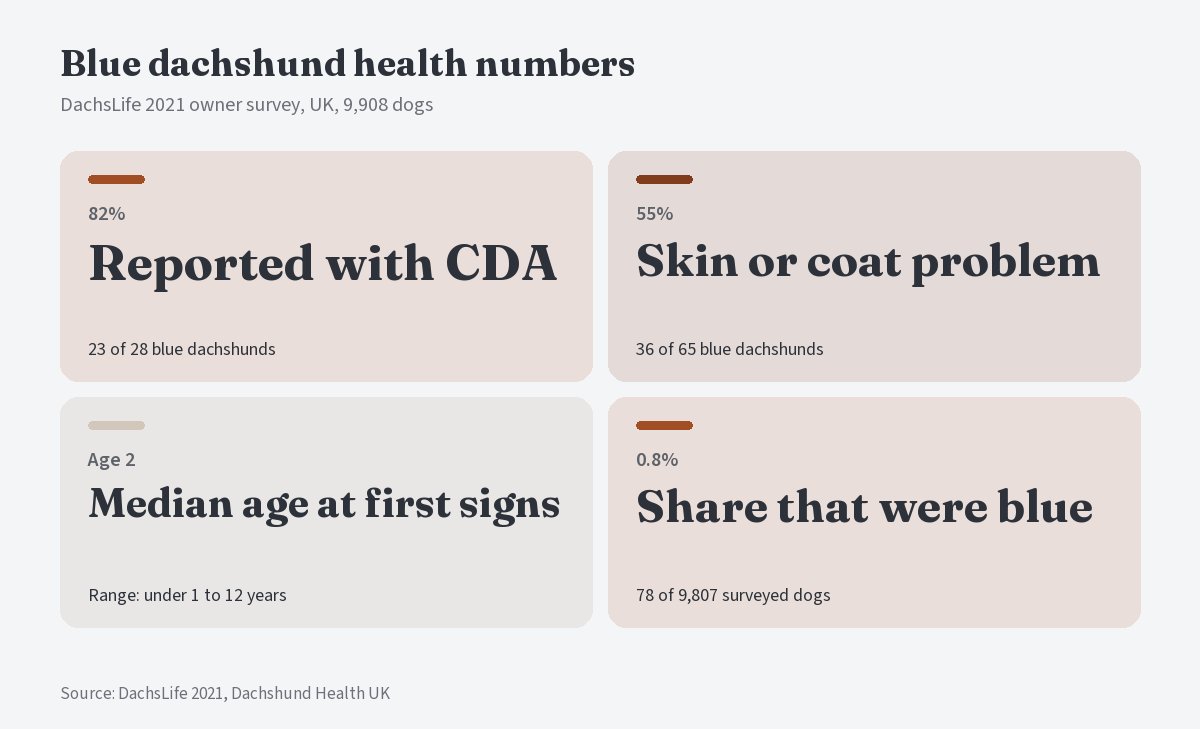
The DachsLife 2021 survey, run in the UK by Dachshund Health UK with the Dachshund Breed Council and The Kennel Club, is the best breakdown by color you’ll find. Owners reported CDA in 23 of 28 blue dachshunds (82.1%) and 6 of 7 Isabellas (85.7%). Across all 9,908 dogs, owners reported a rate of 1.4%, so the blue figure is far above the breed average.
Other figures from that survey:
- 36 of 65 blue dachshunds (55.4%) had a reported skin or coat condition.
- Owners reported patterned baldness in 16 of 28 blue dachshunds (57.1%).
- Across all colors, the median age at first CDA signs was 2 years, ranging from under 1 to 12.
The Dachshund Club of America’s colors sheet goes further, saying dilutes may also be linked to thin coats, skin sensitivity, vaccine failures and a reduced lifespan, though it gives no numbers.
Those numbers come with limits. They’re owner reports, only 28 blue dogs sit behind the CDA figure, and the survey itself notes that owners were probably describing the same condition under CDA and patterned baldness.
Is every bald patch CDA? No, because allergies can thin a coat too, so you’ll want a vet to look before you decide what it is. If you’re unsure what you’re seeing, the dachshund hair loss guide lists the other causes.
Living with it is usually manageable, and VCA says CDA doesn’t otherwise threaten a dog’s health, although scaly skin, small pustules from a bacterial infection and itching can show up. Dachshund Health UK adds that thin hair can leave skin prone to sunburn and infection, so you may want to keep a sparsely coated dog out of strong sun. It isn’t curable, but you can manage it, and management can include shampoos, rinses, ointments, antibiotics when needed and nutrition changes.
“They have skin issues – alopecia is the main one- mine is an Isabella and his chest is mostly bald – gentle shampoo is really all I do – I love him and didn’t breed him – so don’t fret it- he is blue and Isabella lineage – rare – but be ethical and have him neutered – he was meant to be loved by you”
– r/Dachshund, October 2026 (27 upvotes)
That reply came in a thread about a shelter puppy, and it matches the pattern above: a mostly bald chest, gentle shampoo, and a dog that’s loved anyway.
How rare is a blue dachshund?
Yes, by the survey count: owners reported 78 of 9,807 dogs as blue, about 0.8%, against 3,313 black and tan and 1,241 chocolate and tan. That’s one UK survey, so what you’d find where you live could differ.
Rare doesn’t mean valuable.
Dachshund Health UK advises you against buying a dachshund because its color is unusual, such as blue or Isabella, and against breeding from dilutes. Per the charity, no DNA test exists for CDA, and responsible UK breeders don’t deliberately breed dilutes, which is why a blue puppy from a seller who advertises the color as a selling point deserves extra questions before any deposit.
Sellers sometimes invent names for colors too. When an owner asked about a puppy sold as “blue based cream,” one r/Dachshund reply said this:
“Blue based cream is not a real recognized color but likely a term made up by the backyard breeder who sold you this puppy. Blue is not one of the base colors that dachshunds can appear in. Blue is a dilute of the base color black so no color can be blue-based…” [excerpt – 1,298 characters in full]
– r/Dachshund, July 2026 (30 upvotes)
If a listing uses a color name you can’t find in the standard, ask the seller to explain it. You’ll find the accepted ones in the dachshund colors guide.
Before you buy a blue dachshund
Searching for blue dachshund puppies for sale? You can’t screen a puppy with a test, so what you ask the breeder matters more.
- Ask about the parents and siblings. VCA says dogs with CDA, their parents and their siblings shouldn’t be used for breeding, so a litter with affected relatives is a red flag.
- Ask to see skin, not only the coat. Dachshund Health UK described a dilute puppy advertised at £6,500 whose skin “almost glowed pink” through thin hair.
- Ask what the breeder will do if your dog starts losing hair at two or three years old, because most puppies show nothing at the start.
- Budget for skin care: vet visits, medicated shampoo and possibly antibiotics. For general dachshund costs, the dachshund cost calculator is a starting point.
Blue dachshund FAQ
How much does a blue dachshund puppy cost?
No survey or club publishes a verified price for blue puppies. The one figure with a source is a £6,500 UK advert that Dachshund Health UK used as a warning. Treat any quoted range without a source as a guess.
Do some dachshunds have blue eyes?
Yes, but the breed standard ties blue eyes to the dapple pattern. In dapples, partly or wholly blue (wall) eyes are as acceptable as dark ones. In other dogs the standard calls wall eyes a serious fault, and a piebald with blue eyes is disqualified. A blue coat doesn’t promise blue eyes.
Is a blue dachshund the same as a silver dapple?
No, because blue is a dilute of black. Silver dapple is a name often used for a black and tan dapple, which carries the dapple pattern but isn’t a dilute. The table above shows how to tell them apart.
Is a blue dachshund the same as a blue heeler dachshund mix?
No, since a blue dachshund is a purebred coat color, while a blue heeler mix is a cross between two breeds. That cross has its own page, the blue heeler dachshund mix guide.
