
IVDD Dachshund Guide: Stages, Surgery vs Crate Rest, Recovery Odds


IVDD, intervertebral disc disease, is when a disc between two vertebrae bulges or bursts into the spinal canal and presses on the spinal cord. Dachshunds are built for it: about 1 in 4 get some degree of back disease in their lifetime, according to Dachshund Breed Council health surveys.
My own dog Bruno had a disc episode that needed surgery and a long recovery, and he walks normally today. So I know how it feels to leave a vet’s office with an IVDD dachshund and a stage number you don’t understand yet.
Below you’ll find what each stage looks like, what the recovery figures say for surgery and for crate rest, and whether it comes back. None of it replaces your vet. If your dachshund suddenly can’t walk, that’s an emergency, so call a vet first and read this after.
Why dachshunds get IVDD
Dachshunds get IVDD because their discs age early, and that’s in their genes. A 2019 study in Genes by Batcher, Bannasch and colleagues found that a gene insertion on chromosome 12, an extra copy of FGF4 often called CDDY, “acts in a dominant manner to decrease the age of onset and increase the overall risk of disc disease in dogs.”
Should you DNA-test your puppy for it? Not for IVDD risk. Nearly every dachshund carries the insertion: Dachshund Health UK reports that 93% of the 393 dachshunds in that study had two copies, and it doesn’t recommend the CDDY test for the breed. When almost every dog gets the same result, the test can’t tell you which ones are at higher risk.
What does separate dogs is an X-ray. In the UK Kennel Club’s screening scheme, dogs are X-rayed between 2 and 4 years old and scored by how many discs have hardened, or calcified:
- Grade 0: no calcified discs
- Grade 1: 1 or 2
- Grade 2: 3 or 4
- Grade 3: 5 or more
A 2014 Finnish study of 193 screened dachshunds aged ten or older found disc disease “rare in dogs with no calcifications (grade 0) and common in dogs with severe IDC (grade 3).”
That’s a tool for breeders choosing parents. For your own IVDD dachshund, it mostly explains why a disc can go in a dog whose owner did everything by the book. Plenty of owners have. One r/Dachshund owner, posting about a 3.5-year-old diagnosed at stage 2, wrote:
“We have done everything right since birth. No stairs. Ramps everywhere. Proper holding techniques. I’m just sad.”
– r/Dachshund, September 2026 (628 upvotes)
Another owner in that discussion had a similar story with a neck disc:
“My pup got diagnosed with IVDD in her neck at 3.5 years old. I was devastated. I also did everything right for her spine. Her neurologist reassured me that most of this is truly due to genetics.”
– r/Dachshund, September 2026 (12 upvotes)
If that’s where you are, you didn’t cause this. Ramps and careful handling still matter, and you’ll find what the evidence says helps further down. But a disc that ruptures in a dachshund with good habits isn’t a sign you failed.
IVDD stages: what each one means
An IVDD stage describes how hard the disc is pressing on the spinal cord, judged by what your dog can still do. The numbers can mislead you, though, because two common scales count in opposite directions.
The “stages 1 to 5” owners hear most often put the mildest case at 1 and the worst at 5. The modified Frankel scale, used in a 2020 consensus review by the Canine Spinal Cord Injury Consortium, does the reverse: grade 5 is back pain only and grade 0 is the worst.
So a “grade 5” can be the best or the worst news. Instead of the number, ask your vet two plain things: whether your dog can walk, and whether it can still feel deep pain in its back feet.
| What your dog can do | Owner “stage” (5 = worst) | Modified Frankel grade (0 = worst) | Walked again with surgery | Walked again with crate rest and medicine |
|---|---|---|---|---|
| Walks normally, but back or neck pain | 1 | 5 | Not in the review | Not in the review |
| Walks, but wobbly or weak | 2 | 4 | Not in the review | Not in the review |
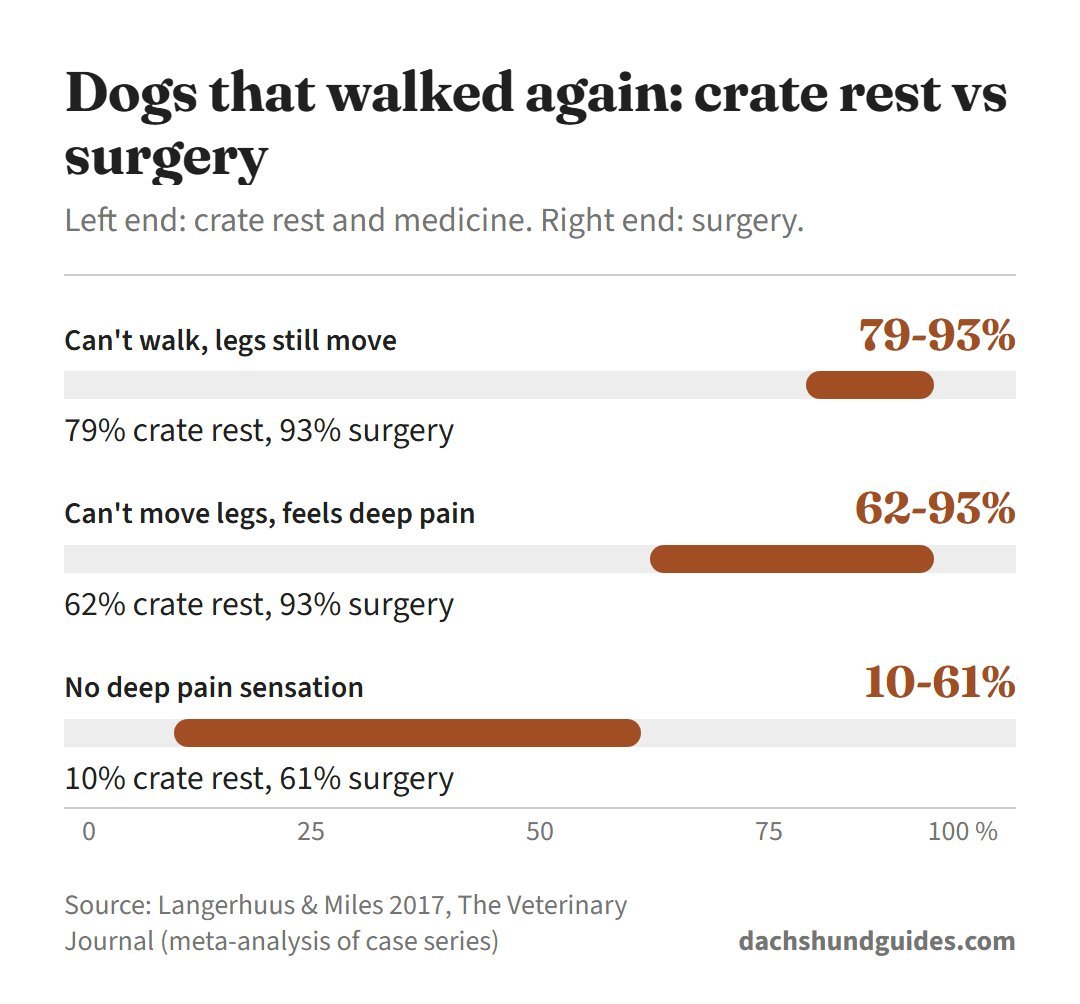
| Can’t walk, but moves the back legs | 3 | 3 | 93% | 79% |
| Can’t move the back legs, still feels deep pain | 4 | 2 or 1 | 93% | 62% |
| No deep pain sensation | 5 | 0 | 61% | 10% |
The recovery figures come from a 2017 meta-analysis in The Veterinary Journal by Langerhuus and Miles, which pooled published case series. It wasn’t limited to dachshunds, and it only included dogs that couldn’t walk, which is why the first two rows are blank.
How is deep pain checked? Vets usually test it with a strong pinch to a toe, as veterinarian Wendy Brooks explains on Veterinary Partner. It’s a test for your vet, not one to try at home, and as the table shows, it’s the answer that moves the odds most.
Surgery or crate rest?
For an IVDD dachshund that can’t walk, surgery gave better odds at every level of severity in that review, and the gap grows as the dog gets worse. At the far end, a dog with no deep pain sensation walked again 61% of the time after surgery and 10% of the time without it.
That’s why I’d want a dachshund that has lost deep pain in front of a neurologist the same day, not after the weekend. The surgery in these studies was a hemilaminectomy, which takes the pressure off the cord.
Crate rest is a real treatment, though, not a fallback. Dachshund Health UK says strict crate rest with anti-inflammatories and pain relief may suit a dog with mild pain and no wobbliness, and that a dog that hasn’t improved after 4 weeks may then need to be considered for surgery. If your dog gets worse at any point during crate rest, go straight back to the vet, because the plan may need to change that day rather than at the next check-up.
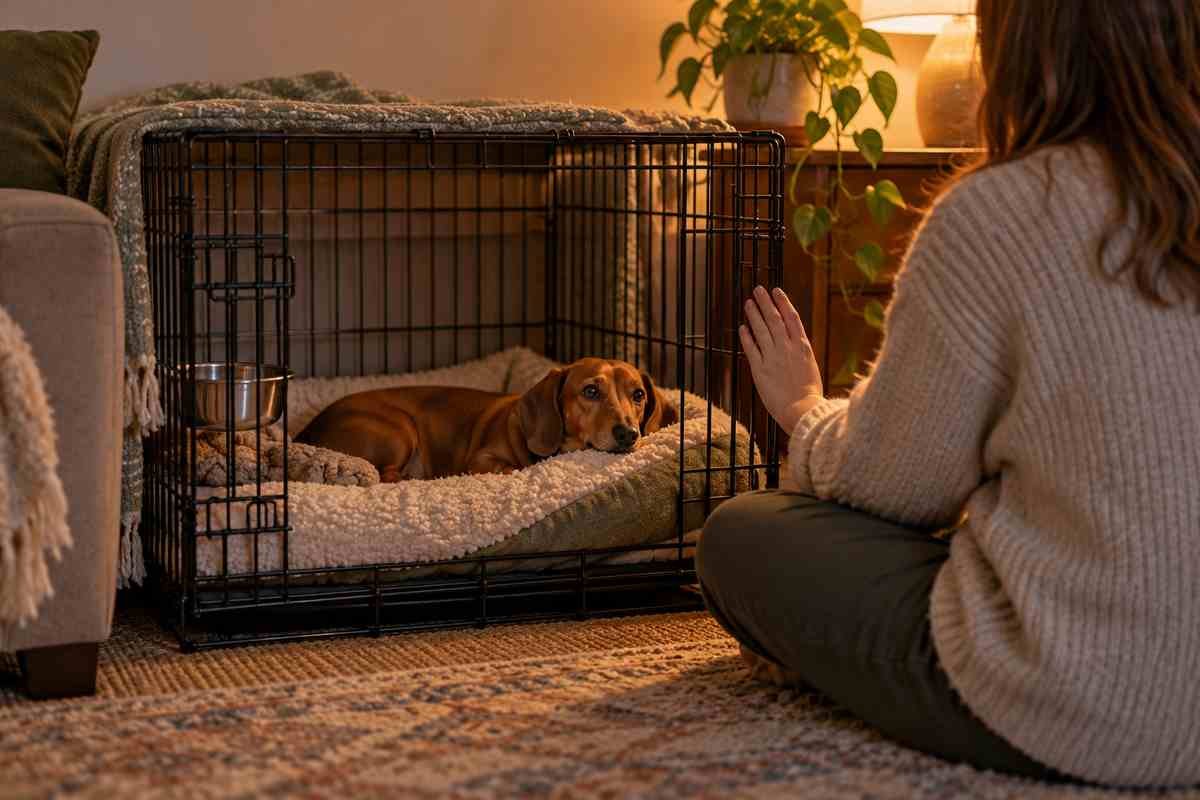
Dachshund IVDD Support Australia sets crate rest at 4 to 6 weeks or longer when there are no neurological signs, and at least 8 weeks once there are. Our crate rest guide explains what those weeks actually involve, and the surgery cost section has US price ranges.
Keep one limit in mind. The review’s authors note there were no controlled studies, only case series, so these are the best numbers available rather than settled ones.
And good odds on paper can still mean a slow road. One owner in that r/Dachshund discussion, whose dog had surgery at stage 4, wrote that he was about 80% recovered, now uses wheels for freedom, and is as happy as he was before.
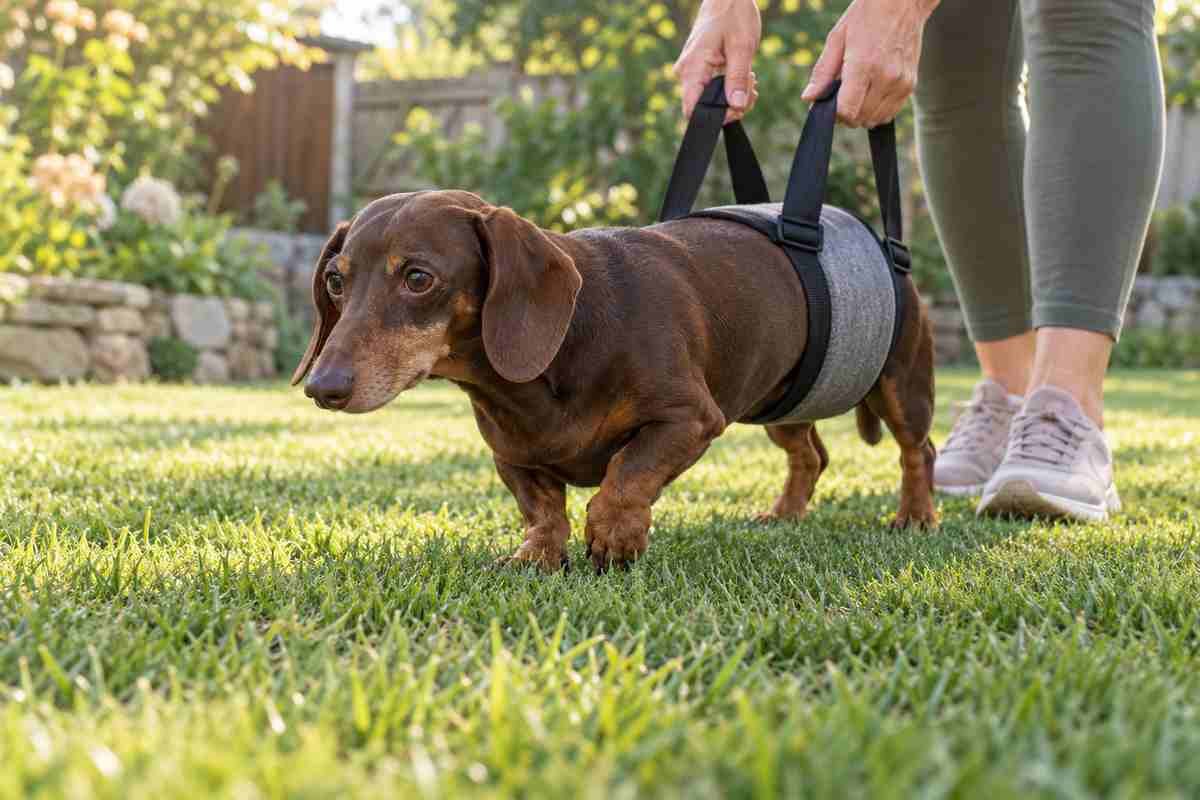
Whichever route you take, a dog that can’t walk needs nursing at home. Brooks lists expressing the bladder, keeping the dog clean and bedded, and physical therapy exercises, and your vet will show you which ones your dog needs.
Bruno’s recovery was a long one.
He got his full mobility back at the end of it. If your dog is a few weeks out and still wobbly, slow progress on its own isn’t a reason to give up.
Does IVDD come back?
It can. In a study of 229 dogs that had back surgery for a disc, published in JAVMA in 2004 by Mayhew and colleagues, signs came back in 19.2% of dogs overall, and in 25% of the dachshunds against 15% of other breeds.
Why would a fixed disc be followed by another one? Every disc in your dachshund’s spine carries the same early ageing from that gene, so the habits that matter after recovery are the same ones that matter before it.
If your dog has had one episode, check your pet insurance wording too. On any new policy, the spine will be excluded as pre-existing.
What age does IVDD start in dachshunds?
Most often in middle age. In the DachsLife 2015 survey of 2,031 dachshunds, published by Packer and colleagues, the average age at diagnosis was 5.4 years, and the median age by variety ranged from 5 to 7.
The Dachshund Breed Council’s 2015 health survey put 76% of affected dogs’ diagnoses between 4 and 8 years old. Younger dogs aren’t safe, though. Both owners quoted above had dogs diagnosed at three and a half.
What lowers the risk of IVDD in dachshunds
You can’t change your dachshund’s genes, but three things you control show up in the research on IVDD risk: how active your dog is, how lean it stays, and when it’s neutered.
- Keep your dog active. In DachsLife 2015, dogs exercised for less than 30 minutes a day had higher odds of IVDD than dogs walked for over an hour.
- Keep your dog lean. In a 2025 JAVMA study of 43,517 dogs, overweight dogs had 1.67 times the odds of owner-reported IVDD.
- Think about when you neuter. In a 2018 study of 1,964 dachshunds by Dorn and Seath, females neutered before 12 months had 2.12 times the risk of disc disease of females neutered later, and males 1.54 times. The authors still say the decision should be made dog by dog.
Stairs are less of a villain than their reputation suggests. Our dachshund stairs page goes through the data, and our dachshund ramp page covers getting your dog on and off furniture without the jump.
IVDD dachshund questions
What are the early signs of IVDD in a dachshund?
Pain usually comes before weakness: yelping when picked up, refusing to jump or climb, a hunched back and a head held low. Wobbly back legs come next.
Our early signs of IVDD section lists the quieter ones as well, and what to say if your vet suggests something else.
How do you lift a dachshund with IVDD?
Keep the body level and the back supported the whole time, with one hand under the chest and the other under the rump. Don’t lift by the front end, and don’t let your dog drop or twist on the way down. Our carrier guide covers moving an IVDD dachshund outside the house.

Does IVDD shorten a dachshund’s life?
I haven’t found a study that measures lifespan after IVDD. What the recovery data show is that most dogs that still feel their back feet walk again, with surgery or without. The stage your dog is at today isn’t necessarily where it ends up.
