
Brindle Dachshund: Where the Stripes Show and How It’s Inherited


A brindle dachshund has dark stripes running over its base color, a pattern the AKC breed standard recognizes in all three coats and both sizes. Brindle is a pattern rather than a color, so you’ll see red brindles, cream brindles and black and tan brindles.
Your dog’s base color matters more than the stripes themselves. I’d call it the whole story, really. It decides whether your brindle looks striped from nose to tail, striped only on its eyebrows and legs, or not striped at all.
What is a brindle dachshund?
A brindle dachshund is a dachshund with black or dark stripes laid over its base color. The AKC standard calls brindle “a pattern (as opposed to a color)”, and it adds that on some dogs the stripes show “only in the tan points”.
Here’s the full line from the AKC’s official dachshund standard: “Brindle is a pattern (as opposed to a color) in which black or dark stripes occur over the entire body although in some specimens the pattern may be visible only in the tan points.” That second half is the part I’d underline, and you’ll see why in a moment.
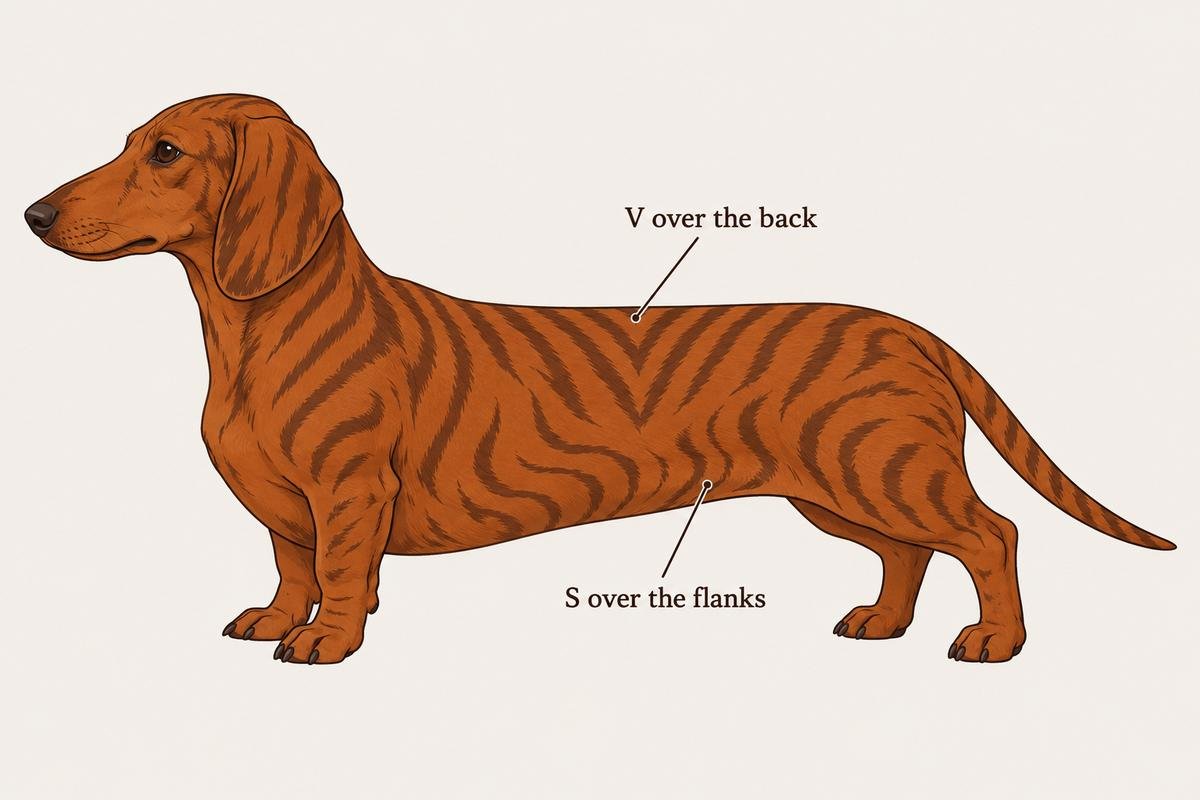
Geneticists describe the stripes the same way. In a 2007 paper in the journal Genetics, Kerns and colleagues define brindle as stripes of red-yellow hair alternating with black-brown hair, usually forming a V shape over the back and an S shape over the flanks and belly.
Where the stripes show depends on the base color
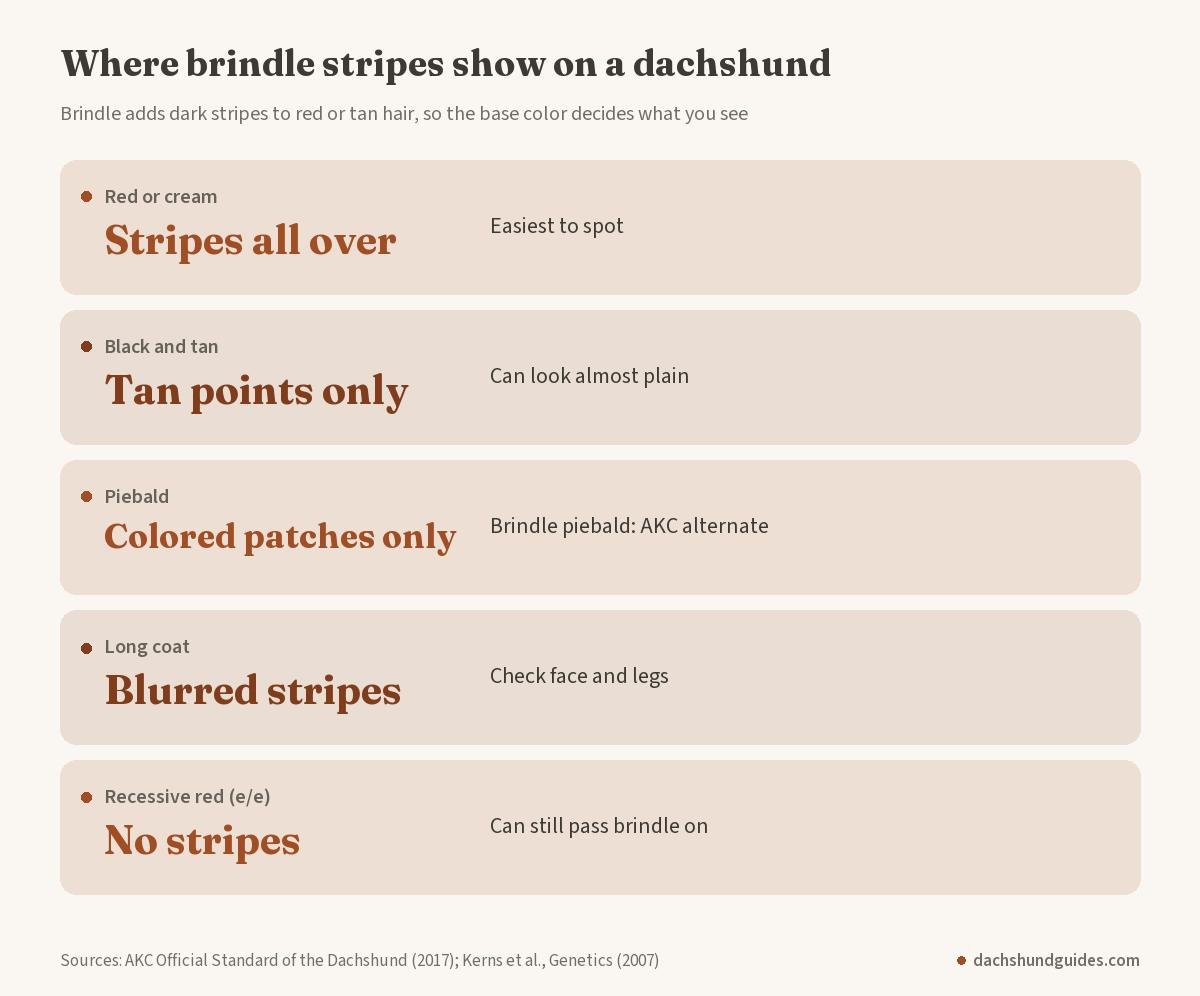
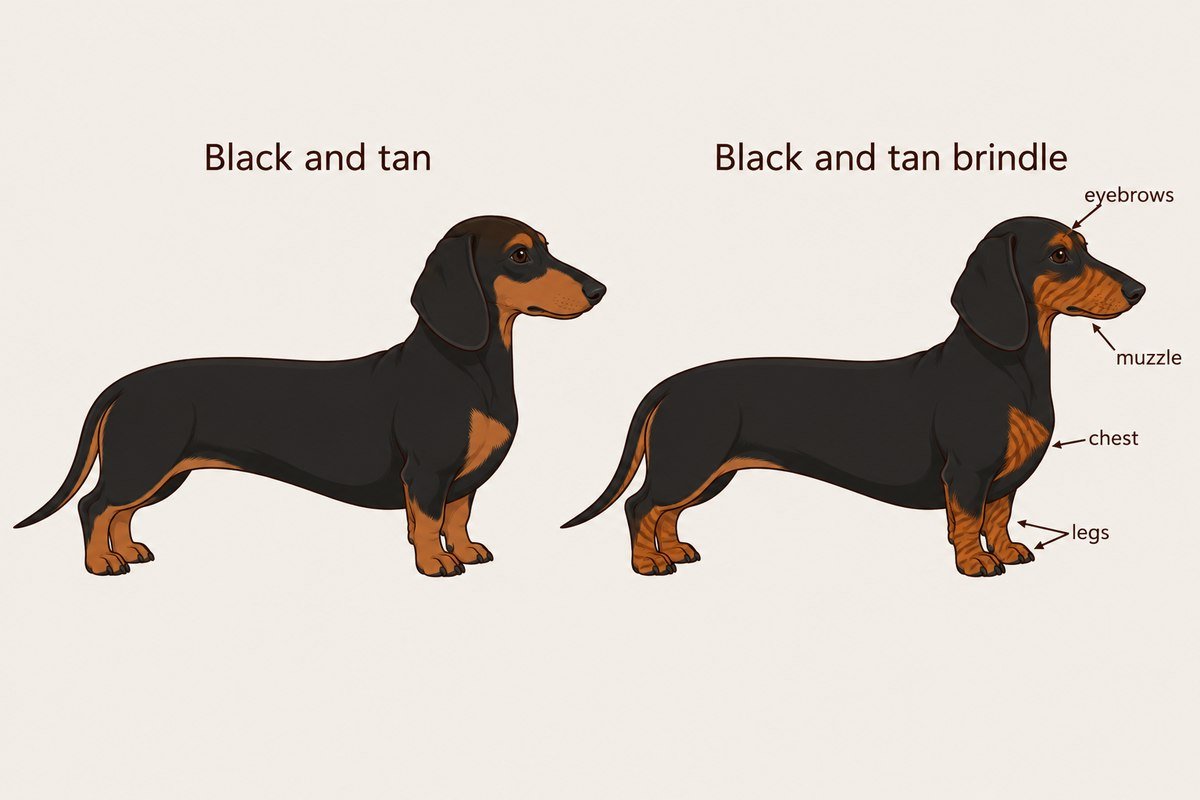
Brindle stripes only show where a dachshund has red or tan hair, because the pattern works by laying black-brown stripes into that lighter pigment. A red or cream brindle is striped all over, while a black and tan brindle shows its stripes only in the tan points.
So why does a black and tan brindle look so plain? Its body is already black, and dark stripes have nowhere to show except above the eyes, on the muzzle, chest and legs, and under the tail. If your dog has small tan points, you could miss the pattern completely.
Owners of black and tan brindles notice it straight away. In a r/Dachshund thread on brindles, one owner described their dog like this:
“My girl is a Black and Tan Brindle. Her base colors are Black and Tan, but she has Brindle stripes on her Tan Points so you barely see any Tan on her.”
– r/Dachshund, January 2025
Coat length changes what you see, too. On a smooth, you’ll find the stripes right on the surface. On a longhair, longer hair blurs them, and owners say the pattern is clearest where the fur is short:
“I love the way on short hairs you can really see the stripes all over. Bluebells are most obvious where her fur is shortest on her face and legs.”
– r/Dachshund, August 2026
So if you’re unsure about a longhaired puppy, look at its face and legs before you look at its back.
You’ll find how that coat grows in covered in the long haired dachshund guide.
Can a purebred dachshund be brindle?
Yes, a purebred dachshund can be brindle. It’s one of the patterns written into the AKC standard, and the AKC registers brindle as a standard marking. The Dachshund Club of America (DCA) adds one rule: at least one parent must be brindle to produce the pattern.
Genetics explains that rule. Kerns and colleagues mapped brindle to a gene called the K locus and found three versions with a dominance order of black, then brindle, then yellow. Because brindle beats the non-striped version, a dog only needs one copy to show stripes, and a puppy usually gets that copy from a parent who shows them too.
There’s one exception you should know about. The same paper found that a dog with two copies of recessive red (written e/e) shows red or yellow whatever it carries at the K locus. A recessive red or cream could carry brindle without a single visible stripe and still pass it to puppies. That study used a Labrador and greyhound cross, not dachshunds, so treat it as general dog genetics.
Did a brindle puppy turn up from two parents that don’t look brindle? A color DNA test that covers the K locus is how you’d settle it.
Brindle vs dapple dachshund
The difference between a brindle and a dapple dachshund is stripes versus patches. Brindle adds dark stripes to the coat, while dapple lightens it, leaving lighter areas against the darker base color, in the standard’s words.
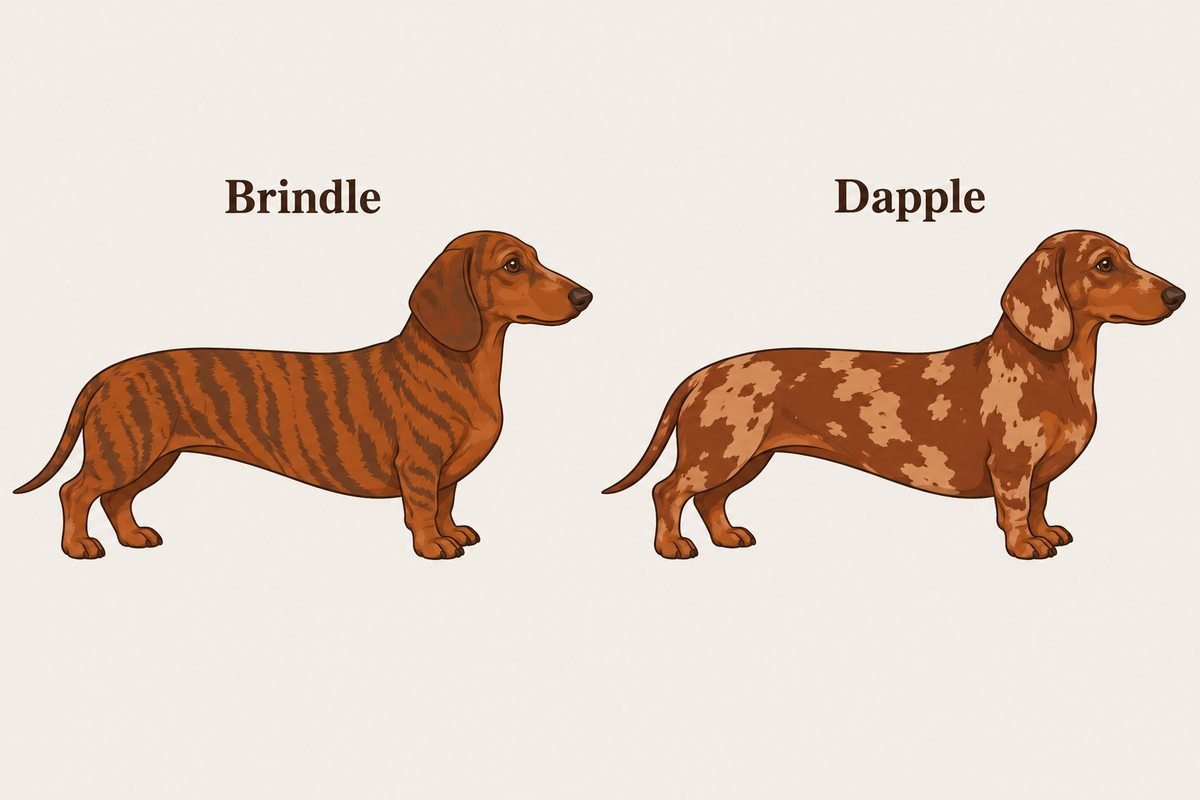
When an owner asked r/Dachshund whether their red puppy was a dapple or a brindle, the most direct reply put it simply: “Dapple = spots and/or patches. Brindle = stripes.” You’ll find that a handy rule with a red puppy, where dapple can be faint.
Health is where the two really part ways. Double dapples, from two dapple parents, are more likely to have deafness, small eyes or missing eyes, the DCA warns. Its guide attaches no health warning to brindle.
You can read more about that risk in the dapple dachshund guide, and the red dachshund guide explains why a red coat can hide a dapple.
Brindle piebald dachshund
A brindle piebald is a brindle dachshund with the white patches of the piebald pattern. The AKC registers it, but lists Brindle Piebald as an alternate marking rather than one of the breed’s standard markings, so it isn’t unregistrable, just outside the standard’s list.
On these dogs, stripes can only appear inside the colored patches, since white areas have no pigment to stripe. You’ll find the white-pattern rules that also apply here in the piebald dachshund guide.
Brindle dachshund questions
Are brindle dachshunds rare?
Nobody publishes a count, so there isn’t a firm answer. AKC ranks the dachshund as one breed, and the UK’s Royal Kennel Club splits its figures by coat and size, not pattern. What the DCA does say is that red and black and tan are the most common colors in smooth and longhaired dachshunds, and that brindle needs a brindle parent.
How much does a brindle dachshund cost?
I couldn’t find a reliable price for brindles specifically, only breeder listings. Base color is “immaterial” in the AKC standard, so the standard doesn’t rank a brindle above any other dachshund. If you’re budgeting, the dachshund price guide covers what actually drives the cost.
Do brindle stripes change as a puppy grows?
Owners often say they do. One brindle owner on r/Dachshund wrote that their dog’s tiger stripes became more pronounced as she grew. Neither the AKC nor the DCA says how much a brindle coat changes, so judge an adult coat, not a puppy one.
If you’re trying to name your dog’s pattern, start with its base color. You’ll find every one listed in the dachshund colors guide, and brindle is just stripes laid on top of one.
