
Are Cats Colorblind? Partly, and in the Same Way Your Dog Is


Are cats colorblind? Partly. Your cat sees color, but with two types of color-sensing cones instead of your three, so it sees roughly what a person with red-green color blindness sees. Blues and yellows come through, while reds and greens blur together.
If you share your home with a dog as well, there’s a bonus fact here. Your dog’s eyes work on the same two-cone plan, so the pair of them see a toy’s color in much the same way.
Are cats colorblind?
Cats aren’t fully colorblind, but they’re dichromats, meaning their eyes compare two kinds of cone instead of three. In a 2016 test by the researchers Clark and Clark, two cats could not tell one shade of blue-green light from plain white, the same blind spot a red-green colorblind person has.
The setup mattered. The Clarks kept changing how bright each target was, so the cats couldn’t win by picking the brighter light.
Both cats picked out colored light from 456 to 497 nanometers and from 510 to 524. At 505 nanometers they failed, trial after trial (Clark & Clark, Experimental Eye Research).
That single gray-looking wavelength is called a neutral point. Normal human vision doesn’t have one. The Clarks found the cat’s sits almost exactly where it does for people with deuteranopia, one form of red-green color blindness.
You’ll still read that cats have three cone types, including on VCA Animal Hospitals’ page.
A few recordings have picked up a third, mid-spectrum signal. Its sensitivity overlaps the rods, though, and the Clarks argue the one behavioral study that found three-color vision let brightness give the answer away.
What colors can cats see?
Cats see blues and yellows best. Their two cones peak near 460 nanometers (blue) and 560 (yellow-green), according to the studies the Clarks summarize. Reds, oranges and greens all land on the long-wave cone, so your cat probably can’t tell them apart by hue.
To your cat, a red ball is likely just a darker shade than a yellow one. Pink is red light mixed with blue, so it probably reads as a pale, grayish blue. A blue-green close to that 505 neutral point looks like gray.
Could a cat see ultraviolet? Possibly. Most adult human lenses block UV. When Douglas and Jeffery measured lenses from 38 mammal species, the cat’s let through 58.9% of UVA light (Douglas & Jeffery, Proceedings of the Royal Society B).
That shows UV reaches the retina. It doesn’t prove the cat notices it, and nobody has tested that directly.
Color isn’t what a cat’s eye is built for. In a 1993 study of cat retinal nerve cells, 92% responded through rods once the eyes were dark-adapted, which suits a hunter that works at dawn and dusk.
Rods carry no color at all, so in dim light your cat’s world really does go gray, and so does yours.
Why people thought cats saw in black and white
The black-and-white idea had real science behind it for a while. A 1954 paper in the Journal of Neurophysiology was titled, plainly, “Absence of color vision in cat.” By 1970 Daw and Pearlman had published a paper titled “Cat colour vision: evidence for more than one cone process,” and the debate flipped.
Loop and Bruce found the likely reason for the mixed results in 1978. Their cats learned to tell blue from green and from gray, until the colored patch shrank to 0.36 square centimeters, about the size of a pencil eraser. At that size the cats could still judge brightness but lost the color.
Loop and Bruce suggested that the size effect could explain both the positive and negative results of the earlier work. It also hints that color is a weak cue for cats. They’ll lean on it only when it’s big and there’s nothing easier on offer.
That’s probably why you’ll hear owners swear their cats have a favorite color. One Reddit commenter described a kitten who’d pick the red toy out of an otherwise identical set every time, and then guard it:
“So even if he can’t see color like we can, he must just really love that particular shade of grey lol.”
– r/Eyebleach, May 2023 (13 points)
That joke is probably the right answer. A red toy looks darker to a cat than a yellow or blue one of the same material, so a kitten can spot it every time by brightness alone.
Do cats and dogs see the same colors?
Close to it. Dogs are dichromats too: Neitz and colleagues tested three dogs in 1989 and found two cone pigments, peaking at about 429 and 555 nanometers.
A cat’s pair sits at about 460 and 560. Both species lose the red-green difference and keep blue versus yellow.
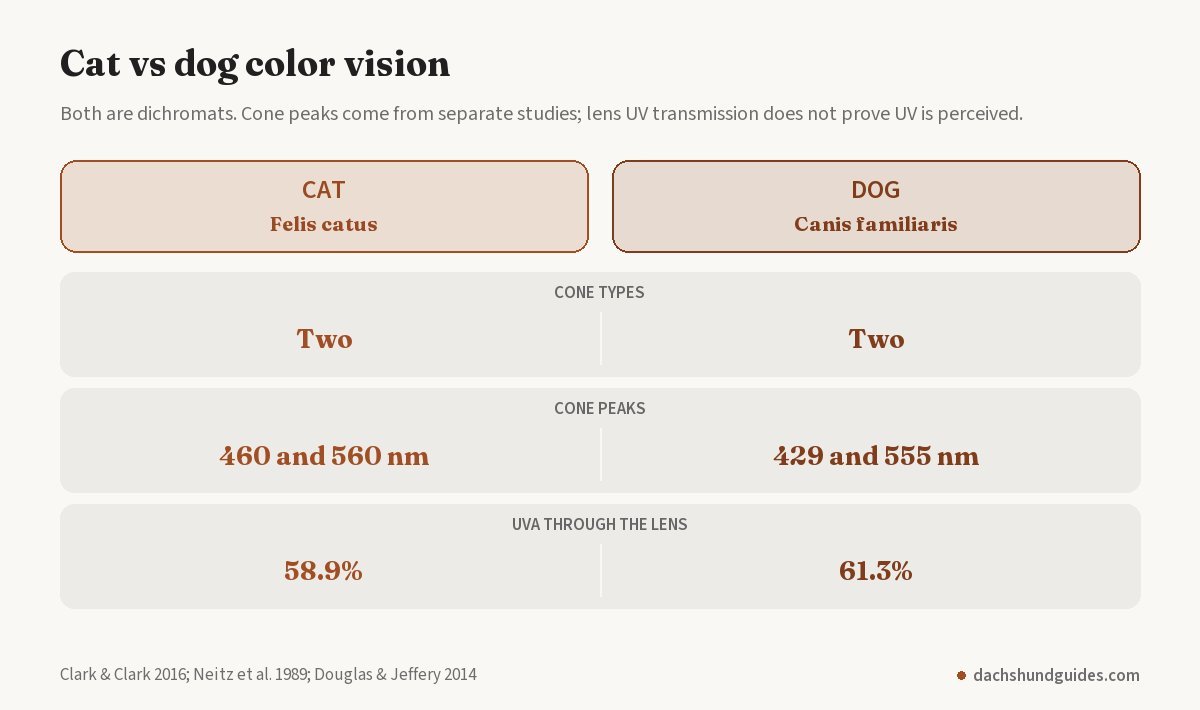
The lens numbers line up as well. In the same Douglas and Jeffery study, a Labrador’s lenses passed 61.3% of UVA, against the cat’s 58.9%. If one of them can pick up UV, the other likely can too.
So when your dachshund and your cat both ignore the red ball that rolled into the grass, they’re seeing the same thing. A red toy on a green lawn is hard to pick out by color for either of them, and both will find it faster by smell or by movement.
If you’re still working on getting the two to share the house, dachshunds and cats walks through how that usually goes.
What a cat’s color vision means for toys and play
Pick blue or yellow toys when you can, and make sure they’re big enough to matter. Those colors stay distinct for your cat, and Loop and Bruce’s results suggest that a toy smaller than a pencil eraser gives a cat little color to work with.
Contrast with the floor helps more than any single color. A yellow mouse on a blue rug stands out, while a red one on your brown wood floor may barely register. Your cat’s red laser dot works anyway, because it’s bright and it moves.

Movement is the cue cats and dogs both chase hardest, which is also why a running cat can set off a dachshund. If that’s happening in your house, a dog chasing the cat covers what to do about it.
So your cat’s world isn’t gray. It’s a two-color world of blues and yellows, and it’s the same one your dog lives in.
