
Dachshund Crate: What Size to Buy and Which Type Works

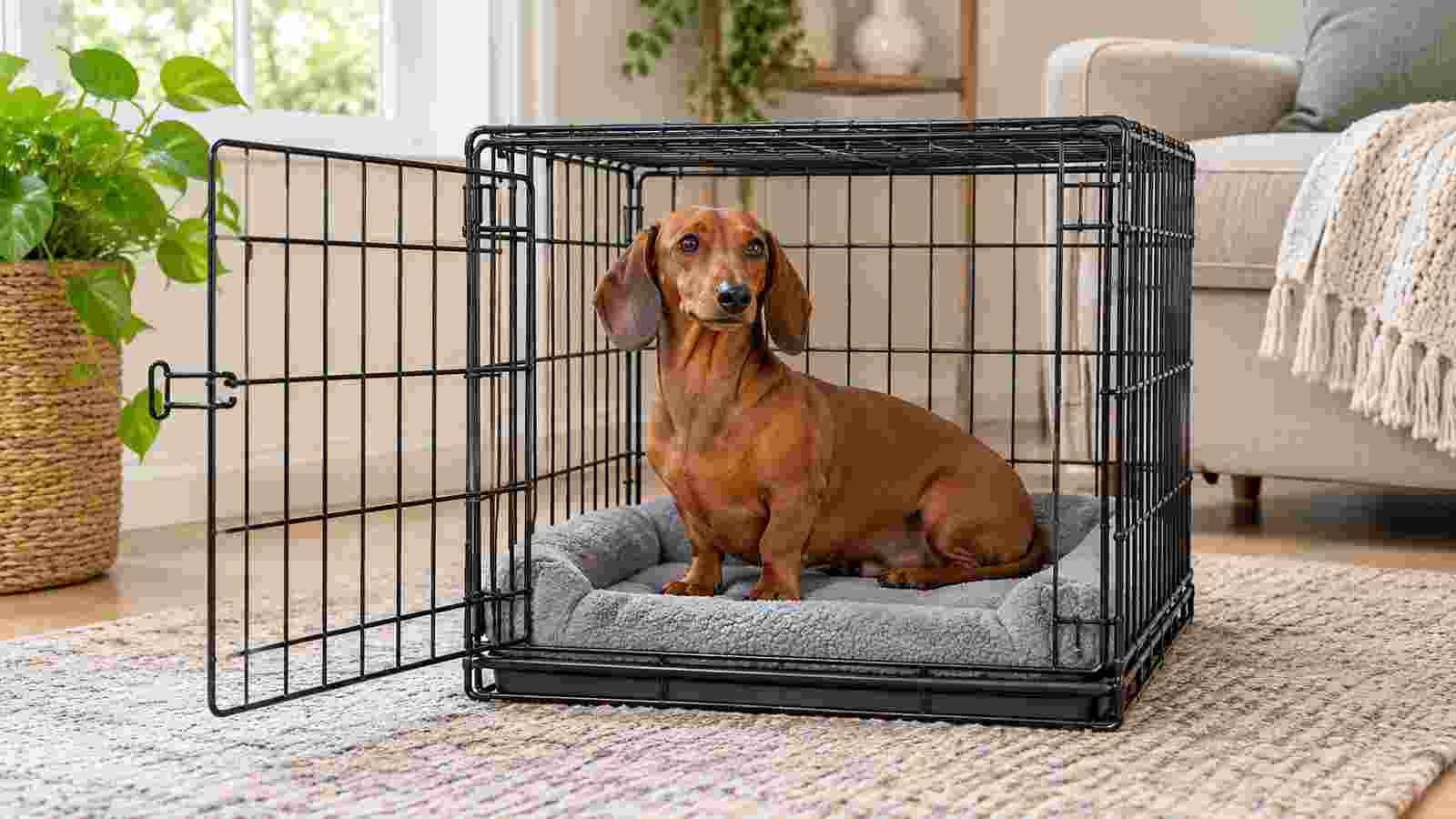
A dachshund crate should be long enough for your dog to lie stretched out and turn around, and no bigger. Dachshund Health UK puts that at about 24 inches long for an adult miniature and 30 inches for a standard.
Length is the measurement that matters most with this breed. The FCI standard sets a dachshund’s body length at about 1.7 to 1.8 times its height, so a crate sized by weight alone can leave your dog curled up with nowhere to stretch.
What size crate does a dachshund need?
Most adult miniature dachshunds need a crate about 24 inches long, and most standards need about 30. Dachshund Health UK gives 24″ x 18″ x 21″ for a miniature, 30″ x 19″ x 21″ for a standard, and 31″ x 21″ x 24″ for two standards sharing.
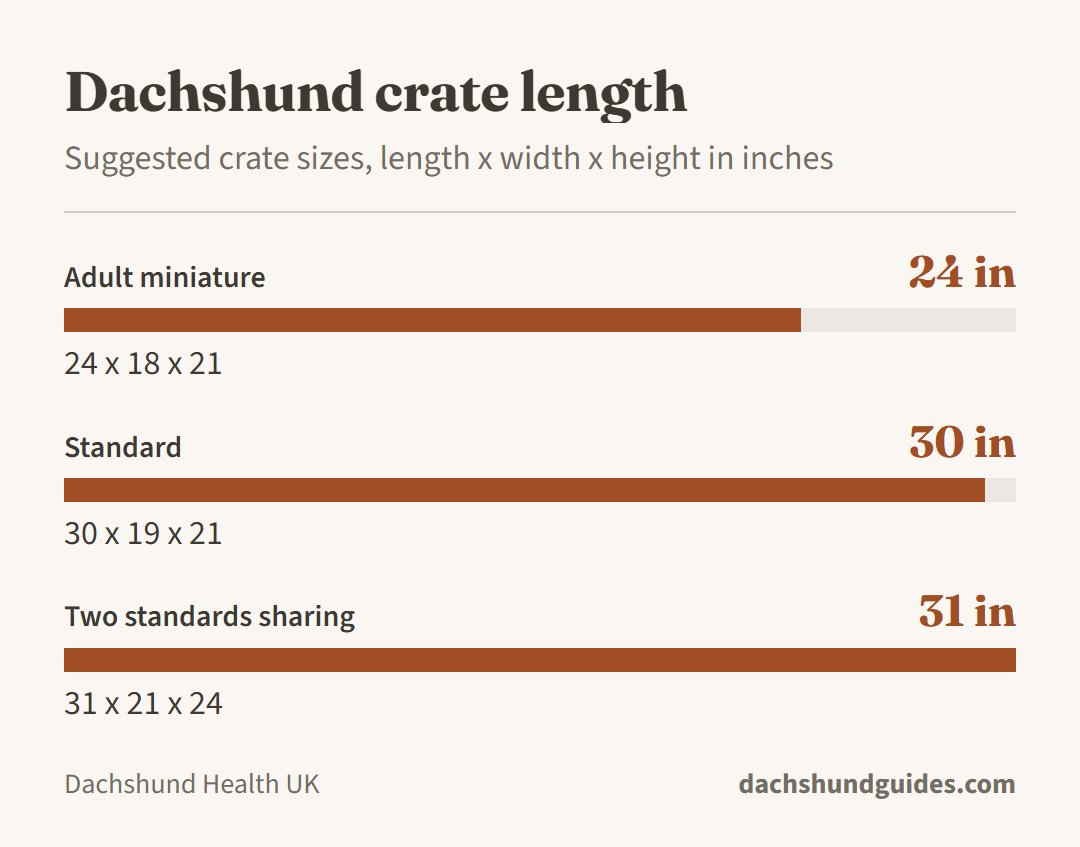
Treat those as starting points, not rules. Your dog’s length matters more than its weight, which is why a tape measure beats the weight chart on the box. Measure first.
Owners who bought small often regret it. One r/Dachshund owner said their dog “technically fit as an adult”, but couldn’t stretch out until they moved up to a 36 x 23 crate.

Measuring your dachshund: the airline formula
The most precise method comes from the airline rules.
IATA’s Live Animals Regulations (Edition 52, January 2026) take four measurements and turn them into a minimum inside size for a travel crate.
- A: tip of the nose to the base of the tail.
- B: the floor to the elbow joint.
- C: width across the shoulders or the widest point, whichever is greater.
- D: the floor to the top of the head or the ear tip, standing naturally.
The crate’s inside length should be at least A plus half of B, its width at least twice C, and its height D plus the depth of the bedding.
Here’s how that works for an example dog measuring 20 inches nose to tail base, 4 inches to the elbow, 5 inches across the shoulders and 10 inches tall. You’d need at least 22 inches of inside length, 10 inches of width and 10 inches of height plus bedding.
Width is easy to overlook, and the shoulder rule takes care of it. For a home crate you’ll live with every day, I’d round up from the formula rather than down, since IATA’s numbers are a floor for a flight, not a bedroom.
The American Kennel Club suggests a simpler version for home crates: measure nose to tail, then add 3 to 4 inches. Whichever method you pick, remember that IATA’s figures are inside dimensions, so check whether a crate’s listed size is inside or outside.
Can a dachshund crate be too big?
Yes, especially for a puppy who isn’t house-trained yet. The AKC warns that a crate with too much room “could encourage your dog to eliminate within the crate because they can sit away from the mess.”
Owners in r/Dachshund say the same thing, more bluntly. Answering a question about a puppy pooping in a large crate, one wrote:
“If the crate is too large they will just poop the corner. They should be able to go in, and curl up comfortably. But they don’t need extra room.”
– r/Dachshund, October 2026
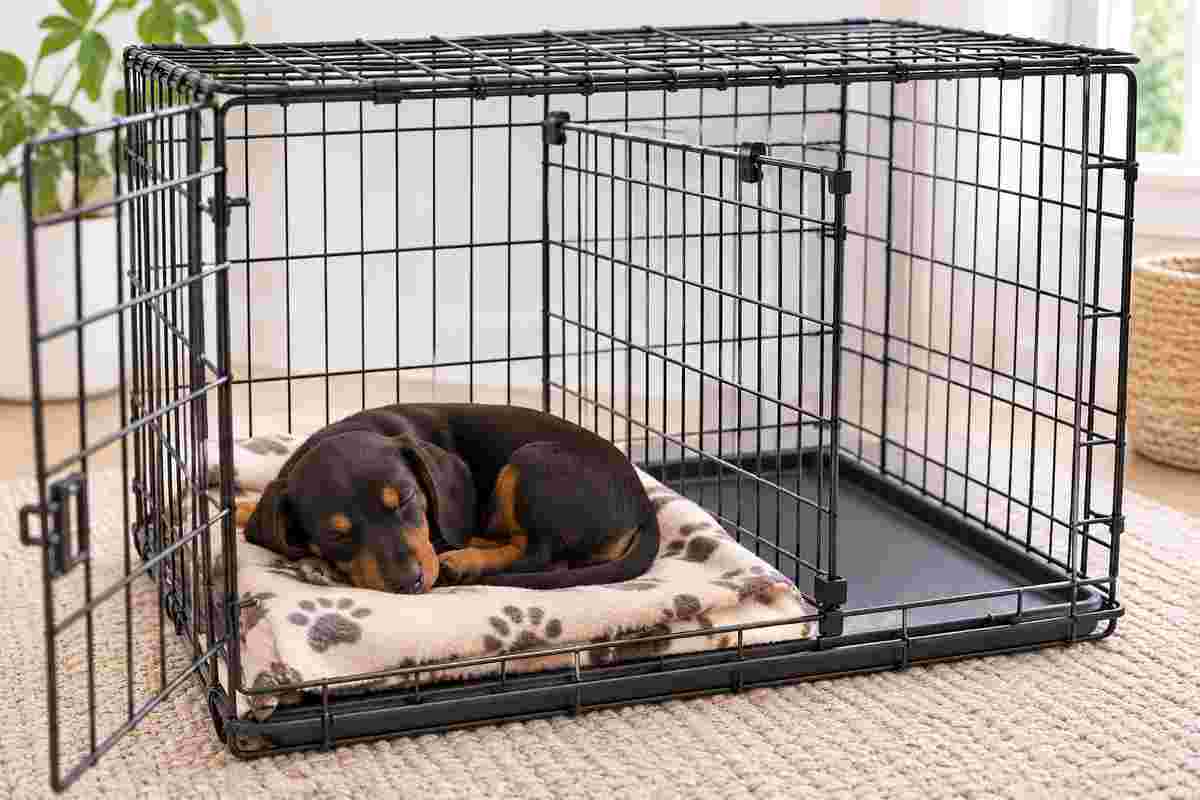
So should you buy a small puppy crate and replace it later? There’s no need. Buy for adult size, as Humane World for Animals advises, and use a divider panel to shrink the space while your puppy grows. Move the panel back as they get longer.
Not sure when to take the divider out for good? Our page on when dachshunds stop growing has the timeline, and the end of growth is a simple point to pick.
Wire, plastic or soft: which crate type?
For most dachshunds at home, a wire crate with a divider is the practical choice, and a plastic crate makes sense if you’ll fly. The AKC calls metal crates “the sturdiest you can buy”, with good air flow and visibility, and recommends them for dogs that chew through other materials.
Plastic crates work in the house and double as travel carriers, and the AKC notes they’re easy to clean. They’re also the type airlines expect: IATA’s rules say containers made entirely of wire mesh “are not suitable and must not be used for air transport.”

Soft fabric crates are light and cheap. The AKC says they suit a small dog “who isn’t going to chew on it”, but they’re harder to clean after an accident, so I’d keep one for hotel stays and weekends away rather than for a puppy who’s still learning where to pee. If you want a bag for short trips instead, see our page on dachshund carriers.
Is the look worth it? Wood crates that double as furniture look the nicest and cost the most. The AKC points out they’re heavier and harder to clean, which matters if your dog is still having accidents.
How long can a dachshund stay in a crate?
Adult dogs shouldn’t be crated for more than 4 to 5 hours during the day, according to Humane World for Animals, and puppies under 6 months no more than three or four hours at a time.
Dachshund Health UK is stricter for young puppies. It says a puppy under 3 months may not cope with more than 30 minutes alone, and that by 6 months you should be able to leave them for a couple of hours. It also says an adult shouldn’t be left alone for more than 4 hours. Two more rules from that page are worth taping to the crate. Always leave fresh water, and never leave a dog in a crate with its collar on, because of “a real risk of the collar getting caught and strangling your dog.”
A crate won’t fix separation anxiety, either. Humane World says using one as a remedy “won’t solve the problem”, and a dog may get hurt trying to escape. If your dachshund panics when you leave, start with our page on dachshund separation anxiety.
A crate for IVDD rest
If your vet prescribes crate rest for a back problem, the crate has a different job: keeping your dog still while a disc heals. Dachshund Health UK notes that conservative treatment means “strict crate-rest plus medications”, for up to 6 weeks.
Some owners on long crate rest move up a size so the dog can turn without twisting. Ask your vet what’s right for your dog’s stage, and read our guide to surgery or crate rest before you buy.
Dachshund crate questions
Is 2 hours too long to leave a dog in a crate?
Not for an adult dachshund or a puppy around 6 months old. Humane World for Animals puts the daytime limit for adults at 4 to 5 hours. For a puppy under 3 months, though, Dachshund Health UK suggests no more than about 30 minutes alone.
What is the 2:1 crate rule?
There isn’t one agreed rule by that name. Pet blogs use “2:1” for opposite things: some mean two hours in the crate for each hour out, others mean the reverse, and others use it for headroom. None of these comes from IATA, the AKC or a vet body, so size the crate from your dog’s measurements and time it with the hour limits above.
How do I crate train my dachshund?
Make the crate somewhere your dog chooses to rest, never a punishment, and build up the time slowly. Our step-by-step guide to crate training a puppy takes you through it, starting with the first nights.
