
Dachshund Potty Training: What the Evidence Says, and the Schedule That Works

Every guide to dachshund potty training opens the same way: dachshunds are stubborn, dachshunds are hard to house-train, brace yourself. I’ve read a dozen of them and not one cites anything.
So is it true? Partly. The claim holds up, but not for the reason everyone gives, and the research behind it is thinner and more recent than you’d guess.
Is a dachshund really harder to potty train?
Small dogs are less likely to end up completely house-trained than large ones. The gap is wide, and it was only measured for the first time in 2020.
Before that, it was folklore. The researchers say so themselves: clinicians routinely categorized small dogs as harder to house-train, but “there have been no published studies to date to confirm the veracity of this assumption.”
Then they tested it. Learn, Radosta and Pike, publishing in the Journal of Veterinary Behavior, surveyed dog owners and analyzed 735 complete responses. The difference was statistically significant:
| Dog size | Completely house-trained |
|---|---|
| Small dogs | 66.8% |
| Large dogs | 95.0% |
So how far off is a third of them? Roughly one small dog in three never gets all the way there. That is a real number attached to a real frustration, and it should make you feel less alone at 6am in the yard.
What the study actually compared
Three things are worth knowing before you carry that 66.8% around.
It compared sizes, not breeds. Nobody has measured house-training completeness in dachshunds specifically, so the breed never appears in the result you are reading about. Your dachshund sits on the small-dog side of a size comparison, which is not the same as the breed being singled out by research.
Nobody knows why, and that matters more than it sounds. The small-bladder-and-fast-metabolism explanation you’ll see repeated everywhere appears in that paper’s introduction as a proposal by earlier authors, not as something the study demonstrated. Its own conclusion asks for more work to understand why the difference exists.
It’s a preliminary survey, and the word is in the title. Owners self-selected into an online questionnaire, and they reported on their own dogs. That is useful evidence, and it is not a controlled trial.
This page is only about house-training. The wider job of teaching a dachshund anything at all lives in the dachshund training guide, which covers commands, the lead and the hunting instincts; come back here for the toilet half.
Here’s the finding that actually helps you, and it’s the one nobody quotes. The same study reported a correlation between the level of training a dog had received and how completely it was house-trained. Size is fixed, and the other variable isn’t.
The schedule that does the work
House-training is mostly arithmetic. A puppy can hold its bladder for about as many hours as it is months old, up to somewhere around nine months to a year, which is the rule of thumb the American Kennel Club gives.
Bruno came home from his breeder at twelve weeks. Three months old means about three hours, which sounds manageable until you count it out across a day and realize how much of your week you’re about to spend standing in the yard.
Beyond the clock, there are moments that call for a trip out regardless of when the last one was. The AKC’s list: first thing in the morning, last thing at night, after naps, after time in a crate, after meals, after drinking, after chewing a toy or bone, and after indoor play.
Notice what those have in common: every one of them is a transition. A dog that has just woken, just eaten or just stopped moving is a dog whose body has changed state, and that is when you want to be outside already rather than reacting to a squat.
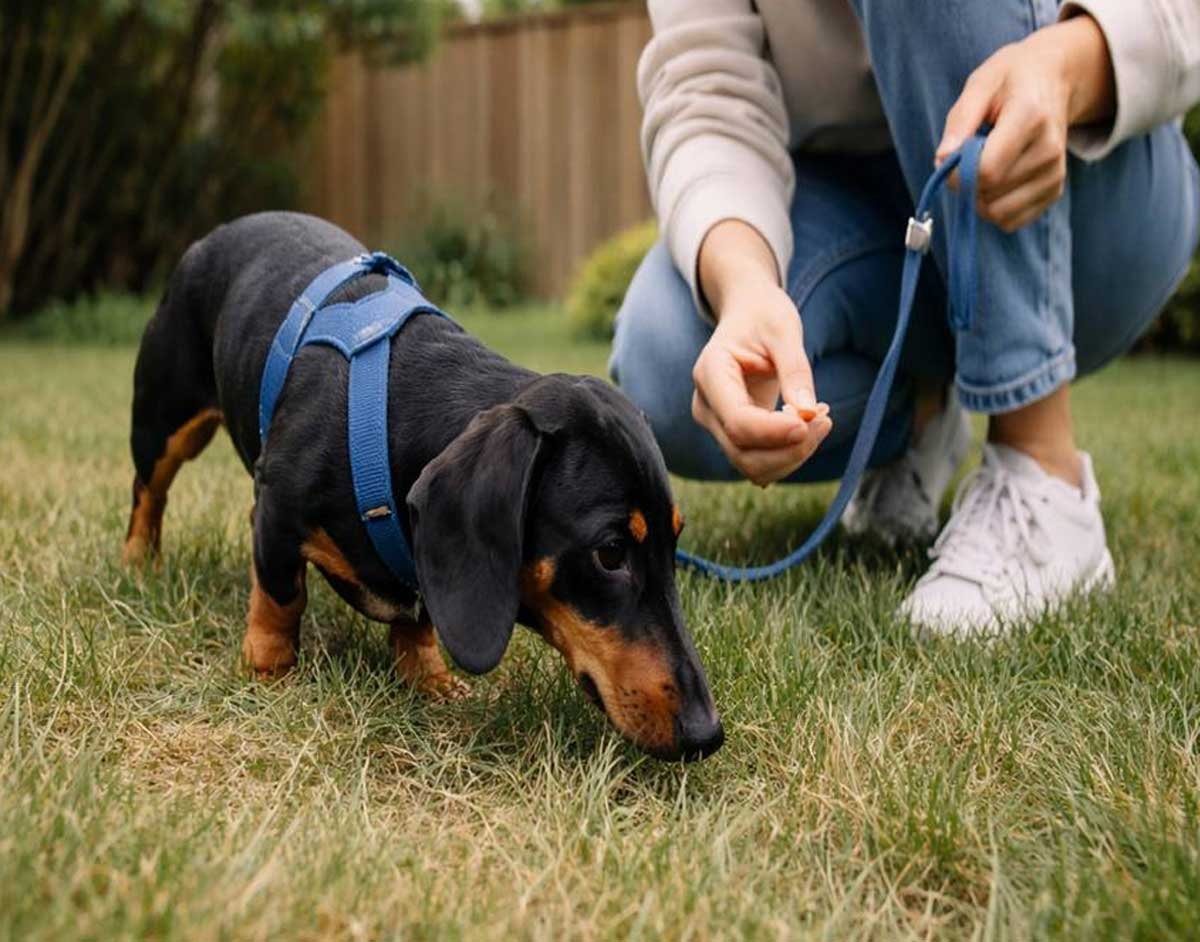
One more piece matters more than it sounds. Take them out on a lead, to one spot, and stand still, and give it three to five minutes of sniffing without turning it into a walk.
Why so rigid? If the trip out is also playtime, you’ve taught your dog that going back inside ends the fun, and some of them will hold it just to stay out longer.

Where you take them, and the rain problem
Weather is the one part of dachshund potty training that really is breed-flavored, and it isn’t stubbornness. A dachshund stands about four inches off the ground, so wet grass reaches the belly rather than the paws, and a dog that finds your yard genuinely unpleasant will hold it until you give up.
Where does it go instead? Behind the sofa, usually, and by the time you find it the moment for teaching anything has long passed. I’ve written separately about why dachshunds hate the rain, and house-training is where it costs you most.
What helps is removing the objection rather than arguing with it: a patch of the yard kept clear, a covered strip by the door, a coat that actually covers the chest and belly, and a towel waiting inside.
None of that is indulgence. You’re keeping the outdoor option from becoming the worse of the two on offer.
Start in the season you’re given, but know that a puppy who arrives in November is being asked something harder than one who arrives in May.
Pads, crates and the boundary question
Pads are genuinely contested, and the objection is about texture. A soft absorbent surface underfoot is difficult to distinguish from a rug, so a dog trained onto pads has been taught something you may have to untrain later.
If your goal is a dog that only ever goes outside, pads make the route longer.
They still earn their place in an apartment, on a high floor, or for an owner who can’t get down to the street every two hours. Just make it a decision rather than a default.
Crating works on a simple principle: dogs avoid soiling where they sleep.
The sizing rule is the whole trick. The crate should let the puppy stand, turn around and lie down comfortably, and no more, because a crate with spare room gives it somewhere to go in one corner and sleep in another.
When you can’t watch, contain. That’s the entire boundary rule, and unsupervised freedom in a large house is how a dog finds a quiet corner you won’t discover until later.
Accidents, and the one thing not to do
Do not punish them. Don’t rub their nose in it, don’t shout, and don’t drag them back to the spot.
If that sounds obvious, consider what the 2020 paper cites on its way to its own question. In a survey across twelve shelters, almost half of the owners giving up their dogs either believed that rubbing a dog’s nose in its mess is helpful, or weren’t sure.
Almost half. These are people at the point of surrendering an animal, often over house-soiling, holding a method that teaches a dog to hide.
Because that’s what punishment actually trains. A dog that has been shouted at doesn’t connect your anger to a decision it made twenty minutes ago; it connects it to you, plus the mess, plus your presence.
What it learns is to go somewhere you aren’t. The AKC’s advice on finding an accident is short and correct: don’t make a fuss, just clean it up.
Clean it properly, though. Use an enzyme cleaner rather than anything ammonia-based, because ammonia smells enough like urine to mark the spot as a toilet.
How long does it take?
Longer than a fortnight and shorter than forever. Owners who write up their own dachshunds tend to report something in the region of three to six months to reliable, which fits what the arithmetic predicts: a puppy physically can’t do it before its bladder can hold the gaps.
Expect the first month to be about your routine rather than the dog’s learning, because what you are really building in those weeks is the schedule.
The dog starts meeting you halfway once the pattern is old enough to be predictable. My Pretzel’s separation-anxiety work took eight weeks of that kind of slow, boring, repeated structure before anything looked like progress, and I’d expect this to feel the same.
And a regression at five or six months is normal rather than a sign it has all failed. What isn’t normal is a dog that was reliable and suddenly isn’t, which is a vet conversation about a urinary tract infection before it’s a training conversation.
Dachshund potty training: common questions
Do dachshunds have a hard time potty training?
On the evidence, small dogs do. A 2020 survey of 735 owners found 66.8% of small dogs were completely house-trained against 95.0% of large dogs. No study has singled out dachshunds, so treat the breed-specific version as a reasonable inference rather than a measured fact. The same study also found training level correlated with the outcome.
At what age should a dachshund be potty trained?
There’s no age at which it should be finished, but the arithmetic sets the floor: a puppy holds roughly an hour per month of age, so reliable overnight control isn’t physically available at eight weeks. Most owners describe something workable by three to six months, and some dogs take longer without anything being wrong.
How do you potty train a dachshund puppy?
Take them out on the hour while awake, plus after every wake-up, meal, drink, chew and play session. Go to one spot, on a lead, and stand still for three to five minutes. Reward the instant they finish rather than when you get back inside, and contain them whenever you can’t watch. Clean accidents with an enzyme cleaner and say nothing.
Should I use puppy pads?
Only if your living situation needs them. A pad feels much like a rug underfoot, so a pad-trained dog has learned something that later has to be undone. In a flat several floors up, that trade is often worth making; in a house with a yard, it usually isn’t.
My dachshund refuses to go out in the rain. Now what?
Make outside less unpleasant instead of insisting. They’re low enough that wet grass hits the belly. A covered patch, a coat that covers the chest, and a towel by the door will do more than waiting them out, because the dog that waits you out goes indoors instead.
Does a crate actually help?
It helps by preventing the accident you’d otherwise never see, not by teaching anything. Dogs avoid soiling where they sleep, so the size has to be right: enough room to stand, turn and lie down, and no spare corner. It stops working the moment the crate is roomy enough to have a bathroom end. How to introduce the crate in the first place is covered in the crate training a puppy guide.
Why has my house-trained dachshund started having accidents again?
If it’s a young dog around five or six months, a wobble is common. If it’s an adult that was reliable, treat it as medical until proven otherwise, because a urinary tract infection, bladder stones and several other conditions present exactly this way. Book the vet before you rebuild the schedule.
