
Dachshund Pet Insurance: Which Policies Cover IVDD

Dachshund pet insurance is decided by its waiting period. Every provider covers intervertebral disc disease in principle, and the clause that settles whether your dog’s first episode gets paid lives in a help-centre article, not on the breed page.
The practical consequence is a date, not a brand. Enroll before there is anything to declare, then book a veterinary exam inside the first two weeks, and you have done more for the claim than any amount of comparing logos.
The reason this breed gets its own arithmetic: Dachshund Health UK puts the lifetime risk of IVDD at around one in four dogs, which makes the condition every policy screens hardest for the same condition you are insuring against.
The waiting period decides whether dachshund pet insurance covers IVDD
Embrace, one of the larger US providers, keeps Intervertebral Disk Disease out of coverage for the first 180 days of a policy and treats any episode inside that window as pre-existing permanently. Its help centre states the rule directly:
“The following orthopedic conditions that occur or show symptoms before the end of the illness waiting period or during the first 180 days of the policy are excluded from coverage and are pre-existing for the life of the policy: Intervertebral Disk Disease (IVDD), Cruciate Ligament Injury, Patellar Luxation, Canine Hip Dysplasia.”
– Embrace Pet Insurance, What Is the Waiting Period for Orthopedic Conditions
Six months is a long exposure for a breed whose discs can go at any age. A dog enrolled in January with a disc episode in April falls inside that window, and the exclusion then attaches for as long as the policy exists. The insurer has not broken anything by refusing that claim.
The same page gives the lever that closes it. Some states allow the orthopedic window to be cut to as few as 14 days through an Orthopedic Exam and Waiver Process: a vet examines the dog after the policy is bought and completes an Orthopedic Report Card, and if the exam happens within the first 14 days and the dog is marked healthy, the waiting period drops to the end of the 14-day illness waiting period. An exam done later shortens the window to the exam date instead.
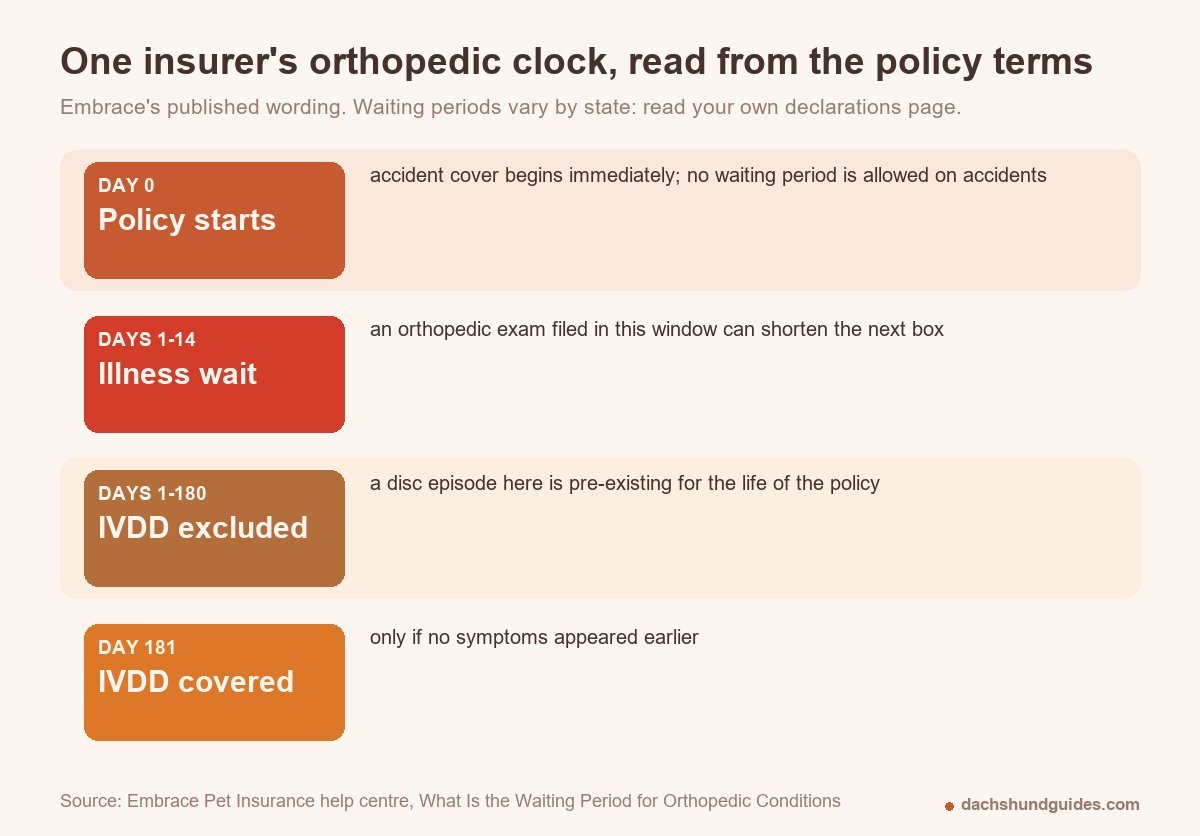
Two limits belong beside that timeline. It describes Embrace’s terms, and other providers structure the same risk differently, some with a short blanket illness period and no separate orthopedic clause. Orthopedic waiting periods also vary by state, which both Embrace and Pets Best say plainly on their own pages, so the number that governs your policy is on your declarations page and nowhere else.
What counts as pre-existing when the condition is IVDD
A pre-existing condition does not require a diagnosis. Pets Best defines it as “any condition that was present before the end of your waiting periods, even if it wasn’t formally diagnosed by a veterinarian.”
The company spells out the consequence on the same page: if signs or symptoms were present before the policy started there is no coverage for that condition, “even if you weren’t sure what was wrong with your pet.”
That wording is not one company being strict. The NAIC Pet Insurance Model Act defines a preexisting condition to include any case where, before the policy took effect or during a waiting period, “the pet had signs or symptoms directly related to the condition for which a claim is being made.”
Signs, for a dachshund, are quiet. A yelp from the next room when the dog turned awkwardly. A morning of standing at the bottom of the sofa and declining a jump that was routine last week. A back held a little hunched for two days. Those are the early signals of a disc problem, and they are precisely the events an owner decides not to spend a consultation fee on.
One protection runs the other way. Under the same model act, “the pet insurer has the burden of proving that the preexisting condition exclusion applies to the condition for which a claim is being made.” A denial letter is a position the insurer has to support, not a verdict.
What the model law requires an insurer to offer
The NAIC model act sets three rules that are useful to quote back at a sales agent. Waiting periods on accidents are prohibited outright, and waiting periods for illnesses or for orthopedic conditions that did not result from an accident “do not exceed 30 days.”
The third rule is the one nobody volunteers. Any policy using a waiting period must contain a provision allowing that period to be waived once a medical examination is completed. The examination is paid for by the policyholder unless the policy says otherwise.
A model act is a template for states, not a federal rule, and adoption is uneven. That unevenness is the reason every provider page carries the phrase “varies by state” and the reason an owner in one state meets a 180-day orthopedic window while an owner two states over meets thirty days on the same product. Someone asking for provider recommendations on r/Dachshund had already worked this out:
“Hello everyone. My wife and I are about to get a dachshund puppy and are planning to get pet insurance that covers IVDD. What providers do you use? What do you pay? What plans and coverage did you get? We are in MA if that helps. Thank you”
– r/Dachshund
Is pet insurance worth it for a dachshund?
Pet insurance is worth it for a dachshund bought before any spinal symptom has appeared, because the breed’s main claim risk is the one condition every policy screens hardest. Bought after a first episode, the policy covers everything except the thing it was bought for.
The alternative owners raise is self-insuring, and one in the same thread put it as paying yourself the premium into a high-yield savings account each month. The arithmetic holds for a dog that stays healthy and collapses for a dog that does not, because the savings balance grows linearly while a surgical bill arrives whole. An owner in that thread had an emergency bill of about $1,500 that insurance absorbed, on a dog that had never had a disc episode.
The scenario those threads keep describing is not a slow decline. It is one bad landing:
“Our guy was jumping up onto to a couch before I could get the ramp up, and he missed and fell back onto his behind,” one owner wrote, describing a dog that was screaming and dragging its back legs minutes later. A ramp that is actually in place removes that specific event; the policy is for the version where it happens anyway.
How much is pet insurance for dachshunds?
Owner-reported premiums for dachshunds sit in the tens of dollars a month, with one owner in r/Dachshund paying $75 a month for a MetLife policy that includes preventive care. No average is meaningful here, because four variables move the price more than the provider does.
Those four are the annual limit, the deductible, the reimbursement percentage, and the dog’s age at enrollment. One owner described settling on a Pets Best plan at a $250 annual deductible with an unlimited annual limit and 90% reimbursement, which is a specific configuration rather than a price, and that is the level a quote comparison has to reach before two numbers mean the same thing.
Age is the variable that quietly decides the rest. Premiums rise with it, and more to the point, the chance that something has already shown symptoms rises with it too. A four-year-old with a clean record is a simple enrollment; the same dog at eight, after one unexplained limp last winter, is a negotiation.
Your first two weeks decide the next ten years
The enrollment window is the part of this an owner controls completely, and it closes fast.
- Enroll while the dog’s record is clean. A puppy with no vet history and no symptom is the only version of this dog that is fully insurable.
- Open the declarations page and find the orthopedic waiting period for your state. The marketing page will not carry it.
- Book the veterinary exam inside the first 14 days, not the first month. The shorter waiver depends on that boundary.
- Have the vet complete the insurer’s orthopedic form and file it before the window closes. An exam with no filed report does nothing.
- Keep every visit on the record afterwards. A complete history is what defeats a pre-existing argument later.
What to ask before you sign
The order of the questions matters more than the list. The waiting period decides whether there is a payout; the deductible and reimbursement rate decide only how big it is.
| Where you are | What to ask | Why it decides the outcome |
|---|---|---|
| New puppy, no vet history | What is the orthopedic or IVDD waiting period in my state, and will an exam waive it? | This clause alone determines whether a first disc episode is paid |
| Adult dog, one yelp last year that never went to a vet | Will an undiagnosed symptom in the history be treated as pre-existing? | Symptoms count without a diagnosis, in both the policy wording and the model act |
| Dog already diagnosed with IVDD | Is the exclusion limited to the spine, and what stays covered? | Everything unrelated to the disc remains insurable, which is most of a dog |
| Comparing two quotes | What are the annual limit, deductible and reimbursement rate on each? | Two premiums are not comparable until these three match |
| Claim already denied as pre-existing | What evidence supports the exclusion? | The model act puts the burden of proof on the insurer, not on you |
None of this is a recommendation of a particular policy, and coverage terms change. The wording quoted here is what those companies had on their own pages at the time of reading, applies to US policies, and varies by state; your declarations page governs your claim. For anything medical, the vet decides, not the policy.
The enrollment date is the only part of this still under your control today.
Frequently asked questions
Which pet insurance is best for dachshunds?
The best dachshund pet insurance is whichever provider offers the shortest orthopedic waiting period in your state and will waive it after a veterinary exam. That clause matters more for this breed than premium or brand.
Does pet insurance cover IVDD surgery?
Pet insurance covers IVDD surgery when the disc episode begins after the policy’s waiting and orthopedic exclusion periods have ended and no earlier symptom is on record. An episode inside those windows is excluded for the life of the policy.
Is pet insurance worth it for dachshunds?
Pet insurance is worth it for dachshunds enrolled before any back symptom appears, given a lifetime IVDD risk near one in four. Enrolled afterwards, the spine is excluded and the policy covers only unrelated conditions.
How much is pet insurance for dachshunds?
Dachshund owners report premiums in the tens of dollars a month, including one paying $75 monthly for a plan with preventive care. The annual limit, deductible, reimbursement rate and enrollment age move the price more than the provider.
Can I insure a dachshund that already had IVDD?
A dachshund that has had an IVDD episode can still be insured, but the spine is excluded as pre-existing. Accidents, illnesses and conditions unrelated to the disc remain covered under a new policy.
