
Dachshund Ramp: How to Choose One Your Dog Will Use


A dachshund ramp works or fails on its length. Every ramp sold for small dogs promises a gentle slope, and almost none of them print the angle, so two products described in the same words can differ by fifteen degrees once they lean against your bed.
That leaves one piece of arithmetic to do before comparing prices or colours. The harder problem arrives after delivery, when a large share of dachshunds walk past the ramp and jump anyway.
The stakes are why anyone shops for one. Intervertebral disc disease is the breed’s defining health problem, and Dachshund Health UK puts the lifetime risk at around one in four dogs.
How long should a dachshund ramp be?
A dachshund ramp should climb at a shallower angle than the staircase in your house. A sofa seat near 18 inches wants 36 inches of ramp or more. A 25-inch bed wants 48 inches at minimum, and 60 to 72 inches is the range that works.
The angle comes from the ramp’s own length, not its footprint on the floor. Divide the surface height by the ramp length and the result is the sine of the climbing angle. A 48-inch ramp reaching a 25-inch mattress climbs at 31 degrees.
Put that number next to something familiar. A staircase built to a 7-inch riser over an 11-inch tread climbs at about 32 degrees, and the International Residential Code allows risers up to 7.75 inches over a minimum 10-inch tread, which works out near 38 degrees at the legal limit. A ramp steeper than your own stairs asks a dog with eight-inch legs to do something harder than climbing to the bedroom.
| What your dog is climbing onto | Height to measure | 36 in ramp | 48 in ramp | 60 in ramp | 72 in ramp |
|---|---|---|---|---|---|
| Sofa, getting up to the seat cushion | about 18 in | 30° | 22° | 17° | 14° |
| Bed, getting up to the mattress top | about 25 in | 44° | 31° | 25° | 20° |
| Car, getting up to an SUV cargo floor | about 28 in | too steep | 36° | 28° | 23° |
Those angles are arcsine calculations, height divided by ramp length, run here on the three heights most homes produce. Measure your own before buying, because the numbers move fast: the table assumes the ramp rests on level floor along its full length, ignores the lip at each end, and says nothing about grip or weight rating. A folding ramp measured along the floor instead of along the board will read shallower than it climbs.
A dachshund ramp for a bed has further to travel than one for a sofa, and that difference alone is why so many bed ramps get returned. Measure to the top of the mattress, not the bed frame. A pillow-top adds three or four inches, which is the gap between a 60-inch ramp working and a 60-inch ramp going back in the box.
Is a ramp or stairs better for dachshunds?
A ramp is the better choice for a dachshund, because pet steps still ask the dog to drop its front end onto each tread, and those small repeated impacts land on the part of the spine you are trying to protect. Steps win on floor space.
Floor space is a real constraint, not a footnote. A 60-inch ramp beside a bed eats most of the walking room in a small bedroom, and it cannot be folded away each morning without also being unavailable at night, which is when the jump you care about happens.
Steps keep one advantage. Some dachshunds treat a ramp as a strange sloping object and treat steps as furniture they understand. A set of steps the dog climbs beats a ramp the dog ignores, even though the ramp is gentler on paper.
Why your dachshund ignores the ramp
Ramps get ignored for three reasons: the ramp is not where the dog gets on and off, the surface feels unstable underfoot, and jumping is still available and faster. All three are fixable, and none of them by buying a second ramp.
“Does anyone have advice on how you trained your dachshund’s on using the ramp? I have ramps on couches and bed, but my dachshund (2yr intact male) seems to always just jump right over them. Have had the ramps since the day he came home.”
– r/Dachshund (113 upvotes)
Several of the owners replying under that post had bought more than one ramp before asking.
Put the ramp where the jump happens
Dogs pick a launch spot and keep it. Watch which corner of the bed your dachshund uses, then put the ramp there, even when a different side would look tidier. Moving the ramp two feet along the bed is often the entire fix.
Blocking the old route matters as much as offering the new one. A storage box or a folded duvet against the launch corner removes the choice for a week or two, long enough for the ramp to become the habit.
Fix the surface before you blame the dog
A ramp that shifts even slightly under the first step will not get a second one, and the moulded ribbing on cheaper plastic ramps is the surface owners most often end up covering. Carpet answers both. One owner in r/Dachshund reported the change after covering theirs: “After putting carpet on the ramp they were good to go.”
Check the feet as well. A ramp standing on hardwood needs rubber contact at both ends, or it creeps away from the bed under load and teaches the dog that the surface cannot be trusted.
The two-week ramp routine
Ramp training works on repetition at a fixed time of day.
- Lay the ramp flat on the floor for two days and feed treats along its length, so the surface stops being novel before it starts being a climb.
- Raise it to the sofa and lure the dog up with a treat held low, one step at a time, without lifting them onto it.
- Reward at the top, then lure back down. Coming down is the part most dogs resist, and the part that matters for the spine.
- Move to the bed once the sofa is reliable, and leave the ramp in place overnight.
- Attach the ramp to something the dog wants anyway. One owner in the same thread gives the nightly treat on the ramp, so the route and the reward arrive together.
Two weeks is a fair trial; three days is not.
What the research says about ramps and IVDD
The largest owner survey of the breed found a lower IVDD rate among dachshunds allowed on and off furniture than among the dogs forbidden it, and its authors read that gap as reverse causality more than protection.
DachsLife 2015, published by Packer and colleagues in Canine Genetics and Epidemiology, collected records for 2,031 dachshunds, 310 of them with a veterinary diagnosis of IVDD. Among dogs allowed on and off furniture, 10.4 per cent had been diagnosed. Among dogs not allowed to jump, 26.7 per cent had, an odds ratio of 3.16.
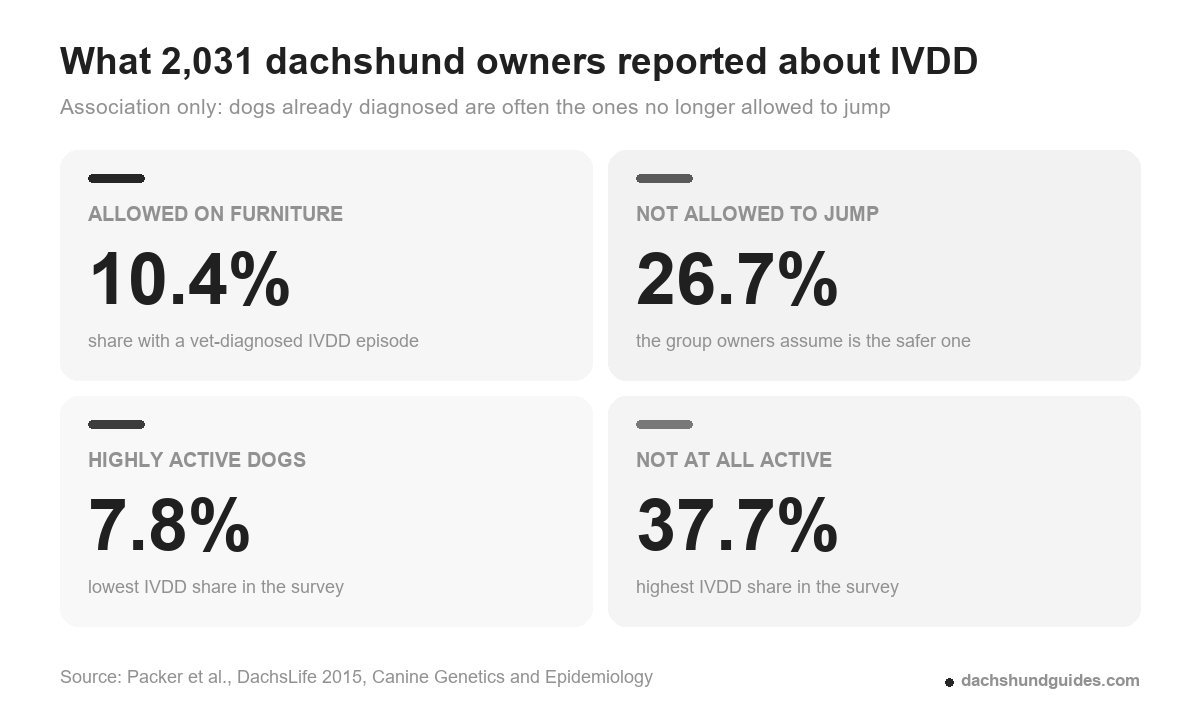
Packer and colleagues do not read that as permission to let a dachshund leap off the bed. They name reverse causality as the likely explanation, since a dog that has had an episode is exactly the dog whose owner stops the jumping afterwards. They raise one other possibility, that dogs jumping regularly build more of the musculature supporting the spine. Either way the finding is a single survey with owner-reported diagnoses, which makes it a reason to question the advice, not to reverse it.
Activity followed the same shape. Dogs their owners called not at all active showed a 37.7 per cent IVDD share, against 7.8 per cent among highly active dogs, and dogs exercised under 30 minutes a day carried higher odds than dogs walked for over an hour.
The usable reading sits between those findings. A ramp removes the impact of a 25-inch drop, which is a real load on a breed that carries this much spinal risk. It should not become the reason a dog gets carried everywhere and walked less.
A ramp is also not a treatment. A dachshund holding its back hunched, refusing a jump it used to make, or dragging a back leg needs a vet the same day. Ramps are prevention equipment, and no arrangement of furniture substitutes for that examination.
Can you get a ramp for a flight of stairs?
Ramps for a full flight of household stairs are not sold as a product. What retailers list as a dachshund stair ramp is a short unit built for two or three steps, usually at a back door. For a staircase inside the house, the answer is a gate.
Owners keep looking anyway. An r/Dachshund thread asking whether anyone has found a stair ramp that works ends without a product.
The geometry explains the gap. A staircase rising eight feet over a twelve-foot run is a 34-degree climb along a diagonal of roughly fourteen feet, and no ramp is built to span that. A plank laid over the treads reproduces the same angle with no side rails and a surface that slides.
A pressure-fitted gate at the top and the bottom costs less than any ramp and settles the question. Threshold ramps are the one stair-adjacent product that earns its price, for the two steps down to a garden where a dachshund otherwise lands hard several times a day.
What to check before you buy
Length is settled by the table above. Six details decide whether the ramp stays in use after the first month.
- Width. A dachshund that decides to turn around mid-climb needs room to do it without a foot going off the side.
- Side rails. Useful at bed height, less so at sofa height. Removable ones let you start training without the dog feeling boxed in.
- Surface. Carpet and rubber both grip. Moulded plastic ribbing grips less well than it looks like it should.
- Feet. Rubber at both ends, or the ramp walks on hard floors.
- Weight rating. Any ramp handles one dachshund. It matters when two of them use it at the same time, which they will.
- Folding. A folding ramp is easier to live with and easier to forget to unfold.
The brand owners keep naming
DoggoRamps is the name that recurs in r/Dachshund ramp threads, usually in the same sentence as a complaint about the price. Its hardwood range is split by destination, and the company lists the couch ramp at up to 150 lb, the small bed ramp at up to 50 lb and the large bed ramp at up to 200 lb. For a dachshund those ratings settle nothing, since even the smallest clears the dog four times over; the choice inside the range is still the height question.
An owner in a thread about a 14-year-old that slipped coming up a set of steps put the same point in one line: “Make sure the angle isn’t too high.” A short ramp from a good brand is still a short ramp.
Lifting stays part of the routine while training is underway, and a supportive harness spreads the load better than a hand under the belly.
If the ramp has to be set up each evening, it will miss the jump that matters, which is the one at 2am when nobody is awake to place it.
Frequently asked questions
What is the best ramp for dachshunds?
The best ramp for a dachshund is the longest one that fits the room, with a carpeted surface and rubber feet. For a bed that means 60 to 72 inches. Length and traction decide more than brand.
Is a ramp or step better for dogs?
A ramp is better for dogs with long backs, because steps involve repeated small impacts on the spine. Steps suit tight rooms and dogs that refuse to use a ramp at all.
What is the best dog ramp for a senior dog?
A senior dog needs a shallower climb than a young one, so add length first, with 72 inches to a bed as the target. Side rails and a non-slip surface matter more once back legs start weakening.
Does a miniature dachshund need a different ramp?
A miniature dachshund needs the same ramp length as a standard one, because the length is set by the height of your furniture and not by the weight of the dog. Width and step-on height are where a mini differs.
Is a homemade dachshund ramp safe?
A homemade dachshund ramp is safe when it meets the same three conditions as a bought one: a climb shallower than your stairs, a carpeted surface, and ends that cannot slide. Most DIY builds fail on length.
