
What Vaccinations Does My Dachshund Need? Schedule and Risk

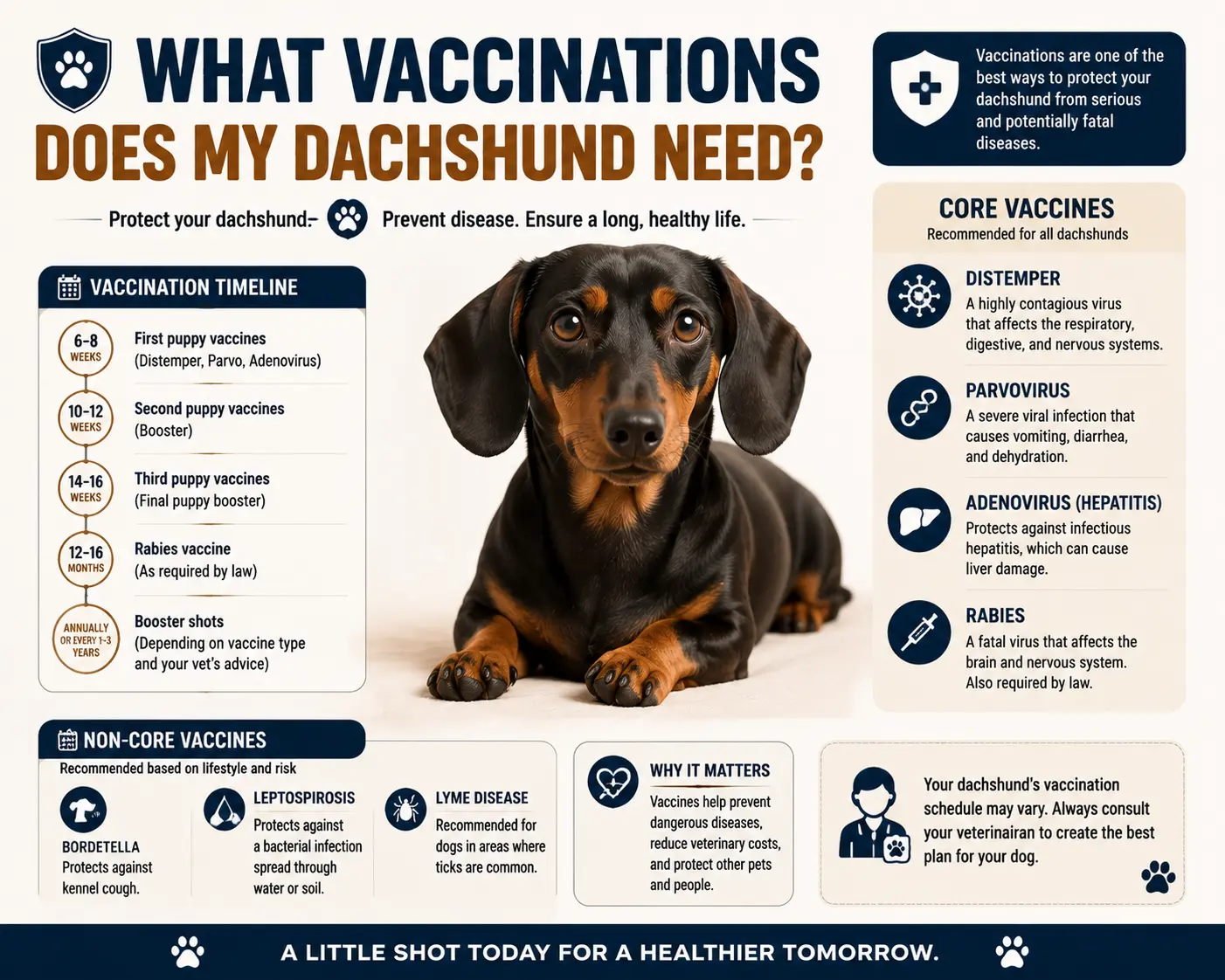
Your dachshund needs five core vaccines: distemper, adenovirus, parvovirus, rabies and leptospirosis. Those are the shots the American Animal Hospital Association (AAHA) recommends for every dog, whatever its lifestyle. Kennel cough, canine flu and Lyme are lifestyle shots, added only when your dog’s routine or region calls for them.
So what vaccinations does my dachshund need that a Lab doesn’t? None, but there’s one breed-specific catch.
Dachshunds have one of the highest recorded rates of vaccine reactions, second only to French Bulldogs in a study of about 4.6 million dogs. Reactions are still uncommon, and the answer isn’t skipping shots. It’s spacing them out.
The five core vaccines
Three of the five come together in one combination shot, often labeled DAPP or DHPP on your vet bill. The other two, rabies and leptospirosis, aren’t part of it. They’re separate injections with their own timing, which matters later when you plan visits.
- Distemper: part of the combination shot.
- Adenovirus type 2: also in the combination shot. It cross-protects against adenovirus type 1, the cause of infectious canine hepatitis, which is where the “H” in DHPP comes from.
- Parvovirus: the third piece of the combination shot, and according to AAHA the most common cause of viral enteritis in dogs.
- Rabies: required by law in many places, and it’s the law that sets the age and booster timing.
- Leptospirosis: a bacterial disease AAHA lists as core in its 2022 vaccination guidelines. You’ll still see older pages call it optional.
Parainfluenza often rides along in the combination shot, but AAHA marks it as optional there, so a DAPP without it still covers the core list.
Dachshund vaccination schedule, from puppy to adult
A puppy’s combination shots start at 6 to 8 weeks and repeat every 2 to 4 weeks until your puppy is older than 16 weeks. Leptospirosis starts at 12 weeks, rabies follows local law, and everything gets one booster within a year of the puppy series.
- 6 to 8 weeks: first combination shot. If you’re buying from a breeder, ask for the record of what was given and when. Our guide to choosing a dachshund puppy covers what else to ask.
- Every 2 to 4 weeks after that: repeat the combination shot until your puppy is past 16 weeks. AAHA prefers finishing at 18 to 20 weeks where parvo risk is high, because antibodies from the mother can block the vaccine and may last 13 to 15 weeks or longer.
- 12 weeks or older: first leptospirosis dose, then a second one 2 to 4 weeks later. AAHA suggests waiting until 12 weeks because reactions are more likely in smaller and younger dogs.
- Rabies: as your local law requires. Every licensed rabies vaccine is labeled for puppies 3 months and older.
- Within a year of the last puppy dose: one booster each of the combination shot and leptospirosis, plus a rabies booster a year after the first rabies shot.
- From then on: the combination shot every 3 years, leptospirosis every year, and rabies every 1 or 3 years, depending on the product and the law where you live.
Adopting an adult with no records? AAHA’s plan is two combination doses 2 to 4 weeks apart, and two lepto doses 2 to 4 weeks apart regardless of age. Its rule of thumb for an unknown history is short: “When in doubt, vaccinate.”
Lifestyle shots: kennel cough, flu and Lyme
These aren’t for every dachshund. AAHA calls them noncore, recommended for some dogs based on lifestyle, location and risk of exposure, and most are boosted yearly once started. Your vet will ask where your dog goes and who it meets.
- Bordetella and parainfluenza (kennel cough): a single dose up the nose for dogs at risk of exposure. Injectable and oral versions exist too.
- Canine influenza: two doses 2 to 4 weeks apart.
- Lyme disease: for dogs that live in or travel to areas where Lyme is established, such as much of the US Northeast. If you’re traveling, you’ll want both doses finished 2 to 4 weeks before you go. Keep up tick prevention too, since stopping ticks from feeding is what stops the disease.
- Rattlesnake toxoid: dosing depends on body weight and exposure risk, so it’s a conversation for snake country only.
Where Lyme is common, some practices treat its vaccine as core, so don’t be surprised if your vet recommends it without being asked.
Why dachshunds react to vaccines more often
In a 2023 study of more than 16 million vaccination visits, dachshunds had about four times the odds of a recorded reaction compared with mixed-breed dogs. Their rate was still roughly 1 in 200 visits. That isn’t a reason to skip shots, but it’s a good reason to plan them differently.
The study covered about 4.6 million dogs at more than 1,100 hospitals in one veterinary practice chain from 2016 to 2020, counting any reaction recorded within 3 days. Here’s how a few breeds compared:
| Breed | Vaccination visits | Reactions per 10,000 visits |
|---|---|---|
| French Bulldog | 169,308 | 55.9 |
| Dachshund | 410,313 | 49.4 |
| Boston Terrier | 146,436 | 44.9 |
| Pug | 247,330 | 33.2 |
| Chihuahua | 1,258,976 | 28.2 |
| Mixed breed | 767,062 | 14.0 |
| Labrador Retriever | 1,264,949 | 11.1 |
Breed wasn’t the only factor. Each extra vaccine given at the same visit, up to four, raised the odds of a reaction by about 25%. The smallest dogs, about 11 pounds (5 kg) or less, had nearly twice the odds of dogs over about 99 pounds (45 kg).
Of the single vaccines, rabies had the highest reaction rate, and leptospirosis wasn’t any worse than the combination shot or rabies, despite its reputation.
Spayed and neutered dogs also had higher odds than intact dogs, which is worth knowing if you’re weighing whether to neuter your dachshund.
Most reactions weren’t coded as severe. Across all dogs, 45.2% were coded as mild, 19.0% as moderate, 18.6% as allergic reactions and 15.4% as severe. The authors say breed differences may point to genetics. AAHA makes a similar point: breed is a crude stand-in for genes, and the risk sits with the individual dog and its family line.
Should your dachshund get the lepto vaccine?
For most dachshunds in North America, yes. AAHA made leptospirosis a core vaccine in 2022, says small-breed dogs are now frequently infected, and puts reactions to the vaccine at fewer than 53 per 10,000 doses. Some breeders still advise against it.
Lepto used to be a disease of big rural dogs. AAHA says that’s no longer true: urban and suburban dogs meet the rodents and wildlife that carry it, and risk factors include any time outdoors and time in kennels or daycare. It can infect people too, though AAHA says there’s little evidence of dogs passing it straight to their owners.
Dachshund owners argue about this one a lot, and this reply was among the most upvoted:
“What is with all these anti-lepto posts lately? Even with my senior girl with heart failure, who I was very cautious about messing with her delicate system, I insisted on a lepto vax. Dogs scavenge. I’m not taking that risk.”
– r/Dachshund, April 2026 (47 upvotes)
The fair version of the worry is about timing, not the vaccine itself. That’s why AAHA starts lepto at 12 weeks and suggests not stacking it with several other shots on the same day.
Planning vet visits around the risk
You can’t change your dog’s genes, but you can change how many shots go in at once. AAHA calls fewer vaccines per visit a particularly useful approach in small dogs, with at least 2 weeks between visits. Here’s what’s worth asking for, and what isn’t:
- Split the shots across visits. For example, you could ask whether rabies can go on one day and the combination shot and lepto at a later visit. It means more trips, which is the trade-off the 2023 authors flagged.
- Don’t ask for half doses. Neither the USDA nor any manufacturer has approved a reduced dose, and nobody has tested whether it still protects.
- If your dog needs kennel cough protection, ask about the nose drops. Bordetella, mostly given up the nose in the study, had the lowest reaction rate of any vaccine.
- Watch your dog for 3 days. That’s the window the studies counted, and it’s when you’ll want to be home with your dog. An earlier study of 1.2 million dogs looked for general vaccine reactions, allergic reactions, hives and anaphylaxis.
What about an antihistamine before the shot? AAHA says it isn’t generally recommended just because a dog belongs to an at-risk breed. If your dog has reacted before, though, pretreatment and fewer vaccines per visit are prudent. One owner described exactly that:
“we used to have a little girl who had a really strong allergy to the lepto shot when she was a puppy, so she got the antihistamine every booster after for the rest of her life. She lived to the ripe old age of sixteen.”
– r/Dachshund, April 2026 (13 upvotes)
If your dog does react, tell your vet so it goes in the record and the next visit can be planned around it. Vet teams can also report the reaction to the manufacturer or the USDA.
What vaccinations does my dachshund need: quick answers
What vaccinations does my dachshund need every year?
Leptospirosis, plus any lifestyle shots your dog gets, such as kennel cough, flu or Lyme. After the first adult booster, the combination shot moves to every 3 years, and rabies is every 1 or 3 years depending on the product and your local law.
Which dog vaccines are absolutely necessary?
The five core vaccines: distemper, adenovirus, parvovirus, rabies and leptospirosis. AAHA recommends them for every dog unless there’s a specific medical reason not to vaccinate, and rabies is also a legal requirement in many places.
Can a titer test replace my dachshund’s boosters?
Not for rabies. AAHA says no protective antibody level has been established for rabies, and a titer isn’t considered a substitute for the vaccine. For the other core shots, ask your vet how a titer result would change the plan before you pay for one.
Is a miniature dachshund at higher risk of a reaction?
Probably, because size matters on its own. A miniature is 11 pounds or less, which puts it in the lightest group in the 2023 study, the one with the highest reaction rate.
That’s on top of the breed’s own risk, so spacing shots matters more for a mini. Our page on how big a miniature dachshund gets has the size details.
