
The Honest Truth: Are Goldendoodles Hypoallergenic?

Introduction
When Sarah decided to adopt a puppy last year, she thought she’d finally found her answer to dog ownership. Her allergies had always kept her from experiencing life with a canine companion, but when she learned about goldendoodles, she felt hopeful. Friends raved about their “hypoallergenic” qualities, and breeders promised low-shedding coats. Six months later, she was reaching for tissues and struggling to understand why are goldendoodles hypoallergenic if she was still sneezing around hers.
This story plays out countless times every year. The question “are goldendoodles hypoallergenic?” has become one of the most searched dog-related queries online, yet the answer remains more nuanced than a simple yes or no. If you’re considering bringing a goldendoodle into your home because of allergies, understanding the reality behind this popular crossbreed is essential before making your decision.
Between 10% and 20% of the global population experiences allergies to dogs, according to research from the American College of Allergy, Asthma and Immunology. That’s potentially 1.5 billion people worldwide who love dogs but struggle with reactions. For many of these individuals, the promise that are goldendoodles hypoallergenic offers genuine hope. But as we’ll explore, the truth requires careful consideration.
What Does Hypoallergenic Really Mean?
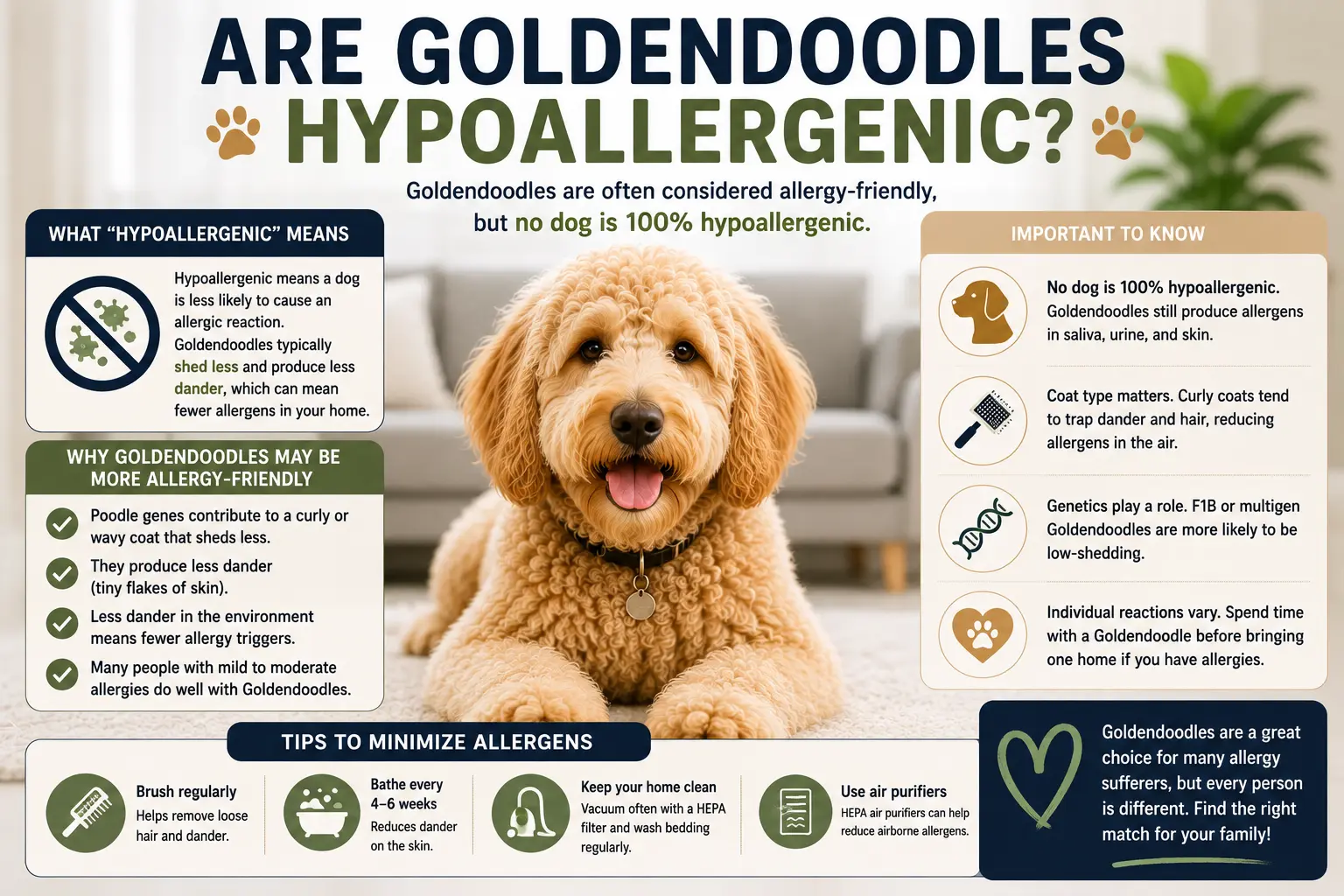
Before we dive deeper into whether are goldendoodles hypoallergenic, we need to understand what hypoallergenic actually means. Contrary to popular belief, hypoallergenic doesn’t mean allergy-free. Instead, it refers to something that’s less likely to trigger allergic reactions.
The reality is that no dog breed on Earth is completely hypoallergenic or allergen-free. This isn’t marketing hyperbole it’s backed by solid science. A landmark 2012 study published in the Journal of Allergy and Clinical Immunology found no evidence to classify any dog breed as truly hypoallergenic. The American Academy of Allergy, Asthma and Immunology similarly confirms there are no 100% hypoallergenic dog breeds.
What many people misunderstand is the source of dog allergies. Most people assume it’s the fur itself causing reactions. In reality, dog allergies are triggered by proteins found in dander (dead skin cells), saliva, and urine not the hair itself. This is a crucial distinction because it changes the entire conversation around whether are goldendoodles hypoallergenic.
The Protein Problem: Why Are Goldendoodles Hypoallergenic (But Not Completely)
Here’s where goldendoodles present a genuine advantage for some allergy sufferers. Research shows that the main allergen from dogs is a protein called Can f 1, which all dogs produce. Since every dog produces this protein regardless of breed, none can be completely allergen-free.
However, the key difference lies in how much allergen gets released into the environment. Dogs with low-shedding coats trap loose hair and dander instead of dispersing them around your home. This is why are goldendoodles hypoallergenic gains some validity their poodle parentage influences coat characteristics that can reduce allergen spread.
The poodle’s curly, non-shedding coat is specifically designed to trap loose hair. When you cross a poodle with a golden retriever, you’re essentially playing a genetic lottery. Some goldendoodles inherit the poodle’s tight curls; others get the golden retriever’s shedding coat. This unpredictability is critical to understanding whether are goldendoodles hypoallergenic for your specific situation.
Studies have shown that allergens can linger in a home for up to 30 weeks after a pet has been removed. Even with thorough cleaning, these proteins remain on furniture, clothing, and carpets. This persistence underscores why coat type matters so much when considering are goldendoodles hypoallergenic as a pet choice.
Goldendoodle Generations: Not All Are Created Equal
When researching are goldendoodles hypoallergenic, you’ll encounter terminology like F1, F1B, F2, and multigen. These designations refer to how many generations removed the dog is from the original purebred parents, and they dramatically impact shedding and allergen production.
F1 Goldendoodles: The Genetic Gamble
An F1 goldendoodle is a direct 50/50 cross between a golden retriever and a purebred poodle. Because they inherit one coat gene from each very different parent, their coats are unpredictable. You might see tight curls, loose waves, or even straight golden retriever-like coats in the same litter.
Most F1 goldendoodles fall somewhere in the wavy-to-shaggy range and shed moderately. Many allergy-sensitive families do fine with an F1, but as one breeder explains, it’s essentially “a roll of the dice rather than a promise.” This means simply asking are goldendoodles hypoallergenic without specifying the generation isn’t sufficient for making a decision.
F1B Goldendoodles: More Predictable Hypoallergenic Qualities
An F1B goldendoodle is 75% poodle and 25% golden retriever, produced by breeding an F1 back to a purebred poodle. This higher poodle percentage generally results in a curlier, lower-shedding coat which is why breeders often recommend F1B goldendoodles for families with allergy concerns.
Research shows that 75% of F1B goldendoodles with the furnishing gene (which controls coat type) carry two copies of this gene, making them reliably low-shedding. This generation offers the best probability for those asking “are goldendoodles hypoallergenic?” to get a positive outcome, though no guarantees exist.
Multigen Goldendoodles: The Most Consistent Option
Multigenerational goldendoodles result from breeding two goldendoodles together, potentially over multiple generations. Breeders often consider multigen goldendoodles the most reliable option for allergy sufferers because they can produce up to 100% non-shedding puppies when both parents carry two furnishing genes.
However, even multigen litters show variation. Just because parents are multigen doesn’t automatically mean all puppies will be non-shedding. Understanding are goldendoodles hypoallergenic truly requires looking at the specific puppy’s genetics and, ideally, meeting the parents first.
Coat Types: The Missing Piece of the Hypoallergenic Puzzle
When deciding if are goldendoodles hypoallergenic would work for your household, coat type is absolutely critical. Goldendoodles can have three primary coat types, each with different implications for allergen spread.
Curly Coats: These tight, spiral-textured coats trap loose hair and dander, making them the best choice for those asking are goldendoodles hypoallergenic. Curly coats require professional grooming every 6-8 weeks and daily brushing to prevent matting, but they shed minimally.
Wavy Coats: Also called fleece coats, these fall between curly and straight. They trap some dander but not as effectively as curly coats. Wavy-coated goldendoodles offer a middle ground if you’re wondering are goldendoodles hypoallergenic they’re often suitable for people with mild allergies.
Straight Coats: These coats shed more like golden retrievers and spread dander more readily. If you have moderate to severe allergies, straight-coated goldendoodles are unlikely to be a good fit, regardless of marketing claims about whether are goldendoodles hypoallergenic.
| Coat Type | Shedding Level | Best For Allergies | Grooming Needs | Hypoallergenic Quality |
|---|---|---|---|---|
| Curly | Minimal | High allergy sufferers | Intensive (6-8 weeks) | Best option |
| Wavy | Low-Moderate | Mild allergies | Moderate (8-10 weeks) | Moderate |
| Straight | Moderate-High | Not recommended | Low-Moderate | Poor |
Personal Insights: What Goldendoodle Owners Actually Experience
Working with goldendoodle families over the years has taught me that the answer to “are goldendoodles hypoallergenic?” varies dramatically based on individual circumstances. I’ve met allergy sufferers who live comfortably with their F1B goldendoodles while experiencing severe reactions to poodles. I’ve also met people with curly-coated goldendoodles who still struggle.
This variability reflects an important reality: allergen sensitivity is highly individual. What triggers one person might not affect another. Genetics, severity of allergies, and even psychological factors play roles. One person might react to dander but tolerate saliva, while someone else experiences the opposite.
The most successful goldendoodle adoptions among allergy sufferers I’ve encountered share a common thread the family spent extended time with the specific puppy (or adult dog) before commitment. They didn’t just ask “are goldendoodles hypoallergenic?” as an abstract question. They asked it about their specific dog.
Making an Informed Decision About Are Goldendoodles Hypoallergenic
If you’re seriously considering whether are goldendoodles hypoallergenic for your home, here are concrete steps to take before bringing one home:
Prioritize F1B or Multigen: If allergies are a deciding factor, focus on these generations. Ask breeders for DNA testing confirmation of furnishing genes and shedding genetics.
Meet the Parents: Spend time with both the mother and father if possible. If you react to them, you’re likely to react to the puppy, regardless of claims about whether are goldendoodles hypoallergenic.
Request a Trial Period: Some responsible breeders offer trial periods. Spend a week or two with the puppy in your home to see how your body responds.
Implement Allergy Management: Even if you get a reliably low-shedding goldendoodle, remember that are goldendoodles hypoallergenic doesn’t mean symptom-free. Regular grooming, HEPA air filtration, and keeping bedrooms pet-free all help.
For more insights on choosing dog breeds for specific lifestyles, check out our guide on Dachshund Guides, which covers similar considerations for other breeds.
The Statistics That Matter
Global research consistently shows what we know about allergies and dogs:
- Between 10-20% of the world’s population experiences dog allergies
- Up to 60% of European and U.S. households contain pets
- An estimated 77.5 million dogs are owned in the United States alone
- Dog allergens are detectable in 90% of U.S. homes, even those without pets
- Research from the American Kennel Club confirms dander and saliva proteins cause most reactions, not hair
When asking “are goldendoodles hypoallergenic?” remember that these statistics suggest millions of people are seeking solutions. Marketing language has capitalized on this demand, sometimes overselling what goldendoodles can deliver.
Environmental Factors That Influence the Hypoallergenic Question
Beyond genetics and coat type, environmental factors significantly impact whether are goldendoodles hypoallergenic works in practice for your family.
Grooming Practices: Regular bathing and grooming of your goldendoodle dramatically reduces dander. Professional grooming every 6-8 weeks for curly coats helps trap allergens before they’re released into your home environment.
Home Cleanliness: HEPA vacuums, air purifiers, and frequent washing of bedding minimize airborne allergens. These management strategies often matter as much as the dog’s genetics when determining whether are goldendoodles hypoallergenic practically solves your allergy problem.
Living Space Size: Larger homes allow better air circulation and easier separation from allergen sources. A goldendoodle in a small apartment presents different allergen exposure challenges than one in a multi-story house.
Frequently Asked Questions
Are Goldendoodles hypoallergenic if they have a curly coat?
Curly-coated Goldendoodles are often lower-shedding and may be more allergy-friendly, as their coats can trap loose hair and dander. However, they still produce allergens through saliva, skin flakes, and urine. People with mild allergies may tolerate them better, but individual reactions vary.
Do F1B Goldendoodles always have hypoallergenic qualities?
No. F1B Goldendoodles have approximately 75% Poodle genetics, so they are more likely to have low-shedding, curly coats than F1 Goldendoodles. However, coat type and shedding still vary between individual dogs. No generation guarantees a completely hypoallergenic dog.
Can someone with severe dog allergies own a Goldendoodle?
Possibly, but caution is essential. Some people with severe allergies tolerate certain Goldendoodles, particularly low-shedding individuals, while others still experience significant symptoms. Spending extended time with the specific dog before bringing it home is strongly recommended.
How often should you groom a Goldendoodle if someone has allergies?
Regular grooming can help reduce loose hair and dander in the home. Brushing several times per week and professional grooming approximately every 6–8 weeks can be helpful, while bathing should be done as recommended for the individual dog’s coat and skin. Allergy sufferers should also keep bedding and living areas clean.
Why is it important to understand whether Goldendoodles are hypoallergenic?
Understanding that Goldendoodles are not 100% hypoallergenic helps families make realistic decisions. Coat type, genetics, grooming, and the individual’s sensitivity all matter. If someone in your household has allergies, spending time around the specific Goldendoodle before adoption or purchase is one of the best ways to assess compatibility.
Conclusion
The honest answer to “are goldendoodles hypoallergenic?” is yes and no it depends on the individual dog, its generation, coat type, and your specific allergen sensitivity. Goldendoodles can be significantly better than many breeds for people with allergies, but they’re not the allergy-free solution marketing sometimes suggests.
The most important takeaway is this: asking whether are goldendoodles hypoallergenic as an abstract question is less useful than asking it about a specific dog. Spend time with your potential goldendoodle. Understand its generation and genetics. Implement proper grooming and environmental management. With these factors aligned, many allergy sufferers successfully live with goldendoodles but only when expectations align with reality.
Your allergies and your dream of dog ownership don’t have to be mutually exclusive. They just require informed decision-making beyond the marketing promise that are goldendoodles hypoallergenic. Visit reliable resources like Petfinder for hypoallergenic dog information and comparisons.
