
Shichi (Shih Tzu Chihuahua Mix): Size, Shedding and Health


A Shichi is a Shih Tzu and Chihuahua cross, and the two parents don’t overlap on the AKC’s scales: a Chihuahua tops out at 6 pounds, while a Shih Tzu starts at 9.
Profiles of the cross straddle that 3-pound gap, with PetGuide listing 3 to 9 pounds and Wag Walking 5 to 12. Lifespan is the steadier number, since PetGuide gives 12 to 15 years and the AKC lists 14 to 16 for the Chihuahua and 10 to 18 for the Shih Tzu.
What changes from one puppy to the next is coat, shedding, breathing and teeth. Both parents can hand down the same kneecap, mouth and eye problems, and each adds an airway issue of its own. You can check most of that before you pick a puppy.
How big does a Shichi get?
Published profiles put an adult Shichi anywhere from 3 to 12 pounds and 7 to 11 inches tall. PetGuide says 3 to 9 pounds and 7 to 10 inches; Wag Walking says 5 to 12 pounds and 9 to 11 inches.
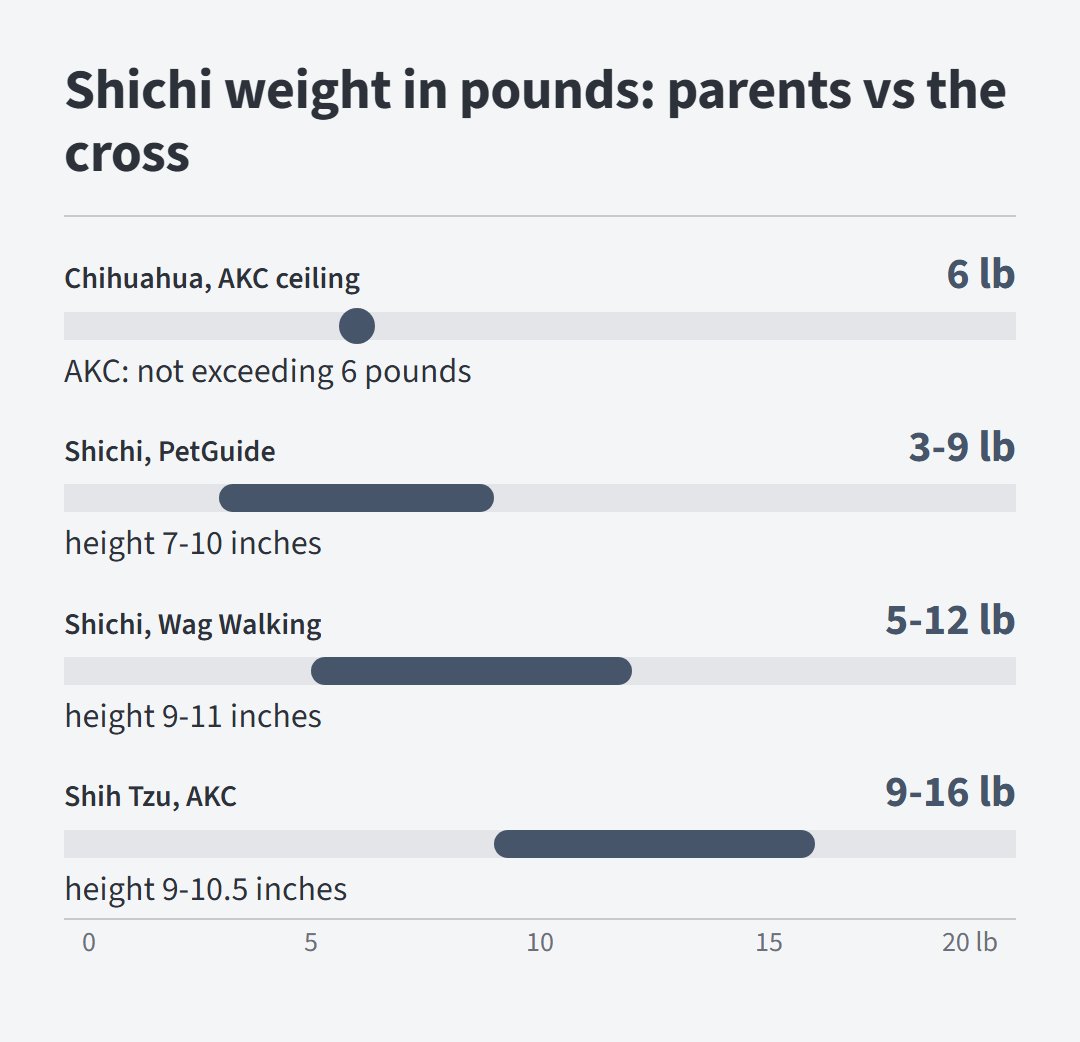
Start with the parents, since they set the frame. The AKC’s Shih Tzu page lists 9 to 10.5 inches and 9 to 16 pounds, and its Chihuahua page lists 5 to 8 inches and a weight that doesn’t exceed 6 pounds.
Nothing connects those two ranges, so a puppy can land at either end of the gap or right on top of a parent. You can’t read the answer off a profile.
Time helps a little. Wag Walking’s growth chart has males at 7 pounds at 6 months and 8.5 at 12, with no change by 18 months, while females go from 6.5 to 8.5 over the same stretch. It’s one chart, though, and it can’t tell you which side of the family your puppy favors.
The top of the spread is a real possibility. An owner in r/DoggyDNA took a shelter dog for a Chihuahua mix and was surprised to find Shih Tzu in him:
“We immediately knew he was a chihuahua when we met him at the shelter, tho the whole liter he was with was long coated! All black and white. I was thinking pug, whippet chihuahua mix. I was so surprised he actually had shih tzu and 0 pug. Hes also very big, 16lbs next to my 66lb lab.”
– r/DoggyDNA, September 2026 (180 upvotes) [excerpt, shown in part]
It’s one dog, and a commenter on the thread reads him as mostly Chihuahua, so he shows how wide the spread can get, not what a typical Shichi weighs.
So weigh the parents, not the profile. A mother near the Chihuahua’s 6-pound ceiling and a father near the Shih Tzu’s 16 point to a very different adult than two 9-pound parents do. Will the seller give you both numbers? If not, you’ve learned something already.
Do Shichis shed, and are they hypoallergenic?
Shichis likely shed lightly to moderately, depending on the coat they inherit, and no one can promise they’re hypoallergenic. PetMD says Shih Tzus don’t shed much, calls Chihuahuas average shedders, and says no dog is 100% hypoallergenic because skin, saliva and urine still carry allergens.
PetGuide expects the cross not to shed too much, which fits the Shih Tzu side. The “hypoallergenic” label follows Shih Tzus around, but PetMD puts the word in quotation marks itself.
Shedding is only part of the allergy picture, since the allergens PetMD names sit in skin, saliva and urine. Its advice for the Shih Tzu is to spend time with the breed and see how your allergies react before you bring a puppy home.
With a Shichi, do that with the puppy and with both parents, and do it more than once. Is someone in your house allergic? Then that visit matters more than any label you’ll read online.
What coat will a Shichi have, and how much brushing does it need?
A Shichi can have a short, medium or long coat, according to PetGuide, and the coat sets your schedule. A short Chihuahua-type coat needs brushing about once a week, while a long one needs it from two or three times a week to every day, depending on the source.
Match the puppy’s coat to a row and you’ve got your routine.
| If the puppy takes after | Coat | Brushing | Baths and trims |
|---|---|---|---|
| The Chihuahua, short coat | Smooth and short | About once a week (PetMD) | A bath once or twice a month (PetMD) |
| The Chihuahua, long coat | Longer hair plus an undercoat | Two or three times a week (PetMD) | A bath once or twice a month (PetMD) |
| The Shih Tzu | Long double coat that grows continuously and mats (PetMD) | A weekly chore if you keep it long (PetMD) | Professional grooming every few weeks, or a short puppy cut (PetMD) |
| A mix of both | Short, medium or long (PetGuide) | Every day if it’s long (PetGuide) | A bath about monthly (PetGuide) |
The sources disagree on long coats, from weekly to daily, so plan on the heavier end until you’ve seen how your dog’s hair behaves.
Whatever the coat, plan on teeth. PetMD says to brush a Chihuahua’s teeth daily, and it ties dental disease to crowded small mouths in both parents, so it’s a safe bet for your Shichi too.
What health problems do Shichis have, and how long do they live?
Shichis can inherit kneecap, dental and eye problems from either parent, airway trouble from both, and low blood sugar and hydrocephalus from the Chihuahua. PetGuide gives the cross 12 to 15 years and says it’s hard to predict which problems a given dog will get.
- Both sides: luxating patella (the kneecap slips out of place and the dog limps or skips), periodontal disease from overcrowded teeth, obesity, and the eye conditions glaucoma, chronic dry eye and cataracts. PetMD lists all of them for each parent.
- From the Shih Tzu: brachycephalic syndrome, meaning small nostrils, a long soft palate and a collapsing trachea, which also raises the risk of overheating, plus hip dysplasia.
- From the Chihuahua: a collapsing trachea with a goose-honking cough, low blood sugar in young dogs, hydrocephalus (fluid in the brain) and, in older dogs, heart disease.
Wag Walking names hip dysplasia and hydrocephalus as the major concerns for the cross itself. That’s the same shape as the lists above, with one problem picked from each side.
Some of this you can act on in week one. PetMD advises a harness instead of a collar for both parents because of the windpipe, and it says Chihuahua puppies should eat three or four meals a day to head off low blood sugar, depending on your vet’s advice.
It ties the airway list to the Shih Tzu’s flat face, so a puppy’s muzzle is worth pointing out at the first visit.
Weight is the one you control most. Bruno was nearly 40% overweight before his vet moved him to Hill’s w/d, and on a 6-pound dog a single extra pound is a sixth of its body weight.
How long will one live? PetGuide says 12 to 15 years. The AKC’s 14 to 16 for the Chihuahua is the longer range, and PetMD calls the Chihuahua one of the longest-living breeds, while the Shih Tzu’s 10 to 18 is wide enough to cover everything. Plan for the 12-year floor and count anything past it as a bonus.
Do Shichis bark a lot, and can they stay home alone?
Plan on a vocal dog that wants company. PetGuide describes a shrill, high-pitched bark and says the cross likes to yap. PetMD adds that Shih Tzus bark to announce newcomers and prefer not to spend time alone.
PetMD’s fix on the Shih Tzu side is early socialization, since an unsocialized puppy can end up barking excessively. On the Chihuahua side it says they bark when nervous and can be feisty with strangers and other dogs. You won’t get a quiet baseline from either parent.
Pretzel’s separation anxiety was a dachshund problem, but I’d start with the same routine for a Shichi. It took eight weeks of training before he could rest for six or seven hours alone.
If your workday runs longer than that, price in a midday walker before the puppy comes home.
What does a Shichi cost, and what should you skip?
No published price survey turned up for the cross, so use the parents as a guide: PetMD lists $1,000 to $3,000 for a Shih Tzu and $800 to $2,000 for a Chihuahua. Pass on any seller who advertises a “teacup” Shichi.
PetMD’s blunt about the label. It says not to buy a teacup Shih Tzu and not to work with a breeder who claims to sell teacup Chihuahuas, because those dogs are bred small at the expense of health. Tiny’s already the baseline here, and one profile reports weights as low as 3 pounds, so read “teacup” as a warning, not a premium size.
Running costs matter as much as the price tag. Wag Walking, a site that promotes pet insurance, puts typical vet bills for a Shichi at $500 to $1,000 a year. Take that as a ballpark from a seller of coverage, since it isn’t a quote. If you’re pricing a dachshund against it, the dachshund price guide covers that side.
Who should get a Shichi, and who should pick a different cross?
Choose a Shichi if someone is home most of the day, you’ll brush a coat several times a week, and you can keep a small dog’s weight, teeth and airway under watch. Choose a different cross if you need a guaranteed size, a quiet dog or an allergy-safe one, since no source says you’ll get any of the three.
If the Shichi isn’t quite right, these are the nearest alternatives on this site:
- Like the Shih Tzu side but want a dachshund for the other half? The Shih Tzu dachshund mix guide covers the Schweenie.
- Want the Chihuahua’s size with a dachshund’s build? The Chiweenie guide covers size, lifespan and the disc risk the dachshund side brings.
- Is the airway list your sticking point? The Pug Chihuahua mix page covers the same question for a different flat-faced parent.
- Would you rather have a Jack Russell Terrier’s side than a Shih Tzu’s? The Chihuahua Jack Russell mix page lays out size, health and temperament.
- Still torn between the Chihuahua half and a purebred dachshund? See Chihuahua vs dachshund, or the dachshund mixes overview to compare 43 crosses by size.
Before you commit to a Shichi, get both parents’ weights, coats and vet records, and spend an afternoon with the puppy and whoever in the house has allergies.
Short answers before you pick a puppy
Is the Shichi a recognized breed?
PetGuide says the AKC doesn’t recognize the Shichi because it’s a hybrid, though designer-dog registries such as the American Canine Hybrid Club do. The AKC’s own pages cover the two parents, and PetMD says it didn’t formally recognize the Shih Tzu until 1969.
What is a fun fact about Shih Tzus?
The AKC says owners have been delighted by this “Lion Dog” for a thousand years, and PetMD says imperial rulers bred them to bark a warning when visitors arrived. The Chihuahua parent is, in the AKC’s words, a national symbol of Mexico.
What is the most common problem with Shih Tzus?
PetMD doesn’t rank them. Its list opens with brachycephalic syndrome and obesity, then luxating patella, dental disease, hip dysplasia and eye problems.
