
English Bulldog Dachshund Mix: What the Parent Breeds Actually Tell You


An English Bulldog Dachshund mix, usually called a Bulldach, is a rare cross that lands somewhere between a 45-pound brick and an 8-inch-tall hunting dog. Most sources put the adult at roughly 11 to 12 inches tall and 25 to 40 pounds.
The two parents are further apart than almost any pair you could pick. Here is what the AKC lists for each:
| Dachshund | Bulldog | |
|---|---|---|
| Height | 8-9 in (standard), 5-6 in (miniature) | 14-15 in |
| Weight | 16-32 lb (standard), 11 lb and under (miniature) | 50 lb (male), 40 lb (female) |
| Life expectancy | 12-16 years | 8-10 years |
Look at the bottom row. There’s a four-to-six-year gap in life expectancy between the two parents, and I haven’t found a single breed guide for this cross that puts those numbers side by side.
That gap is the reason I’d ask a different question than the ones those guides answer.
What an English Bulldog Dachshund mix looks like
Puppies in one litter can look almost nothing like each other. That isn’t a hedge, it’s the predictable result of crossing two breeds whose defining features point in opposite directions.
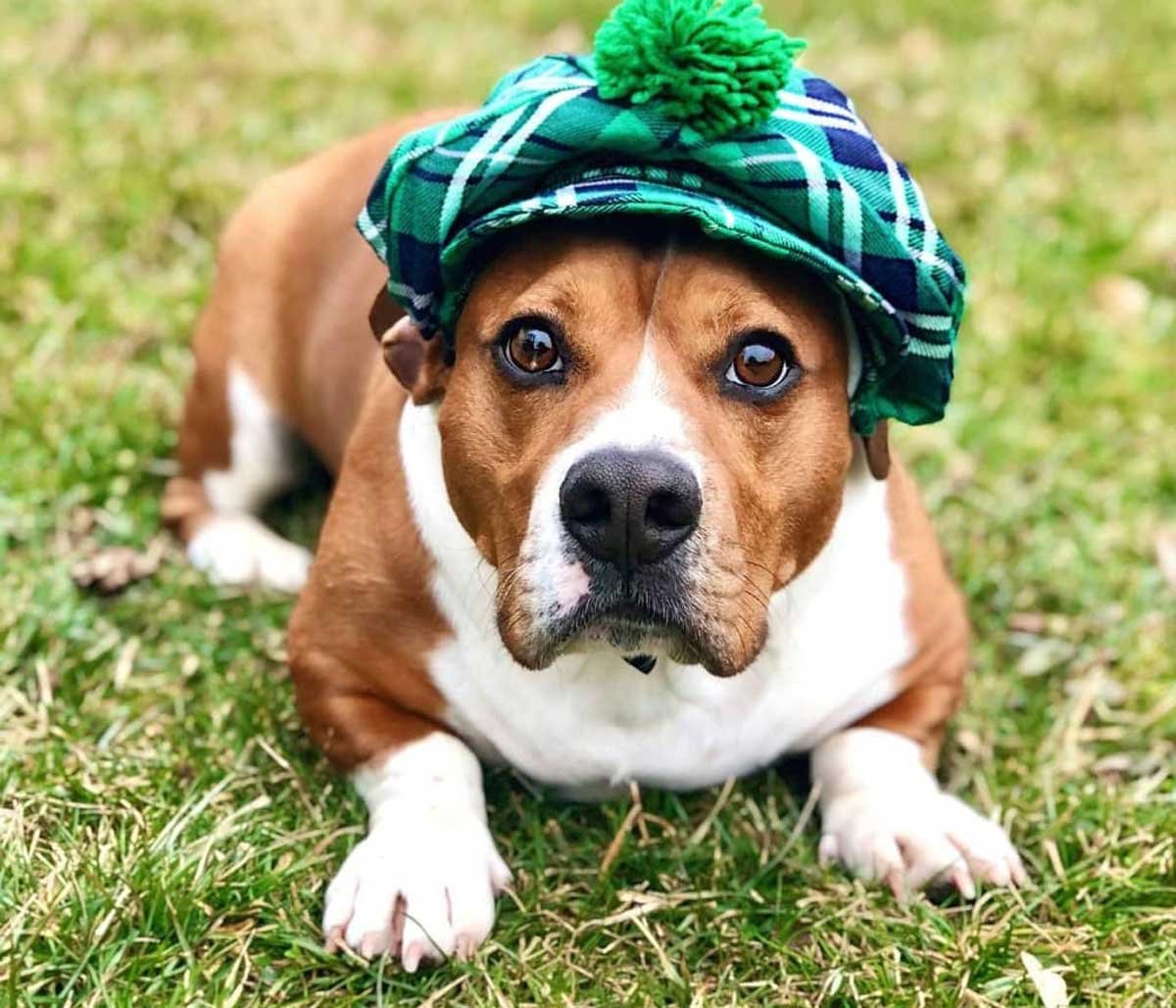
A Bulldach might get the long, low body and longer muzzle of the Dachshund side. It might get the stocky, heavy-boned frame and pushed-in face of the Bulldog side. Most get some blend, and the blend isn’t consistent between siblings.
Coat is the one fairly safe prediction. You’ll get a short, smooth coat unless the Dachshund parent was wirehaired or longhaired. Color ranges wide: cream, fawn, brown, black, brindle, and the diluted lilac that breeders also call isabella.
If you’re trying to identify a dog you already have, a word of caution. A long back plus a wide chest plus a wrinkled face describes a dozen crosses, and it describes some purebred dogs too. A cheek-swab DNA test will tell you more in two weeks than any photo comparison will.
What to actually look at
If you’re standing in front of a dog someone has called a Bulldach, these are the things worth your attention, in the order I’d check them:
- Muzzle length. Put your eye level with the dog’s nose. The more muzzle you can see in front of the eyes, the better your odds on the airway problems described in the breathing section below.
- Breathing at rest. Sit with the dog for a minute while it’s calm. You want quiet. Snorting, snuffling or an open mouth when nothing is going on is the single most useful thing you’ll observe in that visit.
- Chest width against leg length. This tells you which parent won the frame. A wide chest on short legs is the combination that makes stairs and jumps harder for the dog, whatever the research says about risk.
- Skin folds. If the face has Bulldog wrinkles, lift them and look. You’re signing up to clean those a few times a week for the dog’s whole life.
- What the seller can name. Ask which variety of dachshund the mother or father was. You’ll see in a moment why that answer carries more weight than anything else on this list.
None of that identifies the cross for you. It does tell you what kind of dog you’re taking home, which is the more useful question.
A “bull weenie” is a different dog
The bull weenie is a different dog, though the two names get used as if they were interchangeable. A bull weenie, sometimes written French Bull Weiner, is a French Bulldog Dachshund mix.
Does the distinction matter? More than it sounds. The French Bulldog is a much smaller dog than the English Bulldog, so the two crosses land in different weight classes and carry different odds on the breathing problems I’ll get to next.
So check which bulldog a source means before you use its numbers. The two crosses get described interchangeably, and the weight figures don’t transfer between them.
The back question, and the study that complicates it
Here’s where almost every guide to this cross says the same thing: the mix inherits a long spine from one parent and a heavy body from the other, so keep it lean and keep it off the furniture.
I believed that version too. Bruno, my older dachshund, had a spinal disc episode that ended in surgery and a long recovery, and I went looking for the evidence behind the advice I’d been given.
What I found complicates the version of it you’ll read everywhere else.
The largest lifestyle study of dachshunds is DachsLife 2015, published in Canine Genetics and Epidemiology in 2016 by Packer, Seath, O’Neill, De Decker and Volk, and it surveyed 2,031 dogs. Overall prevalence of intervertebral disc disease came out at 15.7%, with a confidence interval of 14.1 to 17.3.
Then the findings stop matching the advice:
- Bodyweight and body condition score were not associated with IVDD risk. Neither was sex, and neither were the two body-proportion measurements the researchers took.
- Dogs exercised less than 30 minutes a day had increased odds. Dogs exercised more than an hour had decreased odds.
- Dogs not allowed to jump on furniture had increased odds.
- Dogs using stairs daily looked protected compared with dogs that rarely used them.
Read that list quickly and you’d conclude you should let the dog jump off the sofa. Don’t. The authors flag reverse causality on every one of those findings, in their own words: owners of dogs that already had an IVDD episode stop letting them jump, stop the stairs, and cut the walks. The management change follows the diagnosis rather than causing it.
I did exactly that myself. After Bruno’s surgery I put a ramp at the sofa, and he kept launching himself off the armrest end anyway. If a researcher had surveyed me that year, I’d have been the owner reporting a furniture ban on a dog with a disc history.
So which findings can you actually act on? Not the lifestyle ones. But two results in that study are not confounded that way, and they’re the useful pair.
Age, and which dachshund the parent was
Age mattered a lot: dogs aged eight to ten carried the highest odds compared with dogs under two, which is worth knowing before you read a clear check-up at eighteen months as a clean bill of health.
And variety mattered more than anything an owner does:
| Dachshund variety | IVDD prevalence |
|---|---|
| Standard Smooth-Haired | 24.4% (95% CI 22.5-26.3) |
| Miniature Smooth-Haired | 17.1% |
| Standard Wire-Haired | 7.1% (95% CI 6.0-8.2) |
That’s a 3.4-fold difference between the highest and lowest variety, sitting inside the same breed.
Which gives you a question no guide to this cross asks: which variety was the dachshund parent? A breeder who can’t tell you, or won’t, is telling you something either way. It’s the only back-related question here that has real numbers behind it.
Worth noting which variety came out best, too. The wire haired dachshund is the least common of the three coats and the one carrying the lowest prevalence in that table, so a wirehaired parent is a better answer to the question than a more fashionable smooth coat.
Three limits on all of this, because they matter. These are purebred dachshund figures, and nobody has measured IVDD in the Bulldach specifically. The study relied on owner-reported diagnoses, and the authors note that not every case had advanced imaging, so the prevalence may be overstated. And a finding of “not associated” isn’t proof that weight is harmless, because extra weight still loads joints and still makes a short muzzle work harder.
The breathing half
The Bulldog side brings a separate problem, and it’s the one that shows up on a warm afternoon rather than in a specialist’s office.
The AKC’s own Bulldog page says it plainly: a Bulldog’s short snout can cause labored breathing in hot and humid weather. That’s the breed’s registry saying so, not a critic.
Muzzle length is the one place where crossing may genuinely help. A Bulldach often ends up with a slightly longer muzzle than a purebred English Bulldog, which can mean less severe airway trouble. That happens often enough to matter, but not reliably enough for you to count on it. It depends which parent the puppy favors, and you can see it by the time the dog is grown.
So watch the dog rather than the pedigree. Noisy breathing at rest, a dog that has to stop and stand on a normal walk, gums that look dark rather than pink, a refusal to move at all in heat: any of those is a conversation with your vet, not something to manage with a slower pace.
Where the two parents disagree
Both sides are stubborn, from different directions. The Dachshund was bred to go down a badger hole and make its own decisions once it got there. The Bulldog simply declines.
Put those together and you get a dog that’s hard to train but not badly behaved. Short sessions work better than long ones, and food works better than repetition.
Expect a dog that wants company. Pretzel, my miniature, had real separation anxiety when he was young, and it took eight weeks of building up alone time before he could rest six or seven hours by himself. Both parent breeds bond hard, so plan for that work rather than hoping you skip it.
Will yours bark? That one is a coin flip. Dachshunds have a genuinely loud bark for their size, Bulldogs mostly don’t bother, and I wouldn’t promise you either outcome.
Who this cross is wrong for
A first dog, honestly, is the wrong place to start. You’re combining two stubborn breeds and two structural health risks, and neither one is easy for you to read in a puppy.
It’s also wrong if you want predictability. Siblings in one litter differ enough that the dog you meet at eight weeks doesn’t tell you the shape of the adult.
And it’s wrong if you live somewhere hot without air conditioning. The breathing risk isn’t theoretical in July.
Who it suits: someone home most of the day, in a moderate climate, who wants a low-energy dog and has the patience for slow training. Thirty minutes of daily exercise is a reasonable floor, and the DachsLife figures suggest more is fine rather than risky.
English Bulldog Dachshund mix: common questions
What does a Dachshund and Bulldog mix look like?
Expect roughly 11 to 12 inches tall and 25 to 40 pounds, with a short smooth coat in cream, fawn, brown, black, brindle or lilac. Beyond that, littermates vary a lot, because the two parent breeds have strongly defined and opposite silhouettes. Some get the long low back, some get the stocky frame, most get a mix.
What is a bull weenie?
A French Bulldog crossed with a Dachshund, also written French Bull Weiner. It is not the English Bulldog cross, and it’s a smaller dog. If a page uses the two names interchangeably, its numbers aren’t reliable.
What is the best English Bulldog mix?
No study ranks them, so any list you find is somebody’s preference. The one comparison worth making is muzzle length: a cross with a longer-muzzled breed gives the puppy a better chance on the airway problems the Bulldog side brings.
What is the best crossbreed of Dachshund?
That one is unmeasured as well, so nobody can hand you a ranked answer. But if back health is what’s driving the question, the DachsLife figures point at the dachshund parent’s variety rather than at the other breed: 24.4% prevalence in Standard Smooth-Haired versus 7.1% in Standard Wire-Haired.
How long does an English Bulldog Dachshund mix live?
Nobody has published a figure for the cross. The parents bracket it: the AKC lists 12 to 16 years for the Dachshund and 8 to 10 for the Bulldog. Where a given dog falls probably depends on which parent’s build and airway it inherited.
Should I stop my dog jumping on the sofa?
For a dog with a disc history, follow your vet’s instructions. For a healthy dog, the honest answer is that the evidence is weaker than the advice sounds: DachsLife found dogs banned from furniture had higher IVDD odds, and the authors attribute that to owners restricting dogs that were already affected. A ramp costs little and does no harm, so it’s a reasonable precaution rather than a proven one.
Why is this mix so hard to find?
Because it’s an uncommon cross, and the size difference between the parents makes it a deliberate breeding decision rather than an accident. Most listings that use the name are guesses about a rescue dog’s parentage. A DNA test settles it.
