Dachshund Carrier: Choose by Spine Position and Body Length

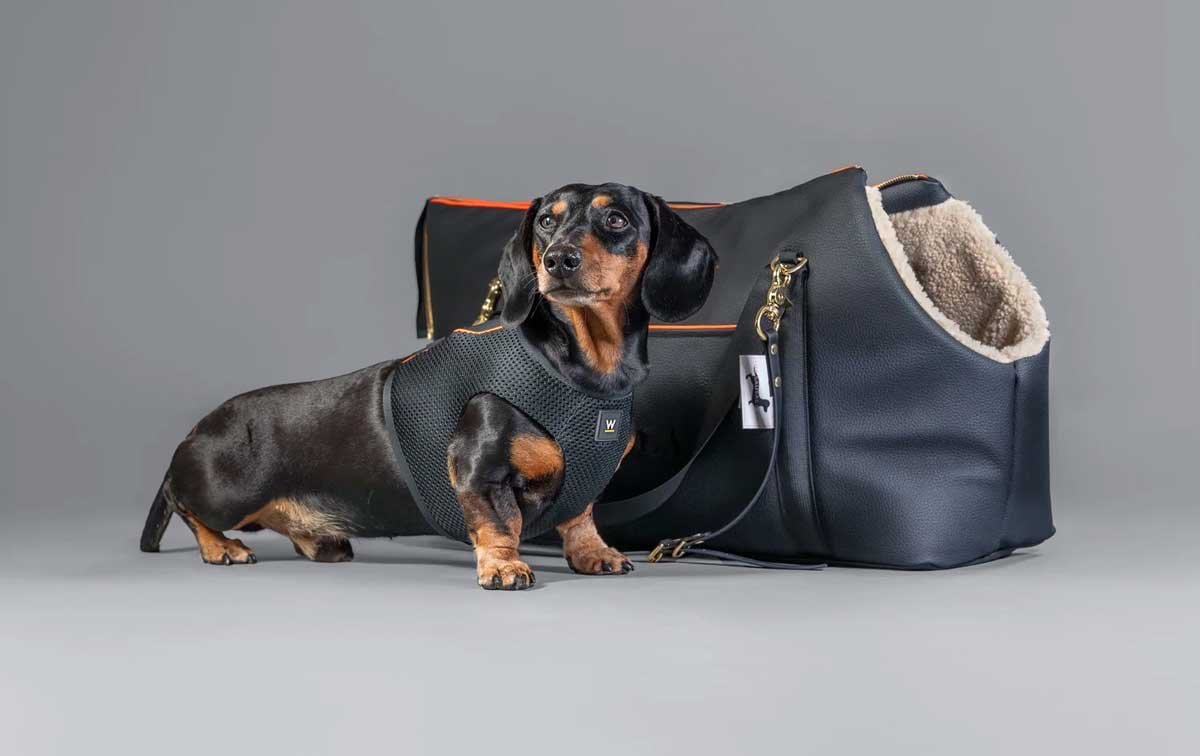
A safe dachshund carrier keeps the spine level, either lying flat or sitting on all fours, and fits the dog’s measured body length.
Style comes after both.
The number most listings put first is the weight limit, and for this breed it is the least useful figure on the page. A long dog can be well under a bag’s limit and still end up folded inside it.
What is the best dachshund carrier?
The best dachshund carrier is one where the dog lies flat with its back supported from chest to rump, or at least rests on all four paws, and whose base is longer than the dog’s measured body. Upright bags that seat the dog on its rear rank last.
That rule comes from how dachshund handling guidance is written. Dachshund IVDD Support Australia tells owners to lift with the body kept level and to keep supporting the back while holding the dog. A carrier is a way of holding the dog for longer, so the same standard applies to it.
Jessica, who runs youdidwhatwithyourweiner.com and has owned the breed for 20 years, uses a close version of that standard when she screens backpacks: can the dog lie horizontally with a straight, fully supported spine, and if not, can it at least sit in a natural position and shift around?
Three carry positions, ranked for a long back
Bags, backpacks and slings put the dog in one of three positions. Sort the options by position first and most of the choice is already made.
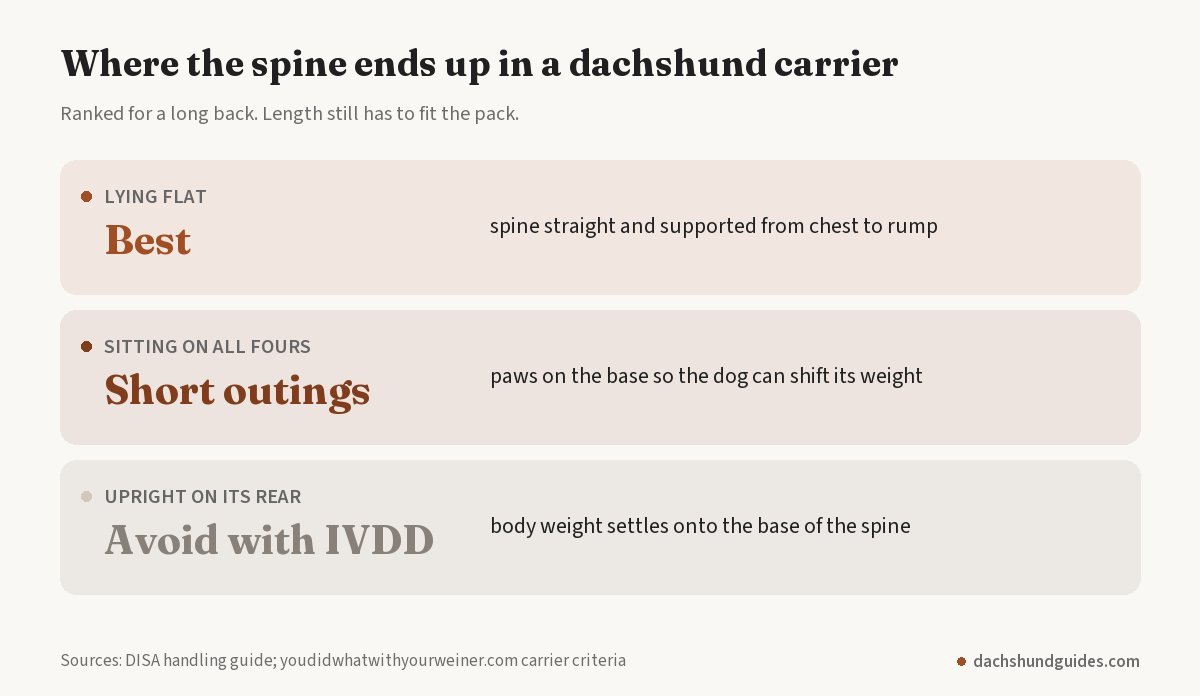
Lying flat: Best
Lying flat is best: the spine stays straight and supported from chest to rump. Horizontal backpacks such as the DjangoPack and the Timbuk2 Luxe Muttmover are designed around this position. Teddy Maximus, which sells dachshund totes, describes the same goal for a shoulder bag: enough room for the dog to lie naturally without curving its spine.
Sitting on all fours: Short outings
Sitting on all fours suits short outings. The dog keeps its paws on the base so the dog can shift its weight instead of hanging from its middle. Jessica rated the Kurgo G-Train in this group and called it acceptable for carrying a dachshund for less than an hour, because there is room for all four paws to touch the bottom even though the dog cannot lie down.
Upright on its rear: Avoid with IVDD
Upright on its rear is the position to avoid with IVDD, because the body weight settles onto the base of the spine. The K9 Sport Sack is the best-known example. Jessica carried her dog Chester in one a few times, said he did not seem uncomfortable, and still wrote that she would never use it for a dachshund with IVDD or earlier back problems.
Measure length, not weight
Measure the dog’s body length before looking at any weight limit. A dachshund that is light enough for a bag can still be too long for its base, and the extra length ends up as a curve in the back or pressure at the head opening.
Chester showed how that goes wrong. At 13 lb he was well inside the Muttmover’s weight limit, yet the opening for his head pressed on his neck and made him cough, because Jessica had measured him from the base of the tail to the withers instead of to the front of the breastbone. Her corrected rule is simple. Measure from the base of the tail to the front of the chest bone, add at least 1 inch, and that total must not exceed the width of the pack’s base.
Weight matters too, just less than owners expect. The American Kennel Club lists miniatures at 11 pounds and under and standards at 16 to 32 pounds. The US backpacks in the table below list limits between 18 and 25 lb, so a standard at the heavy end of the range is over every one of them before length is even considered. Jessica adds that each pack felt most comfortable with a dog about 10 lb under its listed maximum.
The table applies her rule to the base widths she lists for five packs: DjangoPack 14 in (20 to 25 lb), Roverlund Ready-for-Adventure 13.5 in (25 lb), Timbuk2 Luxe Muttmover 13.4 in (20 lb), Kurgo G-Train 12.9 in (25 lb) and PetAmi 12.5 in, listed as its length (18 lb). Subtracting the 1 inch of room from each width gives the longest dog each base can take.
| Your dog measures (tail base to front of chest bone) | Packs whose base clears it | What to check next |
|---|---|---|
| Up to 11.5 in | All five: DjangoPack, Roverlund, Muttmover, Kurgo G-Train, PetAmi | Pick by position: the Kurgo and PetAmi seat the dog instead of letting it lie flat |
| 11.6 to 11.9 in | DjangoPack, Roverlund, Muttmover, Kurgo G-Train | PetAmi drops out on length |
| 12.0 to 12.4 in | DjangoPack, Roverlund, Muttmover | Weight: the Muttmover’s limit is 20 lb |
| 12.5 in | DjangoPack, Roverlund | Head opening height against the neck |
| 12.6 to 13.0 in | DjangoPack only | Its 20 to 25 lb limit |
| Over 13 in | None of the five | A larger European pack or a stroller (see below) |
Two limits apply to this table. The widths are the figures Jessica lists for the versions she tried, and makers revise packs, so confirm the current listing before buying. The rule is also one tester’s comfort margin, not a manufacturer standard.
Watch the landmarks when a brand gives its own sizing. DJANGO’s review of its pack measures from the neck to the base of the tail and says a dog longer than about 16 to 17 inches is likely too long. That is a different starting point from the chest bone, so the two measurements of one dog will not match. Take the measurement the way each maker defines it, and never carry one brand’s number over to another brand’s chart.
For dogs over 13 in, the largest backpack Jessica knows of is the TARIGS Dachshund Backpack, sold in Europe, whose biggest size takes a standard up to 24 inches long and 35 lb; she puts its converted price at $286 to $482 before import fees.
Lifting a dachshund into the bag
Lift a dachshund with one hand under the chest and the other under the rump, keeping the body level, then lower it slowly into the carrier the same way. Getting in and out of the bag is where the handling happens, so a well-shaped carrier does not help if the dog is hauled in by the front end.
DISA’s handling guide lists the don’ts plainly: no picking up by the upper body, no dropping the dog back onto the ground, no bending or twisting on the lift. It also names a warning sign. A dachshund that yelps when picked up is often heading into an IVDD episode, and DISA’s advice is not to ignore it; the next call belongs to the vet, not to a different grip.
Front-opening designs make this easier: Jessica points out that the Muttmover’s front panel zips fully open so the dog can step in instead of being slid down through a top hole, and the PetAmi opens on both sides for the same reason.
Carrying and car travel are different problems. Once the dog is in the car, what matters is the restraint, which the dachshund car seat guide works through.
Slings and front carriers
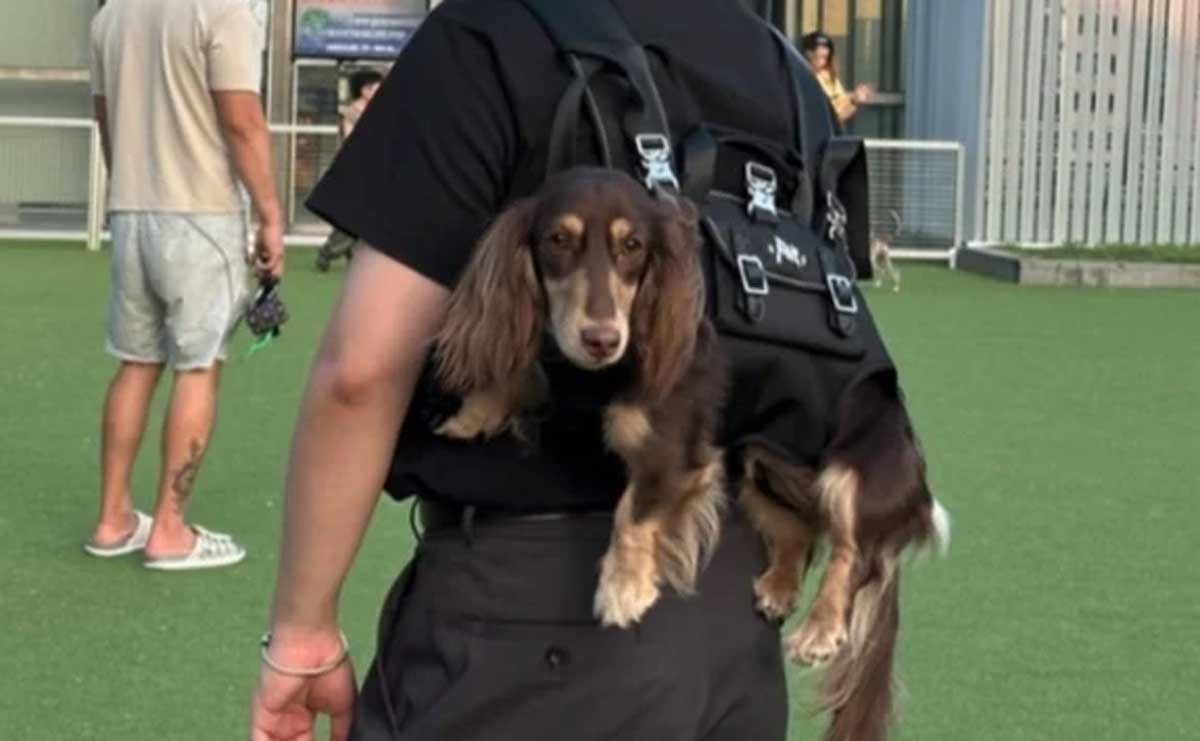
Slings and front carriers are fine for short trips when the dog lies curled along the bottom, and a poor choice when they hang the dog vertically against your chest. The hands-free appeal is real, which is why owners keep asking for one.
A 60-upvote r/Dachshund post asked for a front-style carrier for longer walks so the owner could keep both hands free. One reply was blunt:
“There isn’t one, dach backs aren’t suited to a vertical carry”
– r/Dachshund (6 upvotes)
Slings also put the whole load on one shoulder, which is why Jessica would not use one for a hike or an all-day outing.
Dogs with IVDD or after back surgery
A dachshund with IVDD or recovering from spinal surgery should travel lying flat or in a stroller, and only once the treating vet has cleared outings. Small Animal Specialist Hospital notes that dogs who have had spinal surgery need special care when being picked up and carried.
Jessica’s own first choice for carrying her dogs is a stroller, because it keeps the back fully supported and takes the gear as well. She uses a backpack only where a stroller will not go, such as a hiking trail. For a dog in rehab, that order makes sense: stroller first, horizontal pack second, and no upright bag at all.
Signs of a flare, including a hunched back or reluctance to move, are covered on the dachshund health problems page.
Does a healthy dachshund need a carrier?
A healthy adult dachshund often needs a carrier only as a backup. Owners in the same r/Dachshund thread reported that healthy adult miniatures manage 5 to 10 miles of hiking with enough water, and argued against carrying a fit dog that can walk.
Those are owner reports, not a veterinary distance limit, and puppies, seniors and dogs coming back from injury are different cases. For them, the measurement comes first: tail base to the front of the chest bone, plus an inch, checked against the base of the bag.
