
English Cream Dachshund: What the Label Means and How to Check One

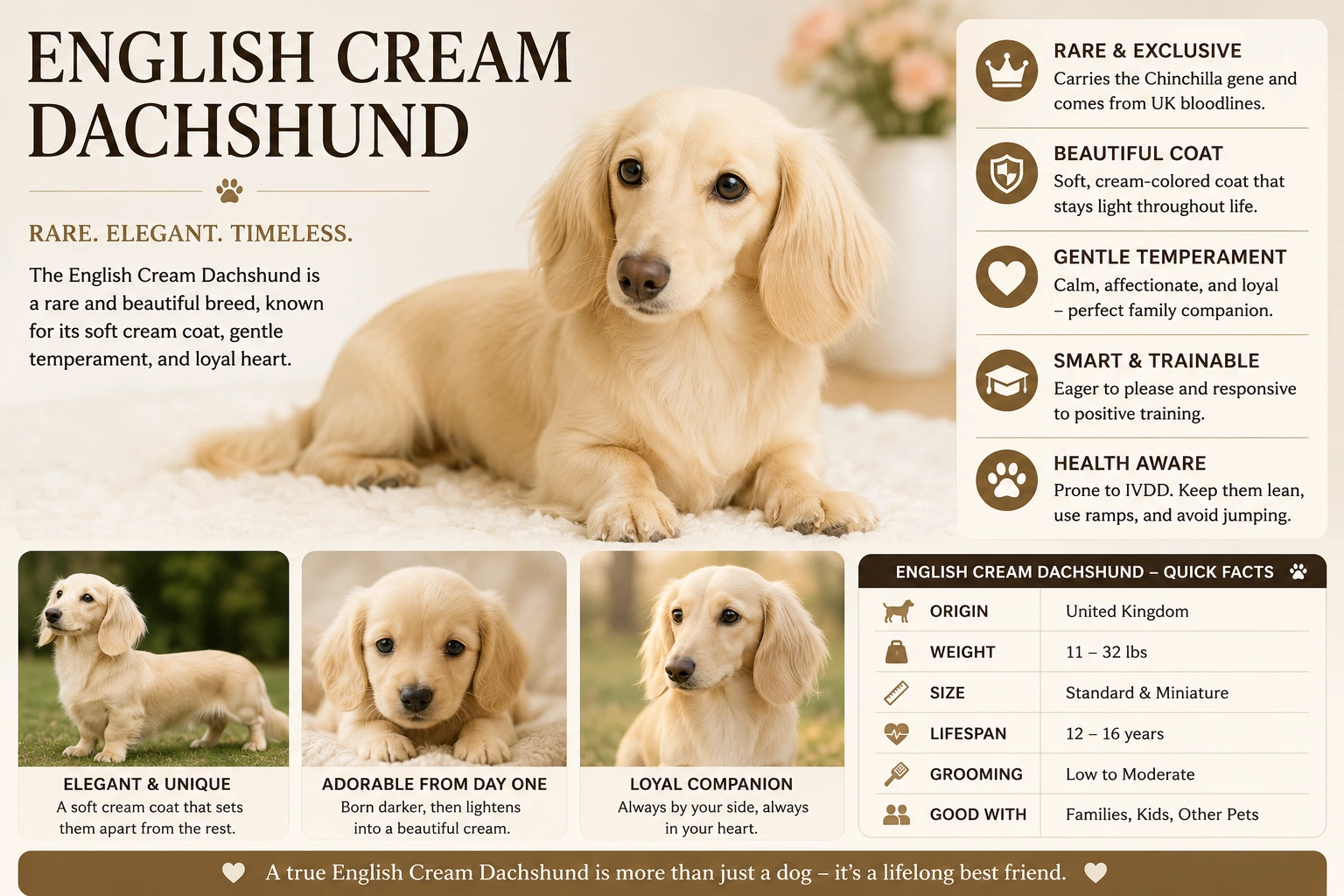
An English cream dachshund is a cream-colored dachshund, usually a long-haired miniature, sold as coming from British breeding lines. “English cream” isn’t a color in the AKC breed standard or on the Dachshund Club of America’s colors sheet. AKC’s standard simply lists cream as a one-colored dachshund, alongside red.
So the label makes two claims you can check separately. “English” is a claim about pedigree, which you check on paper. “Cream” is a claim about color, which you check by looking at the dog, starting with the nose and nails.
What the breed standard says about cream
The AKC standard opens its color section by saying base color is “immaterial”. Next come red and cream as the one-colored dachshunds, “with or without a shading of interspersed dark hairs”, and says a little white on the chest is acceptable but not desirable.
For one-colored dogs, it sets one firm rule: nose and nails black. That line matters more than any adjective in a puppy listing.
It’s also the first thing you can check yourself.
Nothing in the standard ties cream to one coat or one size. Breeders mostly use the English cream label for long-haired miniatures, but a smooth or wirehaired dachshund can be cream too. Our long hair vs short hair dachshund guide covers how the coats differ.
Shaded cream vs clear cream
Breeders split creams into two types. A shaded cream has darker hairs mixed through the coat, often on the ears and back. A clear cream, sometimes sold as “ee cream”, has no dark hairs at all. The AKC wording, “with or without a shading of interspersed dark hairs”, allows both.
Why the difference? Dog coats are built from two pigments: a black or brown one called eumelanin and a red or yellow one called phaeomelanin. A cream coat is red pigment diluted down to pale.
A 2019 study in Genes traced that dilution, in the breeds it tested, to a variant in a gene called MFSD12. Only the red pigment was diluted. In wolves that carried two copies but still made black pigment, black hairs or black-tipped hairs stayed in the coat while the red faded to cream.
That’s the shaded look. In the same study, all 26 solid white dogs checked from three breeds carried two copies of a separate variant, at a gene called MC1R, that stops black pigment reaching the coat at all (the e/e genotype). That’s where the “ee” in “ee cream” comes from.
Here’s the limit. Dachshunds weren’t among the breeds the paper reports testing by name, so we can’t tell you that every cream dachshund carries this exact variant. What the study does explain is why both kinds of cream should keep a dark nose: the dilution acts on red pigment, and the paper notes such dogs “retain pigmentation” in the nose, eye rims, lips and pads.
You’ll also read that English creams carry a “chinchilla gene”. That name comes from an older theory, dating to 1957, that pale coats came from a gene called the C locus. The 2019 study mapped the dilution to MFSD12 instead, so we’d treat “chinchilla gene” as an outdated label rather than a test result.
The dachshund people mistake for a mini golden retriever
A long-haired cream dachshund is the dog people most often take for a tiny golden retriever, or for a golden retriever dachshund mix. Owners hear it so often that a 2021 r/Dachshund post, “Not a miniature golden”, asked whether anyone else gets the question about their blonde doxie. Another owner, posting as “Micro Golden Retriever?” in 2025, has a stock reply:
“I tell people who ask, “Don’t wash your golden retriever in hot water. They shrink.” They never laugh”
– r/Dachshund, May 2025 (55 upvotes)
News stories feed it too. In July 2026, ParadePets ran a story on a miniature dachshund puppy that looks “exactly like a ‘pocket-sized golden retriever'”.
So how do you tell a cream dachshund from a real cross? Weight helps most. The AKC standard puts a miniature dachshund at 11 pounds and under at 12 months, and a golden retriever parent weighs 55 to 75 pounds. Color can’t settle it on its own, but a breed DNA test can. Our golden retriever dachshund mix guide walks through the side-by-side checks.
Checking a puppy before you pay
If you’re paying extra for the label, you’re paying for two things you can verify: a cream color that meets the standard and a pedigree that really goes back to British lines. Do you know what to ask for? These are the checks that hold up:
- Nose and nails. The AKC standard says black for a one-colored dachshund. A brown or pale nose means the dog doesn’t fit the standard’s description of cream, whatever the listing says.
- Pedigree papers. “English” means British lines, so ask to see the pedigree and where the ancestors were bred. A color photo can’t prove ancestry.
- Both parents. Ask to see the dam and, if possible, the sire as adults, so you can see what color the line settles at.
- A DNA test, if color matters to you. The DCA’s colors sheet says DNA testing can help identify a dog’s color or pattern, especially for breeding.
A price on its own proves nothing. We haven’t found a reliable published figure for English cream prices, so our how much are dachshunds page covers cost in general.
Buyers run into this all the time. A January 2026 r/Dachshund post from someone hunting for a cream long-haired puppy put it plainly:
“I found one on good dog, but do you guys have any other reliable recommendations? Craigslist is full of scammers”
– r/Dachshund, January 2026 (18 upvotes)
That’s why the checks above count for more than the photos in a listing.
Are English creams calmer?
You’ll hear this a lot, but we couldn’t find a study that compares temperament by color in dachshunds. The AKC standard gives one temperament description for the whole breed, and the DCA’s colors sheet doesn’t link any color to personality.
If the line you’re buying from has been bred for a steady temperament, that’s worth something, but it’s the breeding and not the color doing it. You’ll learn more by meeting the parents and judging the puppy in front of you.
Health and lifespan
An English cream is a dachshund, so it carries the breed’s main risk: disc disease in the back. Our guide to dachshund health problems covers the warning signs, and it’s worth reading before you buy any dachshund.
You may also see warnings that “dilute” colors bring skin and coat problems. The DCA’s colors sheet attaches that note to gray (blue) and fawn (Isabella), which it describes as dilutes of black and chocolate. Cream isn’t named.
On lifespan, a large UK study found a median of 14.0 years for miniature dachshunds and 13.2 for standards. No results were reported by color. There’s more in our dachshund lifespan guide.
English cream dachshund: common questions
Does an English cream dachshund shed?
Yes, like any dachshund. The AKC describes the breed as moderate shedders and says long-haired dachshunds may need more frequent brushing, depending on how thick the coat is.
Do English cream dachshunds stay cream?
Breeders describe shaded cream puppies as born dark and lightening as they grow. We haven’t found a study that tracks this in dachshunds, so seeing both parents as adults is the best guide to where your puppy’s coat will settle.
Is a long haired mini dachshund a good pet?
It can be, if you’re ready for the breed’s needs, including its back. Color doesn’t change that, so you’d give a cream the same care you’d give a red.
Is every cream dachshund an English cream?
No. Any dachshund with a cream coat is a cream dachshund under the AKC standard, in any size or coat. “English” only adds a claim about British breeding lines, so a cream from American lines is just as much a cream, and it should pass the same black nose and nails check.
Does the AKC recognize English cream dachshunds?
The AKC recognizes cream as a dachshund color. No separate “English cream” color or variety appears in its standard.
