How to Say Dachshund: The Correct Pronunciation

If you’ve ever hesitated before saying your dog’s breed name out loud, you’re not alone. Knowing how to pronounce dachshund is something that trips up even the most devoted dog lovers. I’ve watched confident people stumble at dog parks, at vet offices, and in casual conversation all because this delightful little word looks nothing like it sounds.
Let me save you from that moment of hesitation. By the end of this guide, you’ll know exactly how to pronounce dachshund and more importantly, why it sounds that way. Whether you’re a first-time dachshund parent, a dog breed enthusiast, or just someone who hates mispronouncing things, this one’s for you.
Why Everyone Gets the Dachshund Name Wrong
Before we break down how to pronounce dachshund, let’s talk about why it’s so confusing in the first place.
The word dachshund is German and German phonetics don’t follow the same rules as English. When English speakers see the letters “d-a-c-h-s-h-u-n-d,” the brain auto-translates it in ways that feel natural but are completely off:
- “Dash-hound” — possibly the most common mistake
- “Dash-und” — a close second
- “Dutch-hound” — understandable, but wrong
- “Dach-sand” — a creative interpretation that still misses the mark
Every single one of these gets how to pronounce dachshund wrong. But don’t feel bad even news anchors have made this mistake on live television. In 2025, FOX 26 Houston anchors went viral after humorously mispronouncing “dachshund” during a segment on Texas’s most commonly butchered words.
This popularity problem is real. According to the American Kennel Club’s 2025 rankings, the dachshund moved from No. 6 all the way to No. 5 on their list of most popular dog breeds in the U.S. the first time it’s cracked the top five. More people own dachshunds than ever, which means more people are stumbling over this word than ever.
The Correct Way: How to Pronounce Dachshund
Here’s the answer you came for.
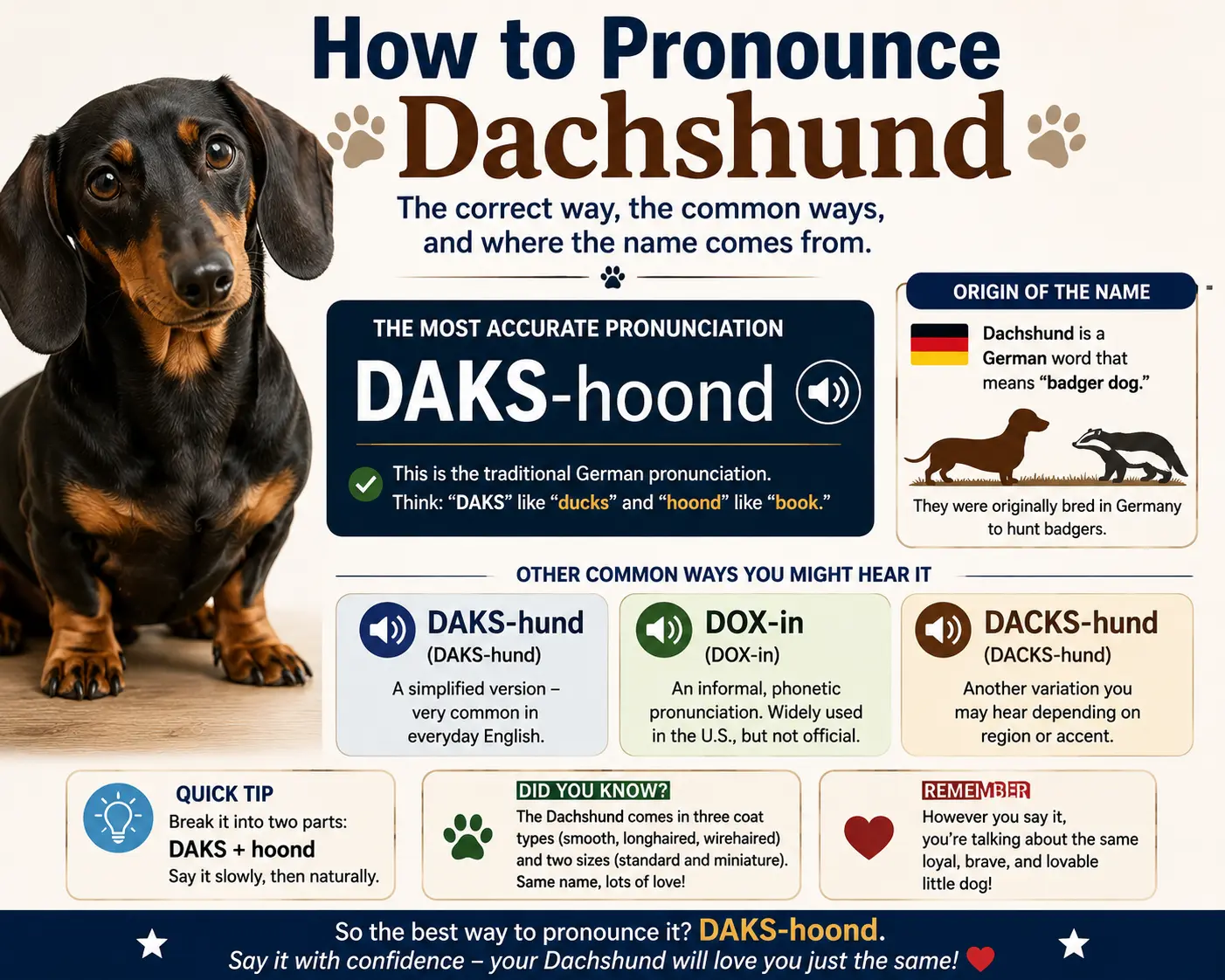
The authentic German pronunciation is: DAKS-hoont (/dɑːks.hʊnt/)
In standard American English, it’s typically softened to: DAX-und (/ˈdɑːks.hʊnd/)
In British English, the Cambridge Dictionary confirms the pronunciation as: DAK-sund (/ˈdæk.sənd/)
So when you’re asking how to pronounce dachshund correctly, the answer depends slightly on your accent but the core sounds remain the same. Let’s break it down step by step.
Step-By-Step Breakdown of the Pronunciation
Learning how to pronounce dachshund is easiest when you tackle it one syllable at a time.
Step 1: Say “Dachs” It Rhymes With “Fox,” Not “Dash”
This is where most people go wrong. The German letters “chs” create a sound like the “x” in “fox” or “tax.” So Dachs sounds like “dax” or “daks” not “dash.”
Think of it this way: if someone asks you to say the word “tax,” you’re halfway there.
Step 2: Say “Hund” It Sounds Like “Hoont,” Not “Hound”
The second half is Hund, the German word for “dog” or “hound.” In German, the vowel sound in “un” is more of an “oo” sound like the oo in “book.” So Hund sounds like “hoont” rather than “hound.”
In Americanized English, this gets reduced to something closer to “und” (rhymes with “fund”), which is totally acceptable.
Step 3: Combine and Practice
Put it together:
- German (authentic): DAKS-hoont
- American English: DAX-und
- British English: DAK-sund
Phonetically, the Cambridge Dictionary confirms both the UK (/ˈdæk.sənd/) and US (/ˈdɑːks.hʊnd/) pronunciations with audio clips which I highly recommend listening to if you’re an auditory learner.
Pronunciation Comparison Table
Here’s a quick reference to understand how to pronounce dachshund across different accents and common mistakes:
| Version | Pronunciation | Correct? |
|---|---|---|
| Authentic German | DAKS-hoont (/dɑːks.hʊnt/) | ✅ Yes |
| American English | DAX-und (/ˈdɑːks.hʊnd/) | ✅ Acceptable |
| British English | DAK-sund (/ˈdæk.sənd/) | ✅ Acceptable |
| “Dash-hound” | /dæʃ.haʊnd/ | ❌ Wrong |
| “Dash-und” | /dæʃ.ənd/ | ❌ Wrong |
| “Dutch-hound” | /dʌtʃ.haʊnd/ | ❌ Wrong |
| “Dach-sand” | /dæk.sænd/ | ❌ Wrong |
As you can see, the common thread in every correct version is that “Dach” sounds like “dax” never like “dash.” Keep that as your anchor whenever you need to remember how to pronounce dachshund.
The German Roots Behind the Name
Understanding the etymology makes how to pronounce dachshund much easier to remember long-term.
Dachshund is a compound of two German words:
- Dachs = badger
- Hund = dog
So the breed’s name literally translates to “badger dog.” This isn’t just a fun fact it’s the entire reason these dogs look the way they do. Dachshunds were originally bred in Germany as early as the 1400s to hunt badgers and other burrowing animals. Their long, low bodies were designed to squeeze into underground tunnels; their powerful paws were built for digging.
As these beloved sausage dogs made their way to English-speaking countries, the German pronunciation got Anglicized. English speakers adapted the sounds to fit their phonetic comfort zones and “dash-hound” was born. But knowing the word’s origin helps you retrace it back to its correct roots, which is why mastering how to pronounce dachshund is also a way of honoring the breed’s heritage.
For a full deep-dive into the history and care of these remarkable dogs, explore our Dachshund Guides for breed-specific advice.
Regional Accents and How They Affect Pronunciation
One reason how to pronounce dachshund can feel confusing is that even the “correct” version varies by region.
In the United States, speakers tend to separate the two consonant clusters more clearly, producing a stronger /ˈdɑːk.ʃʊnt/ often with a flatter vowel in the second syllable. British English reduces the second syllable significantly, landing closer to /ˈdæk.sənd/.
Neither version is wrong. Language evolves, and accepted pronunciations shift over time. What matters is that you’re in the ballpark of DAKS rather than DASH because that’s where almost everyone goes wrong when trying to figure out how to pronounce dachshund.
Even linguistics experts acknowledge this kind of regional drift. The Cambridge Advanced Learner’s Dictionary, one of the most authoritative sources on English pronunciation, documents both British and American variants as standard.
Tips and Tricks to Remember the Pronunciation
Now that you know the theory behind how to pronounce dachshund, let’s make it stick.
Use a Mnemonic: Think “Tax Hound”
One of the most effective tricks is to use the phrase “tax hound” as a mental hook. The “tax” sounds nearly identical to Dachs, and “hound” reminds you of the Hund. Say “tax hound” a few times, then transition to “dax hoont” and you’ve got it.
Shadow Native Speakers
Shadowing is a language-learning technique where you listen to a native speaker and repeat what they say in real time. YouTube has several videos of native German speakers breaking down how to pronounce dachshund and this auditory repetition is one of the fastest ways to internalize a tricky word.
Slow It Down First
Pronunciation experts recommend starting at a slow pace almost comically slow before building up to natural speech speed. Say DAKS clearly, pause, then say hoont. Repeat this until the two syllables naturally flow together.
Write It Phonetically
Some people find it helps to write the pronunciation on a sticky note: DAKS-hoont or DAX-und and put it somewhere visible. This is especially helpful for new dachshund owners who are just learning how to pronounce dachshund while also managing a puppy.
Common Mispronunciations and Why They Happen
The most widespread error “dash-hound” happens because the spelling of “Dach” looks like “dash” to English eyes. The “ch” combination in English is typically pronounced as in “chair” or “cheese,” which leads the brain straight to a “sh” sound.
But in German, “chs” functions more like an “x” a voiceless velar fricative followed by a sibilant. It’s the same reason the name “Max” in German is spelled “Macks” phonetically.
The second mistake, treating “hund” as “hound,” comes from the false cognate. Hund does derive from the same root as hound, but the German pronunciation never evolved to include the “ow” diphthong that English speakers associate with the word “hound.”
This is why context and etymology matter so much when learning how to pronounce dachshund it’s not just phonetics, it’s linguistic history.
Why Getting It Right Actually Matters
You might be wondering: does it really matter if people say “dash-hound” instead of knowing how to pronounce dachshund correctly?
Practically speaking? Not always. Most dachshund owners and breeders will understand you regardless. But there’s something to be said for pronouncing a breed’s name correctly, especially one with such a rich cultural history.
Dachshunds are now the fifth most popular dog breed in the United States according to the AKC’s 2025 data. They’ve bumped the Poodle out of the top five for the first time a testament to how mainstream these dogs have become. The more people own them, the more conversations happen about them, and the more the word gets spoken aloud.
Getting how to pronounce dachshund right is a small nod of respect to the breed’s German heritage and a great way to subtly signal that you really know your dogs.
Frequently Asked Questions (FAQs)
Is “dash-hound” an acceptable pronunciation of dachshund?
While “dash-hound” is widely used and people will understand you, it is technically incorrect. The proper way to say it whether in German (DAKS-hoont) or Americanized English (DAX-und) places the emphasis on the daks sound, not dash. If you care about accuracy, stick with the correct version.
What is the phonetic spelling of dachshund?
The phonetic spelling is /dɑːks.hʊnd/ in American English and /ˈdæk.sənd/ in British English. In simplified form, you can write it as DAKS-hoont (German) or DAX-und (English).
What does the word “dachshund” mean in German?
Dachshund literally means “badger dog” in German from Dachs (badger) and Hund (dog). The breed was originally developed to hunt badgers and other burrowing animals, which explains their distinctive long bodies and short, powerful legs.
Are there other names for dachshunds that are easier to pronounce?
Yes! Dachshunds go by several nicknames: wiener dog, sausage dog, and Doxie are all common alternatives. These nicknames are far easier for English speakers to say, which is part of why they caught on so quickly.
Now that you know how to pronounce dachshund correctly, will you pass it on to a fellow dog lover who’s been saying it wrong?
