
Dachshund vs Doxin: One Dog, Two Names

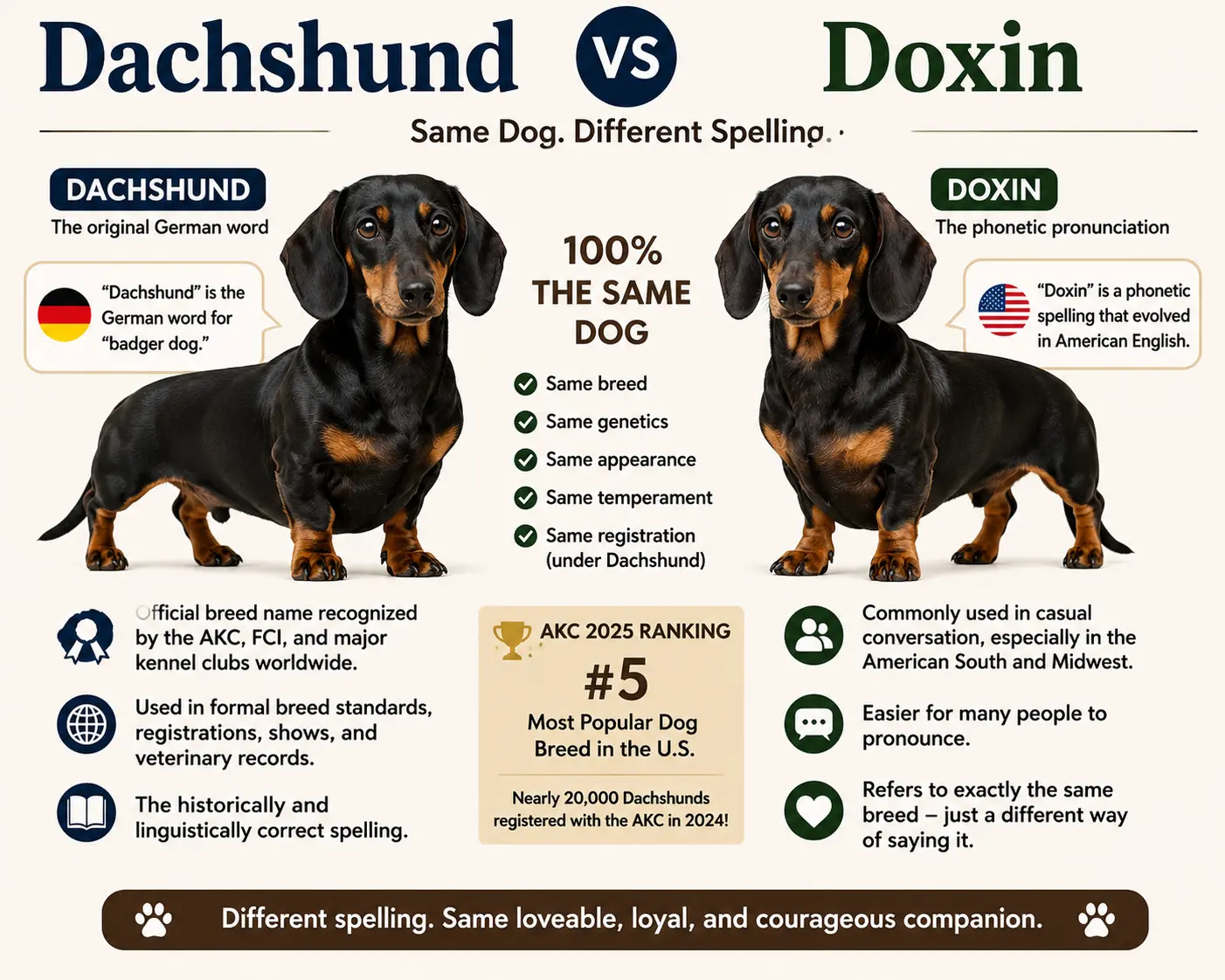
If you’ve ever typed “dachshund vs doxin” into Google, you’re definitely not alone. In fact, I did the same thing when I first got my little sausage dog, convinced I was missing something huge like maybe I’d accidentally brought home the wrong breed. Spoiler alert: I hadn’t. And neither have you.
The dachshund vs doxin debate is one of the most searched pet topics online, and the answer, once you know it, is beautifully simple. A doxin is a dachshund. They are the exact same dog, just wearing two different name tags.
But let’s not stop there. Because once you dig into the story behind the dachshund vs doxin mix-up the history, the nicknames, the AKC rankings, the personality quirks you’ll find that this little “badger dog” has one of the richest, most fascinating backstories in the canine world.
Let’s unpack all of it, from the 15th-century German hunting grounds to the 2025 AKC Top 5 list.
What Exactly Is the Dachshund vs Doxin Debate?
Here’s the honest truth: there is no debate. When people search dachshund vs doxin, they’re unknowingly comparing the same animal with two different spellings. The word “doxin” sometimes written as doxen, doxie, or dotson evolved over generations simply because people struggled to pronounce “Dachshund” correctly.
Think of it like a centuries-long game of telephone. The German word Dachshund (pronounced roughly “DAKS-hoond”) traveled across Europe and eventually landed in English-speaking households where the pronunciation got… creatively altered. Doxin was easier to say. It stuck.
So when you’re searching dachshund vs doxin, you’re essentially searching “dog vs dog.” They are identical in breed, temperament, genetics, appearance, and AKC classification.
“The Dachshund is a creation of German breeders… Dachshunds have been kept by royal courts all over Europe, including that of Queen Victoria, who was particularly enamored of the breed.” Wikipedia
The German Roots of the Dachshund (aka the Doxin)
To truly understand the dachshund vs doxin discussion, you have to go back way back.
How the Dachshund Was First Bred in Germany
The dachshund’s origin story starts in Germany as far back as the 15th century, though the first verifiable written references appear in books from the early 18th century. The name itself says everything: Dachs means “badger,” and Hund means “dog.” These were purpose-built hunting machines, bred to scent, chase, and flush badgers out of underground burrows.
Their long, narrow bodies and short but powerful legs weren’t a design accident they were an engineering masterpiece. Built to navigate tight tunnels and burrow systems, the dachshund was the underground commando of the dog world. German breeders are believed to have combined Hanover Hounds, Terriers, Pinschers, and Bloodhounds to achieve the unique frame we recognize today.
Why the Name Changed from Dachshund to Doxin
By the time dachshunds made their way to English-speaking countries, the original German pronunciation caused real headaches. “DAKS-hoond” didn’t roll off the tongue naturally in English, so people simplified it. “Doxin,” “doxen,” and “dotson” all became informal phonetic substitutes.
Interestingly, even in modern Germany, the breed is rarely called a Dachshund anymore they go by Dackel or Teckel. So the name confusion runs in multiple directions. The dachshund vs doxin question is essentially a cross-cultural linguistic evolution wrapped in a very long, adorable body.
Dachshund vs Doxin: Key Facts at a Glance
Since the dachshund vs doxin comparison keeps coming up, here’s a clear breakdown to put any remaining questions to rest:
| Feature | Dachshund | Doxin |
|---|---|---|
| Breed Type | Purebred | Purebred (same dog) |
| AKC Recognition | Yes | Yes (same registration) |
| Origin | Germany, 15th–18th century | Same |
| Size Varieties | Standard & Miniature | Same |
| Coat Types | Smooth, Long-haired, Wire-haired | Same |
| Typical Weight | 8–32 lbs depending on size | Same |
| Lifespan | 12–16 years | Same |
| Nicknames | Wiener Dog, Sausage Dog, Doxie | Same just another nickname |
The table tells the full story. In every measurable way, dachshund vs doxin is a non-comparison because both names describe the identical animal.
Dachshund vs Doxin Personality: What Are They Really Like?
Whether you call them by the dachshund or doxin name, the personality is consistent and legendary.
Brave, Bold, and Just a Little Stubborn
Dachshunds were bred to hunt independently. That instinct doesn’t disappear when they move into a cozy apartment. The dachshund vs doxin personality is the same: brave to the point of recklessness, curious, clever, and possessed of a stubbornness that would impress a mule.
I’ve personally watched my dachshund drag a chew toy half his body weight across a room just to prove he could. That’s the breed in a nutshell small dog, enormous determination.
Loyal Companions with Big-Dog Energy
Despite their compact size, dachshunds (or doxins, if you prefer) have enormous personalities. They bond deeply with their owners, can be protective, and love nothing more than being the center of attention. They’re equally popular with urban apartment dwellers and suburban families.
According to the AKC, dachshunds have long ranked among the top breeds in 76 of 190 major US cities, which speaks to their adaptability and wide appeal.
Dachshund vs Doxin Popularity: The 2025 AKC Data Is Impressive
Here’s where the dachshund vs doxin story gets genuinely exciting. The numbers behind this breed’s popularity are remarkable.
The Dachshund Just Cracked the AKC Top 5
In the 2025 AKC registration rankings, the dachshund broke into the top five most popular dog breeds in the United States for the first time replacing the Poodle, which had previously held that spot. This is a breed that was ranked 12th as recently as 2018, now sitting at No. 5 in 2025.
That upward trend reflects something real: more and more families are discovering what dachshund and doxin enthusiasts have known for decades. These dogs are special.
In 2024 alone, the AKC recorded 13,941 registered dachshund litters and 19,826 individual dachshund registrations making it one of the most actively bred and registered purebreds in the country.
How Common Is the Dachshund vs Doxin Name Confusion Online?
Very. Google Trends consistently shows high search volume for terms like “doxin dog,” “dachshund vs doxin,” and “are dachshunds and doxins the same.” This kind of search confusion is actually a sign of just how popular the breed has become across diverse communities many of whom discovered the dog through informal naming rather than formal breed guides.
Dachshund vs Doxin Sizes: Standard, Miniature, and Kaninchen
Another area where dachshund vs doxin questions sometimes arise is around size. People encounter a tiny “doxin” and assume it must be a different dog from the larger “dachshund.” Not so.
Standard Dachshund
The standard size typically weighs between 16 and 32 pounds. Sturdy, muscular, and built for the outdoors this was the size originally bred to hunt badgers and foxes.
Miniature Dachshund
The miniature version weighs under 11 pounds and was specifically developed to hunt smaller prey like rabbits. These are the most popular size in urban environments today due to their compact footprint.
Kaninchen Dachshund
A third size, called the Kaninchen (meaning “rabbit” in German), can weigh as little as 8 pounds. This size isn’t recognized by the AKC or UK Kennel Club but is officially registered in over 80 other countries. Many people who encounter a Kaninchen think they’ve found a unique “doxin” variety but it’s still a dachshund.
Health Considerations for Dachshunds (and Doxins)
Regardless of which name you use in the dachshund vs doxin debate, the health profile is the same. And it’s important for any prospective owner to understand.
The Back Problem Every Owner Should Know About
Dachshunds are genetically predisposed to Intervertebral Disc Disease (IVDD) a spinal condition related to their elongated spine and short legs. High-impact activities like jumping off furniture or running down stairs can accelerate disc degeneration.
Smart dachshund owners invest in ramps, avoid rough play, and keep their dogs at a healthy weight. It’s not a reason to avoid the breed it’s just knowledge that leads to better care.
Lifespan: Built to Last
Here’s a bright spot in the dachshund vs doxin health picture: these dogs live long, healthy lives. A 2024 UK study found a life expectancy of 13.2 years for the breed, above the average of 12.7 for purebreds. Historically, some individual dachshunds have reached their early 20s making them one of the longest-lived dog breeds on record.
Fun Facts That Make the Dachshund vs Doxin Story Even Better
Some historical gems that prove this breed has always been extraordinary:
- The 1972 Munich Olympics mascot was a dachshund named Waldi the first-ever official Olympic mascot. Race organizers even designed the marathon route in the shape of a dachshund.
- Pablo Picasso had a dachshund named Lump who lived in his Cannes mansion for six years and was photographed alongside the artist dozens of times.
- The world’s oldest recorded dogs were dachshunds. Chanel lived to be 21 years and 114 days old.
- A British dachshund named Winnie was successfully cloned. Her clone, Minnie Winnie, went on to have two healthy puppies.
- During World War I, dachshunds were used in British propaganda, and the American Kennel Club had to rebrand the breed as “badger dog” to protect it from anti-German sentiment.
No matter which side of the dachshund vs doxin naming conversation you’re on, the history is undeniably rich.
Dachshund vs Doxin: Coat Types and Colors
One more area where dachshund vs doxin confusion can arise is coat variety. The AKC recognizes 15 standard colors and 6 marking types across three distinct coat varieties:
- Smooth coat — Short, shiny, and low-maintenance. The most common type.
- Long-haired coat — Silky and flowing, often with a gentle wave. Requires more regular brushing.
- Wire-haired coat — Rough, bristly outer coat with a softer undercoat. Gives the dog a scruffy, distinguished look.
All three coat types appear in both standard and miniature sizes, and all three are equally the “dachshund” and “doxin” there is no coat type exclusive to one name.
Should You Get a Dachshund (aka Doxin)?
If you’ve been going back and forth on the dachshund vs doxin question, hopefully by now it’s clear: you’re comparing the same wonderful dog. The real question is whether this breed fits your lifestyle.
Dachshunds thrive with owners who:
- Can offer regular moderate exercise (daily walks, not marathon running)
- Are patient with training (stubbornness is real, but so is their intelligence)
- Live in smaller spaces or urban apartments
- Want a loyal, personality-packed companion with a long lifespan
They’re not ideal for households with very young children who play rough, or for owners who want an off-leash dog that hunting instinct makes recall training a genuine challenge.
But if you want a dog that is equal parts comical, courageous, and deeply loving one that will follow you from room to room and make you laugh every single day the dachshund (or doxin, if you prefer) is hard to beat.
FAQ: Dachshund vs Doxin
Q1: Is a doxin the same as a dachshund?
Yes. A “Doxin” is simply an informal, phonetic spelling of “Dachshund.” Both names refer to the same purebred German dog breed recognized by major kennel clubs, including the American Kennel Club (AKC).
Q2: Why do people say “doxin” instead of “dachshund”?
Many English speakers find the German word “Dachshund” difficult to pronounce. Over time, the phonetic pronunciation “Doxin” became common in everyday conversation, particularly in parts of the United States.
Q3: Are there any physical differences between a dachshund and a doxin?
No. There are no physical, genetic, or behavioral differences between a Dachshund and a Doxin because they are the same breed. The different names simply reflect different pronunciations.
Q4: How popular is the dachshund in the US right now?
Dachshunds are one of the most popular dog breeds in the United States. Their affectionate personality, compact size, and distinctive appearance continue to make them a favorite among families and dog lovers.
Q5: What’s the best way to care for a dachshund (or doxin)?
Keep your Dachshund at a healthy weight, provide daily low-impact exercise, avoid excessive jumping and stairs to protect its spine, schedule regular veterinary checkups, and use positive reinforcement training. These practices help support a long, healthy, and happy life.
For more expert breed content, explore our full Dachshund Guides from puppy care to senior health and everything in between.
